Toncoin ниже $3: точка невозврата или точка входа

cryptonews.ruPubblicato 2025-03-29Pubblicato ultima volta 2025-09-30

Toncoin (TON) последние недели быстро падает. Токен уже опустился ниже $3 из-за опасений по поводу предстоящих разблокировок

В краткосрочной перспективе определенно доминируют продавцы, однако активность институциональных инвесторов говорит о том, что они готовятся использовать это снижение для стратегии усреднения долларовой стоимости (DCA).

Разблокировки давят TON

Главным фактором давления на цену остается Believers Fund. С октября 2025 года он будет ежемесячно выпускать около 37 млн TON. Такая разблокировка продлится три года — до тех пор, пока не будут распределены все подлежащие раздаче токены.

Несмотря на то, что токены будут выпускаться постепенно, аналитики считают, что регулярные ежемесячные разблокировки приведут к росту предложения, и называют это «бомбой замедленного действия», которая может спровоцировать краткосрочное падение TON до $2,61, прежде чем цена стабилизируется.

На момент публикации Toncoin (TON) торгуется по $2,66, показав снижение на 1,3% за сутки и более чем на 5% за неделю.
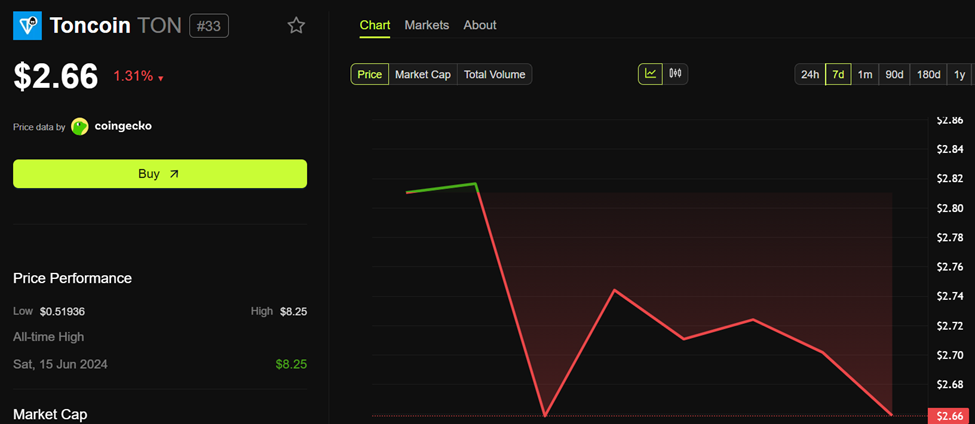

Toncoin (TON) Price Performance
Динамика цены Toncoin (TON). Источник: BeInCrypto

Институционалы поддерживают цену

Несмотря на грядущие разблокировки, институциональные инвесторы уверены в долгосрочном потенциале Toncoin. Компания TON Strategy (Nasdaq: TONX) разместила в стейкинге 82% своих TON. При текущих условиях это приносит около $24 млн в год, и именно эти доходы компания направляет на масштабную программу выкупа акций объемом $250 млн.

«Мы используем доходы от стейкинга для поддержки buyback-программы. Такой подход подчеркивает нашу долгосрочную ориентацию на рост акционерной стоимости», — отметила генеральный директор TONX Вероника Капустина.

С середины сентября TON Strategy уже выкупила более 1,5 млн акций, демонстрируя уверенность как в собственном бизнесе, так и в фундаментальной ценности TON.

Ещк одним крупным игроком стал фонд AlphaTON Capital, недавно привлекший $71 млн. Из этой суммы $30 млн сразу было вложено в Toncoin, а к концу года фонд планирует довести свой казначейский резерв до $100 млн. Поддерживаемая такими лидерами отрасли, как Animoca Brands, биржа Kraken, SkyBridge и DWF Labs, AlphaTON рассматривает интеграцию TON в экосистему Telegram с миллиардной аудиторией как уникальное стратегическое преимущество.

Краткосрочные риски, долгосрочный потенциал

Краткосрочный прогноз для TON определяется противостоянием двух факторов:

  • регулярные разблокировки усиливают давление на продажу;
  • институционалы продолжают накапливать актив.

Это значит, что розничные трейдеры опасаются размывания предложения, но профессиональные игроки делают ставку на уникальное положение TON как единственного крупного криптоактива, глубоко интегрированного в Telegram.

Дополнительный сигнал дает коэффициент Шарпа, который недавно вошел в зону низкого риска. Это значит, что с учетом волатильности TON способен предложить более привлекательный риск/доходность для дисциплинированных инвесторов.
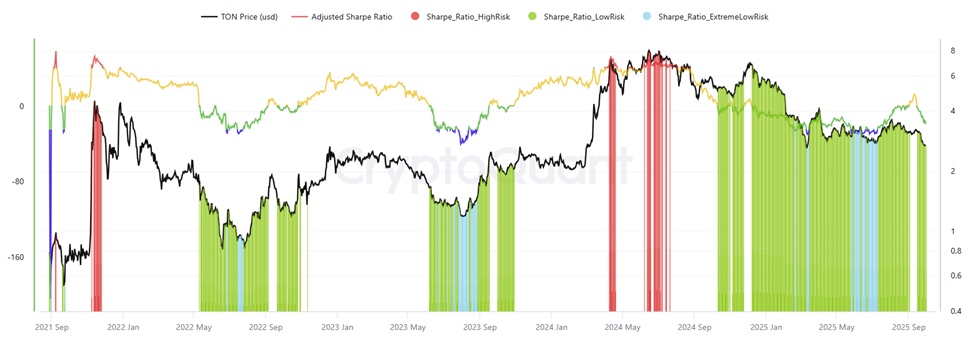
TON Sharpe Ratio
Коэффициент Шарпа для TON. Источник: CryptoQuant

Тем не менее прогноз краткосрочной динамики остается сложным: рост предложения конкурирует с институциональным накоплением. По мнению аналитиков, уровни ниже $3 могут стать удачной точкой входа для тех, кто ориентируется на долгосрок.
Letture associate

Jensen Huang: Prompts are Becoming Obsolete, Loops are the New Paradigm

Jensen Huang, alongside AI leaders like Peter Norvig, Boris Cherny, and Andrew Ng, is advocating for a shift from "prompt engineering" to "loop engineering" as the new paradigm for AI development. Instead of manually crafting individual prompts, the focus is now on designing autonomous loops—systems where AI agents execute tasks, self-validate results, and iterate until completion without constant human oversight. A loop is a management framework that enables agents to operate independently. Key implementations are seen in Claude Code (with features like /loop, /goal, and /schedule) and OpenAI Codex, which employ multiple agents working in parallel within isolated environments. A core principle is the separation of roles: one agent (or model) performs the task, while an independent agent (or a smaller, separate model) validates the output to ensure objectivity. The article outlines a practical roadmap for implementing loops, starting with a "four-condition test" to assess suitability, building a minimal viable loop, and emphasizing critical pitfalls to avoid, such as lacking hard stop conditions or allowing loops to handle tasks requiring human judgment. This evolution is framed as the fourth major shift in AI interaction: from Prompt Engineering (crafting instructions) to Context Engineering (providing background information), then to Harness Engineering (building tool-enabled environments), and finally to Loop Engineering (creating self-sustaining systems). This progression reflects a consistent trend of increasing abstraction, moving human involvement from direct instruction to system design and rule-setting. The concept has academic roots in frameworks like ReAct, which formalized the "reason-act-observe" cycle. While loop engineering promises greater automation, experts caution about managing token costs and warn against outsourcing understanding—AI can assist, but deep problem comprehension remains essential.

marsbit32 min fa

Jensen Huang: Prompts are Becoming Obsolete, Loops are the New Paradigm

marsbit32 min fa

GPT Designs GPT

OpenAI has unveiled its first custom AI chip, Jalapeño, a move signaling a strategic shift beyond being a mere model company. While many see it as a challenge to NVIDIA, its core aim is to control the entire intelligent production pipeline—from models and chips to data centers and energy. The key driver is the evolving competitive landscape: model advantages are shrinking, while the computational gap in areas like cost-per-token, system throughput, and energy efficiency is becoming the true long-term barrier. Jalapeño is primarily an inference chip, targeting the massive and growing "inference tax"—the daily operational cost of generating tokens for services like ChatGPT and APIs. By designing its own hardware optimized for its specific workloads and future product roadmaps (even using AI to aid the chip design process), OpenAI aims to drastically reduce token generation costs and improve system efficiency. This creates a potential flywheel: better models help design better chips, which lower costs for running next-generation models, supporting more users and products, which in turn provides more data to refine future chips. The strategy mirrors Apple’s integrated approach, building a closed loop where hardware, software, and applications are co-optimized. In the long term, OpenAI is not trying to become the next NVIDIA (a supplier of "shovels" to all AI companies) but to own and operate the entire "mine"—selling the end product of intelligence itself. This move marks OpenAI's ambition to evolve from creating the smartest models to controlling the foundational infrastructure of AI production.

marsbit56 min fa

GPT Designs GPT

marsbit56 min fa

Ethereum Foundation Interim Executive Director Speaks Out: What Is Our Mission?

The Ethereum Foundation's core mission is to ensure Ethereum remains a truly permissionless, censorship-resistant, private, and open infrastructure for large-scale, sovereign coordination. The article clarifies the EF's focus and dismisses irrelevant objectives, such as pursuing institutional popularity or short-term speculation. Its core work centers on eliminating systemic weaknesses. This involves fortifying Ethereum across multiple layers—protocol, access, user, and institutional—against exploitation, control, or surveillance. Key initiatives include minimizing harmful MEV and preventing privileged control over transaction flow, making unconditional privacy a foundational default, ensuring staking remains permissionless and decentralized, and strengthening user-facing access points to uphold autonomy. Concurrently, the EF aims to seize strategic opportunities. These include leading the transition to post-quantum cryptography, achieving a fully verifiable protocol stack, establishing Ethereum as private digital cash, integrating user-owned AI agents with personal wallets, and demonstrating that trusted-neutral infrastructure can competitively handle disintermediated coordination at an institutional scale. The article also addresses recent organizational changes, stating that personnel departures were due to strategic realignment, role fit, or natural evolution. It clarifies the approach to spin-outs, emphasizing that external funding will be provided only for work critical to the EF's mission that reduces Ethereum's dependency without creating new risks or mission drift. Ultimately, the EF is committed to building an enduring, neutral system that reshapes global coordination, focusing relentlessly on the principles of censorship resistance, openness, privacy, and sovereignty (CROP).

链捕手1 h fa

Ethereum Foundation Interim Executive Director Speaks Out: What Is Our Mission?

链捕手1 h fa

Trading

Spot
Futures
活动图片