XRP Price Final Low: Here’s The Target To Watch For Next Recovery

bitcoinistPubblicato 2025-09-27Pubblicato ultima volta 2025-09-27

Introduzione

Crypto analyst CasiTrades has indicated that the XRP price could drop to a final low before it begins its next...

Trusted Editorial content, reviewed by leading industry experts and seasoned editors. Ad Disclosure

Crypto analyst CasiTrades has indicated that the XRP price could drop to a final low before it begins its next leg to the upside. In line with this, she highlighted the target to watch out for as altcoin looks to end this downtrend and begin its recovery. 

Level To Watch As XRP Price Eyes Final Low

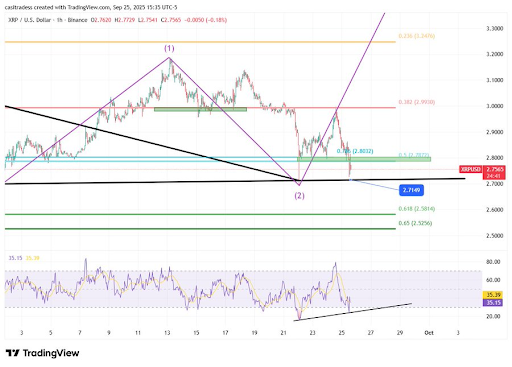
CasiTrades revealed in an X post that $2.715 might mark the final low for the XRP price before it begins its wave 3 impulsive move to the upside. She noted that the price level is the bottom trendline of the consolidation and, importantly, would still not make a new low in the correction. This came as the analyst highlighted that altcoin had faced a significant rejection at the $3 resistance. 

Furthermore, the XRP price also lost its major .5 fib support at $2.79 and even retested it as resistance. She added that the rejection was sharp and that the Relative Strength Index (RSI) is reflecting strong pressure, which suggests that the market may need to drop to lower levels for this correction to be over. This is why she believes that token may still fall to $2.715. 
XRP
Source: Chart from CasiTrades on X

Meanwhile, CasiTrades explained that the price is now forming a divergence on the higher timeframes but that the smaller timeframes haven’t fully exhausted yet. She stated that this suggests that the larger move down is unfolding as a 5th wave, but it hasn’t finished just yet, which is why the altcoin could drop lower. 

The analyst added that some altcoins, such as Ethereum and DOGE, have already reached their bottom targets. Meanwhile, others, including the XRP price, require one last dip to fully exhaust the selling pressure before sentiment can shift bullish. 

Key Signs To Watch For The Altcoin

As part of the key signs to watch, CasiTrades noted that the 1-hour RSI has printed a bullish divergence and is holding a clear trendline. She claimed that a final drop to this price level would help confirm exhaustion. Meanwhile, the altcoin price reclaiming $2.79 by the daily close would be a strong signal, especially if it flips it back into support. 

The crypto analyst assured that the current XRP price action isn’t weakness but a shakeout. She added that tight consolidation, then volatility, and now exhausted selling are the perfect conditions needed for the next major breakout and a fresh market trend. However, crypto analyst Ali Martinez suggested that XRP could drop way lower than the projected bottom at $2.715, noting that there is a gap between $2.73 and $2.51.

At the time of writing, the XRP price is trading at around $2.78, up in the last 24 hours, according to data from CoinMarketCap.

XRP
XRP trading at $2.77 on the 1D chart | Source: XRPUSDT on Tradingview.com
Featured image from Getty Images, chart from Tradingview.com
Editorial Process for bitcoinist is centered on delivering thoroughly researched, accurate, and unbiased content. We uphold strict sourcing standards, and each page undergoes diligent review by our team of top technology experts and seasoned editors. This process ensures the integrity, relevance, and value of our content for our readers.

Scott Matherson is a leading crypto writer at Bitcoinist, who possesses a sharp analytical mind and a deep understanding of the digital currency landscape. Scott has earned a reputation for delivering thought-provoking and well-researched articles that resonate with both newcomers and seasoned crypto enthusiasts. Outside of his writing, Scott is passionate about promoting crypto literacy and often works to educate the public on the potential of blockchain.

Letture associate

Second Half of U.S. Crypto Policy: The Clarity Act Aims for 60 Votes, CFTC's "One-Person Commission" Becomes Biggest Variable

In a pivotal year for US crypto policy, the "CLARITY Act" is advancing in the Senate but faces a high hurdle, needing 60 votes to pass. Key challenges include bridging partisan divides on ethics and swaying undecided Republican senators within a tight legislative calendar of only about 40 working days. The policy "second half" involves intense negotiations on a broader framework for Web3 and DeFi, including crypto tax reforms and the Blockchain Regulatory Certainty Act. A significant uncertainty is the understaffed CFTC, operating with four commissioner vacancies, which complicates regulatory clarity. Meanwhile, the departure of key "crypto champions"—SEC Commissioner Hester Peirce and Senator Cynthia Lummis—will impact ongoing policy efforts. Industry experts are cautiously optimistic but realistic. Sara K. Weed notes that while progress is being made, CLARITY is unlikely to pass this Congress, pushing agencies like the SEC and CFTC to provide more guidance. Sulolit Mukherjee suggests meaningful crypto tax legislation is more likely to be attached to larger must-pass bills. Rashan Colbert discusses the jurisdictional debate over prediction markets, emphasizing the need for a regulatory framework that fosters their development as financial tools rather than treating them broadly as gambling. The clock is ticking, but opportunities remain for substantive progress through continued bipartisan dialogue and pragmatic efforts.

marsbit1 h fa

Second Half of U.S. Crypto Policy: The Clarity Act Aims for 60 Votes, CFTC's "One-Person Commission" Becomes Biggest Variable

marsbit1 h fa

Research Report Analysis: Morgan Stanley Details SanDisk SNDK, The Truth About Cloud Data Center Pricing Power and AI Inference Benefits

Morgan Stanley raised its price target for SanDisk (SNDK) from $1100 to $1750 on June 22, maintaining an Overweight rating. The upgrade is driven by AI inference demand reshaping the NAND market, particularly for KV Cache and context window storage in cloud data centers. These cloud clients exhibit price inelasticity and sign long-term contracts, granting SanDisk significant pricing power. SanDisk's New Business Model (NBM) agreements, covering over one-third of FY27 bit shipments with 3-5 year terms and fixed price/price collar structures, are crucial. They are projected to sustain gross margins around 80% even at floor prices, providing a buffer against cyclical downturns. Morgan Stanley forecasts gross margins to surge from 30.3% in FY25 to 86.7% in FY27e. With NAND supply expected to remain tight into 2026/2027 and cloud/data centers becoming the largest end-market, SanDisk holds supply-side pricing power. The company targets 15-19% bit growth via technology transitions, not capacity expansion. Revenue is projected to grow ~6.6x from FY25 to FY27, with EPS rising from $2.74 to $14.73, driven by high-margin cloud business. Key upside catalysts include faster enterprise SSD adoption and edge AI growth. Downside risks involve slower industry growth, competitor capex increases, market share loss, and competition from Chinese players like YMTC. The investment thesis rests on AI-driven structural demand, NBM's margin protection, and sustained supply tightness. The $1750 target implies ~28x FY27e P/E.

marsbit2 h fa

Research Report Analysis: Morgan Stanley Details SanDisk SNDK, The Truth About Cloud Data Center Pricing Power and AI Inference Benefits

marsbit2 h fa

A Threefold Performance Leap! NEAR Achieves 200ms Physical Block Time Limit with SPICE

NEAR's core development team, Near One, has announced its next major protocol evolution: SPICE (Separation of Consensus and Execution). Currently in development, SPICE represents the most significant upgrade before the full implementation of Nightshade 3.0. Its core innovation is decoupling the consensus layer, responsible for ordering transactions, from the execution layer, which processes them. This allows the consensus layer to run at full speed without waiting for transaction execution to complete. Once deployed, SPICE is projected to triple NEAR's block production speed, achieving a 200ms block time, which is considered the physical limit due to the speed of light and network latency. This leap will dramatically reduce transaction latency and finality, with transactions confirming in roughly 0.4 seconds—faster than a typical card payment. The upgrade also enables more complex, long-running transactions and significantly improves user experience for applications like NEAR Intents and near.com. Beyond raw speed, SPICE enhances network scalability and security. It enables deeper parallelism, efficiently distributing workload across shards and improving resource utilization. The simpler block structure and lighter contracts also facilitate formal verification and security auditing. Furthermore, SPICE lays the critical groundwork for future Nightshade 3.0 features, most notably atomic cross-shard transactions, which would simplify complex contract logic and eliminate development hurdles caused by asynchronous execution. The Near One team is actively developing SPICE, targeting deployment in the coming months.

Foresight News3 h fa

A Threefold Performance Leap! NEAR Achieves 200ms Physical Block Time Limit with SPICE

Foresight News3 h fa

Trading

Spot
Futures
活动图片