Tether And Circle Print $1.5B In Hours: Fresh Liquidity Incoming

bitcoinistPubblicato 2025-09-24Pubblicato ultima volta 2025-09-24

Introduzione

The stablecoin market is once again making headlines as two of the largest issuers, Tether (USDT) and Circle (USDC), significantly...

Trusted Editorial content, reviewed by leading industry experts and seasoned editors. Ad Disclosure

The stablecoin market is once again making headlines as two of the largest issuers, Tether (USDT) and Circle (USDC), significantly expanded supply in just hours. According to data shared by Lookonchain, Tether minted another 1 billion USDT, while Circle printed 500 million USDC only seven hours earlier. These issuances highlight how stablecoins continue to play a central role in fueling market liquidity, often acting as precursors to major shifts in crypto price action.

Stablecoins are widely used as dry powder, giving traders and institutions instant exposure to digital assets without relying on traditional banking rails. Large-scale minting events like this are typically interpreted as a sign that capital is flowing into the ecosystem, positioning the market for heightened volatility and potentially a new wave of demand. Historically, such moves have coincided with phases of increased activity across Bitcoin, Ethereum, and major altcoins.

As crypto investors brace for the next leg of market action, the timing of this combined $1.5 billion injection into USDT and USDC supply has sparked speculation. Many analysts believe the market is preparing to absorb this liquidity, setting the stage for what could be a decisive period in the weeks ahead.

Tether $1B Mint | Source: Lookonchain

Stablecoin Expansion And Market Implications

According to CryptoQuant, the combined circulating supply of Tether (USDT) and Circle’s USD Coin (USDC) now forms a significant portion of the global stablecoin market, which sits at around $147 billion. This dominance underscores the pivotal role both issuers play in shaping crypto liquidity. With Tether minting another $1 billion and Circle adding $500 million in supply, these issuances are not random — they reflect growing demand for stable trading capital and often precede decisive market moves.

Stablecoins act as a bridge between traditional finance and the crypto ecosystem, serving as the backbone for trading activity on centralized and decentralized exchanges. When supply expands rapidly, it typically signals an increase in available liquidity, providing investors with the ability to deploy capital into risk assets quickly. For Bitcoin, which recently faced heavy volatility and a sharp pullback below $115K, this influx could offer support for a continuation trend, particularly if bulls regain momentum.

For altcoins, the impact may be even more pronounced. Historically, stablecoin inflows have fueled periods of explosive growth in non-BTC assets, as traders rotate capital in search of higher returns. With USDT and USDC issuance climbing, analysts suggest that the coming days could define whether altcoins recover strongly or remain under pressure.

Stablecoin Market Cap Dominance Analysis

The chart shows that stablecoin dominance has risen sharply to 7.99%, signaling a renewed demand for safety amid recent volatility. After weeks of consolidation between 7.4% and 7.8%, the breakout above the short-term moving averages (50-day at 7.60% and 100-day at 7.63%) confirms stronger capital rotation into stable assets. This pattern often reflects heightened investor caution, with participants opting to sit in stablecoins while waiting for clearer market direction.
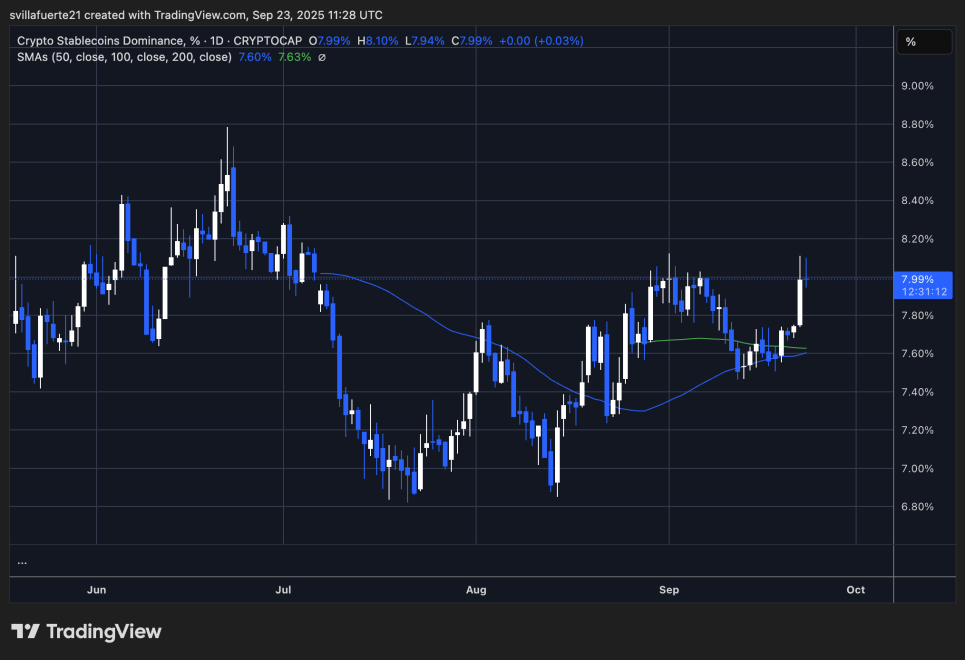
Crypto Stablecoin Dominance | Source: STABLE.C.D chart on TradingView

The move higher coincides with recent liquidations across Bitcoin and altcoins, where leveraged traders were wiped out. Historically, spikes in stablecoin dominance occur when traders de-risk, pulling capital from volatile assets. However, rising stablecoin reserves also indicate available liquidity that could quickly re-enter the market and fuel recovery once sentiment shifts.

If dominance continues to climb toward the 8.2–8.4% range, it may suggest further downside for risk assets in the short term. Conversely, stabilization below this level could mark a base for renewed inflows into Bitcoin and altcoins. The coming sessions will be key in determining whether this rise is a temporary flight to safety or the start of a deeper risk-off trend.

Featured image from Dall-E, chart from TradingView

Editorial Process for bitcoinist is centered on delivering thoroughly researched, accurate, and unbiased content. We uphold strict sourcing standards, and each page undergoes diligent review by our team of top technology experts and seasoned editors. This process ensures the integrity, relevance, and value of our content for our readers.

Sebastian's journey into the world of crypto began four years ago, driven by a fascination with the potential of blockchain technology to revolutionize financial systems. His initial exploration focused on understanding the intricacies of various crypto projects, particularly those focused on building innovative financial solutions. Through countless hours of research and learning, Sebastian developed a deep understanding of the underlying technologies, market dynamics, and potential applications of cryptocurrencies. As his knowledge grew, Sebastian felt compelled to share his insights with others. He began actively contributing to online discussions on platforms like X and LinkedIn, focusing on fintech and crypto-related content. His goal was to expose valuable trends and insights to a wider audience, fostering a deeper understanding of the rapidly evolving crypto landscape. Sebastian's contributions quickly gained recognition, and he became a trusted voice in the online crypto community. To further enhance his expertise, Sebastian pursued a UC Berkeley Fintech: Frameworks, Applications, and Strategies certification. This rigorous program equipped him with valuable skills and knowledge regarding Financial Technology, bridging the gap between traditional finance (TradFi) and decentralized finance (DeFi). The certification deepened his understanding of the broader financial landscape and its intersection with blockchain technology. Sebastian's passion for finance and writing is evident in his work. He enjoys delving into financial research, analyzing market trends, and exploring the latest developments in the crypto space. In his spare time, Sebastian can often be found immersed in charts, studying 10-K forms, or engaging in thought-provoking discussions about the future of finance. Sebastian's journey as a crypto analyst and investor has been marked by a relentless pursuit of knowledge and a dedication to sharing his insights. His ability to navigate the complex world of crypto, combined with his passion for financial research and communication, makes him a valuable asset to the industry. As the crypto landscape continues to evolve, Sebastian remains at the forefront, providing valuable insights and contributing to the growth of this revolutionary technology.

Letture associate

Jensen Huang's Daughter: From Chef to an $8 Million Annual Salary

Madison Huang, daughter of NVIDIA founder Jensen Huang, recently made a rare public appearance in Beijing during the 2026 World Robot Conference. As the Senior Director of Product and Technology Marketing for NVIDIA's Physical AI Platform, with an annual salary of approximately $1.2 million, her visit focused on evaluating leading Chinese robotics companies like UBTech, Unitree, and others. This highlights NVIDIA's strategic interest in the burgeoning Chinese robotics ecosystem, a key battleground for the development of Physical AI—technology that enables machines to understand and interact with the physical world. Huang's career path is unconventional. Initially pursuing her passion, she studied culinary arts, worked as a chef, and later held a marketing role at LVMH. She joined NVIDIA as an intern in 2020 after completing an MBA, quickly rising through the ranks. Her brother, Spencer Huang, followed a similar path, closing a cocktail bar he co-founded to also join NVIDIA, where he now works on robotics software. Jensen Huang has publicly addressed nepotism concerns, humorously noting that some "second-generation" employees outperform their parents. The conference itself underscored China's vibrant robotics sector, marked by Unitree's recent blockbuster IPO and a pipeline of companies preparing to go public. While hardware development and manufacturing are advancing rapidly, industry leaders like Wang Xingxing of Unitree point to the next critical challenge: developing the "brain" or AI that allows robots to perform diverse, unseen tasks based on simple instructions. With massive manufacturing scale and diverse real-world testing scenarios, China is positioned as a central player in the global race to define the future of robotics.

marsbit11 min fa

Jensen Huang's Daughter: From Chef to an $8 Million Annual Salary

marsbit11 min fa

He Gave Wang Xingxing the First 2 Million, Now Serves as Chairman for the Next 'Unitree'

On August 19, 2024, Unitree Robotics, China's "first humanoid robotics stock," went public. Its founder, Wang Xingxing, started a decade ago with his self-developed XDog. In 2016, at a critical funding juncture, he received his first angel investment of 2 million RMB from Yin Fangming. This bet has since yielded a return of over 140 times. Yin Fangming is more than just a key investor. He was a co-founder of the AI robotics company ROOBO, whose own venture ultimately struggled. This firsthand experience with the hardware challenges in robotics gave him unique insight when backing Unitree, a company renowned for its hardware R&D and cost control. While his own company faltered, Yin continued investing shrewdly. He partially cashed out some Unitree shares early, reinvesting the proceeds into sectors like energy (e.g., solid-state battery firm TaiLan) and commercial aerospace (e.g., small launch vehicle developer XianDeng Aerospace). However, his most significant move after Unitree is his deep involvement with Galaxy General, a leading embodied AI unicorn. In July 2024, Yin stepped from behind the scenes to officially become its Chairman, indicating a role far beyond a typical investor. This comes as Galaxy General is viewed as preparing for future capital moves. Yin's career has consistently been ahead of the curve—from mobile internet to AI and robotics. Known for his foresight and low profile, he declined an interview for this story, offering only a statement encouraging support for visionary entrepreneurs like Wang Xingxing.

marsbit26 min fa

He Gave Wang Xingxing the First 2 Million, Now Serves as Chairman for the Next 'Unitree'

marsbit26 min fa

Coldcard Theft Reflection: Source Code Visibility Does Not Equal Security

The article examines the open-source vs. closed-source debate in crypto, prompted by a theft of over $100M in Bitcoin from Coldcard hardware wallets. It clarifies key terminology: true "Free and Open Source Software" (FOSS) grants four essential freedoms (use, study, share, modify), while "source available" code, like Coldcard's firmware, may have usage restrictions. The piece argues that visible source code alone does not guarantee security; actual safety depends on the economic incentives for thorough, ongoing review by skilled individuals. Using Bitcoin Core as a model, the article describes a successful, transparent open-source development culture built on public review and consensus. It contrasts this with the Coldcard case, where a critical bug in a lightly-reviewed, source-available library went undetected for years, highlighting a "tragedy of the commons" scenario where assumed but absent scrutiny creates vulnerability. The economics of licensing are crucial: restrictive licenses can limit the pool of motivated commercial reviewers. Finally, the article explores AI's impact. It cites the Bitcoin Red Team's use of AI to rapidly audit codebases and find vulnerabilities at scale, demonstrating a powerful new tool for security. However, AI also floods projects with low-quality code, straining maintainers. The piece concludes that in high-stakes crypto, only well-audited projects—whether open or closed-source—can withstand evolving threats, with AI both challenging and aiding security practices.

marsbit36 min fa

Coldcard Theft Reflection: Source Code Visibility Does Not Equal Security

marsbit36 min fa

Trading

Spot
活动图片