Altcoin OI Crash Signals Market Stress Beyond Bitcoin – $8B Wiped Out

bitcoinistPubblicato 2025-09-23Pubblicato ultima volta 2025-09-23

Introduzione

Altcoins are facing a crucial test after the broader crypto market experienced a sharp selloff triggered by leveraged liquidations. Ethereum,...

Trusted Editorial content, reviewed by leading industry experts and seasoned editors. Ad Disclosure

Altcoins are facing a crucial test after the broader crypto market experienced a sharp selloff triggered by leveraged liquidations. Ethereum, the second-largest cryptocurrency, slipped below the $4,200 level, signaling weakness across the sector. Meanwhile, Solana and several other major altcoins shed more than 10% of their value within hours, underscoring the speed and intensity of the correction.

This wave of liquidations has fueled debate among investors and analysts about whether the market is entering a deeper corrective phase or simply resetting before another leg higher. With billions of dollars wiped from altcoin valuations in a single session, the event has heightened uncertainty and left traders on edge.

Top analyst Maartunn highlighted that the Altcoin flush accelerates, pointing to the scale of liquidations as evidence that overleveraged positions are being forced out of the market. While painful in the short term, such resets are often viewed as healthy for long-term price stability, flushing out excess speculation.

Altcoin Open Interest Wipeout

According to data shared by top analyst Maartunn, altcoins faced one of their most severe flushes in months as $8.0 billion in open interest was wiped out in a matter of hours. By comparison, Bitcoin saw a much smaller reduction of around $1.5 billion, highlighting the disproportionate impact the selloff had on altcoins. This means that traders, many of whom were highly leveraged, bore the brunt of the liquidation event.
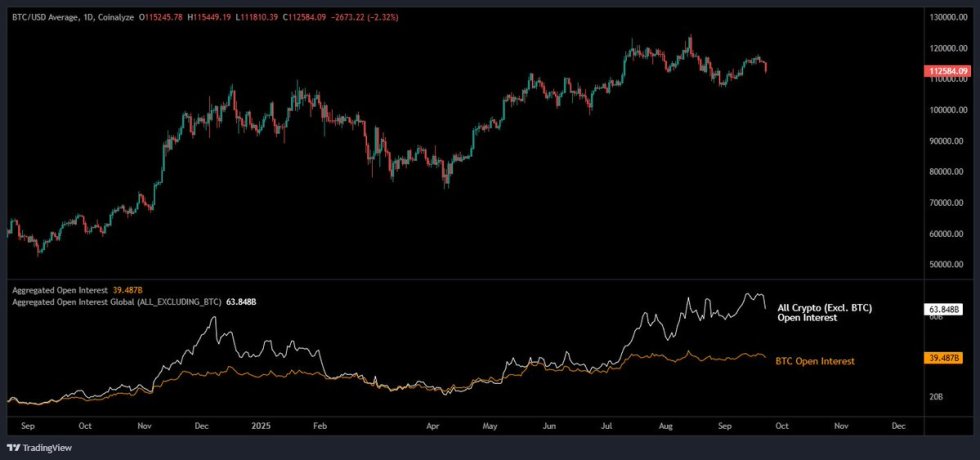
$8.0B in Altcoin Open Interest wiped out | Source: Maartunn

The scale of the wipeout is telling. Altcoin open interest losses were more than five times greater than Bitcoin’s, suggesting that speculative positions in the sector were far riskier and more vulnerable to sharp downside moves. While Bitcoin remains the market’s anchor, the gap between Bitcoin and the broader altcoin market is beginning to close, reflecting a shift in positioning and risk exposure.

For investors, this raises important questions. On one hand, such a dramatic flush often clears excess leverage from the system, paving the way for healthier price action in the medium term. On the other hand, the sheer scale of the altcoin losses could signal lingering fragility and the potential for further volatility if confidence does not return quickly.

The coming days will be decisive. Analysts are watching closely to see whether altcoins can stabilize around key support levels or whether bearish pressure will drive another leg lower. With Bitcoin showing relative resilience, altcoins must now prove they can withstand the shock and rebuild momentum in a market still reeling from billions in liquidations.

Total Market Cap Excluding Top 10 Analysis

The chart of the total crypto market cap excluding the top 10 coins shows that the altcoin sector is at a decisive moment. Currently valued at around $305 billion, the market has recovered significantly from the lows of 2022 and 2023 but remains far from its historical peak above $600 billion.
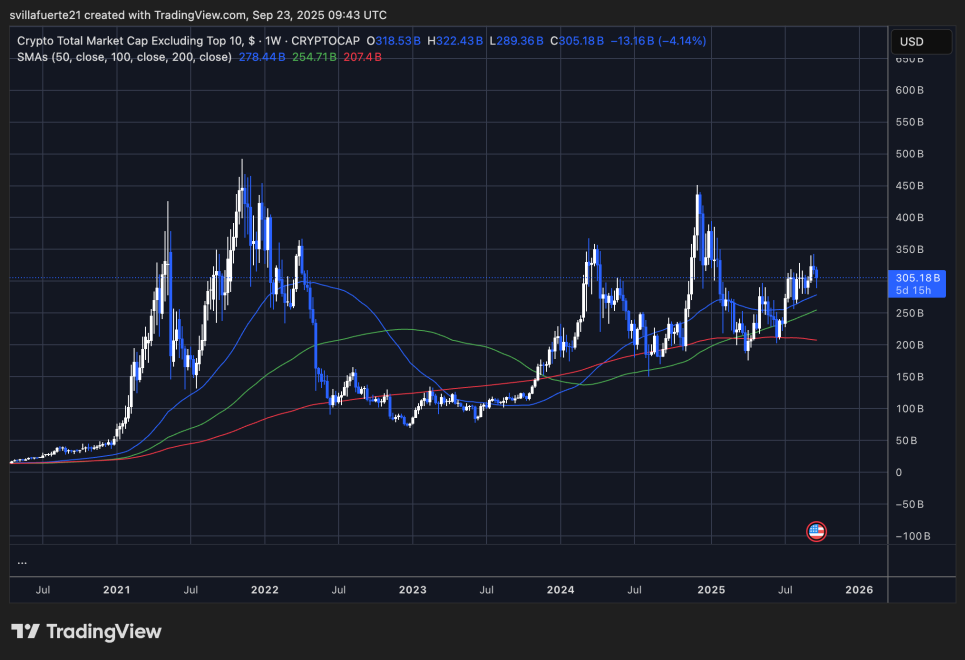
Crypto Total Market Cap Excluding Top 10 | Source: OTHERS chart on TradingView

Price action highlights that after a prolonged consolidation, altcoins have established a steady uptrend, supported by the 50-day and 100-day moving averages, which are now sloping upward. The 200-day moving average has flattened and begun to turn positive, further signaling improving structure in the broader market. Still, the recent rejection near the $320 billion resistance shows sellers remain active at higher levels.

The market’s ability to sustain above $280 billion will be critical for maintaining bullish momentum. A break below could trigger deeper retracements, but holding above this zone suggests strength and potential for expansion.

Excluding top assets like Bitcoin and Ethereum, this index reflects rising investor appetite for smaller-cap projects. The resilience of this sector despite recent volatility signals that risk appetite is returning. If broader conditions improve, altcoins outside the top 10 could lead the next phase of market growth.

Featured image from Dall-E, chart from TradingView

Editorial Process for bitcoinist is centered on delivering thoroughly researched, accurate, and unbiased content. We uphold strict sourcing standards, and each page undergoes diligent review by our team of top technology experts and seasoned editors. This process ensures the integrity, relevance, and value of our content for our readers.

Sebastian's journey into the world of crypto began four years ago, driven by a fascination with the potential of blockchain technology to revolutionize financial systems. His initial exploration focused on understanding the intricacies of various crypto projects, particularly those focused on building innovative financial solutions. Through countless hours of research and learning, Sebastian developed a deep understanding of the underlying technologies, market dynamics, and potential applications of cryptocurrencies. As his knowledge grew, Sebastian felt compelled to share his insights with others. He began actively contributing to online discussions on platforms like X and LinkedIn, focusing on fintech and crypto-related content. His goal was to expose valuable trends and insights to a wider audience, fostering a deeper understanding of the rapidly evolving crypto landscape. Sebastian's contributions quickly gained recognition, and he became a trusted voice in the online crypto community. To further enhance his expertise, Sebastian pursued a UC Berkeley Fintech: Frameworks, Applications, and Strategies certification. This rigorous program equipped him with valuable skills and knowledge regarding Financial Technology, bridging the gap between traditional finance (TradFi) and decentralized finance (DeFi). The certification deepened his understanding of the broader financial landscape and its intersection with blockchain technology. Sebastian's passion for finance and writing is evident in his work. He enjoys delving into financial research, analyzing market trends, and exploring the latest developments in the crypto space. In his spare time, Sebastian can often be found immersed in charts, studying 10-K forms, or engaging in thought-provoking discussions about the future of finance. Sebastian's journey as a crypto analyst and investor has been marked by a relentless pursuit of knowledge and a dedication to sharing his insights. His ability to navigate the complex world of crypto, combined with his passion for financial research and communication, makes him a valuable asset to the industry. As the crypto landscape continues to evolve, Sebastian remains at the forefront, providing valuable insights and contributing to the growth of this revolutionary technology.

Letture associate

a16z: In the AI Era, Company Competition for Talent Starts with Job Title Naming

The article discusses how companies in the AI era are competing for talent through strategic "title arbitrage," or the renaming of key roles to reflect and attract new, high-value capabilities. It uses Palantir's creation of the "Forward-Deployed Engineer" (FDE) as a prime example. This title reframed client-facing technical work from a peripheral "implementation" role into a core, high-status engineering function. The move was strategic, allowing Palantir to attract talent that blended technical skill with business acumen and to dominate the market's perception of this capability. The piece argues that job titles are an organizational language that signals the value and authority of certain work. Effective new titles, like "Data Scientist" or "Site Reliability Engineer," emerge when a role's strategic importance genuinely outgrows its old name. Conversely, mere title inflation without substantive change is ineffective. For AI companies, particularly in B2B, this is a crucial strategy. AI transformation creates new high-leverage roles (e.g., "Legal Engineer," "GTM Engineer") that combine domain expertise with technical automation. By naming these roles, a company can help clients internally legitimize these change-makers. This, in turn, builds market mindshare, associating the company with the new capability. In conclusion, as AI blurs the lines between product and service, the ability to accurately name and organize the critical, client-adjacent work that defines product learning will be a key competitive advantage. The first to define this new organizational language plants a flag in the market's mind.

marsbit47 min fa

a16z: In the AI Era, Company Competition for Talent Starts with Job Title Naming

marsbit47 min fa

Interview with Strategy CEO: Can STRC Recover After Selling Bitcoin?

Interview with Strategy CEO Phong Le on the recent sale of 32 Bitcoin and its impact. He clarifies the move was a small, strategic action to demonstrate liquidity to debt holders, test internal processes, and prove operational discipline—not a response to fears of a "death spiral" from DeFi protocols leveraging STRC (Strategy's preferred stock product), which he notes holds less than 10% of STRC. Le emphasizes Strategy’s long-term focus as the largest corporate Bitcoin holder, using the adage that markets are a "voting machine" short-term but a "weighing machine" long-term. Decision-making is data-driven, involving the board, complex modeling, and multiple stakeholder considerations, moving beyond a founder-centric model. He outlines various capital options but stresses the strategic importance of "doing nothing" as a valid choice, citing resilience built during the 2022 bear market. Le expresses unwavering belief in Bitcoin's foundational value for global sovereignty and its future role in an AI-driven economy with trillions of autonomous agents. Addressing STRC's current price below its $100 face value, Le explains recent pressure was due to using dollar reserves for bond buybacks. He expects STRC to return to par as reserves are replenished and its semi-monthly dividend payments begin, noting the product is heavily over-collateralized. Finally, Le confirms the company sold Bitcoin the week prior to May 31st, as disclosed in an 8-K filing, leaving prediction market interpretations to others. The overarching philosophy remains "Spread Bitcoin with love," embracing all methods of gaining Bitcoin exposure.

marsbit1 h fa

Interview with Strategy CEO: Can STRC Recover After Selling Bitcoin?

marsbit1 h fa

Trading

Spot
Futures
活动图片