Whale buys BTC to fight inflation,is the general trend?

Huobi ResearchPubblicato 2022-06-30Pubblicato ultima volta 2022-07-01

Introduzione

Whale has increased its holdings in BTC to fight inflation.

After the U.S. inflation rate reached the highest level in 40 years, the Federal Reserve's expectation of a substantial interest rate hike after the excess of money supply was strong. After bitcoin fell below $20000, the growth of low absorption opportunities was gradually confirmed.

High inflation pushes up interest rates

In 2022, more price sensitive investors began to talk about inflation. For example, rising prices in the United States have squeezed consumers' budgets more than the highest level in the past 40 years. Both investors and consumers need to find good ways to protect their purchasing power and capital security.

Used to track the change of consumer price index, the U.S. consumer price index (CPI) rebounded from -1.2% in April 2020 to 11.5% in April 2022. The growth trend is very significant, and the inflation rate is the highest level in 40 years.
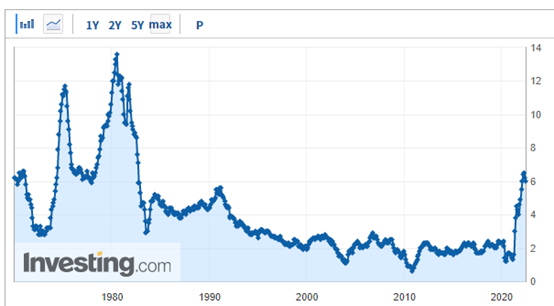
Us non seasonally adjusted core consumer price index (CPI) annual rate

In this case, the Federal Reserve raised interest rates at full steam, making the expected US dollar interest rate reach an unprecedented high.

For the forecast of the federal funds rate at the end of this year, the market is currently betting at most on 3.5%-3.75%, slightly lower than the peak forecast of 3.75%-4% in the dot matrix chart released by the Federal Reserve on June 16.

Dot matrix of Fed's interest rate hike expectation
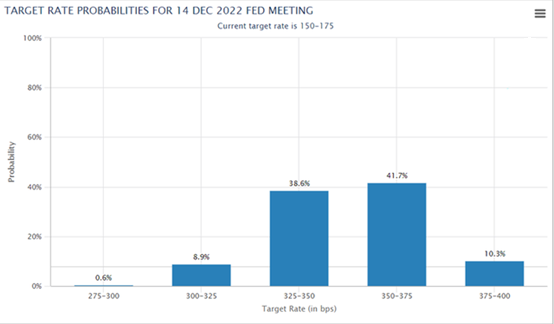
Fed's expectation of raising interest rate

The dot matrix chart in June shows that the benchmark interest rate of the Federal Reserve will rise from the current target range of 1.5%-1.75% to 3.25%-3.5%; As a result, the next four meetings will raise interest rates by 175 basis points.

The expectation of the Federal Reserve to raise interest rates is rising. After a substantial interest rate increase, the attractiveness of the US dollar to investors has been greatly enhanced. Because there is a large room for interest rate growth during the year, this has become an important driving factor for large capital investors to reallocate assets in the short term.

Bitcoin inflation rate change

The data shows that after the 742988 block was excavated by the bitcoin miner poolin, the BTC supply reached 19081175 pieces, and the circulation reached 90.86%.

In the current mining cycle, the output of BTC can reach 6.25 pieces per 10 minutes, and the annual output of BTC is calculated to be 328500 pieces. In other words, for the supply of 19081175 BTCs, the current annual inflation rate can reach 1.72%. Numerically, the ratio is lower than the annual interest rate of most national currencies.
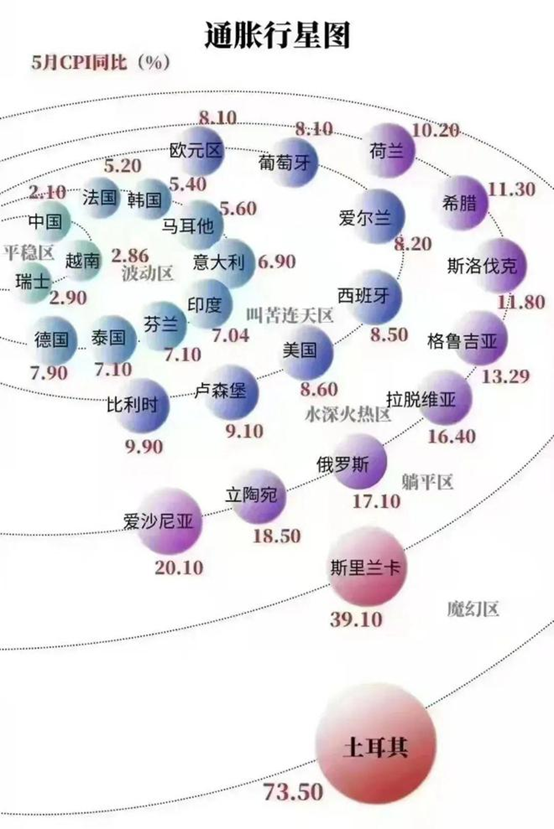
Inflation rate of countries in May 2022

From the inflation performance of various countries in May, the interest rate level of most countries is much higher than 1.72%. In other words, BTC has a competitive advantage in terms of inflation rate. It is a very low inflation rate variety. And with the continuation of BTC's block reward halving every four years, the downward trend of its inflation rate will also exist for a long time. Therefore, the scarcity of BTC is more effective for anti inflation.

Us money supply is abundant

In recent years, the money supply in the United States has grown rapidly. The peak value of M2 supply per week can exceed US $400billion. Judging from this, this is the culprit driving up the inflation rate. The proliferation of US dollars has virtually enhanced the attractiveness of BTC with declining long-term inflation rate. After all, BTC's inflation target is 0 after BTC finally ends its mining incentives. Among them, the increase in the number of long-term investors holding currency has increased the long-term deflation expectation after reducing the circulation of BTC.
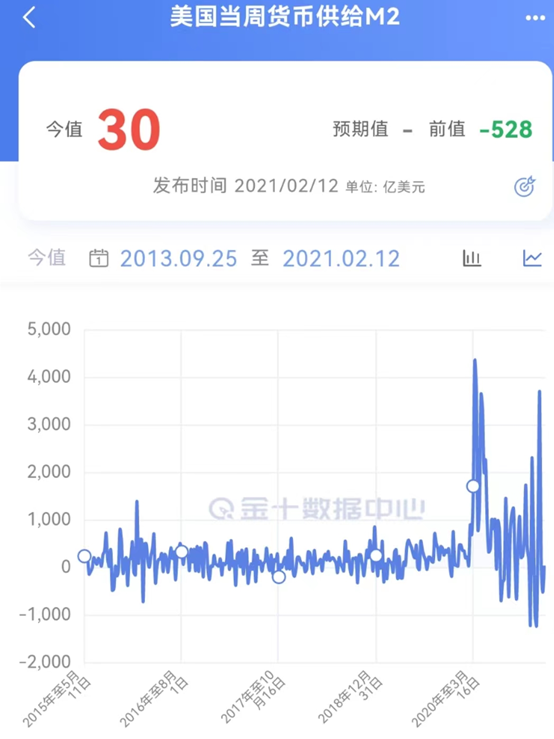
Us money supply

Whale increased its holdings and held a large amount of BTC

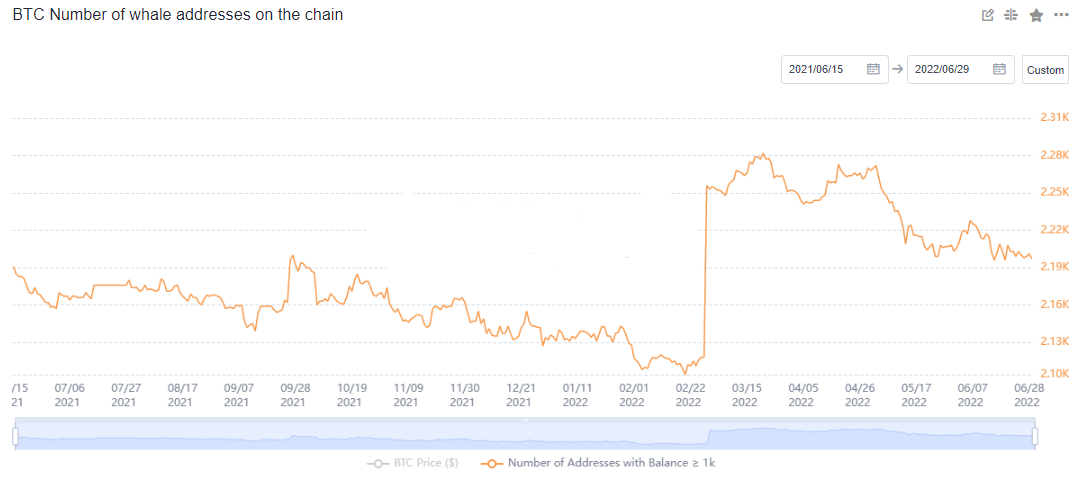
The data on the number of currency holding addresses shows that the number of BTC's giant whale addresses is growing, against the background of the Fed's interest rate hike and the substantial decline in BTC prices. The number of BTC addresses with 1000 BTCs remained at a high level. After a substantial increase on February 28, the value remained at a high level. This shows that the concentration of main cash holdings is still high. Although the factor of the increase of the exchange's currency holdings is not excluded here, on the whole, the increase of BTC's giant whale's currency holdings may be recognition of the long-term performance against inflation. Therefore, in terms of investment opportunities, long-term fixed investment and low absorption may be a better choice.
Letture associate

Four Questions on the Zcash Orchard Vulnerability: Was It Exploited? Can Funds Be Recovered? Is the Supply Verifiable? And Are There Others?

Zcash Orchard Bug: Four Key Questions Answered A critical forgery vulnerability was discovered in Zcash's Orchard privacy pool, raising four major concerns for users. 1. **Was the Orchard bug exploited?** The likelihood is considered low. The bug was found proactively using advanced AI-assisted tools and was promptly patched, limiting any potential attack window. If exploitation had occurred, evidence would likely have surfaced by now. 2. **Can legitimate Orchard funds be recovered?** It is believed so, based on the assessment that the bug was not exploited. If forgery did happen, existing "turnstile" mechanisms could prevent full recovery of legitimate funds if forged coins were moved out first, though this scenario is deemed unlikely. Users can choose to move funds, but this carries risks like loss of privacy or new wallet/software issues. 3. **Can users verify Zcash's total supply?** Currently, no. The vulnerability's prior existence prevented independent verification of the shielded supply. The proposed "Ironwood" network upgrade will restore this ability by sealing the Orchard pool, allowing anyone running a node to verify that the circulating ZEC does not exceed the correct amount. 4. **Are there other forgery bugs?** Ongoing intensive audits by multiple teams, including AI-assisted analysis, have not found additional forgery vulnerabilities, increasing confidence that none remain. Further work and collaborations are planned to provide additional guarantees. In conclusion, while the team assesses that exploitation was unlikely and the supply is safe, the upcoming upgrade is critical to restore users' ability to independently verify Zcash's supply integrity, moving away from reliance on trust.

marsbit13 min fa

Four Questions on the Zcash Orchard Vulnerability: Was It Exploited? Can Funds Be Recovered? Is the Supply Verifiable? And Are There Others?

marsbit13 min fa

Four Questions on the Zcash Orchard Vulnerability: Was it Exploited? Can Funds Be Recovered? Is the Supply Verifiable? Are There Others?

**Summary: Zcash Orchard Vulnerability Analysis** A critical forgery vulnerability was recently discovered in Zcash's Orchard shielded pool, raising concerns about the coin's supply and user funds. The developers, led by Zcash Open Development Labs, acted swiftly to temporarily freeze the pool and deploy a fix. The article addresses four key questions: 1. **Was the vulnerability exploited?** While unknown, the developers believe it is unlikely for several reasons: the bug was difficult to find, using advanced AI tools; the fix was deployed quickly; and typical crypto exploits are fast, with no evidence of abnormal outflows. 2. **Can legitimate Orchard funds be recovered?** If the bug was not exploited, all funds are safe. If exploited, a mechanism limits total withdrawals from the pool to the amount legitimately entered, potentially blocking some legitimate funds. The developers deem this unlikely but advise cautious users to consider moving funds, noting the privacy and risk trade-offs of moving to transparent or Sapling pools. 3. **Can users verify Zcash's total supply?** Not currently. The vulnerability temporarily broke the ability for users to independently verify that no extra ZEC was created. 4. **Are there other forgery bugs?** Ongoing audits by multiple teams, including using advanced AI analysis, have so far found no others, increasing confidence. The proposed "Ironwood" network upgrade is the core solution. It will **seal** the Orchard pool, preventing new entries or internal circulation. This action, combined with the existing withdrawal mechanism, will restore the ability for any node operator to verify that Zcash's supply limit has not been violated, regardless of whether exploitation occurred in the past. The upgrade aims to restore the system's long-term credibility through user-verifiable supply integrity.

Odaily星球日报13 min fa

Four Questions on the Zcash Orchard Vulnerability: Was it Exploited? Can Funds Be Recovered? Is the Supply Verifiable? Are There Others?

Odaily星球日报13 min fa

An AI Version of the 'Subprime Crisis'? A Hidden Debt of $1.8 Trillion is Accumulating in the Shadows Amid the Frenzy

Amidst the AI infrastructure construction boom, a massive debt expansion is forming, with the most dangerous portion remaining off-balance sheets. Morgan Stanley research reveals approximately $1.8 trillion in off-balance-sheet exposures, including nearly $1 trillion in purchase commitments and over $800 billion in non-active lease contracts. These future cash outflows are not recorded as liabilities. The leverage of hyperscale cloud companies has surged from 0.9x to 1.8x in just two quarters. Private credit firms like Apollo and Blackstone are shifting leverage into the supply chain through complex, opaque SPV (Special Purpose Vehicle) financing structures. Global AI-related bond issuance has skyrocketed, with annual volume projected to exceed $570 billion. However, capital expenditure growth is outpacing revenue and free cash flow. Major cloud providers may see free cash flow approach zero or turn negative in 2026. A significant 'depreciation cliff' looms as vast amounts of current capital spending, recorded as 'construction in progress,' have yet to begin depreciating, artificially inflating current profit margins. Future depreciation could severely pressure earnings. The core risk is identified as a series of timing mismatches, not an immediate solvency crisis. Investment is racing ahead of monetization, leverage is being obscured, and accounting classifications hinder comparability. The entire financing structure faces a fundamental stress test if AI commercialization lags or enterprise clients shift to cheaper alternatives, potentially triggering chain reactions within the highly interconnected funding ecosystem.

marsbit24 min fa

An AI Version of the 'Subprime Crisis'? A Hidden Debt of $1.8 Trillion is Accumulating in the Shadows Amid the Frenzy

marsbit24 min fa

Trading

Spot
Futures
活动图片