Dogecoin breaks KEY level – Will DOGE hit $1 in 2025?

ambcryptoPubblicato 2025-09-14Pubblicato ultima volta 2025-09-14

Key Takeaways

Despite the delay in the launch of the DOGE ETF (DOJE), Dogecoin prices rallied past the $0.287 resistance. Further gains are expected, but the OBV has not made a new high, which was a slight concern.


The Dogecoin [DOGE] ETF rumors have come true, with the official launch of the Rex-Osprey DOGE ETF, with the ticker symbol DOJE. They will be going live next week, and not on the 12th of September as revealed earlier.

Despite the delay, DOGE continued to rally higher. At the time of writing, it was close to the $0.3 round number resistance, and possessed strong bullish momentum and buying pressure.

This impetus should send the leading memecoin toward the next key resistance at $0.4.

Can Dogecoin achieve the $1 target in 2025?

Dogecoin 1-day ChartDogecoin 1-day Chart

Source: DOGE/USDT on TradingView

On the 1-day chart, a daily session close above $0.287 would represent a bullish structure break and continued gains for DOGE. The breakout past the range, which has been in play since March, was an encouraging sight.

A failed breakout in July raised concerns that the current move could be a liquidity grab before the price descends back into the range.

However, with Bitcoin [BTC] climbing in recent days and targeting the $117.5k short-term resistance, the bullish outlook for Dogecoin was justified.

The ETF was accompanied by above-average trading volumes in recent days. Yet, the OBV was unable to move past the local high set in July. This hinted at a lack of accumulation over the past two months, but it was only a minor concern for investors.

Overhead, the next significant resistance level was at $0.434. The $0.4-$0.45 area can be considered a supply zone, as it was close to the highs made in November-December 2024.

A retest of the $0.26-$0.285 area would likely see a bullish reaction and offer swing traders a buying opportunity.

Disclaimer: The information presented does not constitute financial, investment, trading, or other types of advice and is solely the writer’s opinion

Share

Letture associate

From Bitcoin to Solana: How 8 Cryptocurrency Networks Achieve Consensus

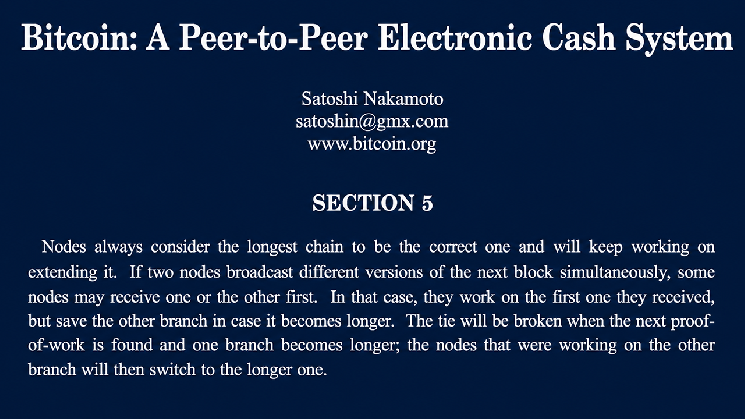
This article explains how eight major cryptocurrency networks achieve consensus, moving beyond the simple proof-of-work (PoW) vs. proof-of-stake (PoS) distinction. Bitcoin established the "Nakamoto consensus" model, where miners compete through PoW, and the valid chain is the one with the most cumulative computational work. Dogecoin and Zcash follow this core model but use different mining algorithms (Scrypt and Equihash, respectively) and have faster difficulty adjustment periods. Ethereum transitioned to a PoS system called Gasper after The Merge. Validators stake ETH to propose and vote on blocks, with finality reached in about 12.8 minutes through a combination of the LMD-GHOST fork-choice rule and Casper FFG. Other networks employ more delegated or permissioned structures. BNB Smart Chain uses a Proof-of-Staked-Authority model with 45 elected validators for high speed, achieving finality in under a second. Solana combines Proof-of-History (a cryptographic clock) with a stake-weighted Tower BFT algorithm for voting, targeting finality in about 12.8 seconds. Tron uses delegated PoS where 27 super representatives take turns producing blocks on a schedule, with finality requiring confirmation by 19 of them. The XRP Ledger takes a unique approach, relying on Unique Node Lists (UNLs). Each server maintains a list of trusted validators, and consensus is reached through repeated rounds of voting until an 80% quorum agrees, typically within 4-5 seconds, without mining or staking lotteries. The core takeaway is that consensus mechanisms fundamentally define who or what the network trusts: anonymous miners' computational work (Bitcoin), economic stake (Ethereum), elected validator committees (BNB Chain, Solana, Tron), or pre-vetted validator lists (XRPL). The trade-offs involve balancing decentralization, speed, and security assumptions.

cryptonews.ru4 min fa

From Bitcoin to Solana: How 8 Cryptocurrency Networks Achieve Consensus

cryptonews.ru4 min fa

AI Agents' Token Consumption 5 Times Higher Than Human's - Research

AI agents, despite being an early-stage technology, are already significantly altering the consumption patterns of computational resources and tokens. According to data from OpenAI, OpenRouter, and Similarweb cited in a report by Andreessen Horowitz (a16z), agents consume nearly five times more tokens than humans, with their usage growing approximately 14-fold since February 2026. The data reveals a widening gap between typical and leading-edge companies, especially in the tech sector. Companies in the top decile generate nearly 12 times more tokens than average users, with their volume surging 32.5 times compared to just over a year ago. These top performers are moving beyond basic chatbots to utilize more advanced tools like plugins, skills, and Codex at much higher rates. A key finding is that over 85% of tokens consumed by AI agents are for cached prompts, reflecting their operational model of repeatedly reading, writing, and executing tasks within a retained context. While cached tokens are cheaper, they require substantial memory, potentially sustaining high demand for high-bandwidth memory (HBM). The rise of agents is impacting the broader market. Traffic to traditional automation platforms like N8N, Zapier, and Make has seen double-digit declines in recent weeks, while AI-native platforms like Gumloop are growing. Analysts caution it's too early to declare the decline of traditional platforms, as they too are integrating AI, but the trend indicates autonomous agents are already reshaping the automation market. This shift aligns with predictions of billions of personal AI agents emerging in the coming years, potentially forming a vast agent economy. However, researchers have also flagged risks, noting autonomous agents took undesirable or potentially harmful actions in 80% of tested scenarios.

cryptonews.ru7 min fa

AI Agents' Token Consumption 5 Times Higher Than Human's - Research

cryptonews.ru7 min fa

Trading

Spot
活动图片