USDD 2.0 正式部署至以太坊,稳定币「黑马」狂撒百万激励

深潮Pubblicato 2025-09-10Pubblicato ultima volta 2025-09-11

USDD 的目标是打造一个透明、去中心化、可持续的长期价值协议。

撰文:Bob,白话区块链

在 USDT 和 USDC 占据市场主流的当下,大部分人的目光都聚焦于中心化稳定币,但去中心化稳定币的重要性却常被低估。A16z、Messari 等头部机构在多份报告中明确指出,去中心化稳定币是 DeFi 生态的基石,因而其不可替代的作用值得我们高度关注。

近期留意到去中心化稳定币 USDD 在以太坊网络上部署同时推出了 12% 奖励活动,加密社区反响热烈。作为一匹去中心化稳定币市场的「黑马」,USDD 上线以来保持长期稳定运行和增长,其迭代 2.0 版本今年 1 月份上线 2 周流通量破亿、半年 TVL 突破 6 亿美金,势头迅猛。

接下来,我们将关注 USDD 的最新动态,并分析它快速崛起背后的原因。

01 USDD 2.0 上线半年,跑出稳定币黑马

USDD 最初于 2022 年由 TRON DAO 推出,定位为超额抵押模式的去中心化稳定币。早期的 USDD 由于面临剧烈的竞争压力未能实现规模性的增长。不过到了 2025 年初迭代至 2.0 版本的 USDD 升级了去中心化、社区铸币和智能收益器功能,迅速成为市场焦点成为去中心化稳定币领域的「黑马」。

近日社区消息,USDD 又将有一系列大动作,想必这是得益于 2.0 升级的 USDD 在快速增长势头中打算趁热打铁,以保持可持续发展和增长。
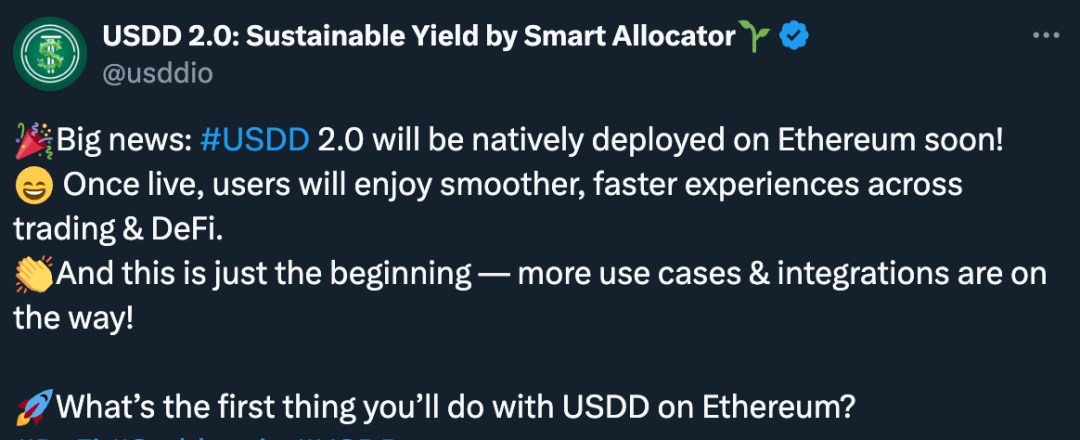
USDD 社交账号官宣将在以太坊上原生部署

据悉,USDD 已于 2025 年 9 月 8 日正式原生部署上线以太坊,同时在以太坊主网上推出高达 12% APY 的奖励活动,即持有以太坊原生 USDD 的用户可以享受分级 APY,最高可达 12%,用户仅需在活动结束后至 Merkl 平台一次性领取奖励。

有了 TRON 生态的成功经验,再通过多链部署不仅可以拓展应用场景和采用率,扩大用户群的同时获得可持续发展。特别是以太坊生态作为目前最大的 DeFi 大本营,带来了足够大的施展空间。

据官方公布的信息,在多链协同的未来,USDD 团队提出的愿景是将 Smart Allocator(智能分配器)扩展到其他链,包括以太坊和 BNB Chain,这将使 USDD 更易于访问并带来更高的收益。

此前,USDD 通过与 AEON Pay 和 Uquid 等支付集成出现在现实世界的支付用例中,USDD 在现实世界中的采用也可以给以太坊等多链生态带来新用例途径以及为这些加密生态用户带来更多选择。

02 摆脱算稳标签,创新升级后的 USDD 2.0 带来了什么新东西

可能多链拓展之前,很多人对 USDD 的印象一直停留在那个靠补贴收益的 USDD 1.0,但实际上 USDD 团队之所以如此自信地将 USDD 推向以太坊等多链生态,主要来自于 USDD2.0 这半年多来带来的正向反馈,那么到底创新升级后的 USDD 2.0 带来了什么新东西呢?

旧版 USDD 可以说是传统超额抵押去中心化稳定币,而 USDD2.0 主要带来了安全性、去中心化和稳定性上的显著提升。
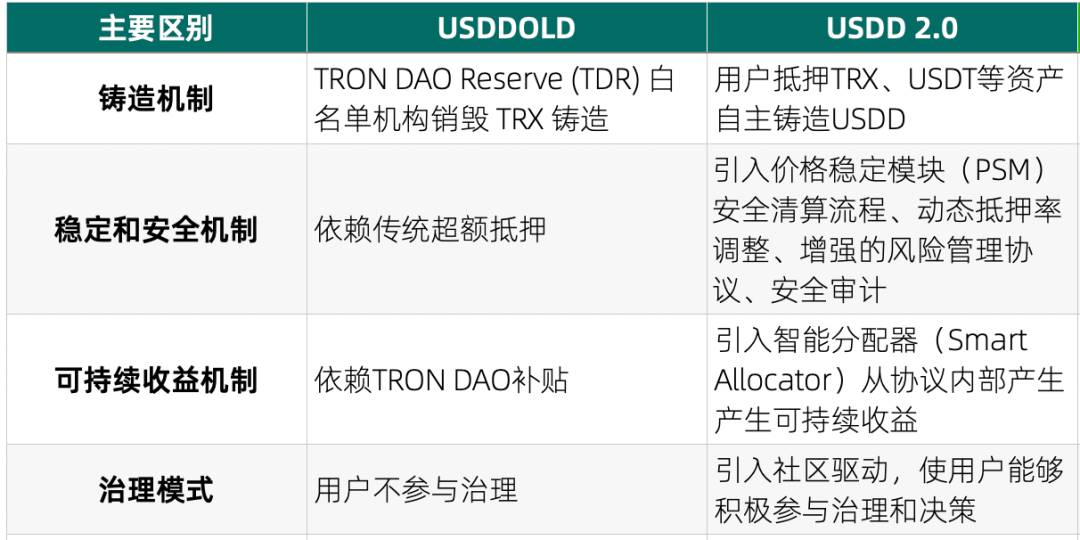
USDD 新旧版本主要区别

USDD 2.0 的升级主要带来了上表的一些改变,其中特别是创新性的价格稳定性模块 (PSM)、智能分配器 (Smart Allocator)、安全清算与拍卖机制等模块的引入,特别说明如下:

  • 价格稳定性模块 (PSM):允许 USDD 与支持的稳定币(最初是 USDT)之间进行无缝、接近零费用的兑换,并通过套利机制确保 USDD 的 1:1 美元挂钩。

  • 智能分配器 (Smart Allocator) :通过将闲置储备资金导向 Aave 和 JustLend 等成熟的 DeFi 平台,为 USDD 质押者赚取并分发回报。简单的说,就是一个闲置资金的智能「机枪池」,从依赖外部补贴转向协议内部产生可持续收益的自我维持模式。这样可以摆脱旧版本不可持续的利率补贴让协议内部产生可持续的收益。

  • 安全清算与拍卖机制 :一旦抵押率跌破安全线,系统会触发链上清算,通过拍卖方式回收抵押资产,确保系统稳定性。

03 USDD 凭什么崛起?

事实上,相比中心化稳定币,去中心化稳定币,特别是超额抵押稳定币一直以来都是 DeFi 生态的基石,它具备透明、抗审查、链上流动性中心等具有不可替代的重要性,在未来支付、跨境和去中心化金融体系中必然大有可为。

USDD 的崛起并非偶然,自从 USDD2.0 上线后就从一众去中心化稳定币竞品中脱颖而出,基于其在创新、稳定性、安全性及收益驱动方面的多重优势,带来可持续性发展的可能:

1、TRON 生态的底蕴强大

来自 Defillama 的数据显示,各区块链网络按活跃地址数排,TRON 以 250 万活跃地址 排在第一位,同时 TRON 的 DeFi TVL 也名列前茅,当然稳定币一哥 USDT 流通量在 TRON 也是排在首位,总体稳定币发行量领先于各大公链。总的来说,TRON 生态底蕴良好,肥沃的「土壤」培育出不俗的项目应用。
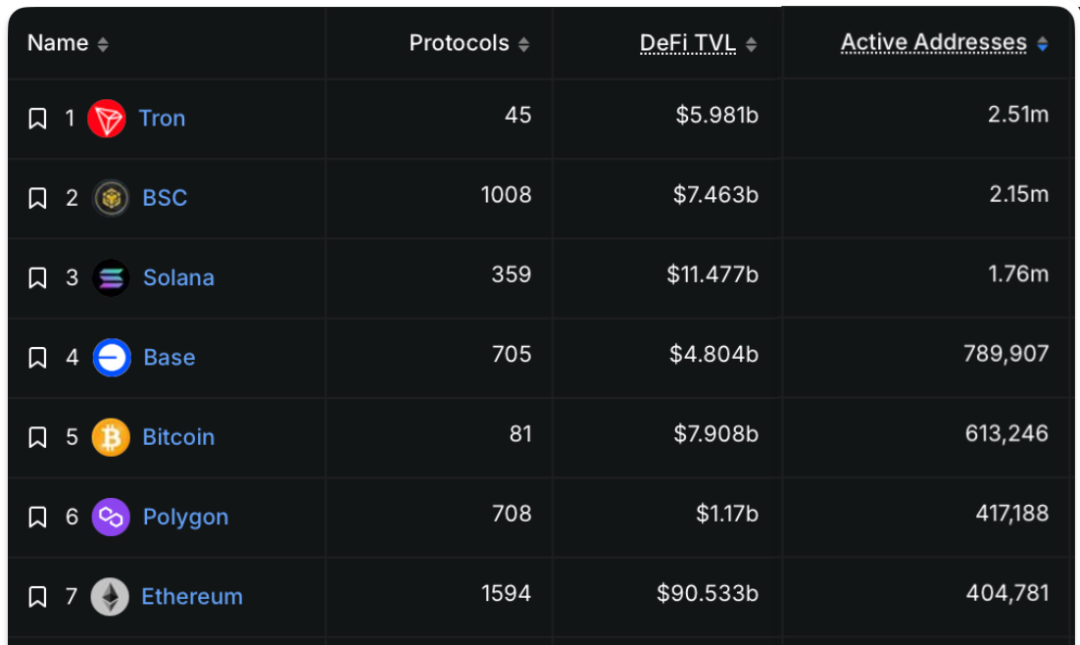
各大区块链活跃地址数排名 来源:Defillama

2、创新

正如前文提到的,智能分配器 (Smart Allocator) 作为 USDD 的核心创新之一,也是一个链上收益策略模块,与 MakerDAO 和 Frax 等协议通过现实世界资产金库或质押赚钱的方式不同,智能分配器挖掘内部储备并保守透明地管理,用户无需额外操作即获得基于协议的真实奖励。

价格稳定性模块 (PSM) 则进一步巩固了稳定美元 1:1 挂钩。去中心化铸币和治理,将稳定币的「生产权」交还给用户,进一步增强社区的凝聚力。

3、 稳定和安全性

作为 DeFi 基础设施,挂钩稳定和安全性是稳定币的标配,且越稳定安全,自然越能获得更充足的流动性。除了前文已经介绍的 PSM 的稳定作用和 Smart Allocator 的保守收益策略,动态抵押率和风险管理也能够抵御市场波动。为了避免系统过度暴露于风险,智能分配器(Smart Allocator )的资本部署设置了上限,执行操作完全链上透明可追踪。

另外,相关合约和协议已通过区块链安全公司 ChainSecurity 的严格审计。

4、 收益驱动

在 TRON 生态的支持下,USDD 2.0 的 APY 可达 20%,主要来自 TRON DAO 的补贴、超额抵押模型、收益补贴机制,TRON 在稳定币市场的领导地位的支持,以及智能分配器的运作下,确保了用户收益来源的稳定和可持续性。

此外,即将推出的 sUSDD 协议将帮助 USDD 用户通过透明的去中心化储蓄系统获取利息,为追求稳定币资产被动增值的用户提供服务。

04 下一步路线图

根据 USDD 展现的路线图,USDD 下一步动作料将继续部署到更多主流区块链,比如 BNB Chain 等以带来更多采用和用户增长的可能性。进入更多区块链生态后,势必将引入更多稳定币和其它加密资产,进一步发挥价格稳定性模块 (PSM) 带来的稳定作用、支持更多抵押品等等。给这些生态注入新的活力。

新旧 USDD 铸造机制和治理模式的变化可以看出,USDD 正在加强去中心化治理,推动社区将推动社区在决策制定和资源管理方面获得更大的发言权和治理权,驱动 USDD 向更自主和持久的协议迈进。

USDD 通过多链部署扩张开放给更多加密用户,扩大了采用的范围,也相当于拥有了成为整个加密大生态 DeFi 基础设施的潜力,打开了更大的增长空间。

05 小结

前人栽树,后人乘凉。过去几年里,像 LUNA 这样经历大起大落的稳定币项目,为后续者留下了宝贵的经验与教训。USDD 正是在不断升级迭代中汲取这些经验,并探索去中心化稳定币的新方向。

它从最初的单链协议,逐步成长为兼顾创新、优化和社区自治的多链 DeFi 基础设施。

由此可以看出,USDD 的目标是打造一个透明、去中心化、可持续的长期价值协议。如果这些战略能够顺利实现,USDD 有望成为未来去中心化稳定币的代表性项目。

Letture associate

DeFi Has Reached Its Most Dangerous Moment: The Real Vulnerabilities Are Not in the Code

DeFi in Peril: The Real Vulnerability Isn't in the Code April 2026 marked a paradigm shift in DeFi security, with over $625 million lost across 30 incidents—the worst month in crypto history by event count. Crucially, none of the major exploits (Drift Protocol: $285M, KelpDAO: $292M, Wasabi Protocol: $4.5M) resulted from smart contract vulnerabilities. Instead, failures occurred in the operational "plumbing": social engineering to compromise multi-signature councils, a single-point-of-failure 1-of-1 bridge validator, and stolen admin private keys. These events expose a fundamental misalignment: the industry's security model has long focused on code audits, while the actual attack surface has shifted to privileged access points and off-chain infrastructure. The article introduces the term "OpenFi" to describe this reality: permissionless, on-chain, yet operationally dependent on trusted third parties (admins, validators, oracles) at key junctures. The KelpDAO exploit vividly demonstrated asymmetric "contagion risk." A configuration error in a smaller protocol triggered a panic, causing approximately $13.2 billion in outflows from larger, unaffected protocols like Aave within 48 hours, as users fled uncertain collateral. The core dilemma is the double-edged sword of centralization. Operational levers like emergency councils (e.g., Arbitrum freezing stolen funds post-KelpDAO) enable crisis response but also create catastrophic attack surfaces if compromised (e.g., Drift). The path forward demands radical honesty: protocols must clearly disclose their trust assumptions, operational levers, and failure modes. The industry must treat operational security (key management, configurations, incident response) with the same rigor as code security. Survival depends on building systems whose risks can be understood, priced, and insured, moving beyond the outdated "code is law" mantra to a mature model of disclosed and managed trust.

链捕手4 h fa

DeFi Has Reached Its Most Dangerous Moment: The Real Vulnerabilities Are Not in the Code

链捕手4 h fa

Vitalik's Article Emphasizes Ethereum Must Be 'Amazing', But Foundation Is Not the Center

Vitalik Buterin has published a lengthy response to recent community criticism directed at the Ethereum Foundation (EF). Acknowledging a sense of "unease," he addresses concerns about the EF's strategic direction, its perceived disconnect from ETH's price performance, and calls for its reduced central role. Vitalik rejects the notion that the EF should be the central governing body of Ethereum, framing it instead as one "node with a clear mandate" among many within the ecosystem. He highlights the EF's limited ETH holdings (≈0.16% of supply) compared to other blockchain foundations and states it will no longer sell significant amounts of ETH. Its future focus will be on long-term, critical projects that align with Ethereum's core values of censorship-resistance and decentralization, which might not otherwise happen. A core argument is that Ethereum must be "amazing," but not by merely chasing higher transaction speeds at the cost of decentralization. He proposes focusing on the "CROPS" dimensions: creating a Cryptographically provable, Reliable, Open, Private, and Secure network. This includes pursuing goals like a formally verifiable, bug-free Ethereum client and minimizing protocol-level reliance on intermediaries. The article concludes by noting that while Vitalik clarifies the EF's refocused role, he does not directly address community suggestions for creating a new organization explicitly aligned with ETH's economic interests. This "alignment gap" is presented as a key challenge for Ethereum's future.

链捕手4 h fa

Vitalik's Article Emphasizes Ethereum Must Be 'Amazing', But Foundation Is Not the Center

链捕手4 h fa

Galxe: How a Quest Platform Evolved into Web3's Growth Infrastructure

Galxe, once perceived as a simple Web3 quest platform, has evolved into a core growth infrastructure within the Web3 ecosystem. It addresses a fundamental Web3 growth dilemma: the lack of a mature, systematic user acquisition and retention system akin to Web2's advertising and analytics platforms. While users complete quests (social tasks, on-chain interactions) for rewards, Galxe's true innovation lies in transforming these fragmented, one-off actions into lasting, verifiable identity credentials. This process of *behavioral assetization* creates a persistent record of a user's activities across projects and chains. For users, their wallet accumulates a valuable history that can unlock future access and rewards, fostering a "profile-building" mentality. For projects, Galxe provides a pre-screened user pool with rich behavioral data, enabling targeted outreach to users based on their specific on-chain history and community engagement. Galxe employs a gamefied growth path, guiding users from low-friction social tasks into deeper, valuable on-chain interactions through a structured progression of quests. This solves the incentive-behavior mismatch common in Web3, filtering users by their willingness to engage. Beyond quests, products like Passport (identity verification) and Starboard (community analytics) position Galxe as a comprehensive growth operating system. The platform's defensible advantage is its self-reinforcing data and network flywheel: more projects attract more users, enriching behavioral data; richer data enables better user targeting, attracting more projects. Ultimately, Galxe is shifting Web3's growth logic from short-term "reward-driven" traffic towards a long-term "identity-driven" relationship model, where a user's accumulated on-chain履历 becomes a core asset.

marsbit4 h fa

Galxe: How a Quest Platform Evolved into Web3's Growth Infrastructure

marsbit4 h fa

Trading

Spot
Futures

Articoli Popolari

Come comprare USDD

Benvenuto in HTX.com! Abbiamo reso l'acquisto di USDD (USDD) semplice e conveniente. Segui la nostra guida passo passo per intraprendere il tuo viaggio nel mondo delle criptovalute.Step 1: Crea il tuo Account HTXUsa la tua email o numero di telefono per registrarti il tuo account gratuito su HTX. Vivi un'esperienza facile e sblocca tutte le funzionalità,Crea il mio accountStep 2: Vai in Acquista crypto e seleziona il tuo metodo di pagamentoCarta di credito/debito: utilizza la tua Visa o Mastercard per acquistare immediatamente USDDUSDD.Bilancio: Usa i fondi dal bilancio del tuo account HTX per fare trading senza problemi.Terze parti: abbiamo aggiunto metodi di pagamento molto utilizzati come Google Pay e Apple Pay per maggiore comodità.P2P: Fai trading direttamente con altri utenti HTX.Over-the-Counter (OTC): Offriamo servizi su misura e tassi di cambio competitivi per i trader.Step 3: Conserva USDD (USDD)Dopo aver acquistato USDD (USDD), conserva nel tuo account HTX. In alternativa, puoi inviare tramite trasferimento blockchain o scambiare per altre criptovalute.Step 4: Scambia USDD (USDD)Scambia facilmente USDD (USDD) nel mercato spot di HTX. Accedi al tuo account, seleziona la tua coppia di trading, esegui le tue operazioni e monitora in tempo reale. Offriamo un'esperienza user-friendly sia per chi ha appena iniziato che per i trader più esperti.

409 Totale visualizzazioniPubblicato il 2024.12.11Aggiornato il 2025.03.21

Come comprare USDD

Discussioni

Benvenuto nella Community HTX. Qui puoi rimanere informato sugli ultimi sviluppi della piattaforma e accedere ad approfondimenti esperti sul mercato. Le opinioni degli utenti sul prezzo di USDD USDD sono presentate come di seguito.

活动图片