Sky вступает в борьбу за запуск стейблкоина USDH от Hyperliquid

cryptonews.ruPubblicato 2025-03-08Pubblicato ultima volta 2025-09-09

Криптовалютный протокол Sky стал пятым криптопроектом, предложившим помощь в запуске и выпуске стейблкоина для децентрализованной биржи Hyperliquid.

Соучредитель Sky Руне Кристенсен в понедельник опубликовал предложение своего проекта по поддержке стейблкоина USDH от Hyperliquid, предложив ресурсы Sky и пообещав настраиваемый токен с доходностью, сопоставимой с доходностью казначейских векселей США.

«Используя Sky для обеспечения USDH, сообщество Hyperliquid получит неоспоримые преимущества, которые не может предложить ни один другой проект со стейблкоинами», — заявил Кристенсен в своей презентации.

Компания Sky, ранее известная как Maker, создала и поддерживает USDS (USDS) и Dai (DAI) — четвёртый и пятый по величине стейблкоины, совокупная стоимость которых составляет около 12,5 млрд долларов. Её предложение объединяет по меньшей мере четыре других криптопроекта, претендующих на получение работы USDH, о которой Hyperliquid объявила в пятницу.

Sky обещает доходность в USDH и возможность соблюдения закона GENIUS

Согласно масштабному предложению Кристенсена, Hyperliquid будет получать 4,85 % дохода от всех USDH на своей платформе, что, по его словам, «значительно превышает ставку по казначейским векселям».

Он добавил, что USDH также можно будет конвертировать в стейблкоин USDS и обратно. Стейблкоин USDS приносит своим держателям доход в размере 4,75 % и является «нативно мультичейн-коином», использующим кроссчейн-протокол LayerZero.
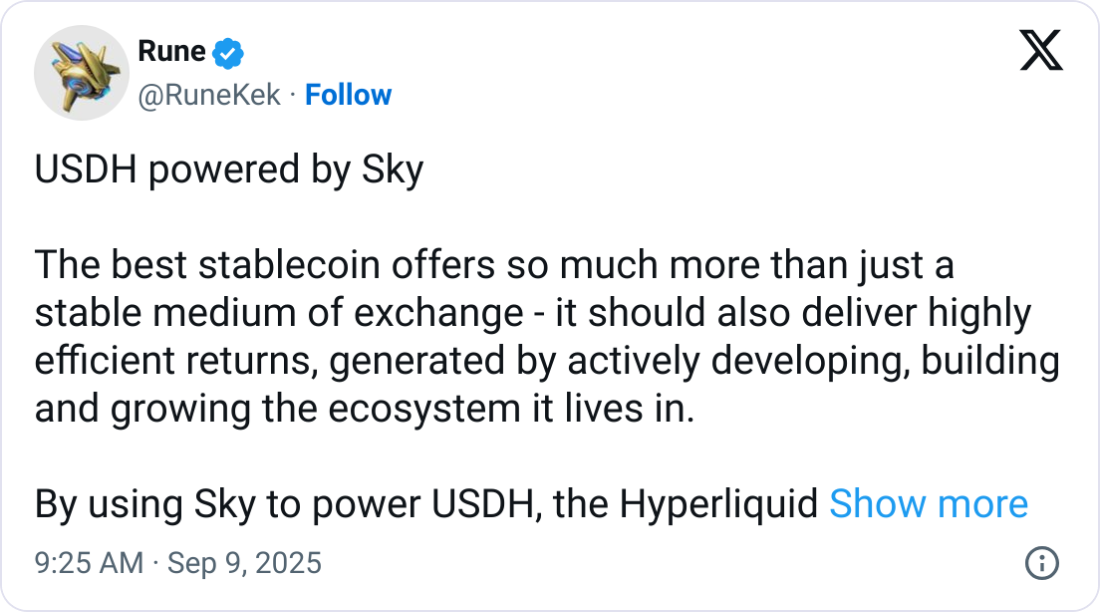
Источник: Руне Кристенсен

Сообщество Hyperliquid также сможет настраивать стейблкоин в соответствии с предложением Sky. Кристенсен привел в пример закон США о стейблкоинах GENIUS Act, который запрещает эмитентам стейблкоинов выплачивать доход.

Кристенсен сказал, что Sky также выделит 25 миллионов долларов на создание проекта по «автономному развитию DeFi на Hyperliquid», в рамках которого будут выпущены эксклюзивные токены, которые «потенциально могут принести миллиарды» протоколу.

Скай предложил пятую версию Hyperliquid

Предложение Sky — это пятая аналогичная заявка на стейблкоин от крупного криптопроекта после того, как в пятницу компания Hyperliquid опубликовала в своём Discord сообщение о том, что ей нужны предложения от «команд, заинтересованных в развёртывании собственного стейблкоина Hyperliquid с тикером USDH».

Это произошло после того, как Native Markets, новое предприятие, созданное сторонником Hyperliquid Максом Фиге, предложило платёжному процессору Bridge, работающему со стейблкоинами Stripe, выпустить USDH.

В число участников также входят протокол стейблкоинов Frax, эмитент стейблкоинов Paxos и компания Agora, занимающаяся криптоинфраструктурой, при поддержке криптофинтех-компании MoonPay.

Генеральный директор VanEck обращается к Hyperliquid

Тем временем Ян ван Эк, генеральный директор инвестиционного гиганта VanEck и отец соучредителя Agora Ника ван Эка, в понедельник написал в X, что призывает сообщество Hyperliquid поддержать предложение его сына о стейблкоинах.

«Мы были бы рады стать частью экосистемы вашего сообщества, — написал он. — Мы общались со многими ведущими разработчиками HyperEVM и продолжаем искать новые способы внести свой вклад в развитие Hyperliquid, будь то через это предложение Agora или что-то другое в будущем».

«Но нам не нравится, когда на нас нападают толпой, — сказал ван Эк. — Вы бы не захотели иметь нас в качестве партнёра, если бы нами можно было легко манипулировать».

Валидаторы Hyperliquid проголосуют за понравившееся им предложение после следующего обновления сети, о котором пока ничего не известно.

Letture associate

Just now, DeepSeek V4 updates with DSpark, improving inference speed by 80%

DeepSeek has updated its DeepSeek V4 model with the DSpark speculative decoding framework, achieving a significant 60-85% speedup in generation for Flash models and 57-78% for Pro models while maintaining the same overall throughput. This engineering-focused update, rather than a core architectural change, introduces DSpark to address latency and throughput bottlenecks in high-concurrency production environments. DSpark combines high-throughput parallel generation with adaptive load-aware verification. Its key innovations include a semi-autoregressive generation architecture to model dependencies within token blocks and a hardware-aware confidence-scheduled verification system. This system uses a confidence head to predict token acceptance probabilities, allowing it to dynamically optimize verification length per request and allocate compute only to tokens with the highest expected payoff. The asynchronous scheduler is designed for real-world deployment, ensuring zero-overhead scheduling and continuous CUDA graph replay while preserving the target model's output distribution. In tests across mathematical reasoning, code generation, and daily dialogue, DSpark outperformed state-of-the-art models like Eagle3 and DFlash, increasing average acceptance length by 26.7%-30.9% and 16.3%-18.4% respectively on Qwen3 target models. DeepSeek also open-sourced DeepSpec, a full-stack codebase for training and evaluating speculative decoding draft models, providing a standardized toolkit that includes data preparation tools, model implementations, training code, and evaluation scripts.

marsbit1 h fa

Just now, DeepSeek V4 updates with DSpark, improving inference speed by 80%

marsbit1 h fa

BIT Research: The 2028 Halving Is Not the End, the Real Shake-Up of the Bitcoin Mining Industry Is Just Beginning

The Bitcoin mining industry is undergoing its most complex structural adjustment since inception. Despite Bitcoin's price holding near $61,000 and the network hash rate approaching a record 1 ZH/s, miner profitability is deteriorating. The industry is operating close to its breakeven point, with the 2028 halving expected to accelerate consolidation. The challenges extend beyond the halving's subsidy reduction; the industry's revenue model has yet to successfully transition towards a fee-driven structure. Increasingly, mining companies are evolving from simple Bitcoin producers into infrastructure and energy operators, including providers of AI/HPC computing power. Competition is shifting from pure hash rate expansion to business model upgrades. Economic pressure is evident. The theoretical daily mining revenue at current prices is around $78 million, yet the actual figure is only about $33 million—a 136% gap. Transaction fees remain low at roughly $220k daily, far below historical implied levels. With a current estimated industry-wide breakeven price near $65,000, mining alone is struggling to generate ideal profits. The 2028 halving is projected to push the fundamental production cost floor to approximately $93,289. This will likely accelerate a shift towards consolidation among larger, well-capitalized miners with diversified revenue streams. Competitive advantage will belong to institutionalized players with access to low-cost energy, AI/HPC hosting operations, and stronger balance sheets. In essence, Bitcoin mining is transitioning from a "mining business" to an "infrastructure business." Future profitability and resilience will depend less on block rewards and more on diversified income sources like energy management and computational infrastructure services. For investors, the key question is not the halving itself, but which miners can successfully navigate this business model transformation.

marsbit2 h fa

BIT Research: The 2028 Halving Is Not the End, the Real Shake-Up of the Bitcoin Mining Industry Is Just Beginning

marsbit2 h fa

This is How God Karpathy Uses Claude?

Andrej Karpathy, a prominent figure in AI, has reportedly joined Anthropic, leading to a noticeable decrease in his open-source contributions and social media activity. A document claiming to be his personal "CLAUDE.md" file—a set of instructions for the Claude AI to follow within a specific codebase—has been circulating online. While its authenticity is unverified, the content aligns closely with Karpathy's publicly shared principles on effective AI-assisted programming. The document outlines key rules for AI coding assistants, emphasizing the importance of reading existing code thoroughly before writing new code to maintain consistency. It advises against over-engineering, advocating for simple, surgical modifications that match the project's existing style. Other guidelines include clarifying assumptions upfront, writing meaningful tests, thoughtful debugging, and carefully considering dependencies. The core message is that these principles help prevent common AI coding failures, such as introducing unnecessary abstractions, style drift, or making invisible architectural decisions. The community has noted that even experts like Karpathy require detailed instructions to guide AI effectively, akin to managing a junior developer. A related GitHub repository, "andrej-karpathy-skills," which encapsulates these ideas, is reported to significantly reduce Claude's code error rate. Ultimately, the advice stresses that the best CLAUDE.md is tailored to one's own tech stack and coding practices.

marsbit2 h fa

This is How God Karpathy Uses Claude?

marsbit2 h fa

Trading

Spot
活动图片