一个$USDH 引发的稳定币竞争

深潮Pubblicato 2025-09-07Pubblicato ultima volta 2025-09-08

Hyperliquid ,敲响老牌稳定币城门。

撰文:Yanz

2025年9月5日,Hyperliquid 宣布准备在下一次网络升级中以治理为主导推出其原生稳定币 USDH。

该协议将 USDH 描述为“Hyperliquid 优先且合规”的与美元挂钩的资产,希望取代USDC等外部稳定币,打造自给自足的DeFi生态。

与传统稳定币(如USDT、USDC)由中心化实体发行并独占利润不同,Hyperliquid 通过了一个创新的去中心化投票机制:

将 $USDH 稳定币的发行权开放给生态团队,而非自行推出,将社区驱动模式融入稳定币发行。
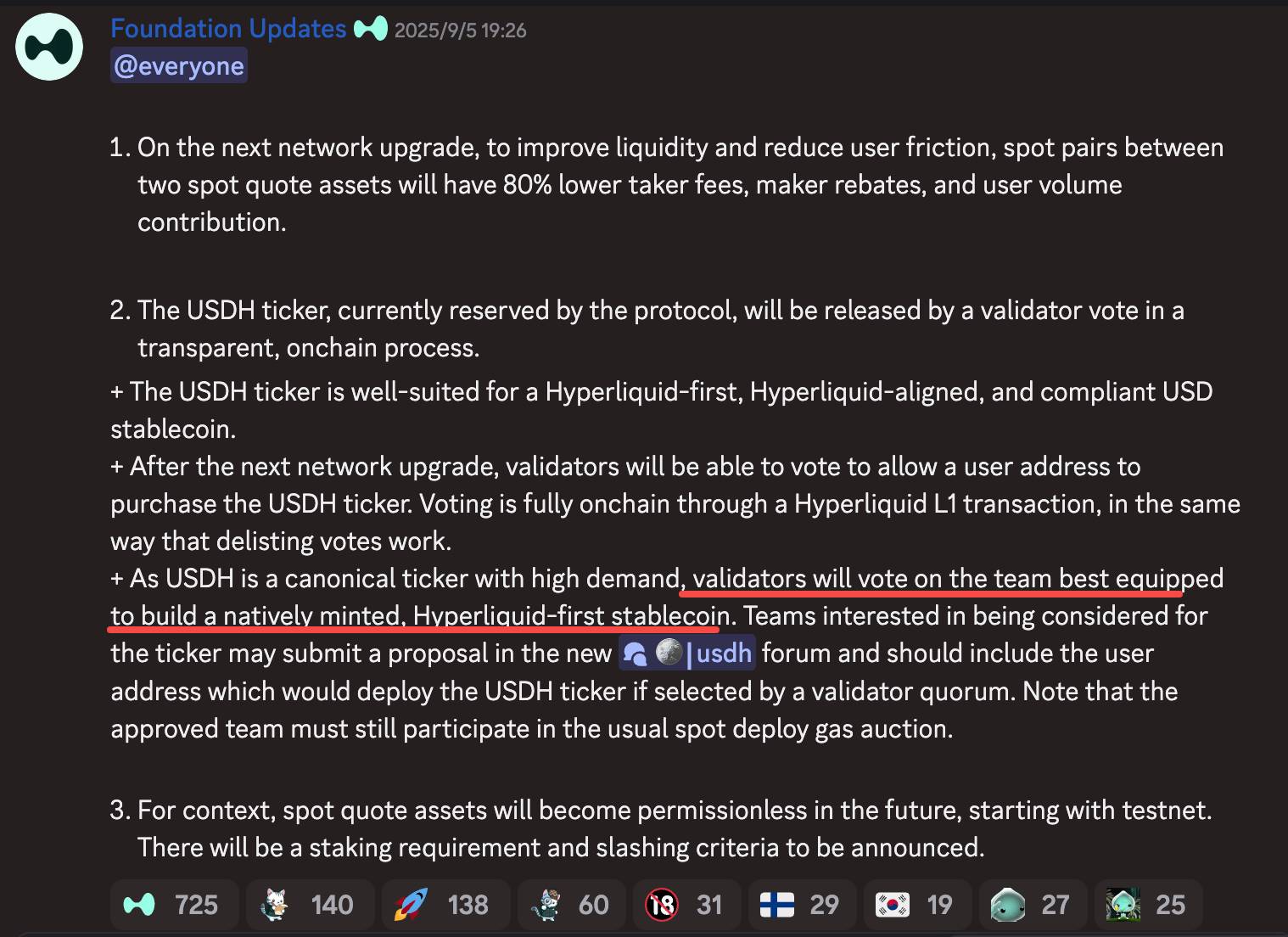
此举一出立即引发激烈竞争,Frax 和 Paxos 已提交提案,Ethena Labs也被看好可能入局。这场预计于 9月10日前结束的投票,不仅可能重塑 Hyperliquid 生态格局,也暗藏稳定币格局洗牌的危机。

发行竞标

$USDH 稳定币发行的激烈竞争,源于其在 Hyperliquid 生态中的战略价值和潜在的经济回报。

Hyperliquid 目前持有约57.2亿美元的稳定币,其中 95% 为USDC,这使其意识到依赖外部稳定币的脆弱性,尤其是USDC可能被冻结的风险。

自2025年9月5日起通过去中心化投票机制开放的 $USDH发行权,是Hyperliquid 打造自给自足 DeFi 生态的一次尝试。

基于4%至 5%的储备金收益率,成功替代 USDC 的预期年收益极其可观,可达1.5至2.2亿美元。这笔资金通过回购$HYPE 或分红返还社区,能够显著提升 $HYPE 价值和生态吸引力,吸引了如Paxos、Frax等大玩家竞相投标。

在$USDH 的发行竞争中,胜出团队将主导 Hyperliquid 5.7亿美元流动性池,带来长期收益和行业影响力。

当前竞争白热化,提案截止日期9月10日临近,各方承诺加码,提出了不同的发行计划和收益分配方案。
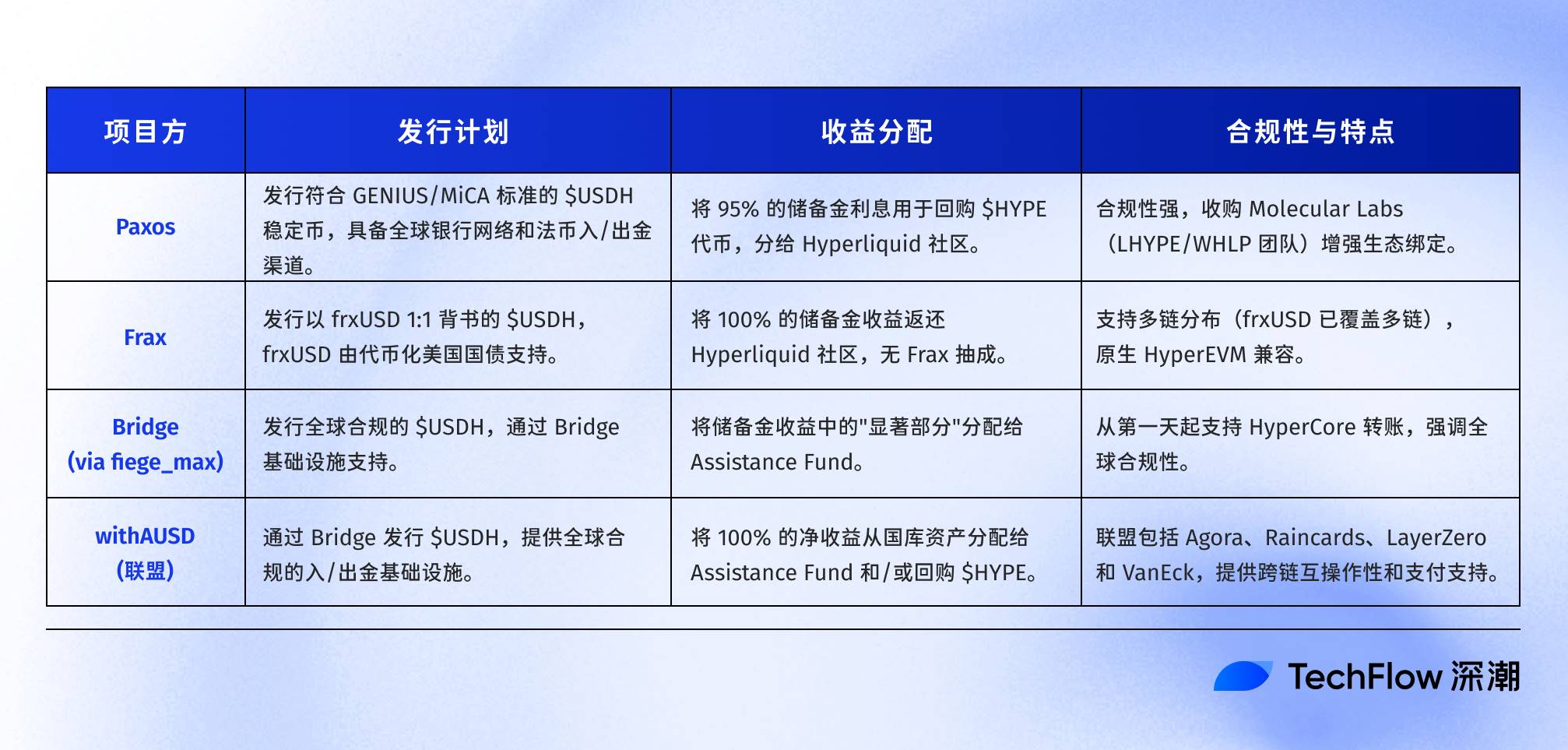
 

(表格内容详见:Hyperliquid 稳定币竞标战打响,谁会成为 USDH 的发行人?

此外,Ethena Labs、Circle和Paypal被社区寄予厚望,潜在提案可能成为黑马。

不过,方案各异,社区也有各种质疑。这场 Bidding wars 不仅关乎技术比拼,更是对 DeFi 未来格局的一场争夺。

稳定币大战

不只是 $USDH 的发行竞争,更广阔范围的变动也正在发生。

Dragonfly 合伙人 Omar Kanji 表示 ,此举可能会对 Circle 的 USDC 造成重大影响。USDC 目前是 Hyperliquid 衍生品交易的主要结算货币,目前 Hyperliquid 上的 USDC 存款额达 55 亿美元。

按照 4% 的收益率假设,这项迁移在给HYPE 代币持有者带来额外的 2.2 亿美元年化收入的同时,也给 Circle 带来收入减少同等数额的风险,USDC 的流通量或将减少 7%。

对 Circle 和 Tether 来说,$USDH 无疑会对其垄断地位带来影响,促使它们加速创新(如Circle的CCTP V2)以应对稳定币格局的变化。稳定币市场可能从双寡头(USDT、USDC)走向多极化。

可以看到的是,Circle 的 CEO 已经坐不住了,他在 9 月 8 日发声表示将会强势进军HYPE 生态系统,帖中把在HyperEVM 上部署原生 USDC 和 CCTP V2 作为破局之方。
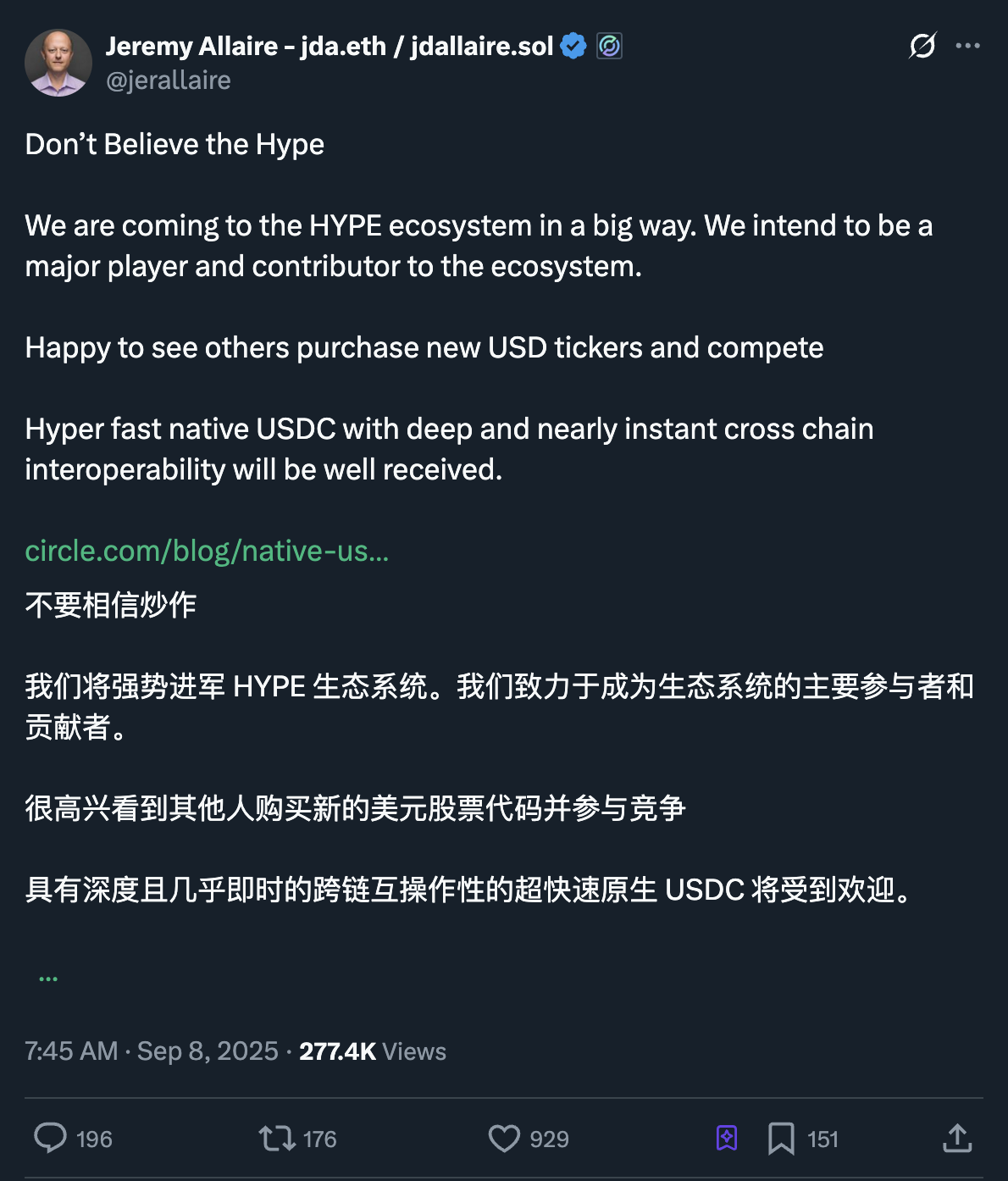
(原贴出处

但这并不能让人信服。毕竟这条博文发布于7 月 31 日,Circle 那时就宣称即将登陆的方案,至今仍然没有明确进展,不少用户表示质疑,一条高赞评论表示:“你应该做的更好,行动更快。”

从整体来看,最新数据显示,稳定币全球市场规模已突破2860 亿美元,$USDT(59%)和$USDC(25.2%)合计占据了将近85%的市场份额。

截至 9 月 8 日,Tether 的 USDT 以 1688 亿美元流通市值领跑,凭借其在中心化交易所(CEX)的广泛流通和低交易成本吸引了大量交易者和散户,Circle的 USDC 以725 亿美元市值紧随其后,吸引机构用户。

不仅直接冲击着当前稳定币赛道的双寡头格局,Hyperliquid 的尝试也正在为其他DEX提供范本,刺激Arbitrum、Optimism等平台探索类似路径,促使稳定币赛道向多极化转型。

这种对传统秩序的挑战与颠覆,让人不禁想起金融史上那个经典的比喻——“门口的野蛮人”。

在1989年《Barbarians at the Gate: The Fall of RJR Nabisco》一书中,“门口的野蛮人”象征着新兴力量对传统秩序的挑战。

如今,这一隐喻恰如其分地投射到稳定币行业,Hyperliquid作为“野蛮人”正以其创新的 $USDH 敲响老牌势力的城门。

$USDH 点燃了短期价格波动,七天内$HYPE 价格上涨12.27%。在建立新的标准,迫使老牌势力调整策略的同时,Hyperliquid 基金会及其CEO Jeff 目前掌握大部分投票权重也引发市场的公平性讨论,决策权高度集中使其面临中心化的争议。

变革浪潮汹涌,不论 $USDH 归于何方,社区受益将是不变的核心。

Letture associate

From Mining Pool to Mars: Why Is Wang Chun in the SpaceX Cockpit?

Title: From Mining Pool to Mars: Why Wang Chun is in the SpaceX Cockpit? When SpaceX announced that Wang Chun, co-founder of F2Pool, would command the first commercial crewed interplanetary mission, many were shocked. Why would a Bitcoin mining pool founder be on a Mars mission roster? However, understanding Wang Chun's journey over the past decade and the deepening ties between the crypto industry and SpaceX reveals this is not accidental, but an inevitable result of a new era taking shape. Today's Mars plan is no longer just a space engineering project; it is evolving into a civilization-upgrading experiment driven by global tech capital, AI, computing power, energy, and the crypto economy. Wang Chun stands precisely at the intersection of these forces. Part 1: From F2Pool to SpaceX – Wang Chun's Leap F2Pool, founded when Bitcoin was still niche, is one of the earliest large-scale mining pools and once held a significant share of global Bitcoin hash rate. Wang Chun belongs to the first generation of Chinese Bitcoin advocates and infrastructure builders—idealists and engineers who believed in a new value network independent of traditional finance. Miners like him built the hardware, energy, and computing power foundational to decentralized networks. This aligns with the long-term, high-engineering, future-oriented vision required for space civilization. Elon Musk’s space endeavors value such long-term builders over mere capital players, which explains Wang Chun's entry into the SpaceX ecosystem. Part 2: Why Crypto and SpaceX Are Growing Closer The core of global tech competition is shifting from internet applications to next-generation infrastructure. Both crypto and SpaceX are part of this. SpaceX's goal is to drastically reduce space access costs. If successful, it could enable orbital servers, space-based energy, global satellite internet, and Martian bases. These new frontiers will require new payment systems, value networks, and global financial architectures. Cryptocurrencies, inherently global and trustless, are poised to become key to off-planet economies. Moreover, crypto and SpaceX share a high-risk, long-termist ethos—believing in ambitious, world-changing goals despite early skepticism. Part 3: Human Spaceflight Enters the Commercial Era Space exploration, long dominated by state actors, is now being transformed by commercial entities like SpaceX. Wang Chun's involvement signifies that future deep-space participants may include not just career astronauts, but also entrepreneurs, engineers, and AI researchers. This mirrors the Age of Exploration, where commercial capital eventually drove global expansion. Wang Chun has emphasized that Mars colonization must not be delayed for future generations, countering a potential over-focus on nearer-term, commercial lunar projects. His presence symbolizes how new capital, technical communities, and idealists from the crypto world are now entering the interstellar age. In summary, the true significance is not an individual's journey to Mars, but the shift in the driving force of human civilization expansion from state machinery to tech companies, AI systems, and global technology capital. Wang Chun's path—from mining pool to Mars, from the Bitcoin network to starships—may be a preview of technological civilization's evolution in the coming decades.

marsbit4 h fa

From Mining Pool to Mars: Why Is Wang Chun in the SpaceX Cockpit?

marsbit4 h fa

Trading

Spot
Futures
活动图片