InfoFi 为何不香了?

marsbitPubblicato 2025-09-04Pubblicato ultima volta 2025-09-05

如果我们已迎来 InfoFi 时代的终结,或是正一步步逼近这个节点,我并不会感到意外。

自 InfoFi 兴起以来,许多人借此赚取了可观的收益,有人累计赚了 5 位数,有人甚至赚到了 6 位数。但如今,一些信号值得我们高度警惕。


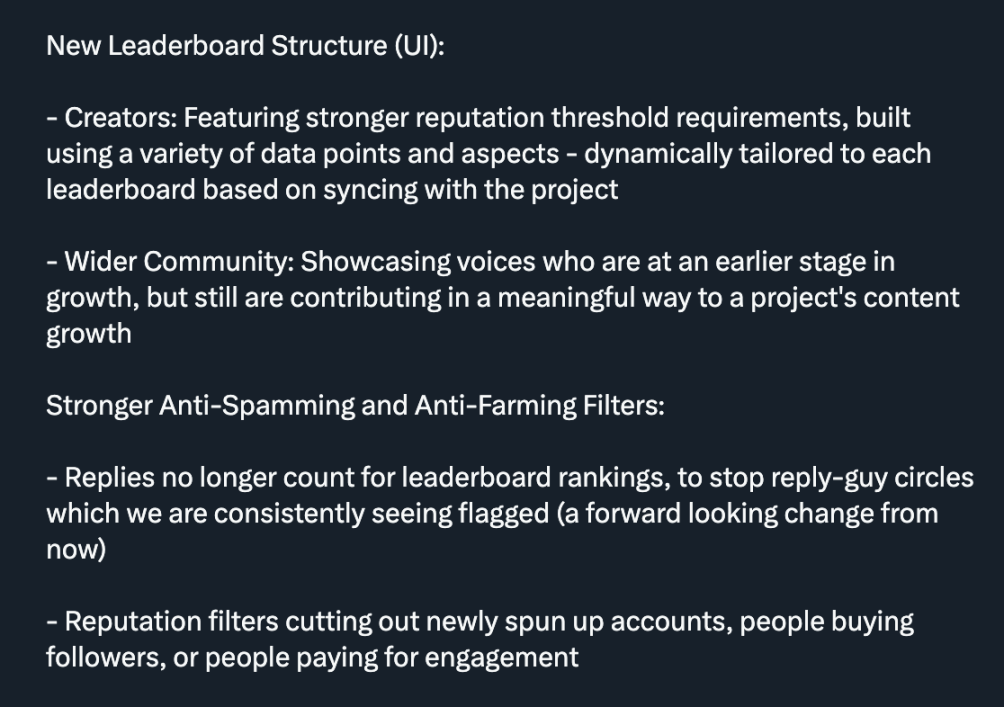
门槛规则变更

严格来说,我并不认为 Kaito 这次升级完全是件坏事,它或许能有效杜绝大量账号用 AI 生成劣质内容 「刷量」 的行为,同时提升内容质量。

但升级后,不仅小号受到冲击,许多大号也未能幸免。这导致大量依赖 Kaito 的用户选择离开,因为升级后,他们几乎没有机会再通过平台赚到钱。
 Capital Launchpad

对此,一些项目方选择取消门槛,以吸引小号入驻。这恰恰说明:在大多数情况下,小号群体是至关重要的。

我的看法是:Kaito 似乎对这次升级的方向感到困惑,而且很多项目方显然不喜欢这种 「门槛限制」。不过不可否认的是,在过去几个月里,Kaito 的表现一直相当出色。


代币分配方案拉胯

对于内容创作者(yappers)而言,如今常规的 0.5%-1% 代币分配比例已远远不够,因为这些代币上线时的估值往往很低。

早期,有些账号通过 1-2 个月的推广活动就能赚到 4-5 位数收益;而现在,即便是参与 3-6 个月的活动,也只能赚 3-4 位数,这让很多人感到心灰意冷。

甚至连头部账号,即便产出了优质内容,也很难赚到可观的 4 位数收益。

这对依赖 InfoFi 的创作者来说为何是坏消息?在 InfoFi 兴起之前,许多创作者作为品牌大使或 KOL 推广内容,就能获得不错的收入。而现在 Kaito 上的项目方给出的报酬,根本无法与外部合作相提并论 。鉴于这一事实,越来越多创作者选择离开 InfoFi 平台,也就不足为奇了。


「Capital Launchpad」 主导地位凸显

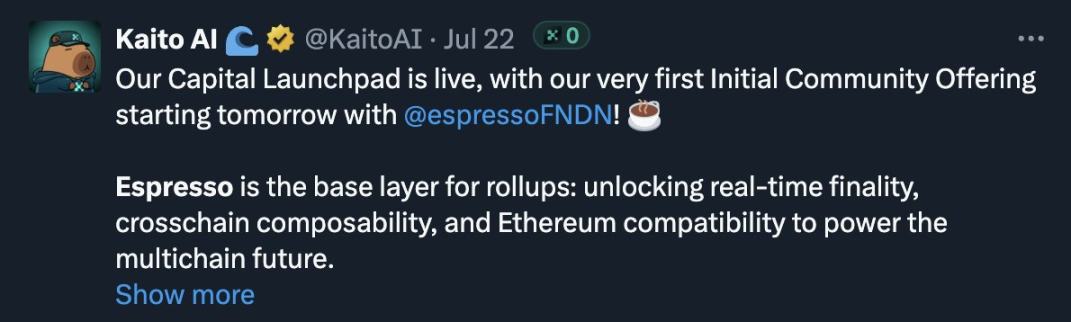
7 月 22 日,Kaito 的 「Capital Launchpad」正式上线,首个上线项目是 Espresso,随后有更多项目陆续入驻。
 Capital Launchpad

对 Kaito 而言,这无疑是个不错的产品,但我也有几点担忧:

  • 通过 Kaito 首次代币发行的项目,至今没有一个在公开市场上线;
  • 这些项目均未公布上线日期;
  • 大多数项目的估值过高,且代币解锁方案对投资者不友好。

我的补充观点:Kaito 最初是专为 InfoFi 打造的平台,后来才决定增加额外的平台功能(如 Launchpad),这本身是很棒的尝试。但最近,越来越多项目选择入驻 「Capital Launchpad」,而非参与 「创作者排行榜」。对于一个 InfoFi 平台来说,这种趋势显然不太乐观。

不过,这只是我观察到的明显现象,似乎没多少人对此提出质疑。


项目方更倾向于与 KOL 直接合作,而非通过 Kaito 平台

这一点很明显:项目方已不再那么热衷于参与 InfoFi 合作了。

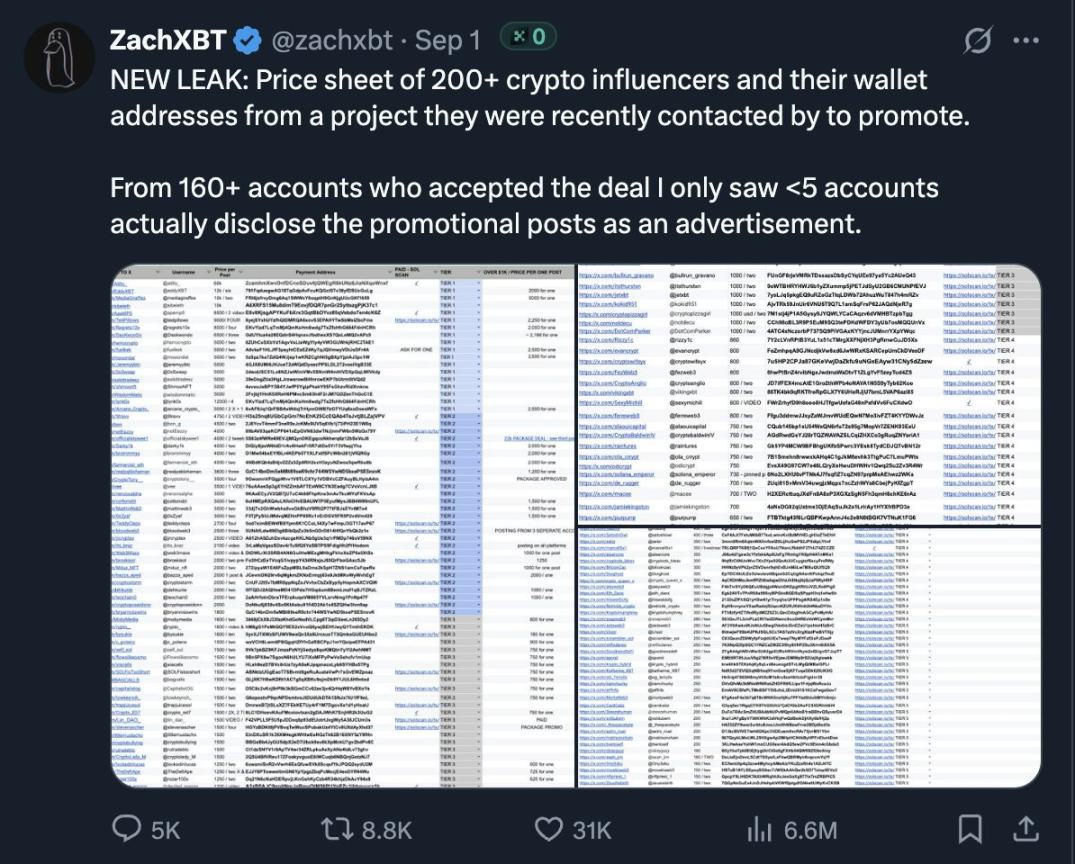
最近,Zachxbt 发布了一个谷歌表格,列出了一批从某项目方获得报酬的账号。我提及此事并非因为惊讶,而是因为这些报酬金额相当可观,尤其是与 Kaito 「创作者排行榜」 上的项目相比。
 Capital Launchpad

我相信,这已经让不少人意识到:除了 InfoFi,还有很多赚钱的方式。而人性的现实是 「想尽办法多赚钱」,因此我认为这对 Kaito 构成了直接竞争。
Letture associate

The AI Industrial Revolution: Where Are We Now?

This article explores the current stage of the AI industrial revolution, arguing we are still merely attaching new tools to old workflows rather than fundamentally redesigning production. The author compares this to the early Industrial Revolution, where factories simply replaced waterwheels with steam engines without changing their core structure. Similarly, today we embed AI chat windows into existing software but leave organizational processes unchanged. While massive investment floods into AI infrastructure (data centers, chips), akin to railway manias of the past, the real transformation lies in "dismantling the old workshop"—reorganizing companies around AI. Examples include Notion's use of hundreds of AI Agents and Y Combinator's experiments with self-improving AI systems that operate autonomously. The author notes a critical gap: while China has vast AI user growth, few companies have rebuilt core workflows. AI is beginning to impact entry-level jobs, and early adopters are gaining a compounding advantage. The conclusion is that the pivotal moment will not be the invention of better models, but when organizations decide to tear down old structures and rebuild around AI, shifting the bottleneck from human coordination to computing power. The future workplace and job titles are yet to be defined, but the imperative is to move away from legacy processes and position oneself where the new "railway" is being built.

marsbit16 min fa

The AI Industrial Revolution: Where Are We Now?

marsbit16 min fa

Morning Post | Hyperliquid Launches Off-chain Event Prediction Market Contract; Strategy Completes $1.5 Billion Debt Buyback; Kelp DAO Announces rsETH Fully Restored

Crypto Market Digest (May 27, 2026) Ondo Finance's founder Nathan Allman has passed away, with President Ian De Bode taking over as CEO. In regulatory news, Hong Kong authorities concluded a consultation on virtual asset service provider licensing, aiming to align rules with traditional finance. Kelp DAO announced its rsETH token has fully recovered five weeks after a $293 million hack by Lazarus Group, though the incident caused significant damage to DeFi lending protocols like Aave. Key industry developments include Hyperliquid launching off-chain event prediction market contracts, and the CME introducing futures for Avalanche and Sui. A report highlights the rise of AI Agent payments, with over $73 million settled on-chain in a year, predominantly using USDC. Meanwhile, blockchain detective ZachXBT exposed market manipulation involving several BSC tokens. In investment news, a firm referred to as "Strategy" completed a $1.5 billion debt buyback. Political contributions from the crypto sector for the 2026 U.S. elections have surpassed $500 million, heavily favoring Republican candidates. BitMEX founder Arthur Hayes revealed Zcash is his second-largest holding, citing the growing necessity for monetary privacy. The digest concludes with trending memecoins on Ethereum, Solana, and Base networks, and highlights in-depth articles covering the impending SpaceX IPO, Polymarket's regulatory challenges, and an analysis of the on-chain treasury landscape.

链捕手16 min fa

Morning Post | Hyperliquid Launches Off-chain Event Prediction Market Contract; Strategy Completes $1.5 Billion Debt Buyback; Kelp DAO Announces rsETH Fully Restored

链捕手16 min fa

Just Now, Chinese AI Enters Top 2 in Global Programming, Only Claude Remains Ahead

**China's AI Ranks Second Globally in Programming, Trailing Only Claude** Today, Alibaba's Qwen3.7-Max achieved a score of 1541 on the Code Arena benchmark, securing fourth place globally and surpassing top models like GPT-5.5 and Gemini 3.5 Flash. Among the top positions, it is now the only non-Claude model, placing second overall after Anthropic's Opus models. Before this official ranking, Qwen3.7-Max had already gained recognition overseas. In practical tests, it outperformed rivals on tasks like creating a self-training Tetris AI and generating complex 3D models, often at a significantly lower cost. Developers praised its ability, especially when integrated with tools like Hermes Agent and OpenCode, to effectively replace models such as GPT-5.5. In a hands-on challenge to create a 3D racing game from a detailed prompt, Qwen3.7-Max delivered a fully playable HTML file in the first attempt, requiring only minor bug fixes. It uniquely included a start menu and sound effects—details missed by other models. While competitors like Gemini 3.5 Flash and Claude Opus 4.6 produced less polished or functional versions, and GPT-5.5 had its own quirks, Qwen3.7-Max stood out for its initial completeness and playability. This performance stems from its design as an "Agent Base Model," built for long-duration, autonomous task execution. Internal tests show it can run continuously for 35 hours, making over 1158 tool calls without context degradation or instruction drift. Key technical advancements include "environment expansion" training, which improves adaptability across different frameworks, and "long-horizon autonomous execution" training, enabling sustained strategic decision-making. By entering the top tier of the programming arena, Qwen3.7-Max demonstrates that Chinese AI models are not just catching up but are becoming defining competitors, challenging the long-standing dominance of Silicon Valley in this field.

marsbit1 h fa

Just Now, Chinese AI Enters Top 2 in Global Programming, Only Claude Remains Ahead

marsbit1 h fa

From a Lunch Table to an Infinite Universe: Fei-Fei Li Bets on AI's Next Dimension

From a Lunch Table Conversation to an Infinite Universe: Fei-Fei Li Bets on AI's Next Frontier - Spatial Intelligence In an era dominated by large language models, AI pioneer Fei-Fei Li argues that true understanding requires spatial intelligence — the ability to perceive, reason, and interact within the physical 3D/4D world. She points to evolutionary history: spatial perception drove the Cambrian explosion 540 million years ago, while language is a far more recent, inherently "lossy" way to encode reality. Current models struggle with basic spatial tasks a child can do, like counting chairs in a video. Her company, World Labs, is pioneering this shift with "Marble," a model that generates navigable, consistent 3D worlds from text, images, or simple 3D inputs—distinct from video generators like Sora. Though smaller than models like GPT-5, due to scarce 3D data and early-stage scaling laws, Marble is already used in gaming, robot training (by NVIDIA), architectural design, and personalized therapy for conditions like OCD and acrophobia. Li envisions this technology enabling "infinite universes" for creativity, social interaction, and more. However, she cautions against utopian or dystopian extremes, advocating for a measured vision where AI enhances human dignity and prosperity, akin to how electricity transformed civilization. The journey is long — as evidenced by the 20-year path to viable autonomous vehicles — but the direction is clear: for AI to move from merely talking about the world to truly understanding and acting within it.

marsbit1 h fa

From a Lunch Table to an Infinite Universe: Fei-Fei Li Bets on AI's Next Dimension

marsbit1 h fa

Trading

Spot
Futures
活动图片