数据冲上历史新高!USDT 链上交易量暴涨,市场酝酿剧烈波动

marsbitPubblicato 2025-09-02Pubblicato ultima volta 2025-09-03

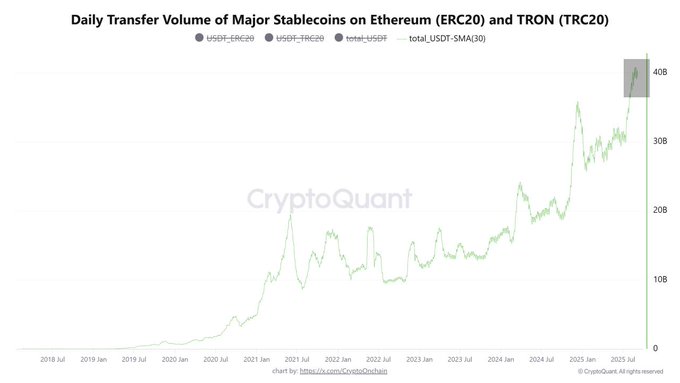
CryptoOnchain 今(3)日透过 CryptoQuant 发布最新分析报告,指出美元稳定币 USDT 的交易量近期出现显著增长,显示市场可能即将迎来剧烈波动。

USDT 交易量暴涨、投资者蠢蠢欲动

CryptoOnchain 的报告详细分析了 USDT 在以太坊与波场(TRON)上的链上活动,揭示了稳定币流动性的显著变化。报告首先指出,USDT 交易量的 30 天简单移动平均线(SMA-30)已达到历史新高,反映出市场参与者对流动性的强烈需求;其二,在 8 月 22 日,USDT 单日交易量激增至 778 亿美元,创下自 2022 年 5 月 12 日 LUNA 危机以来的最高纪录。然而,与当时由恐慌和资本外逃驱动的市场环境不同,当下市场相对稳定,这一交易量高峰更像是「聪明钱」在进行策略性累积,而非 FUD 驱动的抛售。

结合数据来看,CryptoOnchain 报告认为,USDT 的链上状况可能暗示着多种情景:大户投资者正在准备「逢低买入」,全球对 USDT 的需求(尤其在低成本的波场网络上)正在增长,暗示市场正在为即将到来的高波动期做准备:

这些信号表明,市场可能正处于剧烈波动的前夕。

交易量投资者关注美国宏观经济事件

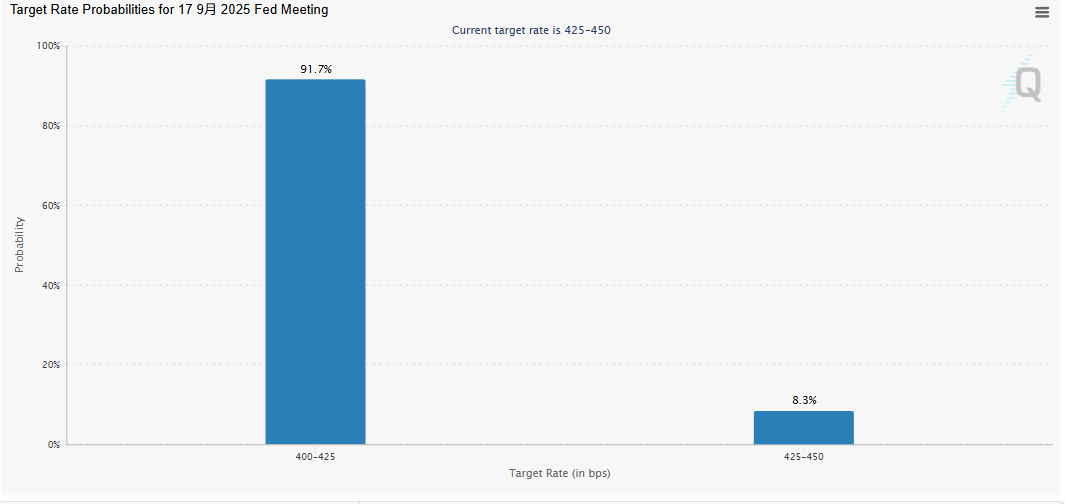
与 CryptoOnchain 报告相呼应的是,市场普遍认为,本月的加密货币市场将会受到美国联准会即将于 9 月公布的最新利率决议影响,届时,Fed 将决定是否在 9 月重启降息、以及降息幅度为多少。而据芝商所 Fed Watch 工具显示,目前市场认为本月联准会重启降息的机率为 91.7%,认为仍维持利率不变的机率仅为 8.3%。

交易量

而值得注意的是,在 FOMC 会议之前,美国劳工统计局(BLS)还将于本周五(9 月 5 日)发布 8 月份的非农就业报告。这份报告将揭示美国非农业部门的就业增长、失业率以及其他关键劳动市场指标。分析师认为,若非农就业报告显示劳动市场疲软,将进一步加剧联准会的降息预期;反之,若劳动市场仍然表现火热,联准会的降息路径,恐再出现阻碍与变数。

目前,市场正屏息以待即将发生的潜在波动。

Letture associate

Wang Xing Is Happy, Wang Xingxing Is Not Necessarily

Yu Shu Technology's (Unitree) IPO on the STAR Market sparked discussions centered on wealth creation: the surge in founder Wang Xingxing's net worth, the substantial gains for early investors like Meituan's Wang Xing, and employee stock wealth. Yet, a key observation from the listing ceremony was the founder's calm demeanor, contrasting with the celebratory atmosphere. The article explores this divergence. For investor Wang Xing, the IPO represents a successful bet on embodied AI and robotics as the next foundational tech wave, with Meituan's stake now highly valuable. For founder Wang Xingxing, the milestone brings a new set of pressures. His company, now valued at ~341.8 billion yuan, must transition from proving technological feasibility (which it has done with its quadruped and humanoid robots) to delivering scalable commercial success. The market's high valuation is an advance payment for a future that Yu Shu must now build. Post-IPO, Yu Shu faces the critical challenge of moving beyond impressive demos to creating sustainable businesses. This means making robots reliable, affordable, and indispensable for both consumers and industrial clients, proving their real-world economic value. As the "first stock" in embodied AI on the STAR Market, Yu Shu also becomes a public benchmark for the entire industry, its performance influencing sector-wide expectations. Ultimately, while investors can celebrate realized gains, Wang Xingxing's work is just beginning. He must now manage a public company, meet heightened market expectations, and navigate the complex journey from innovative engineering to large-scale commercial execution. The IPO is a starting line, not a finish line.

marsbit3 min fa

Wang Xing Is Happy, Wang Xingxing Is Not Necessarily

marsbit3 min fa

U.S. Market Trend (August 20): U.S. Treasury Intervention Halts Stock Decline; Moderna's Cancer Vaccine Breakthrough Sparks 180% Surge

U.S. Stocks Rebound on Treasury Intervention; Moderna Soars 180% on Cancer Vaccine Breakthrough Key Points: • U.S. stocks ended a three-day decline, with the rebound driven primarily by the U.S. Treasury Department's move to significantly increase its long-term bond repurchase ceiling. This action briefly pushed the 30-year Treasury yield down by about 10 basis points, easing long-term interest rate pressures. • Despite this, the market faced a countervailing force from the hawkish July FOMC meeting minutes, which revealed broader support for potential rate hikes among officials due to lingering inflation concerns. • Moderna shares skyrocketed nearly 180% after announcing positive Phase 3 trial results for its personalized mRNA cancer vaccine in partnership with Merck, which also rose nearly 13%. This fueled a major rally in the healthcare sector. • Contrary to the broader market, the Philadelphia Semiconductor Index fell over 2%, highlighting persistent pressure on the AI hardware chain. Concerns include AI's potential inflationary impact and questions about application-side cash flows supporting high capital expenditures. • Commodities and cryptocurrencies rallied alongside the equity rebound, supported by a weaker dollar and lower long-term yields. Geopolitical risks continued to underpin oil prices. Outlook: Market focus shifts to whether long-term bond yields stabilize post-intervention, upcoming U.S. economic data (jobless claims, Philly Fed index), and the impact of SK Hynix's massive share buyback plan on the memory chip sector. The tech sector's full recovery remains contingent on the semiconductor index's performance.

marsbit12 min fa

U.S. Market Trend (August 20): U.S. Treasury Intervention Halts Stock Decline; Moderna's Cancer Vaccine Breakthrough Sparks 180% Surge

marsbit12 min fa

The 19 Must-Know Top Chinese and American Entrepreneurs Born After 2000 • The 21st-Century Successors Have Arrived

The 21st century's first generation of entrepreneurs, born in the 2000s, are already taking center stage. This analysis of publicly prominent founders reveals distinct trends between China and the U.S., shaped by their respective ecosystems. In China, young founders are heavily focused on giving AI a physical presence, tackling challenges in robotics and hardware. Examples include Huang Yi (RoboParty, humanoid robots), Qin Shentao (Yuanchen Taichu, embodied AI data infrastructure), and founders working on robotic hands, home cleaning robots, and computing power networks. Their paths often emerge from university labs and robotics competitions, prioritizing prototype demonstration, cost control, and manufacturing delivery. In contrast, their U.S. counterparts frequently leverage software, AI, and capital networks to rapidly reorganize digital services and information flows. Startups like Mercor (AI talent/data, reaching $10B revenue), Etched (AI chips), and various AI-powered SaaS tools for consumers and SMBs demonstrate a focus on user growth, subscription models, and global scalability. However, this velocity has also led to high-profile cases questioning business practices and credibility. The key differentiator for this generation is not merely youth, but the compressed early stage of venture creation. Access to open-source tools, AI models, mature supply chains, and willing venture capital allows them to bypass traditional career ladders. Yet, while technology lowers the barrier to product creation, it does not reduce the challenges of building a sustainable company—managing teams, ensuring reliable delivery, and establishing trust remain hard-earned skills. The article concludes that the true test for these founders will be the "second growth": evolving from product creators into responsible company leaders capable of sustained execution and organizational building. For established businesses, the rise of these fast-moving, technologically adept teams necessitates new strategies for collaboration, competition, and investment.

marsbit16 min fa
The 19 Must-Know Top Chinese and American Entrepreneurs Born After 2000 • The 21st-Century Successors Have Arrived

marsbit16 min fa

A Trillion-Dollar Consumer Credit Market Lacks Key Players

The trillion-dollar global consumer credit market remains largely untapped by blockchain technology. While projects like Pharos have rapidly attracted millions in stablecoin deposits for short-term consumer loans in emerging markets, they represent early attempts to bring this massive asset class on-chain. The core challenge isn't technical tokenization, but the "repackaging" of countless small, heterogeneous loans into standardized, investable products that digital asset funds can understand and price. Current approaches primarily change the *distribution* of capital—using stablecoins for settlement and smart contracts for transparency—but do not eliminate underlying credit risk. Several models are emerging: Pharos and Huma Finance/Tala focus on connecting high-yield emerging market loans to global crypto capital. Figure stands out by building full-stack, regulated infrastructure, securing AAA ratings for its securitizations and proving blockchain assets can meet traditional institutional standards. Conversely, Goldfinch's difficulties highlight that on-chain transparency cannot replace offline credit underwriting and collection capabilities. The article identifies a four-layer value chain: 1) loan origination, 2) credit structuring & securitization, 3) on-chain infrastructure, and 4) capital. The current gap is in the second layer—the mature capital markets expertise for structuring, rating, credit enhancement, and institutional distribution. This is the critical link needed to transform scattered loans into large-scale, trustworthy on-chain credit assets, bridging traditional finance's rigor with blockchain's new capital pools.

marsbit52 min fa

A Trillion-Dollar Consumer Credit Market Lacks Key Players

marsbit52 min fa

Trading

Spot
活动图片