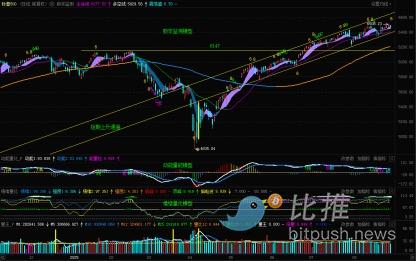
警惕!标普指数高位震荡,冲击将至!

比推Pubblicato 2025-09-02Pubblicato ultima volta 2025-09-02

附经典案例分析:美国航空,股票代码_AAL

一、一周行情回顾:(08.25~08.29)

周一开盘价6457.67点,周二产生最低价6429.21点,周四创出最高价6508.23点,最终收盘价6460.26点,周振幅79.02点,跌幅0.10%,周线收出一根十字星小阴线,收在5周均线之上,创出标普指数历史新高。

从4月7日到8月29日,指数已连续上涨了21周,共计101个交易日,累计最大涨幅达到34.61%左右。

标普500指数周线图:(动能量化模型*情绪量化模型)
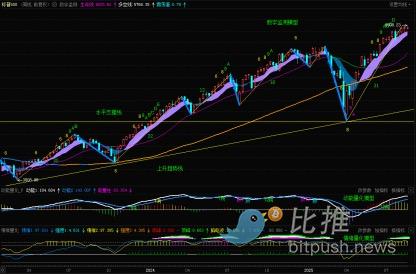
image.png

(图一)

标普500指数日线图:

image.png

(图二)

标普500指数周线图:(历史数据回测:2009年3月6日至2025年4月4日)
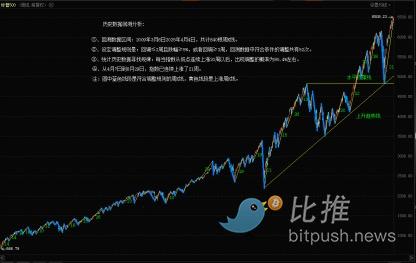
image.png

(图三)

笔者上周文章的题目是《历史数据亮起红灯:标普500连涨20周后的警示》,在文章中依据多周期技术指标共振以及十几年历史数据回测,对本周指数做出预测。

在指数走势方面:

目前指数继续在5月2日之后形成的上升通道内运行,上方压力位在通道上轨附近,上涨空间有限;指数向下调整第一支撑位在6300至6340点附近,重要支撑位在6200至6147点区域。

在操作策略方面:

①、总仓位控制在50%左右,另外一半持币观望。如果指数跌破生命线通道,必须将持股仓位降到30%以下。

②、对于激进的投资者,可以从持股仓位中拿出少部分筹码,依据笔者给出的支撑、压力位做“短差”。

现在回顾本周的实际走势:周一指数以6457.67点开盘,全天做窄幅震荡,收出一根跌幅0.43%的小阴线;周二至周四指数连续三天震荡上行,分别收出涨幅为0.41%、0.24%、0.32%的三根小阳线;周五指数低开低走,大部分时间在低位维持窄幅震荡,当日收出一根跌幅为0.64%的小阴线。本周指数走势与笔者上周预测的大致相符。

接下来,笔者将从多维度视角,分析当前指数发生的变化。

(一)、量化模型信号分析:

1、周线视角(见图一):

①、动能量化模型:维持高位钝化状态,动能1号线向上运行,速度变缓,能量(红)柱与上周相比继续缩短。

模型提示下跌风险指数:高

②、情绪量化模型:情绪1指标强度是4.63(取值范围0~10)左右,情绪2强度是4.39左右,顶峰信号指标是8.68。

模型提示下跌风险指数:高

③、数字监测模型:本周没有信号显示。

2、日线视角(见图二):

①、动能量化模型:在8月19日形成的动能顶背离信号,在本周三收盘后消失,模型再次进入高位钝化状态,周五盘后能量(绿)柱与周四比较小幅放大。

模型提示指数处于高位震荡状态,下跌风险指数:高

②、情绪量化模型:由于周五下跌收阴线,各指标数值降低。情绪1指标强度是3.30,情绪2指标强度是 0,顶峰信号指标是6.82。

模型提示下跌风险指数:偏高

③、数字监测模型:没有顶部信号显示。

(二)、趋势时序与历史数据回测分析(图三):

1、笔者制定的数据回测模型:

①、回测数据区间:2009年3月6日2025年4月4日,共计840根周K线。

②、设定调整规则:回调≤2周且跌幅≥5%,或者回调≥3周,回测数据中符合条件的调整共有52次。

2、统计历史数据寻找规律:每当指数从低点连续上涨21周后,出现调整的概率大于91%。

3、从4月7日到8月29日,指数已连续上涨了21周。

综上所述,笔者认为指数在周线及日线级别均处在高风险区,上有压力下有支撑,交投清淡,观望情绪浓厚。

二、下周行情预测:(09.02~09.05)

1、目前指数一直运行在5月2日之后形成的上升通道内(见图二),前期指数分别有4次调整到通道下轨附近获得支撑。笔者认为下周指数还会再次回踩通道下轨,关注这次的支撑作用,如果有效跌破下轨,指数调整时间将延长。

2、指数向上压力位在通道上轨附近;向下第一支撑位在通道下轨附近,第二支撑位在6300至6340点附近,重要支撑位在6200至6147点区域,如果有效跌破此区域,指数下跌幅度将加大。

2、提醒投资者关注市场消息面的变化,关注大市值权重股的异动。

三、下周操作策略:(09.02~09.05)

1、笔者强调:下周投资者首要任务是严格控制仓位,降低交易频率,以观望为主。

2、总仓位:多单持股仓位在50%左右,另外一半持币观望。如果指数跌破生命线通道,必须将仓位降到30%以下。

2、对于激进的投资者,可以从仓位中拿出少部分筹码,依据笔者给出的支撑、压力位做“短差”。

3、短线操作时,建议把分析周期切换到60分钟或者120分钟的小周期,以便获取更精准的买卖点。

4、个股交易也可以参照上述操作策略。

四、经典案例分析:(只作为案例分析,不作为投资推荐)

美国航空(股票代码_AAL):(多单)

美国航空(AAL)日线图:
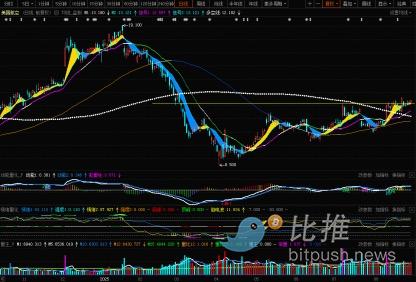
image.png

这是笔者上周分析的一只股票:

1、买入条件:买入价是13.10~13.20美元,止损位是12.45美元,第一目标位是15.5~16美元,波段操作。

2、本周美国航空开盘价是13.27美元,最高价是13.39美元,最低价是12.88美元,收盘价是13.37美元,周跌幅1.33%,周线收出一根带下影线的“假阳线”,技术形态完好,本周提供了充足的入场机会。

3、下周笔者继续跟踪这只股票。

以上各种模型是本人操作时遵守的交易规则,不构成任何买卖依据。个人观点,仅作参考。

作者:Cody Feng


Twitter:https://twitter.com/BitpushNewsCN

比推 TG 交流群:https://t.me/BitPushCommunity

比推 TG 订阅: https://t.me/bitpush
说明: 比推所有文章只代表作者观点,不构成投资建议

Letture associate

U.S. Market Trend (August 20): U.S. Treasury Intervention Halts Stock Decline; Moderna's Cancer Vaccine Breakthrough Sparks 180% Surge

U.S. Stocks Rebound on Treasury Intervention; Moderna Soars 180% on Cancer Vaccine Breakthrough Key Points: • U.S. stocks ended a three-day decline, with the rebound driven primarily by the U.S. Treasury Department's move to significantly increase its long-term bond repurchase ceiling. This action briefly pushed the 30-year Treasury yield down by about 10 basis points, easing long-term interest rate pressures. • Despite this, the market faced a countervailing force from the hawkish July FOMC meeting minutes, which revealed broader support for potential rate hikes among officials due to lingering inflation concerns. • Moderna shares skyrocketed nearly 180% after announcing positive Phase 3 trial results for its personalized mRNA cancer vaccine in partnership with Merck, which also rose nearly 13%. This fueled a major rally in the healthcare sector. • Contrary to the broader market, the Philadelphia Semiconductor Index fell over 2%, highlighting persistent pressure on the AI hardware chain. Concerns include AI's potential inflationary impact and questions about application-side cash flows supporting high capital expenditures. • Commodities and cryptocurrencies rallied alongside the equity rebound, supported by a weaker dollar and lower long-term yields. Geopolitical risks continued to underpin oil prices. Outlook: Market focus shifts to whether long-term bond yields stabilize post-intervention, upcoming U.S. economic data (jobless claims, Philly Fed index), and the impact of SK Hynix's massive share buyback plan on the memory chip sector. The tech sector's full recovery remains contingent on the semiconductor index's performance.

marsbit9 min fa

U.S. Market Trend (August 20): U.S. Treasury Intervention Halts Stock Decline; Moderna's Cancer Vaccine Breakthrough Sparks 180% Surge

marsbit9 min fa

The 19 Must-Know Top Chinese and American Entrepreneurs Born After 2000 • The 21st-Century Successors Have Arrived

The 21st century's first generation of entrepreneurs, born in the 2000s, are already taking center stage. This analysis of publicly prominent founders reveals distinct trends between China and the U.S., shaped by their respective ecosystems. In China, young founders are heavily focused on giving AI a physical presence, tackling challenges in robotics and hardware. Examples include Huang Yi (RoboParty, humanoid robots), Qin Shentao (Yuanchen Taichu, embodied AI data infrastructure), and founders working on robotic hands, home cleaning robots, and computing power networks. Their paths often emerge from university labs and robotics competitions, prioritizing prototype demonstration, cost control, and manufacturing delivery. In contrast, their U.S. counterparts frequently leverage software, AI, and capital networks to rapidly reorganize digital services and information flows. Startups like Mercor (AI talent/data, reaching $10B revenue), Etched (AI chips), and various AI-powered SaaS tools for consumers and SMBs demonstrate a focus on user growth, subscription models, and global scalability. However, this velocity has also led to high-profile cases questioning business practices and credibility. The key differentiator for this generation is not merely youth, but the compressed early stage of venture creation. Access to open-source tools, AI models, mature supply chains, and willing venture capital allows them to bypass traditional career ladders. Yet, while technology lowers the barrier to product creation, it does not reduce the challenges of building a sustainable company—managing teams, ensuring reliable delivery, and establishing trust remain hard-earned skills. The article concludes that the true test for these founders will be the "second growth": evolving from product creators into responsible company leaders capable of sustained execution and organizational building. For established businesses, the rise of these fast-moving, technologically adept teams necessitates new strategies for collaboration, competition, and investment.

marsbit14 min fa

The 19 Must-Know Top Chinese and American Entrepreneurs Born After 2000 • The 21st-Century Successors Have Arrived

marsbit14 min fa

A Trillion-Dollar Consumer Credit Market Lacks Key Players

The trillion-dollar global consumer credit market remains largely untapped by blockchain technology. While projects like Pharos have rapidly attracted millions in stablecoin deposits for short-term consumer loans in emerging markets, they represent early attempts to bring this massive asset class on-chain. The core challenge isn't technical tokenization, but the "repackaging" of countless small, heterogeneous loans into standardized, investable products that digital asset funds can understand and price. Current approaches primarily change the *distribution* of capital—using stablecoins for settlement and smart contracts for transparency—but do not eliminate underlying credit risk. Several models are emerging: Pharos and Huma Finance/Tala focus on connecting high-yield emerging market loans to global crypto capital. Figure stands out by building full-stack, regulated infrastructure, securing AAA ratings for its securitizations and proving blockchain assets can meet traditional institutional standards. Conversely, Goldfinch's difficulties highlight that on-chain transparency cannot replace offline credit underwriting and collection capabilities. The article identifies a four-layer value chain: 1) loan origination, 2) credit structuring & securitization, 3) on-chain infrastructure, and 4) capital. The current gap is in the second layer—the mature capital markets expertise for structuring, rating, credit enhancement, and institutional distribution. This is the critical link needed to transform scattered loans into large-scale, trustworthy on-chain credit assets, bridging traditional finance's rigor with blockchain's new capital pools.

marsbit49 min fa

A Trillion-Dollar Consumer Credit Market Lacks Key Players

marsbit49 min fa

Interpretation of SEC's New Crypto Regulatory Rules: Fundraising Below $5 Million Exempt from Registration, Is Altcoin Season Making a Comeback?

The U.S. Securities and Exchange Commission (SEC) has proposed a new regulatory framework titled "Regulation Crypto Assets." This proposal aims to establish tailored exemptions for crypto asset fundraising and a pathway for tokens to transition out of being classified as securities. The core provisions include two exemptions from standard securities registration: 1. **Startup Exemption**: Allows early-stage projects to raise up to $5 million over four years with simplified, narrative-based disclosures, avoiding full registration. 2. **Fundraising Exemption**: Permits raising up to $75 million within any 12-month period. It requires audited financial statements and imposes ongoing reporting obligations, similar to the Regulation A+ framework. A key component is the **Investment Contract Safe Harbor**. This rule allows a token initially sold as an investment contract (a security) to lose that designation once the issuer has completed or permanently ceased the "essential managerial efforts" promised to investors. This theoretically clears regulatory hurdles for tokens where development is finished or abandoned. The proposal defines a narrow scope, applying only to crypto assets that are not securities themselves and are part of an investment contract involving no other assets. This SEC initiative is seen as a response to the stalled progress of the comprehensive *CLARITY Act* in Congress. It represents a shift from relying solely on the historical Howey test, which the SEC admits is ill-suited for dynamic crypto assets. The proposal is currently in a 60-day public comment period, with a final rule likely months away, leaving the U.S. regulatory landscape for crypto in a transitional state.

Odaily星球日报1 h fa

Interpretation of SEC's New Crypto Regulatory Rules: Fundraising Below $5 Million Exempt from Registration, Is Altcoin Season Making a Comeback?

Odaily星球日报1 h fa

Trading

Spot
活动图片