Key Bitcoin price metrics say BTC bottomed, but traders still fear a drop to $10K

CointelegraphPubblicato 2022-06-29Pubblicato ultima volta 2022-06-29

Introduzione

On-chain and technical analysis indicators suggest BTC price may have bottomed, but several traders are still wary that BTC price could fall as low as $10,000 in the short-term.

The crypto market is currently going through a period of heightened volatility as global economic conditions continue to worsen amid a backdrop of rising inflation and interest rates.

As the headwinds impacting global financial markets beat down all traces of bullish sentiment, many crypto investors are predicting that Bitcoin (BTC) price could drop to as low as $10,000 before a market bottom is found.

BTC/USDT 1-day chart. Source: TradingView

While many traders scoffed at the idea of BTC falling below its 2017 all-time high, the recent dip to $17,600 suggests that this bear market could be different from the last one.

Here’s what several analysts are saying about the possibility of Bitcoin falling to $10,000 in the next few weeks.

Historic pullbacks point to a low at $10,350

Insight into how BTC may perform in the short-term can be gleaned by looking at its performance during the bear market cycles of 2013 and 2017. In 2013, the maximum drawdown for Bitcoin was 85%, which took place over a period of 407 days. The maximum drawdown in 2017 was 84% and this period lasted for 364 days.

Historical drawdowns for Bitcoin. Source: Arcane Research

According to a recent report by Arcane Research, the current drawdown has been going on for 229 days and has thus far seen a maximum drawdown of 73%.

Arcane Research said: “If Bitcoin follows the blueprint of these cycles, a bottom should occur sometime in late Q4 2022, at a price as low as $10,350.”

While there is always a chance that an 85% pullback is a possibility, Arcane Research also noted that “Bitcoin is now far more intertwined in the broad financial markets, with the Fed, US elections, crypto regulations, and stock market impacting its performance.”

Further evidence that supports the possibility of a drop to the $10,000 range was touched upon by cryptocurrency research firm Delphi Digital, who posted the following chart noting that “From a high timeframe market structure perspective, the next place we have to be looking at is $10K-$12K.”

Brave new coin index for Bitcoin (BLX) 1-month chart. Source: Delphi Digital

Based on the chart above, the high timeframe market structure support is likely to exist between $9,500 and $13,500.

Delphi Digital said: “Coincidentally, this area lines up with the implied low if BTC experiences an 85% drawdown from peak to trough.”

Would $10,000 be a good spot to go long?

Not every analyst expects a drop to $10,000. Take for example, Will Clemente of Blockware Solutions. According to Clemente, Bitcoin's current range reflects a good spot for accumulation.
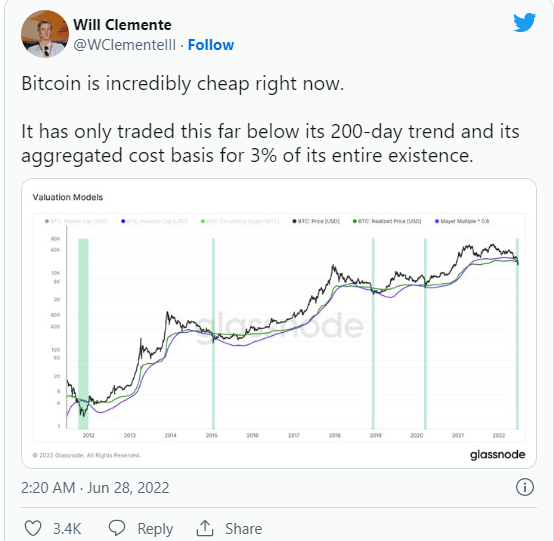
Additional data from Glassnode shows that Bitcoin’s 200-week moving average, balance price and delta price in its bear market floor model align with the 0.6 Mayer Multiple metric analyzed by Clemente.

Bitcoin bear market floor models. Source: Glassnode

Glassnode said: “Only 13 out of 4,360 trading days (0.2%) have ever seen similar circumstances, occurring in just two prior events, Jan 2015 and March 2020. These points are marked in green on the chart.”

Based on the Delta price metric which still remains untouched, the potential low for BTC is $15,750.

BTC/USD 1-month chart. Source: Twitter

John Bollinger, the creator of the popular Bollinger Bands trading indicator also suggested that Bitcoin price may have bottomed.

According to Bollinger: “Picture perfect double (M-type) top in BTCUSD on the monthly chart complete with confirmation by BandWidth and %b leads to a tag of the lower Bollinger Band. No sign of one yet, but this would be a logical place to put in a bottom.”


Letture associate

If the AI Bubble Is Already Bursting, Who Will Truly Remain?

**Summary: If the AI Bubble is Bursting, What Will Remain?** The debate around an AI bubble is intensifying, with figures like Ray Dalio warning of high valuations while Jensen Huang sees immense opportunity. This echoes the dot-com bubble, which saw massive wealth destruction but ultimately left behind critical infrastructure like undersea cables and broadband, enabling future giants like Amazon and Netflix. Similarly, today's AI boom involves trillions invested in data centers, power, cooling, and GPUs, while application-layer revenue remains comparatively modest. This investment-disparity signals a bubble. However, the core technological progress is real and accelerating. AI inference costs have plummeted by over 99.7% since 2023, making intelligence increasingly cheap and accessible. This cost collapse is unlocking vast new demand. Instead of reducing spending, enterprises are tripling their AI cloud expenditure. Cheap "tokens" enable AI to move beyond simple chatbots into complex workflows—automating code writing, legal document review, financial analysis, and scientific research. This follows "Jevons's paradox": improved efficiency leads to greater total consumption. The market is now undergoing a necessary purification, weeding out "API-wrapper" startups with no real moat. The deeper evolution involves a shift from capital expenditure (CapEx) on infrastructure to operational expenditure (OpEx) on value-creation in applications. While hardware vendors currently profit most, long-term value will migrate to AI-native firms solving vertical industry problems. Ultimately, a market correction will cleanse speculative excess but will not reverse the AI+ trend. The massive physical and algorithmic infrastructure being built will endure, becoming a cheap, utility-like foundation. Just as the internet became indispensable to all industries post-2000, AI is poised to empower and redefine every sector, moving society irreversibly toward an intelligence-augmented era. The bubble may burst, but the underlying productive momentum is solid.

链捕手7 min fa

If the AI Bubble Is Already Bursting, Who Will Truly Remain?

链捕手7 min fa

Microsoft CEO: In the AI Era, How Do You Define a Company's Moat?

Microsoft CEO Satya Nadella argues that in the AI era, a company's true competitive edge, or "moat," is not determined by choosing the single most powerful model, but by its ability to build a continuous "learning loop." This system integrates and evolves by connecting human workflows, domain expertise, organizational judgment, and employee experience. He posits that future companies will accumulate two types of capital: Human Capital (employee knowledge, judgment, creativity) and "Token Capital" (a firm's own built and owned AI capabilities). Importantly, AI amplifies rather than devalues human capital. Human direction is essential to guide progress, as computational power alone is aimless. The core opportunity lies in creating a closed-loop system where human and token capital reinforce each other in a compound, self-improving cycle. A company must be able to preserve its unique institutional knowledge—its "company veteran" expertise—even if it switches underlying general-purpose AI models. This requires private evaluation benchmarks, reinforcement learning environments based on internal data, and queryable knowledge bases. Nadella warns against a future where economic value is concentrated by a few dominant models that commoditize entire industries' knowledge. Instead, the priority should be building a broad "frontier ecosystem" where every company, industry, and nation can own its learning loop. This allows organizations to retain control of their intellectual property, amplify employee capabilities, and ensure the economic value created by AI is captured within their own businesses and communities. True corporate sovereignty in the AI age comes from turning organizational knowledge into a compounding system that creates enduring, defensible value.

marsbit42 min fa

Microsoft CEO: In the AI Era, How Do You Define a Company's Moat?

marsbit42 min fa

ETFs Are Just the Ticket: The True Institutionalization of Bitcoin Is Happening Where You Can't See It

Beyond the Bitcoin ETF spotlight, a deeper institutionalization is underway, leveraging Bitcoin as a foundational financial primitive. Institutions are using Bitcoin for purposes long reserved for assets like U.S. Treasuries and gold: as collateral for loans, insurance reserves, and the backbone of rated bonds. Examples include a Barbados-based insurer capitalizing with $40M in Bitcoin reserves and Ledn's $188M securitization of Bitcoin-backed loans, which received the first-ever investment-grade rating (BBB-) from S&P for a digital asset-backed security. This structure was stress-tested during a 27% price drop in early 2026, triggering automatic liquidations that functioned as designed but revealed the systemic risk of synchronized selling across leveraged positions. Infrastructure is evolving to support this, with platforms like Anchorage Digital's Atlas network enabling secure, institutional-grade settlement and collateral management. Strategies like basis trades and corporate treasuries (exemplified by companies like MicroStrategy issuing billions in equity and debt to fund Bitcoin acquisitions) further integrate Bitcoin into financial mechanics. While ETFs solved "how to own" Bitcoin, these developments answer "what to do with it," embedding the asset into the working machinery of finance—as collateral upon which loans, derivatives, and structured products are built. The real, enduring institutional shift is happening in these largely invisible plumbing and financing systems.

marsbit48 min fa

ETFs Are Just the Ticket: The True Institutionalization of Bitcoin Is Happening Where You Can't See It

marsbit48 min fa

ZEC Co-Founder Responds to Orchard Vulnerability: No Signs of Theft, Orchard Pool to Be Sealed

ZEC Co-Founder Addresses Orchard Vulnerability: No Signs of Theft, Plans to Sunset Orchard Pool A security vulnerability was recently discovered in Zcash's Orchard shielded pool, raising key concerns. The primary questions are whether the flaw was exploited, if user funds are safe, whether users can verify the total ZEC supply, and if other similar vulnerabilities exist. Analysis suggests the vulnerability was likely not exploited prior to its discovery. It was found proactively by a researcher using specialized tools, not due to an active breach. The development team and mining pools acted quickly to contain the issue. Typical financially-motivated attacks would likely have left visible on-chain evidence, which has not been observed. User funds in Orchard are considered safe and should be recoverable, assuming no prior exploitation. If the flaw was never used, all legitimate funds can be withdrawn. The article outlines risks associated with moving funds to transparent addresses or other pools, but concludes that leaving assets in place is a reasonable option. Currently, users cannot independently verify that the total ZEC supply hasn't been inflated due to this bug. However, the planned Ironwood network upgrade is designed to resolve this. It will permanently close the Orchard pool to new deposits and internal transfers, allowing only withdrawals. This mechanism will cap total withdrawals at the amount of legitimately deposited funds, enabling anyone to cryptographically verify the supply post-upgrade. Multiple teams, including Shielded Labs, have conducted extensive audits focused on counterfeiting vulnerabilities, assisted by advanced AI tools. No additional flaws of this type have been found so far, increasing confidence that no other similar undisclosed vulnerabilities exist. In summary, evidence indicates the Orchard bug was probably not used, user funds are secure, and no other counterfeiting flaws are currently known. The upcoming Ironwood upgrade will restore users' ability to independently verify the total ZEC supply, closing this chapter.

Foresight News53 min fa

ZEC Co-Founder Responds to Orchard Vulnerability: No Signs of Theft, Orchard Pool to Be Sealed

Foresight News53 min fa

Trading

Spot
Futures
活动图片