Биткоин-трейдеры указали на возможные манипуляции в книге ордеров

cryptonews.ruPubblicato 2025-11-19Pubblicato ultima volta 2025-08-20

За последние шесть недель ликвидность биткоина значительно уменьшилась по обоим направлениям. Крупнейшие кластеры ордеров находятся на отметках $112 000 и $120 000, обратил внимание трейдер под ником DaanCrypto.
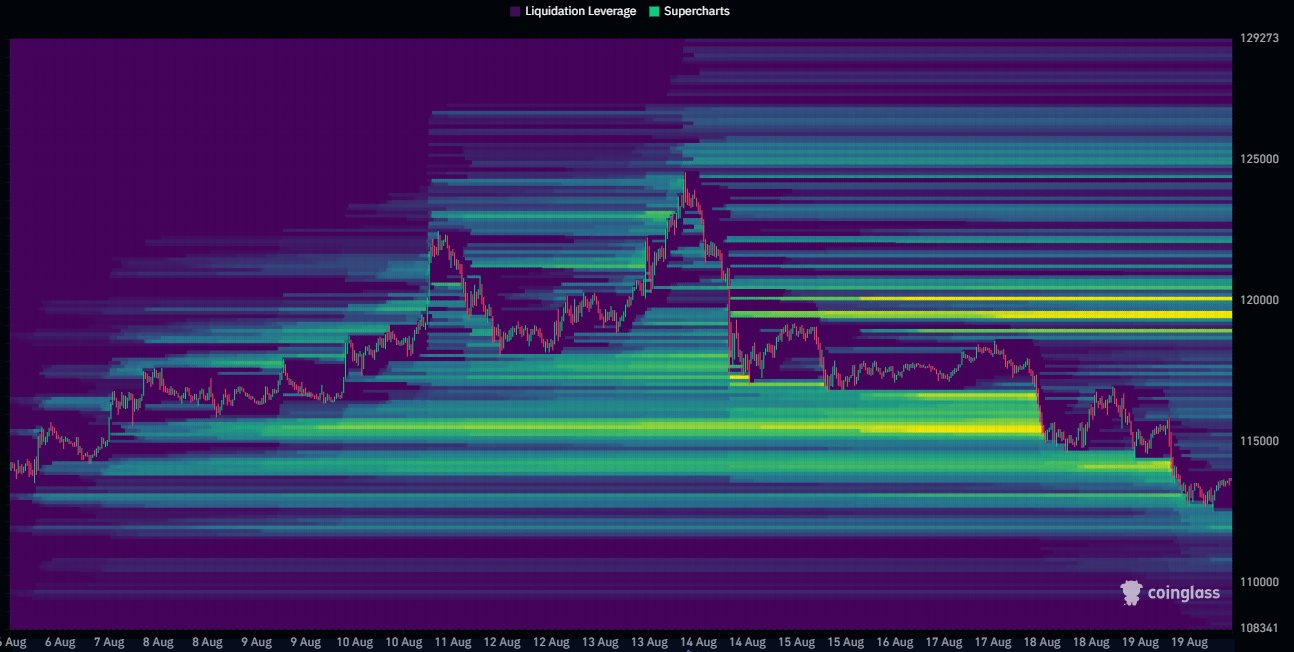
Тепловая карта зон ликвидаций биткоина. Источник: X.

«Следите за этими областями, поскольку они часто служат зонами локального разворота или магнитами, когда цена к ним приближается», — отметил инвестор.

Соучредитель Material Indicators Кит Алан предположил, что большие объемы ликвидности в книге ордеров, включая «защиту от падения» на уровне $105 000, могут оказаться формой манипулирования ценами.

2 Moves don’t make a trend, but FireCharts is showing some behavior in the $BTC order book that has similar characteristics of what we’ve previously seen from “Spoofy the Whale” and “Notorious B.I.D.”

Too soon to make any assumptions, but the influence on price direction will be… pic.twitter.com/sIsBwrgj9n

— Keith Alan (@KAProductions) August 20, 2025

«Два движения не формируют тренд […]. Пока рано делать какие-либо предположения, но влияние на направление цены будет таким же. Снижение цены спроса провоцирует снижение котировок. Следите за новостями», — добавил он.

По мнению аналитика под ником TheKingfisher, биткоин может «покраснеть» еще сильнее. Это гарантирует серьезные последствия для альткоинов.

The $BTC liquidation heatmap shows a notable cluster, likely marking a seller's footprint from TOF this week. A strong liquidation zone sits at $102,349. Altcoins currently show a balanced skew. We might see a minor retrace aimed at liquidating high-leverage shorts. Momentum… pic.twitter.com/pTz4SvmSDc

— TheKingfisher (@kingfisher_btc) August 20, 2025

Зона ликвидации со значительным объемом находится на уровне $102 349, указал эксперт. Он также ожидает небольшой коррекции, которая ликвидирует шортистов с высоким левериджем.

«Импульс остается стабильным. Тем не менее мы можем наблюдать постепенное каскадное истощение от блока к блоку. Хотя основные криптовалюты остаются стабильными, падение биткоина на 5% может спровоцировать падение альткоинов на 10–30%», — подчеркнул TheKingfisher.

Трейдер под псевдонимом RektCapital отметил положительный момент: аналогичный тип коррекций происходил в те же моменты цикла в 2017 и 2021 годах. По его наблюдениям, каждый откат предшествовал росту до новых исторических максимумов.

#BTC

One of the most positive things about this current pullback is that this same type of retrace took place at this same moment in the cycle in both 2017 and 2021

In both 2017 and 2021, each of those retraces preceded upside to new All Time Highs$BTC #Crypto #Bitcoin https://t.co/ONprKhpUvs

— Rekt Capital (@rektcapital) August 19, 2025

На момент написания первая криптовалюта торгуется около $113 500, согласно CoinGecko. Сейчас основное внимание инвесторов сосредоточено на публикации протоколов июльского заседания FOMC и выступлении главы ФРС Джерома Пауэлла в Джексон-Хоуле 20 и 22 августа соответственно.

«Ставки высоки: необходимо определить путь денежно-кредитной политики, пока рынки балансируют между снижением инфляции и ростом рисков на рынке труда», — написали аналитики QCP.

Согласно CME FedWatch Tool, трейдеры оценивают вероятность снижения ставки ФРС на 25 базисных пунктов 17 сентября в 85%.
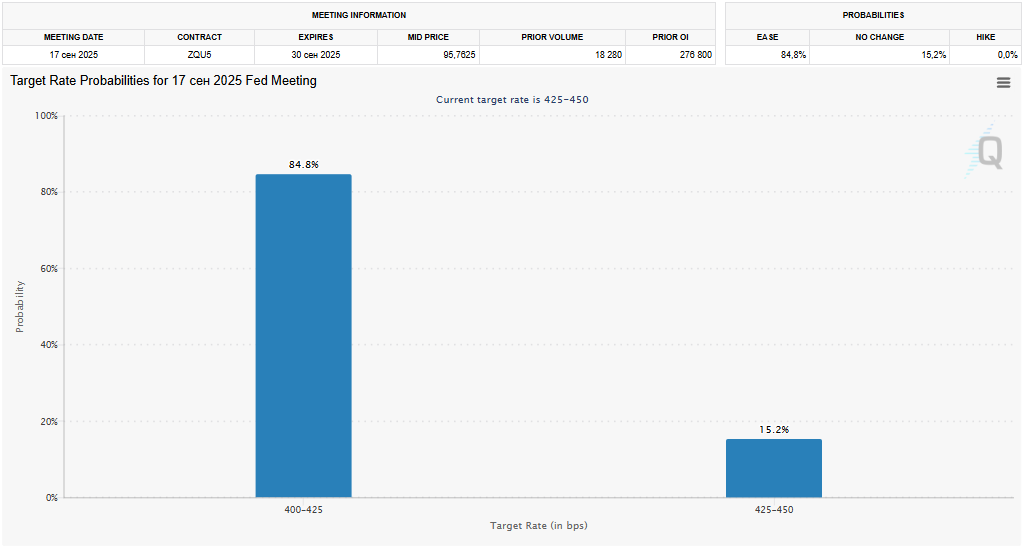
Источник: CME FedWatch Tool.

Напомним, аналитики K33 Research предупредили о надвигающейся волатильности на фоне роста соотношения ETH/BTC до годового максимума.

В Bitwise спрогнозировали рост биткоина до $200 000

Letture associate

The War Without a Unified Name: The Domestic Tech Giants' World Model Landscape

The article outlines the diverse and fragmented landscape of "World Models" in China's tech industry, where major players are pursuing similar goals under different names like world foundational models, physical AI, or integrated within autonomous driving and embodied intelligence systems. The core aim is to enable AI to create an internal, dynamic environment for simulation, reasoning, and learning, reducing reliance on infinite real-world data. This "data engine" allows for unlimited generation, experimentation, and iteration. The report categorizes the approaches of different companies: * **Internet Giants:** Alibaba is developing models for linguistic, virtual, and physical worlds (Qwen-AgentWorld, HappyOyster, Qwen-RobotWorld). Tencent's HY-World focuses on 3D, game, and social scenarios. ByteDance leverages its vast video data for a potential "digital twin" model. Huawei integrates its model into industrial applications like smart cars and robotics without separately branding it. Baidu embeds world model capabilities within its Apollo autonomous driving and Ernie systems. * **Automakers:** Companies like NIO, Li Auto, XPeng, and Geely are using world models as virtual "driving schools" and "testing grounds." They generate complex scenarios (e.g., rain, snow) to train and validate autonomous driving systems in simulation, aiming for more capable and safer AI drivers. * **Autonomous Driving Suppliers:** Firms such as Momenta, Horizon Robotics, Haomo.ai, and DeepRoute.ai are building the underlying "world engines." They focus on large-scale video generation for simulation, reinforcement learning, and enhancing end-to-end autonomous driving models, often integrating these capabilities into commercial products. While startups bring focus and innovation, they face challenges like limited data, compute resources, and deployment channels. Large companies possess these advantages and are rapidly transitioning world models from research projects into core business infrastructure powering products in vehicles, games, and industry. The conclusion is that world models represent an evolution and convergence of existing AI fields into crucial industrial infrastructure, moving the competition from simply building a model to effectively deploying it to understand and interact with the physical world.

marsbit6 min fa

The War Without a Unified Name: The Domestic Tech Giants' World Model Landscape

marsbit6 min fa

The Crypto Industry Enters the 'Show Me' Era: Vision Alone Is No Longer Enough

The crypto industry has entered a "Show Me" era, where grand visions and white papers are no longer sufficient to gain traction. This shift is driven by increased skepticism, high-profile bad actors, and notably, the serious entry of traditional finance (TradFi) institutions like BlackRock, Fidelity, and JPMorgan Chase, which are launching real, scaled products such as tokenized funds and blockchain-based settlement. This raises the bar for what constitutes a credible project. The communication dynamic has fundamentally changed. The focus is no longer on "what you are building" but on "what you have built and who is using it." Startups must now provide a "proof stack": verifiable data like mainnet transaction volume and active wallets, genuine partnerships with signed contracts, and evidence of organic product-market fit from real users, not just investors. Announcements must be backed by concrete, chain-verifiable evidence. For communication strategies, this means leading with proven facts and hard data—even if modest—rather than speculative narratives. A compelling story must be grounded in demonstrated results. While vision remains important, the balance has inverted from 80% vision/20% substance to the opposite. This higher threshold ultimately benefits builders with genuine traction, filtering out noise and allowing their real signals to stand out clearly. The "Show Me" era is a permanent maturation, demanding that communication strategies prove value, not just promise it.

链捕手38 min fa

The Crypto Industry Enters the 'Show Me' Era: Vision Alone Is No Longer Enough

链捕手38 min fa

Meta Follows the Trend into Prediction Markets: Can It Avoid Repeating the Failure of the Metaverse?

Meta, the tech giant behind Facebook, has reportedly formed a team to develop "Arena," a new application focused on prediction markets. Users would use platform points to place bets on outcomes in politics, sports, and global events. This move follows Meta's massive, nearly $900 billion, losses from its heavily-invested metaverse division, Reality Labs. The prediction market industry is already showing strong demand, with leading platforms like Kalshi and Polymarket facilitating hundreds of billions in annual volume. Meta, with its 3.56 billion daily active users across its apps, possesses the unprecedented scale to bring this niche activity to a mainstream audience, similar to its past success in cloning features like Stories and Reels. However, Arena faces significant hurdles. Meta plans to start with a points-based system to avoid strict financial regulations, but this may dilute the core incentive of accurate prediction that real-money markets provide. More critically, Meta enters the space with a major trust deficit stemming from its past regulatory battles, notably the failed Libra/Diem stablecoin project, and its controversial history with political content and misinformation. The prediction market sector itself is under increasing regulatory scrutiny, with recent CFTC actions including fines and the first-ever insider trading case. While Meta's vast user base offers a unique opportunity to expand the market, its success hinges on navigating complex regulations and rebuilding the credibility necessary for a platform dealing with sensitive topics like elections. The outcome could range from Meta dramatically growing the industry to Arena becoming a high-profile regulatory target before it can scale.

Foresight News55 min fa

Meta Follows the Trend into Prediction Markets: Can It Avoid Repeating the Failure of the Metaverse?

Foresight News55 min fa

Trading

Spot
Futures
活动图片