Ripple CTO Says Next Project Is ‘Production Ready’, What Is It?

bitcoinistPubblicato 2025-08-19Pubblicato ultima volta 2025-08-19

Introduzione

Ripple Chief Technology Officer (CTO) David Schwartz has provided an update on his next project for the XRP Ledger (XRPL)....

Trusted Editorial content, reviewed by leading industry experts and seasoned editors. Ad Disclosure

Ripple Chief Technology Officer (CTO) David Schwartz has provided an update on his next project for the XRP Ledger (XRPL). He stated that it is almost production-ready and explained what it entails. 

Ripple CTO Gives Update On Next Project

In an X post, the Ripple CTO said that the next project, which relates to an upgrade on the XRPL, is going well. He noted that there has been one spike in latency that only affected a few links that were already poor. Schwartz added that the tiny drop in network bandwidth appears to be a monitoring dropout and doesn’t show on the switch port’s monitoring. In line with this, he opined that they are nearly production ready. 

When asked on what exactly the project was about, the Ripple CTO explained that he is running a hub server that will soon help keep important XRPL nodes slightly more reliably connected to each other. He added that he hasn’t run any production infrastructure in a while, which makes this current project exciting. 
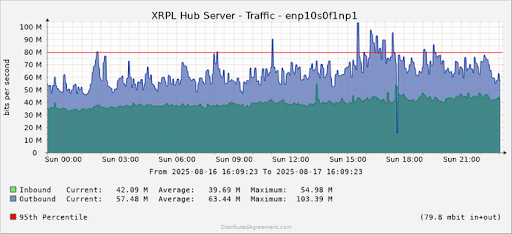
Ripple
Source: Ripple CTO on X

Earlier on, Schwartz had mentioned why he was looking to run this XRPL infrastructure. The Ripple CTO remarked that, looking at the network, the most useful thing would be a high-quality hub with reserved slots for UNL validators, other hubs, and servers serving applications on the XRPL. He noted that this is a personal project from him and not Ripple. 

More Details Into The Hub Server

Based on the plan he shared, the Ripple CTO deployed a server using an AMD 9950X CPU, 256GB of RAM, a 2TB boot SATA SSD, 2x2TB NVME SSDs (s/w RAID 0) for NuDB, and a 10GB (unmetered) link. The server will run Ubunutu LTE and be in a datacenter in NYC. Schwartz further said that it would be a single server run as a production service, aiming for maximum uptime and reliability. 

He warned that nobody should rely on it because an important XRPL server should never rely on a single hub. The Ripple CTO plans also to gather data from the server to understand network behavior and performance. However, he noted that there will be no disruptive testing unless there are unusual circumstances that make it necessary. 

Meanwhile, although the hub server is mainly for important XRPL nodes, the Ripple CTO had mentioned that the rest of the slots would be available to the public on a best-effort and space-available basis. He noted that only reserved slots would be restricted to important nodes. 

Besides the Ripple CTO’s project, XRPL validator Vet also revealed that there is a Concentrated Liquidity proposal for the Automated Market Maker (AMM), which is in the pipeline. He explained that this is a way to make the AMM more advanced and especially capital efficient. This will further enable liquidity providers to specify provision ranges.

Ripple
XRP trading at $3.01 on the 1D chart | Source: XRPUSDT on Tradingview.com
Featured image from Getty Images, chart from Tradingview.com
Editorial Process for bitcoinist is centered on delivering thoroughly researched, accurate, and unbiased content. We uphold strict sourcing standards, and each page undergoes diligent review by our team of top technology experts and seasoned editors. This process ensures the integrity, relevance, and value of our content for our readers.

Scott Matherson is a leading crypto writer at Bitcoinist, who possesses a sharp analytical mind and a deep understanding of the digital currency landscape. Scott has earned a reputation for delivering thought-provoking and well-researched articles that resonate with both newcomers and seasoned crypto enthusiasts. Outside of his writing, Scott is passionate about promoting crypto literacy and often works to educate the public on the potential of blockchain.

Letture associate

AAVE Rallies 30% in a Week, Is It Back on Track?

Over the past week, the price of AAVE surged from around $70 to nearly $100, a rebound exceeding 30%. This occurred despite Aave's TVL continuing to decline following the Kelp DAO security incident. The price movement was partly driven by market rumors, first reported by CoinDesk, that Kraken was negotiating to acquire a stake in Aave. While Aave founder Stani Kulechov denied the specific terms, he confirmed discussions with multiple parties about purchasing Aave Labs' AAVE tokens. He also revealed ongoing work on Tokenomics 3.0, featuring an automated buyback mechanism, and plans to expand into securities-backed lending. Analysts remain optimistic about Aave's long-term prospects. Standard Chartered gave an extremely bullish $3,500 price target for 2030, citing DeFi revival and RWA tokenization. Grayscale offered a more conservative one-year target of $175. However, competitors like Morpho are gaining traction, with recent reports highlighting its advantages in capital efficiency and customization. Morpho also secured a massive $175 million funding round. Fundamentally, Aave maintains its dominance as the leading DeFi lending protocol. Its TVL is nearly double that of second-place Morpho and rivals the combined total of the next several competitors. Key metrics like active borrowing, total supply, and revenue significantly outpace rivals. While Aave faces challenges from newer, more flexible protocols, its deep liquidity and established position make it a preferred choice for large, yield-seeking users. The article concludes that despite setbacks, Aave's long-tested protocol merits ongoing attention in a market with increasingly scarce quality projects.

Foresight News28 min fa

AAVE Rallies 30% in a Week, Is It Back on Track?

Foresight News28 min fa

Real-life 'Black Mirror' Pumpfun Go: 40 Yuan to Lick Toilets, 14,000 USD for a Logo Tattoo on the Forehead

The article discusses the controversial new platform "Pumpfun Go," a bounty task platform launched by the meme coin platform Pump.fun. Its slogan is "Pay anyone to do anything." The platform allows users to anonymously post tasks with cryptocurrency rewards, which are held in escrow until completion and verification. The piece highlights extreme and disturbing tasks that have gained notoriety, such as licking a gas station toilet floor for roughly $5.63, eating live insects, getting a company logo tattooed on one's forehead for $14,000, and even a now-removed $700,000 bounty for suicide. These tasks are often linked to promoting specific meme coins by generating shocking, attention-grabbing content. While some tasks involve community-building or charity, critics, including New York Governor Kathy Hochul, condemn the platform for exploiting economic desperation and encouraging humiliating or dangerous behavior. They argue it mirrors dystopian narratives from shows like "Black Mirror" and movies like "Nerve," where online dares escalate for viewers' entertainment. Supporters and some participants counter that the platform provides much-needed income opportunities for the financially struggling. One user claimed the bounty money far exceeded his monthly salary. The article concludes by questioning the morality of a system where the wealthy pay for spectacle and the poor trade dignity for survival, reflecting a long history of public consumption of others' suffering. It suggests hope may lie in future technological abundance freeing people from such desperate choices.

marsbit52 min fa

Real-life 'Black Mirror' Pumpfun Go: 40 Yuan to Lick Toilets, 14,000 USD for a Logo Tattoo on the Forehead

marsbit52 min fa

Faked Trades, Clone Websites, 1105 Videos: Polymarket Under CFTC Scrutiny

The U.S. Commodity Futures Trading Commission (CFTC) has launched a wide-ranging investigation into prediction market platform Polymarket. The probe, triggered by a Wall Street Journal report, focuses on allegations of systematic marketing fraud. The report revealed Polymarket allegedly hired dozens of student content creators to post over 1,100 videos showing fake, profitable trades on cloned websites, without disclosing the paid relationships. These videos, with over 140 million views, were pivotal to user growth. Simultaneously, the National Association of Consumer Advocates (NACA) filed a lawsuit in Washington D.C., accusing Polymarket and its executives of deceptive advertising targeting college students. The suit details off-campus promotions and payments made through the CMO's personal PayPal account to influencers who failed to disclose sponsorships. The investigation places CFTC Chairman Michael Selig in a difficult position, as he has been a vocal advocate for prediction markets and is currently suing multiple states to assert federal jurisdiction over them. This case tests the CFTC's dual role as both promoter and enforcer. This marks Polymarket's second major clash with the CFTC. After a 2022 settlement and U.S. ban, it regained approval to operate in September 2025, secured a $20 billion investment, and saw its valuation soar. The current crisis, compounded by a recent $3.1 million front-end supply chain attack, represents the platform's most severe multi-front challenge since its founding.

Foresight News54 min fa

Faked Trades, Clone Websites, 1105 Videos: Polymarket Under CFTC Scrutiny

Foresight News54 min fa

Trading

Spot
活动图片