Новые правила Google Play не повлияют на некастодиальные криптокошельки

cryptonews.ruPubblicato 2025-09-13Pubblicato ultima volta 2025-09-13

Согласно обновленной политике Google Play, поставщики криптокошельков в более чем 15 юрисдикциях, включая США и Европейский союз, должны будут получить лицензию и соблюдать «отраслевые стандарты». Эти изменения не затронут некастодиальные кошельки.

В уведомлении о политике Google Play указано, что изменения вступают в силу 29 октября. Разработчикам в США потребуется зарегистрироваться в местных регулирующих органах как компании, предоставляющие денежные услуги, или как компании, осуществляющие денежные переводы. Разработчики в ЕС должны будут зарегистрироваться в качестве поставщиков услуг криптоактивов (CASP).

В США компании, зарегистрированные в FinCEN как поставщики денежных услуг, должны соответствовать определенным требованиям, включая разработку письменной программы по противодействию отмыванию денег. Это может привести к более широкому внедрению процедур «Знай своего клиента» и других мер.

Google ответила на вопросы о влиянии новой политики через X после негативной реакции криптосообщества: «Некастодиальные кошельки не подпадают под действие Политики Google Play в отношении криптовалютных бирж и программных кошельков. Мы обновляем Справочный центр для уточнения этой информации».
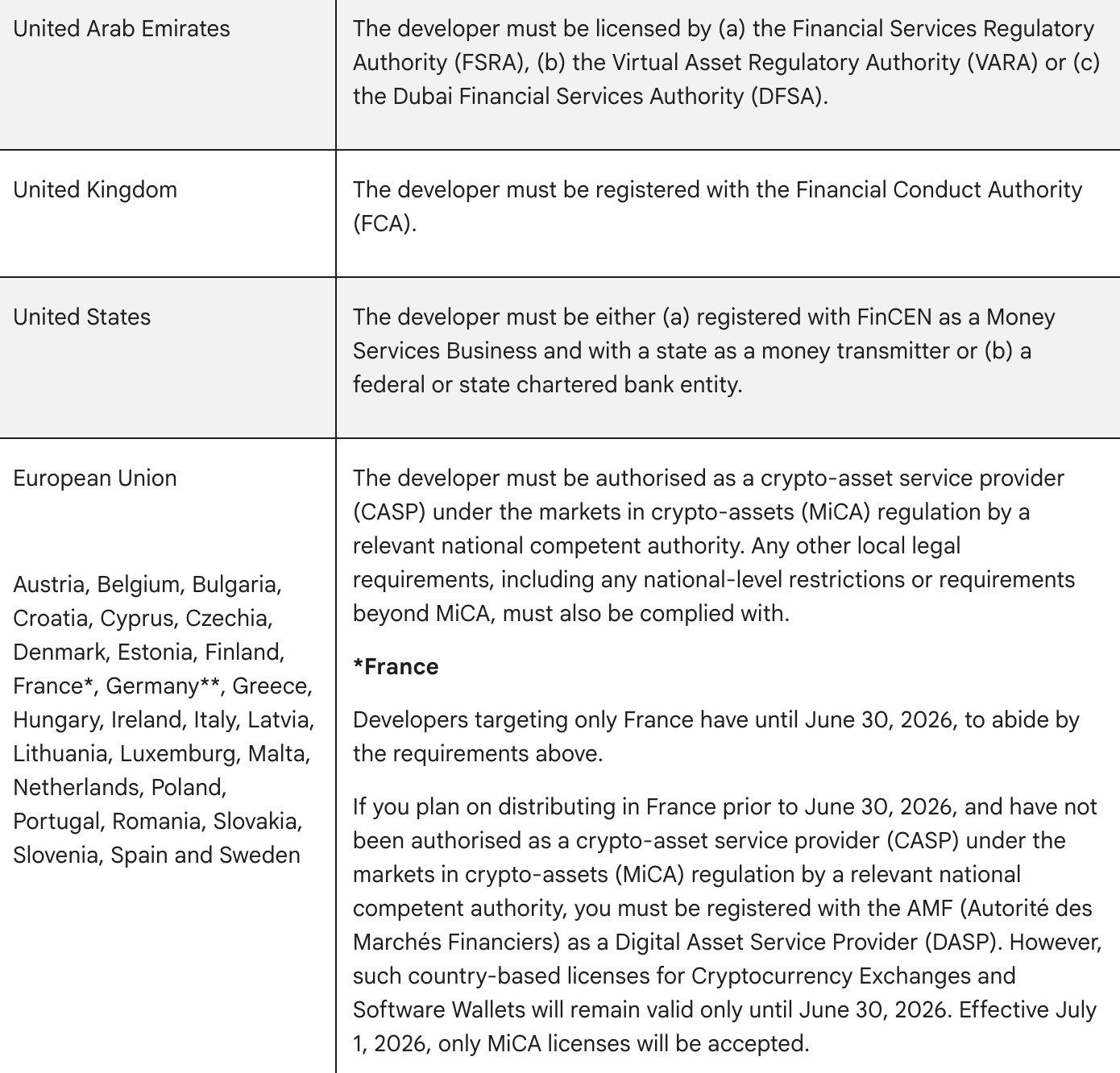

Google Play потребует от разработчиков приложений для криптокошельков в 15 регионах получения лицензий. Источник: Google

У Google Play неоднозначная история с криптоприложениями

Google Play имеет сложную историю взаимодействия с криптоиндустрией. В 2018 году компания запретила приложения для майнинга криптовалют, а в 2020 году удалила видеоигру Bitcoin Blast. В том же году без объяснения причин были удалены приложения криптовалютных новостей, включая Cointelegraph и Coindesk.

В 2021 году компания запретила восемь «обманных» криптоприложений, которые, как предполагалось, заставляли пользователей платить за нелегальный облачный сервис.

В 2023 году Google разрешила игры с невзаимозаменяемыми токенами, обязав разработчиков раскрывать эту функцию и запретив элементы азартных игр. Также были запрещены «лутбоксы», предлагавшие игрокам случайные виртуальные предметы.

Согласно информации о блокчейне на странице Google Play Store, в настоящее время выделяются четыре типа приложений: криптовалютные биржи и программные кошельки, криптокошельки, приложения для распространения токенизированных цифровых активов и NFT-геймификация.

Letture associate

Pax Silica vs. WAICO: The US Wants to Prohibit Europe from Using Chinese Artificial Intelligence

The United States is preparing to demand that European and other partners abandon Chinese artificial intelligence initiatives, threatening exclusion from the American-led "Pax Silica" coalition, according to a leaked U.S. State Department document. This ultimatum forces signatories of the "AI Opportunity Statement" to choose between the Western technological ecosystem and alternative frameworks, with China not explicitly named but clearly targeted. Pax Silica is a U.S. strategy for AI and semiconductor hegemony, launched in late 2025. Its European presence expanded significantly in mid-2026. Concurrently, China, Russia, and 27 other nations established the World AI Cooperation Organization (WAICO) in July 2026 as an independent intergovernmental platform promoting AI governance based on UN principles. This situation creates a difficult choice, especially for European nations balancing strategic autonomy with dependence on U.S. tech and security. It also pressures Global South countries with pragmatic ties to both Washington and Beijing. The formation of competing blocks risks fragmenting the global tech landscape, forcing companies to split supply chains, increasing costs, and potentially leading to incompatible standards and protocols. The era of open globalization in AI may be ending, replaced by geopolitical confrontation where technological sovereignty trumps economic efficiency. The decisions made will shape the global digital economy for decades.

cryptonews.ru1 h fa

Pax Silica vs. WAICO: The US Wants to Prohibit Europe from Using Chinese Artificial Intelligence

cryptonews.ru1 h fa

Robert Kiyosaki Shares His Mentor's Predictions About the Emergence of Bitcoin and AI

American entrepreneur and author of "Rich Dad Poor Dad," Robert Kiyosaki, discussed the influence of futurist R. Buckminster Fuller on his worldview, linking Fuller's past technological predictions to the emergence of Bitcoin and the development of artificial intelligence. In an X post, Kiyosaki also reflected on personal purpose, sharing his journey from the music business—where he worked with bands like The Police and Iron Maiden—to creating the "Cashflow" board game and writing his famous book. He described feeling an inner emptiness despite his success, a turning point that came after meeting Fuller, whom he studied with for three summers. Kiyosaki described Fuller as a "friendly genius" who foresaw world-changing developments like Bitcoin and AI. However, the core of his post focused on Fuller's philosophical impact, particularly a quote about belonging to the universe and finding purpose by dedicating one's life to the maximum benefit of others. The entrepreneur remains a vocal advocate for cryptocurrencies. He regularly advises buying Bitcoin during market panics, viewing it and assets like Ethereum, gold, and silver as hedges against traditional financial system failures. Kiyosaki has predicted a major market crash by 2026, seeing it as an opportunity for prepared investors, with long-term price targets including $750,000 for Bitcoin and $95,000 for Ethereum.

cryptonews.ru3 h fa

Robert Kiyosaki Shares His Mentor's Predictions About the Emergence of Bitcoin and AI

cryptonews.ru3 h fa

Etherealize CEO Calls Wall Street's Private Blockchains a 'Race to the Bottom'

Etherealize co-founder and CEO Vivek Raman criticized Wall Street's growing interest in private, permissioned blockchains, calling them a "race to the bottom." In an interview with CoinDesk, Raman argued that consortium networks fragment liquidity and return the industry to the siloed systems that blockchain technology was meant to overcome. He stated that closed networks do not interoperate, undermining two key advantages of the technology: system compatibility and liquidity concentration. Etherealize promotes Ethereum as an open, foundational layer for institutional players. Raman insists that privacy and access restrictions should be built on top of public infrastructure—at the application or L2 level—rather than creating separate, closed networks. He compared Ethereum to HTTP as a base layer, with additional permissioned and private layers akin to HTTPS. Examples of this new wave of "closed" solutions mentioned include Canton Network from Digital Asset, Circle's Arc project, and Stripe's Tempo. Raman termed this trend "consortium chains 2.0," recalling earlier initiatives like the R3 interbank consortium and the Hyperledger corporate ecosystem from 2016 that failed to gain significant traction. He reiterated his firm belief that a global, open, permissionless infrastructure is necessary as a foundational base layer. Raman previously noted in June that traditional financial institutions had begun implementing Ethereum-based solutions into real business processes.

cryptonews.ru3 h fa

Etherealize CEO Calls Wall Street's Private Blockchains a 'Race to the Bottom'

cryptonews.ru3 h fa

Trading

Spot
活动图片