Bitmine Stocks Jump 60% in 5 days Following ETH Rally

TheCryptoTimesPubblicato 2025-08-03Pubblicato ultima volta 2025-08-13

Bitmine Immersion Technologies (NYSE: BMNR) witnessed its stock surge over 60% in massive gains over the last 5 days as Ethereum, the firm’s focused treasury token, rallied, nearly reaching its all time high of $4891 today.

Currently, BMNR is up 11%, trading for $69.85 after surging from $65.89 during early trading hours. One catalyst that propelled the stock is the company’s new plan to raise $24.5 billion through a massive common stock sale. 

Bmnr Stock Price Over The Last 5 Days
BMNR Stock Price over the last 5 days | Source: Yahoo Finance

According to the U.S. Securities and Exchange Commission filing dated August 11, Bitmine aims to use this capital to increase its Ethereum holdings, which is already the largest among public companies. 

The firm currently owns about 1.15 million ETH worth over $5 billion and intends to eventually control around 5% of the total ETH supply.

According to previous reports, the stock sale will be conducted under an at-the-market agreement with ThinkEquity and Cantor Fitzgerald. Bitmine stated the shares will be priced at $0.0001 each, which is one of the most aggressive treasury expansion moves seen in the crypto market this year.

ETH is up 5% in 24 hours

Moreover, Ethereum’s rally is also adding to the excitement. As of the time of writing, ETH is trading for $4,626, this is about a 5% surge from the previous day after reaching a daily high of $4,728 during Asia’s session hours with 28% to $65.53 billion in trading volume.
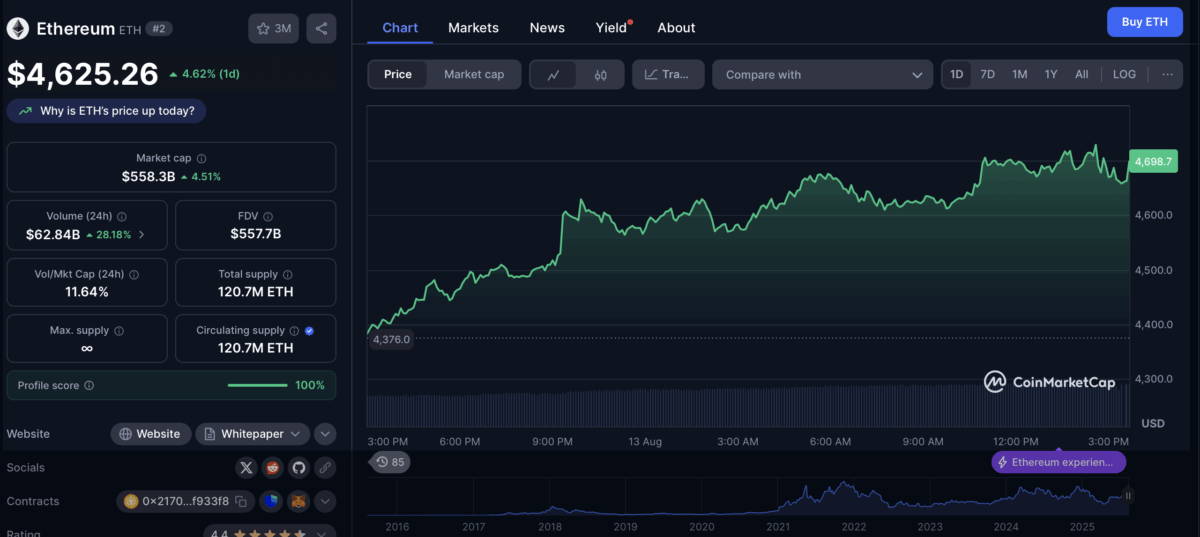
Eth Price Chart
ETH Price Chart | Source: CoinMarketCap

The cryptocurrency is just a few dollars away from breaking its record and investors are actively buying in through both direct purchases and exchange-traded funds.

Bitmine has been steadily increasing its ETH stash over the past three months. Earlier this year, it sold $4.5 billion worth of stock under a previous authorization. Before the latest filing, it still had $723 million in unused stock sale capacity, now joined by the fresh $20 billion allowance. 

Other corporate players are also moving into Ethereum. Sharplink Gaming, the second-largest corporate ETH holder, is preparing to raise nearly $500 million to expand its reserves. 

Also Read: Bullish Crypto Exchange Raises $1.1B in NYSE IPO


Letture associate

BIS Report Compliance Observations: The True Risks of Stablecoins Go Beyond 'De-pegging'

The BIS report, "Anchoring trust in money: innovation beyond stablecoins," highlights that the primary risks of stablecoins extend beyond potential de-pegging. It argues that the core challenge is whether stablecoins can be integrated into a financial system that is identifiable, monitorable, accountable, and regulatable. While acknowledging efficiency gains like faster payments and programmability, BIS emphasizes that money requires an institutional framework—including legal certainty, liquidity support, and financial integrity controls—which many stablecoins currently lack. The report details compliance risks, noting that while blockchain transactions are transparent, address visibility does not equate to identity or purpose clarity. This creates a systemic risk as pseudonymity, non-custodial wallets, and cross-chain bridges can undermine AML/CFT controls. Furthermore, these risks can spill over into the traditional financial system through on- and off-ramps. The future direction, per BIS, is not to prohibit innovation but to embed regulatory rules—such as identity verification and transaction screening—directly into the technological infrastructure of tokenized finance. The key takeaway for compliance is that any new financial instrument must clearly address questions of customer identification, transaction monitoring, accountability, and cross-border rule consistency to be viable as a mainstream payment tool.

marsbit1 h fa

BIS Report Compliance Observations: The True Risks of Stablecoins Go Beyond 'De-pegging'

marsbit1 h fa

When US Giants Collectively "Defect" to Chinese AI Models

When Silicon Valley Giants Turn to Chinese AI Models to Cut Costs A surprising trend is emerging: major U.S. tech companies are significantly reducing AI costs by switching to Chinese models. Coinbase, the largest U.S. cryptocurrency exchange, reportedly halved its AI spending after migrating to China's GLM-5.2 and Kimi 2.7 models, despite increasing usage. They achieved this through a sophisticated three-part strategy: implementing an automatic routing system to select the most cost-effective model per task, boosting cache hit rates from 5% to 60% to reuse computations, and employing "context engineering" to provide AI with more precise, less cluttered information. They are not alone. AI startup Lindy switched from Claude to DeepSeek, saving millions, while Snowflake's tests found GLM-5.2 solved 66% of coding tasks compared to Claude Opus's 67%—but at a fraction of the cost (output pricing is 5-7 times lower). While the top Western models may offer slightly better stability, the massive price differential is leading many businesses to reconsider their value proposition. This shift signals a deeper change in the AI industry, moving beyond pure performance benchmarks to a fierce cost competition. As pressure mounts, even OpenAI and Anthropic have begun slashing prices. For users, this means more choices, lower costs, and a crucial lesson: using multiple models based on task complexity, optimizing with caching, and keeping contexts lean are now key to leveraging AI efficiently and affordably.

marsbit1 h fa

When US Giants Collectively "Defect" to Chinese AI Models

marsbit1 h fa

BIS Report Compliance Watch: The Real Risks of Stablecoins Are Not Just 'De-pegging'

BIS Report Compliance Observations: The real risks of stablecoins go beyond "depegging" The BIS report "Anchoring trust in money: innovation beyond stablecoins" argues that while stablecoins and tokenization offer efficiency gains, their primary risk lies in fitting into an identifiable, monitorable, accountable, and regulatable financial system. Money's trust stems not just from technology but from institutional arrangements: a common unit of account, guaranteed redemption at par, liquidity support, regulatory frameworks, and financial integrity requirements. Stablecoins, operating on permissionless blockchains with pseudo-anonymity and non-custodial wallets, create systemic compliance gaps: unclear customer identity, incomplete fund origins, unexplained transaction purposes, fragmented cross-chain paths, and ambiguous liability. On-chain transparency does not equal compliance transparency. Public addresses don't reveal identity or intent. While blockchain analytics aid law enforcement, they cannot replace routine, large-scale AML/CFT controls. Effective compliance requires a closed-loop process encompassing customer onboarding, transaction monitoring, investigation, reporting, and audit. Stablecoin risks are not confined to the blockchain; they re-enter the traditional financial system via on/off-ramps, exchanges, and payment institutions. This forces banks to monitor client accounts for activity linked to virtual assets. The future direction is not to prohibit innovation but to embed rules into the technology. Tokenized finance should integrate with the existing two-tier monetary system, embedding compliance—like customer identification, pre-transaction screening, and auditable data trails—directly into the transaction flow. For compliance professionals, the key takeaway is that any new financial instrument must answer core questions: Who identifies the customer? Who monitors transactions? Who handles exceptions? Who is liable? Compliance is not the antithesis of innovation but the essential infrastructure for its sustainable growth.

链捕手1 h fa

BIS Report Compliance Watch: The Real Risks of Stablecoins Are Not Just 'De-pegging'

链捕手1 h fa

Trading

Spot
活动图片