Hex Trust добавляет институциональное хранение токенизированного урана

cryptonews.ruPubblicato 2025-01-12Pubblicato ultima volta 2025-08-13

Компания Hex Trust, специализирующаяся на хранении цифровых активов, объявила о поддержке токенизированного урана xU3O8 через интеграцию с Etherlink — решением второго уровня на блокчейне Tezos, совместимым с виртуальной машиной Ethereum (EVM).

Интеграция реализована при поддержке Trilitech, исследовательского центра экосистемы Tezos. Согласно официальному заявлению, Hex Trust будет обеспечивать институциональное хранение xU3O8 и других активов на платформе Etherlink.

«Токенизированные товары, включая уран, вызывают растущий интерес институциональных инвесторов по мере перевода реальных активов в блокчейн», — отметила Джорджия Пеллиццари, руководитель отдела хранения Hex Trust.

Особенности токена xU3O8

Токен xU3O8, доступный на нескольких торговых площадках, представляет цифровой аналог физического урана (U308) — продукта переработки урановой руды. Проект поддерживается компанией Curzon, специализирующейся на торговле ураном, и регулируемой британской биржей Archax.
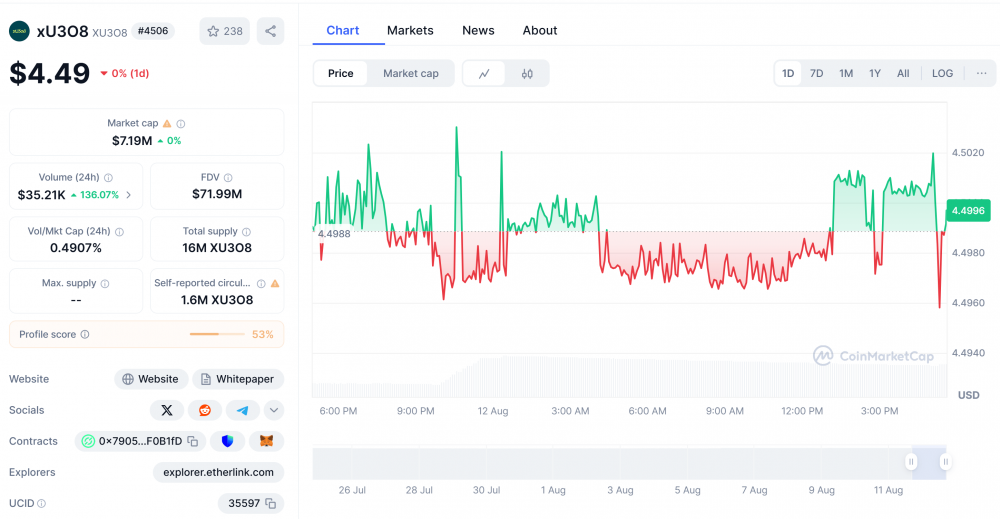

Цена на xU3O8. Источник: CoinMarketCap

Расширение услуг для RWA

Добавление урана в перечень поддерживаемых активов знаменует расширение сервисов Hex Trust в сегменте токенизированных реальных активов (RWA). Уран традиционно относится к строго регулируемым и малодоступным для большинства инвесторов товарам.

Бен Элвидж, руководитель отдела коммерческих приложений Trilitech, назвал уран идеальным кандидатом для токенизации, указав на проблемы с доступом к рынку и прозрачностью ценообразования. «Теперь мы можем решить обе проблемы с помощью блокчейн-технологий. Наличие такого хорошо регулируемого кастодиана, как Hex Trust, значительно упрощает для учреждений процесс токенизации», — пояснил он.

Hex Trust обладает лицензиями в Гонконге, Сингапуре, Дубае и Италии. В прошлом году компания получила предварительное одобрение от финансового регулятора Сингапура на получение лицензии крупной платежной организации (MPI).

Uranium.io и доступность токенизированного урана

В прошлом году на блокчейне Tezos было запущено приложение Uranium.io — первая в мире децентрализованная платформа для торговли токенизированным ураном, разработанная совместно с Curzon Uranium и Archax.

Платформа направлена на снижение барьеров входа на глобальный рынок урана, традиционно ориентированный на институциональных инвесторов. Ранее розничные инвесторы могли получить доступ к урану только через ETF, тогда как прямые сделки требовали значительного капитала.

В текущем году партнерство с Transak позволило Uranium.io предложить розничным инвесторам возможность покупки токенизированного урана за криптовалюту или банковские карты с минимальной суммой входа всего $10, что радикально отличается от требований внебиржевого рынка с минимальной суммой сделки $4,2 млн.

Letture associate

Robinhood Chain Mainnet Goes Live: Can Stocks Finally Be Moved Into Wallets?

Robinhood has officially launched its public mainnet, Robinhood Chain, along with stock-like tokens, the USDG yield product, and a DeFi lending portal. This marks a significant shift where a major online broker is integrating its user interface, regulatory compliance, self-custody wallet, and on-chain protocols into a single, streamlined experience. The goal is to simplify access to stock exposure, stablecoin yields, collateralized lending, and AMM trading for mainstream users. Eligible non-U.S. users can hold these "Stock Tokens"—structured as tokenized debt securities—in the Robinhood Wallet for 24/7 exposure to assets like U.S. stocks or ETFs. U.S. users can access an estimated ~7% APY on dollar-backed USDG through the Robinhood Earn program via self-custody wallets, with lending infrastructure powered by Morpho protocol. Built as a Layer 2 on Arbitrum, Robinhood Chain leverages existing DeFi protocols like Uniswap. The core strategy is not to reinvent DeFi but to channel Robinhood's large traditional finance user base (27.4 million funded customers as of Q1 2026) into on-chain finance, lowering the technical barriers. However, key limitations exist. The stock tokens are not direct equity ownership and are unavailable in the U.S. and some jurisdictions due to regulatory constraints. The ~7% yield is variable and carries inherent DeFi risks, not guaranteed principal protection. Furthermore, while AMMs enable trading, price discovery for major stocks will likely remain anchored in traditional markets like NASDAQ for the foreseeable future. Ultimately, Robinhood Chain is an early experiment in "on-chain brokerage." Its success will depend on real-world metrics like trading volume, sustained user migration to self-custody, stable yield performance, and regulatory feedback, rather than its launch narrative.

marsbit1 h fa

Robinhood Chain Mainnet Goes Live: Can Stocks Finally Be Moved Into Wallets?

marsbit1 h fa

Circle CEO Responds to OUSD Challenge: Stablecoin Market Is 'Winner-Takes-All', Consortium Model Doomed to Fail

Circle CEO Jeremy Allaire addresses market concerns following the announcement of the Open USD (OUSD) stablecoin project backed by 140 global companies. Allaire argues the stablecoin market exhibits "winner-takes-all" dynamics due to powerful network effects. He cites USDC's near-decade lead in three key areas: 1) **Application Integration & Protocol Development**: Thousands of integrated services and protocols (like CCTP) create utility and lock-in for developers and users. 2) **Liquidity Network Effects**: A deeply embedded, globally distributed liquidity infrastructure across primary and secondary markets, built over years. 3) **Regulatory Integration**: Extensive licensing and compliance groundwork ensuring USDC's acceptance in major markets like Europe and Japan. Allaire challenges OUSD's proposed advantages. He contends that promises of free redemption, while appealing, face market realities where such models can become exit routes for other stablecoins. He also questions the feasibility of fully distributing all revenue to an alliance, stating it would "starve" the critical infrastructure investments needed for scale and utility. Furthermore, he expresses skepticism about large alliance governance models, noting they often lead to slow decision-making and misaligned incentives. While welcoming OUSD to the ecosystem, Allaire reaffirms confidence in USDC's dominant position, backed by its long-term infrastructure investments and strong partnerships, including its ongoing collaboration with Coinbase.

marsbit1 h fa

Circle CEO Responds to OUSD Challenge: Stablecoin Market Is 'Winner-Takes-All', Consortium Model Doomed to Fail

marsbit1 h fa

Circle CEO Responds to OUSD Challenge: Alliance Model Doomed to Fail, It's a 'Winner-Takes-All' Game

Circle CEO Jeremy Allaire addresses the challenge posed by the new Open USD (OUSD) stablecoin project, backed by 140 global companies. He argues that the stablecoin market exhibits "winner-take-all" characteristics, where USDC's near-decade-long lead in application integrations, global liquidity, and regulatory compliance secures its dominant position. Allaire outlines three key network effects underpinning USDC's strength: 1) Extensive integration as an internet protocol layer, 2) Deep, globally distributed liquidity networks, and 3) Deep integration with global policy and regulatory frameworks. He cites data showing USDC facilitated 80% of on-chain USD stablecoin transaction volume in Q1 2026. He directly counters OUSD's proposed advantages: 1) "Free minting and redemption" may not be sustainable against market realities, which USDC addresses via contractual mechanisms. 2) "Sharing all revenue" risks starving the infrastructure of necessary investment for growth and reliability. 3) A "consortium model" often leads to slow innovation and poor coordination compared to focused, independent operators like Circle. Allaire reaffirms Circle's strong partnership with Coinbase and notes that Circle continues to collaborate with many OUSD founding members. He concludes by welcoming OUSD to the ecosystem while expressing confidence in USDC's entrenched network advantages and continued expansion.

Odaily星球日报1 h fa

Circle CEO Responds to OUSD Challenge: Alliance Model Doomed to Fail, It's a 'Winner-Takes-All' Game

Odaily星球日报1 h fa

Trading

Spot
活动图片