$3 Billion in August: Bitcoin ETFs Experience Best Month in a Year

cryptonews.ruPubblicato 2026-08-26Pubblicato ultima volta 2026-08-26

Introduzione

Bitcoin ETFs in the US have extended their capital inflow streak to seven consecutive trading days. On August 25th, these funds attracted a net investment of $314.37 million, pushing the total August inflow to $3.03 billion. This marks Bitcoin ETFs' strongest month since October of last year. The funds' total net assets have reached $99.05 billion. While Bitcoin briefly surpassed $80,000 on August 25th, it has since retreated, trading above $79,000. Market sentiment, as measured by the Fear and Greed Index, has cooled slightly but remains in the "Greed" zone. US spot Ethereum ETFs are mirroring the trend, also extending their inflow streak to seven days. They added $179.8 million on Tuesday, bringing their series total to around $1 billion. This synchronized institutional demand for both Bitcoin and Ethereum ETFs suggests a broader recovery of interest. If the current pace continues, August could set a ten-month record for capital inflows. However, machine analysis of the data notes this growth is occurring ahead of the uncertain Fed meeting on September 15-16, which could test investor risk appetite.

Bitcoin ETFs in the US extended their capital inflow streak to seven consecutive trading days — on Tuesday, August 25th, the funds attracted $314.37 million in net investments. Thanks to this streak, the August inflow reached $3.03 billion, leaving the funds just $390 million shy of October 2025's result — with four trading sessions remaining until the end of the month.

August is already becoming the strongest month for Bitcoin ETFs since October of last year. Simultaneously, the funds have more than halved the net outflow deficit since the start of the year — to $2.26 billion. The total net assets of the funds reached $99.05 billion, and the cumulative net inflow since launch has risen to $54.36 billion.

Bitcoin Retreats from $80,000

At the time of publication, Bitcoin was trading above $79,000. On August 25th, the asset briefly surpassed the $80,000 level but failed to hold its position.
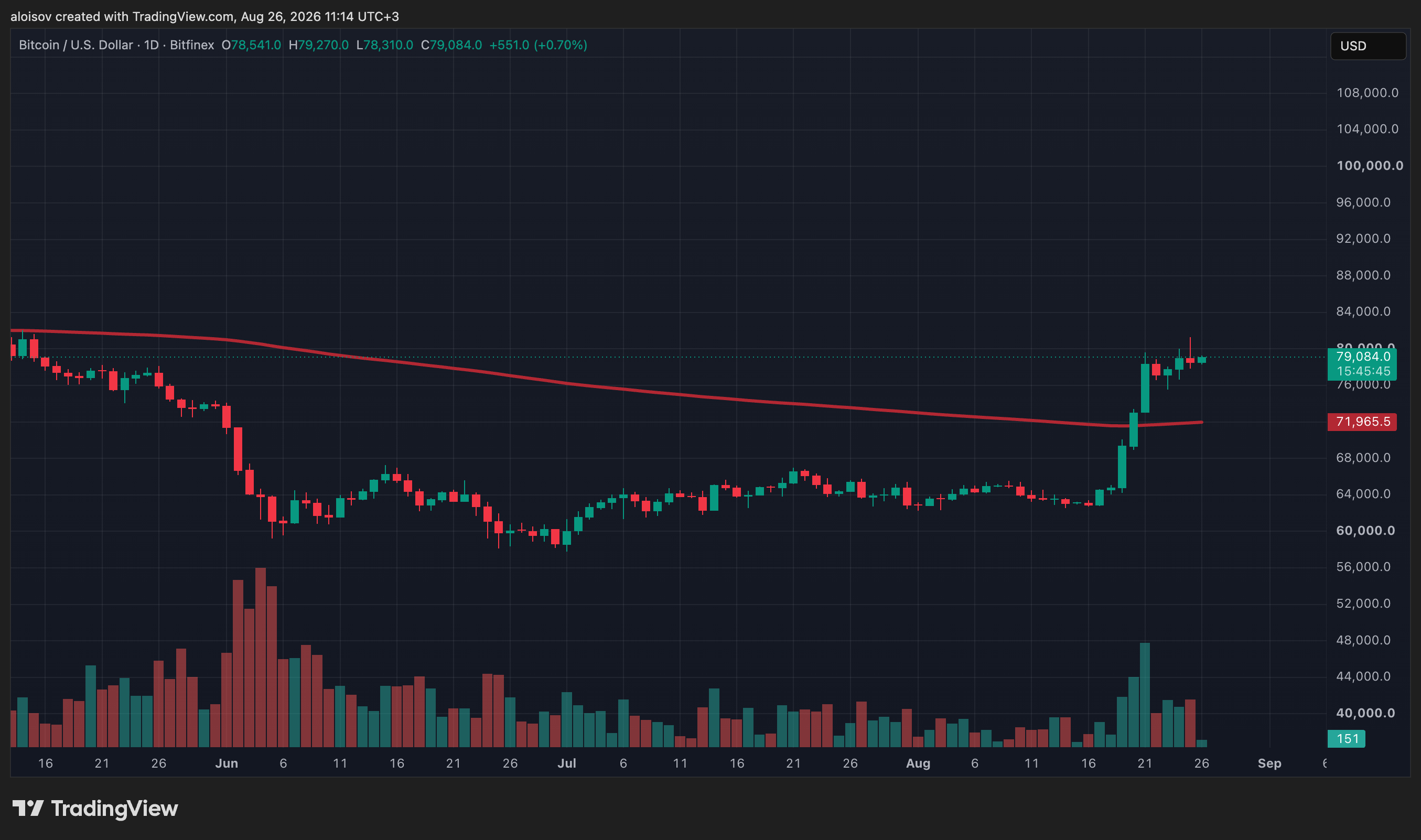
1-day BTC/USD chart and 200EMA. Source: Bitfinex

Market participant sentiment cooled slightly: the Fear and Greed index dropped from 74 to 65 points, remaining in the "Greed" zone.

Ethereum ETFs Mirror Bitcoin's Dynamics

Spot Ethereum ETFs in the US also extended their inflow streak to seven trading days. On Tuesday, the funds added $179.8 million, bringing the total inflow during this period to approximately $1 billion.

  • Bitcoin ETF inflow on Tuesday — $314.37 million

  • Inflow since the start of August — $3.03 billion

  • Bitcoin ETF net assets — $99.05 billion

  • Ethereum ETF inflow on Tuesday — $179.8 million

The synchronous increase in interest in Bitcoin and Ethereum ETFs indicates that institutional demand is recovering in August across both directions. If the current dynamics persist until the end of the month, August could set a new record for capital inflow in the last ten months.

AI Opinion

From the perspective of machine data analysis, the seven-day inflow streak into Bitcoin ETFs is forming against the backdrop of the approaching Fed meeting on September 15-16, the outcome of which markets do not yet assess unambiguously — traders on Kalshi are pricing in about a 67% probability of the current rate being maintained. The Fed rate traditionally determines the strength of the dollar and investor risk appetite, meaning the current capital inflow could face a test even before the end of September.

end-content

Domande pertinenti

QWhat milestone did US Bitcoin-ETFs achieve in August based on the data presented?

AUS Bitcoin-ETFs achieved a net capital inflow of $3.03 billion in August, making it their strongest month since October of the previous year.

QWhat happened to Bitcoin's price on August 25th according to the article?

AOn August 25th, Bitcoin briefly surpassed the $80,000 level but failed to maintain that position and was trading above $79,000 at the time of publication.

QHow have US spot Ethereum-ETFs performed recently in terms of capital inflows?

AUS spot Ethereum-ETFs extended their inflow streak to seven trading days, adding $179.8 million on Tuesday mentioned, with the total inflow for that period reaching about $1 billion.

QWhat potential market event does the article's 'AI Opinion' section suggest could test the current capital inflows into Bitcoin-ETFs?

AThe 'AI Opinion' section suggests that the upcoming Federal Reserve meeting on September 15-16 could test the current inflows, as its outcome regarding interest rates influences the US dollar's strength and investor risk appetite.

QWhat was the total net asset value of Bitcoin-ETFs reported in the article?

AThe total net assets of the Bitcoin-ETFs reached $99.05 billion.

Letture associate

With Revenue 3.8 Billion Lower Than CXMT, Net Profit Is 8.6 Billion Higher: What Secrets Are Hidden in YMTC's IPO?

Chinese NAND flash giant Changcun Holdings has submitted its IPO prospectus to the Shanghai Stock Exchange. In Q1 2026, the company reported revenue of 47.042 billion yuan and a net profit attributable to parent company shareholders of 33.379 billion yuan. This presents a striking contrast with its competitor Changxin Technology, which had higher revenue (50.8 billion yuan) but a significantly lower net profit of 24.762 billion yuan. The key to this discrepancy lies in their ownership structures of core assets. Changcun Holdings fully owns its main operating entity, Yangtze Memory Technologies Co., Ltd., allowing nearly all group profits to flow to the parent company. In contrast, Changxin Technology controls but does not fully own its key production subsidiaries, meaning a substantial portion of its consolidated profits (approximately 8.25 billion yuan in Q1 2026) belongs to minority shareholders, reducing its reported net profit. Despite Changcun's higher net profit, its pre-IPO valuation is estimated lower than Changxin's. Analysts attribute this to differing market expectations: Changxin, focused on DRAM and the high-growth HBM market for AI servers, is seen as having greater long-term growth potential. Changcun, while dominant in NAND flash, operates in a market with inherent size constraints, making its future valuation more dependent on successfully upgrading its product mix toward higher-value segments like enterprise SSDs.

marsbit7 min fa

With Revenue 3.8 Billion Lower Than CXMT, Net Profit Is 8.6 Billion Higher: What Secrets Are Hidden in YMTC's IPO?

marsbit7 min fa

Perpetual Contract Liquidation Wave Resurges, Bitcoin $62k - $67k May Become the 'Disaster Zone'

A wave of liquidations has hit the crypto perpetual futures market, with analysts warning of continued volatility. Following Bitcoin's drop below $76,000 and subsequent rebound, over $84 million in long positions were liquidated in one hour, demonstrating the amplified impact of leverage. The U.S. CFTC's recent approval of a spot Bitcoin perpetual contract on the Kalshi exchange has opened this "previously closed" asset class to American institutions, with the platform reporting $5.5 billion in volume in its first two weeks. However, critics like Better Markets warn that perpetuals are "among the most dangerous crypto products" for retail investors due to a lack of enhanced protections. Recent price action saw a massive $529 million in hourly liquidations, predominantly longs. Analysts note that while a $3.3 billion short squeeze cleared liquidity above $80,000, a significant pool of long liquidations now sits between $62,000 and $67,000, posing a downside risk if key resistance holds. Experts caution new traders against using leverage or options, which can expire worthless, without proper experience and risk management. Despite the dangers, the demand for leveraged products persists, with some institutional players preferring on-chain platforms for their transparency and self-custody. As Kalshi expands its perpetual offerings beyond crypto, the core warning remains: leverage can lead to sudden, severe losses for unprepared investors.

marsbit8 min fa

Perpetual Contract Liquidation Wave Resurges, Bitcoin $62k - $67k May Become the 'Disaster Zone'

marsbit8 min fa

Japanese Interest Rates Return to 1996 Levels: Can Bitcoin's 'Decoupling Narrative' Withstand the September Rate Hike?

Japan's borrowing costs have hit their highest level since 1996, with 30-year and 10-year government bond yields rising significantly. This marks a major shift for a country long reliant on negative rates. Meanwhile, Bitcoin surged 22% in a week, topping $80,000. The core question is whether crypto's apparent decoupling from traditional market turbulence can withstand potential interest rate hikes by the Bank of Japan (BOJ) in September. For years, the yen carry trade—borrowing cheap yen to invest in higher-yielding assets—has fueled global risk assets. This leverage, estimated at up to $500 billion, relies on near-zero Japanese rates. The BOJ raised its policy rate to 1.0% in June, a 31-year high, with a further hike expected in September. A rapid yen appreciation could quickly wipe out carry trade profits and trigger deleveraging, as seen in August 2024 when Bitcoin and Japanese stocks fell sharply. Currently, however, the yen is weakening, which could temporarily support the carry trade and risk assets. Japan faces a debt dilemma. Its national debt has soared to a record ¥1,346 trillion. Raising rates could stabilize the yen but drastically increase debt servicing costs. The BOJ has signaled a slower pace of policy normalization to ensure market stability. Japan's large-scale selling of US Treasuries to fund currency intervention has also contributed to rising global yields. Bitcoin's recent resilience challenges traditional risk-asset logic. A pessimistic view holds that significant BOJ tightening and a stronger yen would force global deleveraging, pulling Bitcoin down. Higher yields also make interest-bearing assets relatively more attractive than Bitcoin. An optimistic scenario suggests that continued yen weakness could make Bitcoin an appealing hedge for Japanese investors. Japanese institutional interest is growing, with regulatory progress potentially paving the way for spot crypto ETFs by 2027. The key event is the BOJ's September 17-18 meeting. Market focus will be less on the expected rate hike to 1.25% and more on the future policy guidance. A hawkish signal aiming for higher rates could strengthen the yen and unwind carry trades. A dovish stance, constrained by debt concerns, could further weaken the yen, potentially benefiting Bitcoin via a weaker dollar and local demand. The current market prices in a slow evolution of Japan's debt issues. While Bitcoin may be trading on yen weakness and institutional adoption, the 30-year yield near 4% is a significant risk signal. The correlation between the yen's direction and Bitcoin remains crucial and could reverse swiftly if the BOJ alters market expectations in September.

marsbit13 min fa

Japanese Interest Rates Return to 1996 Levels: Can Bitcoin's 'Decoupling Narrative' Withstand the September Rate Hike?

marsbit13 min fa

Trading

Spot
活动图片