RWA周报|白宫发布数字资产报告;SEC宣布启动“Project Crypto”计划(7.30-8.5)

Odaily星球日报Pubblicato 2025-08-05Pubblicato ultima volta 2025-08-05

原创 | Odaily 星球日报(@OdailyChina

作者 | Ethan(@ethanzhang_web 3

RWA 板块市场表现

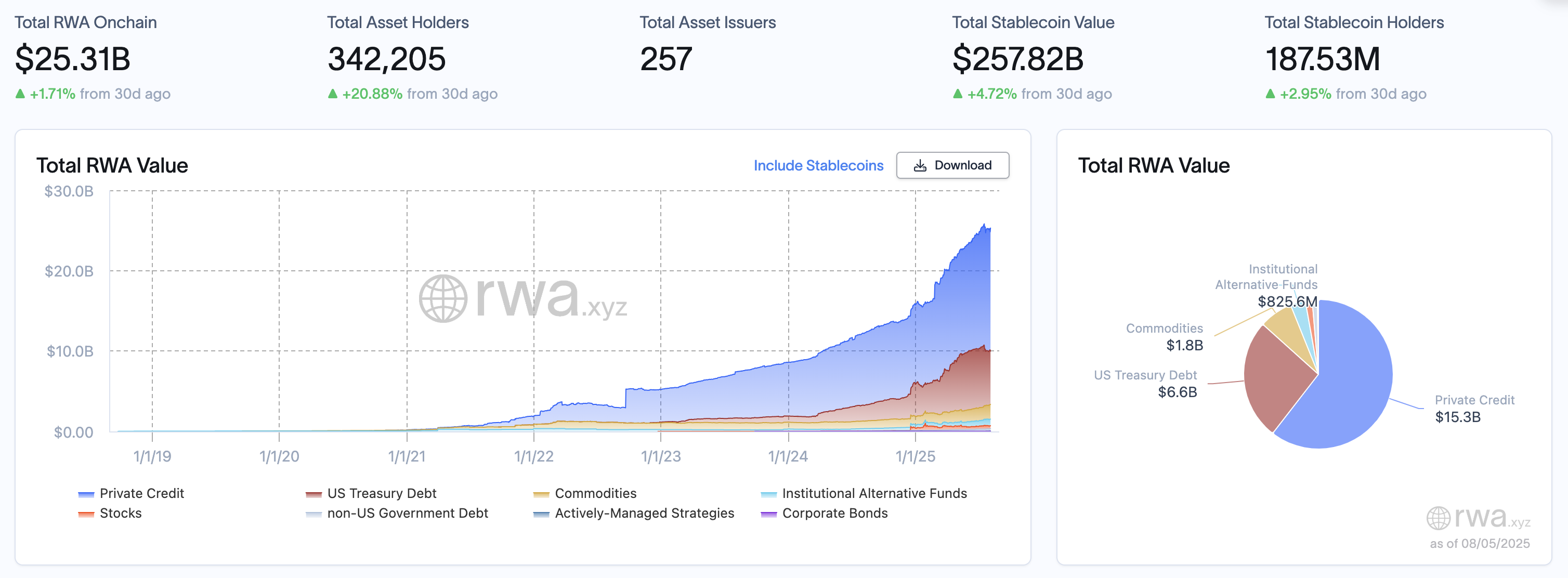
根据 RWA.xyz 最新数据显示,截至 2025 年 8 月 5 日,RWA 链上总价值为253.1 亿美元,较 7 月 29 日的251.8 亿美元上涨1.3 亿美元,涨幅约0.52%,市场整体维持在高位震荡区间。虽然市值回升幅度不大,但链上生态数据持续走强。资产持有者数量从上周的331,119 人增至342,205 人,单周净增11,086 人,增长3.35%,显示出入场情绪依旧积极。资产发行方数量上升至257 家,环比增加2 家,为近三周以来首次回升。稳定币方面,链上总价值从2536.8 亿美元上升至2578.2 亿美元,增幅1.63%;持有者数量从1.7439 亿人上升至1.8753 亿人,周增超 1300 万人,涨幅达7.56%。

从资产结构看,本周多数资产表现稳定,其中私人信贷152 亿美元小幅上涨至153 亿美元,继续占据主导地位,市值占比近六成。美国国债本周出现小幅回撤,由68 亿美元降至66 亿美元,为连续第二周回落。商品类资产维持在18 亿美元不变,延续震荡走势。机构另类资产基金则由8.155 亿美元上涨至8.256 亿美元,延续上升趋势,资金对结构化资产的兴趣未减。

有何趋势(对比上周

本周 RWA 市场延续“稳中向上、结构偏暖”的格局。链上用户规模稳步提升,协议侧扩容同步进行,生态活跃度与数据面均展现出良好韧性。尽管总市值未出现明显跳升,但资金分布呈现出边际回流趋势,特别是私人信贷与另类资产板块保持资金吸附能力,构建起稳健的主干结构。与此形成对比的是,美国国债类资产连续两周小幅缩量,或反映出市场对中短期利率路径的再评估,机构配置态度进入观望期。另类资产方面,本周继续稳中有增,非标资产作为风险调节器与收益补充来源的战略地位正在被机构接受。结构配置正从“追求单一高息”走向“组合视角下的风险收益最优化”,生态参与者更重视长期可持续性与链上治理弹性。
重点事件回看

白宫发布数字资产报告(解读:白宫数字资产报告中的十一项要点)

白宫正式发布数字资产监管框架,被业内称为“监管圣经”,涵盖稳定币、比特币战略储备、银行参与路径、税务与市场结构等 11 项要点,总结如下:

1. 稳定币定性明确:美国许可的支付稳定币被界定为非证券、非商品,发行人不适用“投资公司”规则,且不得带息。

2. 纳入 BSA 监管体系:稳定币发行人被正式纳入《银行保密法》下的“金融机构”,海外主体亦须配合美国冻结/没收命令打击非法用途。

3. 储备机制与跨境互认:稳定币需以高流动性资产全额备付,合规国家框架可享互认,支持跨境流通。

4. 禁止推动 CBDC:行政命令 EO 14178 明确禁止推进央行数字货币(CBDC),并支持《反 CBDC 监控国家法案》。

5. 银行监管路径重启:SAB 121 撤销、FDIC 取消事前通报、OCC 重申银行可开展托管、支付及稳定币业务,2023 年“谨慎声明”也已废除。

6. 牌照与主账户审批机制优化:建议设置明确审批时限,逾期视作批准,并禁止因涉足加密业务拒发主账户。

7. 市场结构改革:鼓励 SEC/CFTC 设立联合分类与创新沙盒机制,支持定制注册、安全港和联邦预 emption,减少多州重复许可。

8. 期货监管归属 CFTC:明确比特币、以太坊期货等归 CFTC 管辖,多数 DePIN 类代币亦如此,除非转为证券。

9. 税务合理化:建议非托管及去中心化协议不纳入 6045 报送义务,避免对技术类项目过度征税。

10. 强化美元国际支付竞争力:报告强调私营部门推动代币化可增强金融市场与跨境支付效率,若不主动布局将削弱美元全球地位。

11. 比特币战略储备确立:EO 14233 设立战略比特币储备机制,由财政部管理,以执法没收资产为主要来源,储备币原则上不出售。

SEC 宣布启动“Project Crypto”计划,旨在推动美国成为全球加密中心

美 SEC 主席 Paul Atkins 近日发表演讲,宣布启动一项名为“Project Crypto”的委员会级倡议,旨在现代化证券法规,以推动美国金融市场实现链上化,响应特朗普总统将美国打造成“全球加密中心”的愿景。

该计划将致力于将加密资产发行带回美国,为加密资产的发行、托管和交易制定清晰简明的规则,并致力于更新现有法规以适应链上软件系统。

Atkins 表示,该计划还将允许市场参与者通过“超级应用”进行创新,提供一站式、单一牌照的多种产品和服务,并探索创新豁免以鼓励新兴商业模式。

香港《稳定币条例》正式生效:储备资产须全额覆盖流通面值

8 月 1 日,香港《稳定币条例》正式生效,建立起稳定币发行人牌照制度,完善香港对虚拟资产活动的监管框架。大湾区国际资讯科技协会会长杨德斌表示,如今国际上稳定币的发展已经达到一定规模。香港在这个时点推出《稳定币条例》,是在监管方面与时俱进的体现。与国际标准接轨,中国香港在制定稳定币相关规定时也力求与全球其他国家和地区的标准接轨。根据香港《稳定币条例》,持牌人必须确保其发行的指定稳定币的储备资产的市值,始终不低于该类稳定币尚未赎回且流通中的面值。持牌人应考虑储备资产的风险状况,确保有适当的超额抵押以覆盖市场风险。

Coinbase 拟推出“全能交易所”计划,向美国用户开放代币化股票与预测市场

Coinbase 计划在未来数月内向美国用户推出包括代币化股票、预测市场和早期代币发行在内的新产品,构建“全能交易所”。该平台旨在实现所有资产链上交易。Coinbase 将与已持牌的 Kalshi 和近期收购 QCEX 的 Polymarket 在预测市场领域展开竞争,并将挑战 Robinhood 等提供代币化股票服务的平台。

摩根大通与 Coinbase 展开合作使客户便捷购买加密货币

加密记者 Eleanor Terrett 在 X 平台发文表示,摩根大通正与 Coinbase 正展开合作,旨在让大通银行(Chase)客户更便捷地购买加密货币。 不久后,摩根大通客户将能够使用大通信用卡为 Coinbase 账户充值。到 2026 年,将推出直接银行账户到钱包的转账服务,以及 1:1 兑换大通终极奖励(Chase Ultimate Rewards)积分的功能,这将是首次有大型银行的奖励计划可用于购买加密货币。

香港 RWA 注册登记平台将于 8 月 7 日上线

香港 RWA 注册登记平台将于 8 月 7 日上线,由香港 Web 3.0 标准化协会发起,将打通 RWA 资产代币化的数据化、资产化和金融化全过程服务体系。

Interactive Brokers 考虑推出稳定币产品

据路透社报道,美国大型券商 Interactive Brokers 正在考虑为客户发行稳定币,以实现 24/7 全天候资金结算与加密资产转账。公司创始人 Thomas Peterffy 表示,发行稳定币尚未最终决定,但也在评估支持使用其他机构发行的稳定币进行账户资金注入的可行性。该平台已与 Paxos 合作,并投资了加密交易平台 Zero Hash,支持多种加密货币交易。

热点项目动态

Ondo Finance (ONDO)

一句话介绍:

Ondo Finance 是一个去中心化金融协议,专注于结构化金融产品和现实世界资产的代币化。它的目标是通过区块链技术为用户提供固定收益类产品,如代币化的美国国债或其他金融工具。Ondo Finance 允许用户投资于低风险、高流动性的资产,同时保持去中心化的透明性和安全性。其代币 ONDO 用于协议治理和激励机制,平台还支持跨链操作,以扩大其在 DeFi 生态中的应用范围。

最新动态:

7 月 31 日,Ondo Finance 在 X 上宣布,其被写入美国总统数字资产市场工作组(President's Working Group)最新发布的白宫报告中。报告对代币化证券、稳定币和可编程结算作为未来金融体系的重要组成部分表示认可。

8 月 4 日,Ondo Finance 宣布 即将推出“史上最大规模的代币化股票和 ETF 发布”,计划首日上线 100 多种资产,到年底扩展至超 1000 种。

MyStonks(STONKS)
一句话介绍:

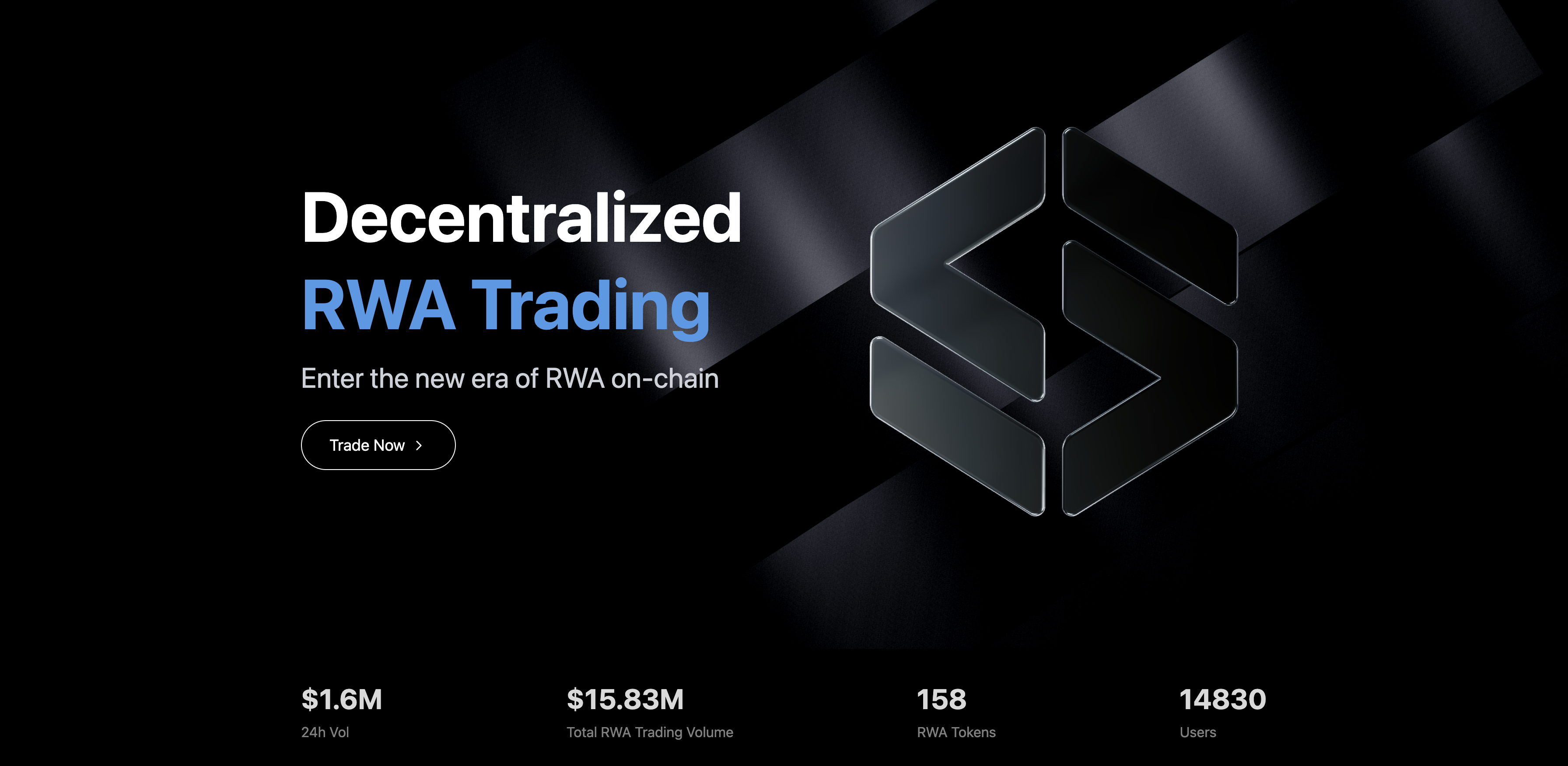
MyStonks 是一个由社区驱动的 DeFi 平台,专注于将美国股票等 RWA 代币化并上线链上交易。平台通过与 Fidelity 合作,实现 1: 1 实物托管与代币发行,用户可使用 USDC、USDT、USD 1 等稳定币铸造如 AAPL.M、MSFT.M 等股票代币,并在 Base 区块链上全天候进行买卖。所有交易、铸币与赎回流程均由智能合约执行,确保透明、安全、可审计。MyStonks 致力于打通 TradFi 与 DeFi 边界,为用户提供高流动性、低门槛的美股链上投资入口,构建“加密世界的 NASDAQ”。

最新动态:

8 月 2 日,MyStonks 平台日交易量突破 1200 万 USD。其合约产品在白名单邀请测试阶段,单日交易量达到 1,100 万 USD。

8 月 5 日,MyStonks 平台正式上线“默克尔树”功能,开启美股链上资产透明度和数据可验证性的全新时代。该功能通过默克尔树技术,实现用户对个人资产存证及全平台资产快照数据的高效验证,确保每笔资产变动均可链上溯源、完整校验,用户无需依赖第三方即可获取真实、有效的数据证明。

相关链接

RWA 周报系列

梳理 RWA 板块最新洞察及市场数据。

《RWA 项目启示录:从贝莱德 BUIDL 基金看透被企业忽略的核心逻辑》

万亿巨头贝莱德的 BUIDL 基金,藏着 RWA 项目哪些成功秘诀?

《监管会谈、收购牌照、组建联盟:RWA 之光 Ondo 近期动作一览》

白宫点名背书,Ondo 已在监管框架内大步迈进。

《当佳士得能用加密货币购房,RWA 赛道的新里程碑》

加上 Crypto 后,玩房地产就像玩「大富翁」。

《市值排名前十的现实世界资产 (RWA) 项目:2025 年完整分析》

这项全面分析按市值考察了排名前 10 位的真正 RWA 项目,重点关注那些真正将现实世界资产代币化的平台,而不是基础设施提供商。

Letture associate

AI Relay Stations Spark Heated Debate on Zhihu: Behind Cheap Tokens, What Are Users Really Worried About?

A discussion on Zhihu about "AI relay stations" shifted the niche developer topic of "cheap tokens" into broader user awareness. Users moved beyond simply questioning the legitimacy of these services to focus on practical concerns: Where do cheap tokens truly come from? Is the model being accessed the real one? Can relay stations see prompts, code, and API keys? For occasional users, are the risks worth it? The core debate centered less on price and more on trust. A primary worry is model authenticity—the risk of "model swapping," where users paying for a premium model might be routed to a cheaper one, creating an information asymmetry. Others argued that cost comparisons matter; while cheaper than official pay-as-you-go APIs, relay stations may not be the lowest-cost option versus subscriptions, domestic models, or free tiers, making user needs assessment crucial. Speculation about token sources ranged from legitimate bulk discounts to gray-area methods like account sharing or exploiting regional pricing. This opacity makes risk assessment difficult for users. Data security emerged as a critical concern, especially for enterprise use. When processing sensitive information like code, contracts, or client data, the inability to verify a relay station's data handling, retention, or access policies poses significant compliance and confidentiality risks. The evolving consensus suggests relay stations can be used cautiously for low-sensitivity, disposable tasks (e.g., summarizing public info, simple translation). However, they should not be the default for sensitive, professional, or production workflows involving proprietary data, Agents, or automated systems. Recommendations include avoiding large prepayments, not relying on a single service, using test prompts to monitor quality, anonymizing data where possible, and keeping official channels as backups. Ultimately, the discussion framed tokens not just as a billing unit but as a measure of real cost encompassing price, model integrity, data security, and service stability. The popularity of relay stations highlights user demand for affordable access, but the debate underscores a key trade-off: the savings from cheap tokens may come at the price of trust, transparency, and control over one's data and AI experience.

marsbit23 min fa

AI Relay Stations Spark Heated Debate on Zhihu: Behind Cheap Tokens, What Are Users Really Worried About?

marsbit23 min fa

In-Depth Research Report on TradFi: The Convergence Wave of Crypto and Traditional Finance

In 2026, the crypto industry is undergoing a profound infrastructure-level transformation—TradFi assets are migrating on-chain at an unprecedented pace. According to CoinGecko's Q1 2026 report, the total value locked (TVL) of tokenized real-world assets (RWA) has surpassed $31 billion, a nearly 4x increase from $7.8 billion at the beginning of 2025, with the sector’s aggregate market capitalization reaching $19.3 billion. Among these, the market cap of tokenized stocks surged from $2 million to $486 million, with Q1 spot trading volume reaching $15.1 billion—a single quarter already surpassing the entire second half of 2025. RWA perpetual contract Q1 trading volume reached a staggering $524.8 billion, far exceeding the $313 billion for all of 2025. Meanwhile, BlackRock's BUIDL fund has reached $2.3 billion in scale and has filed for two new tokenized funds, signaling that the world's largest asset manager's tokenization strategy is evolving from pilot to product suite expansion. HTX, as a core participant in the crypto exchange sector, officially launched TradFi perpetual futures products including NVDA, AAPL, MSFT, META, and SPY in 2026, enabling crypto users to gain 24/7 trading access to core U.S. equities. Boston Consulting Group predicts that global tokenized asset scale could reach $16 trillion by 2030, while McKinsey offers a conservative estimate of approximately $2 trillion. The on-chain migration of TradFi assets is no longer a "future narrative" but a structural transformation unfolding in real time, as crypto exchanges evolve from single crypto asset trading platforms toward "multi-asset-class trading infrastructure."

HTX Learn26 min fa

In-Depth Research Report on TradFi: The Convergence Wave of Crypto and Traditional Finance

HTX Learn26 min fa

Blocked Its Own Treasure, WeChat AI Steps Up

Tencent's stock surged over 10% on June 2nd amid reports that WeChat, with 1.43 billion monthly users, is finalizing tests for a native AI Agent. The reported feature, accessible by swiping right from the main interface, allows users to issue commands in natural language. The AI then decomposes tasks and automatically calls upon relevant Mini Programs within WeChat to complete actions like ordering food, booking tickets, or making payments, creating a closed-loop service execution system. This strategic shift follows the internal conflict and subsequent "blocking" of Tencent's standalone AI app, Yuanbao, by WeChat for violating sharing rules during a 2026 Spring Festival promotion. The incident highlighted a lack of internal consensus and exposed the weakness of competing in the standalone AI assistant arena against rivals like ByteDance's Doubao (345M MAU) and Alibaba's Qianwen. The new WeChat AI Agent aims to leverage WeChat's unique assets—its massive user base, standardized Mini Program APIs, WeChat Pay, and identity system—to move from simple content generation to actual task execution. Analysts note this changes the competitive landscape from model benchmarks to which AI can connect to more real-world services. However, success depends on key variables: the capability of Tencent's underlying Hunyuan model, managing massive inference costs, and redesigning incentives for Mini Program developers whose traffic might be bypassed. The move is seen as an attempt to keep user service intent within WeChat's ecosystem as AI begins to redefine how users access services.

marsbit1 h fa

Blocked Its Own Treasure, WeChat AI Steps Up

marsbit1 h fa

ByteDance Adopts Arm CPUs, Jensen Huang: So Sad I Didn't Buy Arm

**Summary:** At Computex 2026, Arm CEO Rene Haas announced that ByteDance and Oracle have adopted Arm's self-designed Arm AGI data center CPU. The company expects significant revenue growth from this product, projecting $20 billion in demand for the 2027/2028 fiscal years. Haas noted that restricting AI-capable CPUs from the US to China is nearly impossible due to their widespread applications. Arm's stock has surged dramatically this year, notably rising 16% after NVIDIA's Arm-based Vera CPU and RTX Spark announcements. A highlight was the informal, humorous on-stage conversation between Haas and NVIDIA CEO Jensen Huang. Huang joked about NVIDIA's failed attempt to acquire Arm and playfully lamented selling his Arm shares. Both executives showed a clear sense of camaraderie and shared regret over the missed merger. Key technical topics were discussed: 1. **AI PC Design:** Huang explained NVIDIA's RTX Spark superchip (with a 20-core Arm CPU) is designed for future AI agents that will autonomously run and use tools on PCs, blending local and cloud processing. 2. **Agent vs. OS:** Huang emphasized the operating system remains crucial, as AI agents rely on its APIs and tools to function. 3. **Growth Constraints:** He identified the shift to "useful AI" that generates profitable tokens as a primary driver for immense, almost limitless, computational demand. Haas outlined Arm's strategy across PC and data centers. For PCs, Arm collaborates with partners like NVIDIA and MediaTek, offering its compute subsystem (CSS) for custom SoCs. In data centers, its Arm AGI CPU (built on TSMC's 3nm process) has gained major partners including OpenAI, Meta, and now ByteDance and Oracle. Arm presented a multi-year roadmap for its in-house CPU line. The article concludes that while GPUs dominated the AI training race, the explosion of AI agents is shifting significant focus to CPUs for inference, state management, and tool orchestration. The industry is trending towards vertical integration, with companies like cloud providers designing chips and chip/IP firms offering full solutions, all competing to deliver more efficient computing per watt.

marsbit1 h fa

ByteDance Adopts Arm CPUs, Jensen Huang: So Sad I Didn't Buy Arm

marsbit1 h fa

Trading

Spot
Futures
活动图片