USD1脱锚警示:政治光环能否托起稳定币生态?

比推Pubblicato 2025-07-30Pubblicato ultima volta 2025-07-30

原创 | Odaily 星球日报(@OdailyChina

作者 | 叮当(@XiaMiPP

原标题:未大规模采用先脱锚,特朗普家的USD1能稳定住吗?


7 月 29 日下午 6 点,稳定币 USD1 出现短时脱锚,最低跌至 0.9934 USDT,偏离其 1:1 美元锚定值。随后,USD1 价格逐步回升,截至目前已稳定在 0.9984 USDT。这一短暂的波动引发了市场关注。

USD1 脱锚真相

从目前社区的讨论与推测来看,此次脱锚事件的直接诱因,或与 Gate 交易所于 7 月 26 日启动的 IKA Launchpad 活动密切相关。该活动共计提供 2 亿枚 IKA 代币供认购,用户可使用 USD1 或 Gate 自家平台币 GT 进行参与,认购价格设定为 1 IKA = 0.001424 GT = 0.025 USD1。根据 Gate 官方披露的数据,截至 7 月 28 日,仅 USD1 池的认购总量就已突破 2 亿美元。如此大规模的认购量显示了市场对 IKA 项目的热情,但也可能为 USD1 的抛售压力埋下伏笔。

我们留意到,IKA 认购活动于 7 月 29 日下午 1 点正式结束。结合价格走势来看,USD1 的初始下跌恰好始于此后不久,且跌幅持续至当日下午 6 点左右。这一时间轴与脱锚事件高度吻合,进一步印证了“活动结束后资金流出导致抛压激增”的可能性。一些参与用户或许在认购完成后,选择将手中的 USD1 迅速变现,造成了集中抛售。

USD1 由 World Liberty Financial(WLFI)发行,其官方定位为“低波动性的数字资产选择”,旨在通过 1:1 锚定美元,为用户提供稳定的加密资产交易媒介。根据其白皮书与审计报告,USD1 的储备资产主要包括美国短期国债和美元存款等,理论上应具备较强的兑付能力与价格锚定机制。

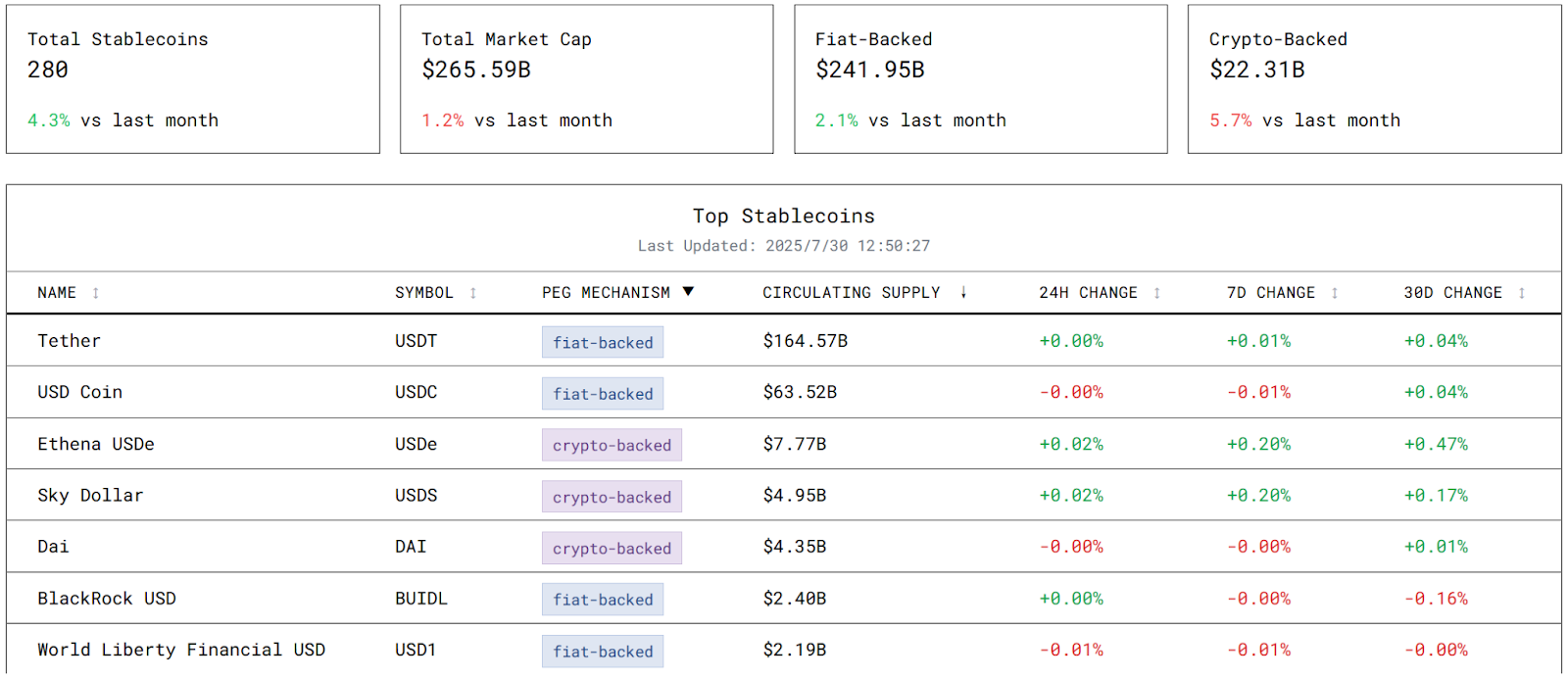
然而,从更宏观的视角来看,这次脱锚背后,暴露的却是中小体量稳定币在高强度资金运动下的脆弱性。据 stablecoins.asxn.xyz 数据显示,当前稳定币市场总规模达到 2655.9 亿美元,USDT 以 1645.7 亿美元的规模占绝对领导地位,而 USD1 的流通规模仅为 21.9 亿美元,占比约 1.3%。从绝对数值来看,这样的市场体量尚不足以承接大规模的应用压力,更遑论突然涌入并迅速退出的 2 亿美元认购资金。对于 USD1 而言,这不仅是一次实战检验,更像是一次被动的压力测试。
背靠特朗普,资源优势初现

眼下来看,USD1 在本次事件中虽然经历了短暂的脱锚,但也从另一个侧面印证了它在市场资源层面所具备的优势。不同于传统稳定币依赖链上生态自我滚动的增长路径,USD1 背后不仅有 World Liberty Financial 的金融资源,更有特朗普家族的政治与资本网络作为背书。正因如此,USD1 才得以迅速进入一些加密项目募资、交易结算与 Launchpad 环节,成为越来越多平台愿意引导用户使用的“战略稳定币”选项。

然而,“背后有人”并不等于“前方无虞”。此次 IKA Launchpad 事件的脱锚教训已充分表明,市场对资源背景的认可,不能替代对机制安全性的验证。当 USD1 成为加密应用中的关键入口时,它自身的抗压能力、流动性设计和用户信心机制,才是真正决定其能否长期被“用起来”的核心。

特别是在面对短时间内数亿美元级别的流动性冲击时,USD1 暴露出的问题值得 WLFI 高度重视。特朗普家族的政治光环可以带来一次次的注意力红利,但只有将注意力转化为使用场景、将使用场景沉淀为生态惯性,USD1 才有可能从一张被赋能的筹码,成长为稳定币格局中的有力参与者。

说明: 比推所有文章只代表作者观点,不构成投资建议

Letture associate

Silicon Valley 'Startup Guru' Steve Hoffman: Web3 + AI Could Be a Trap

Silicon Valley investor and "Godfather of Startups" Steve Hoffman warns that combining Web3 with AI is likely a trap, not a promising venture. In an interview, Hoffman argues that while AI is a foundational technology touching all industries, Web3 adds complexity, friction, and regulatory risk without solving mainstream consumer or business needs. He advises founders to focus on deep, specialized applications where startups can out-iterate giants, rather than on generic features easily replicated by large tech companies. Hoffman observes that Silicon Valley will lead foundational AI research, while China excels at rapid, large-scale application and commercialization, particularly in robotics. He stresses that AI-driven autonomous agents capable of collaborative, multi-step tasks are 2-4 years away, which will cause significant job displacement. The solution is not to slow AI but to redesign business models around human-AI collaboration and reform social systems like education and retraining. For startups, Hoffman recommends focusing on vertical, expertise-heavy domains to build defensibility. He sees major opportunities in AI fraud detection and cybersecurity. Key founder mindsets include systemic thinking over feature-focus, relentless customer centricity, building adaptive teams, and deeply understanding AI's capabilities and limits. Hoffman is also leading a non-profit initiative to establish university centers aimed at training future leaders in responsible, human-value-aligned AI innovation.

marsbit1 h fa

Silicon Valley 'Startup Guru' Steve Hoffman: Web3 + AI Could Be a Trap

marsbit1 h fa

Token Inefficient, Economy Tokenless

The article "Tokens Aren't Economical, Economics Aren't Tokenized" analyzes a pivotal shift in the AI industry from a technology-driven narrative to one dominated by capital efficiency. It highlights two concurrent trends: a severe capital shortage due to the exorbitant and recurring costs of compute (e.g., OpenAI's high burn rate) and a wave of corporate spin-offs where major tech companies are separating their AI units (like Kuaishou's Kling and Baidu's Kunlunxin). The core argument is that AI's "anti-internet" business model, where user growth increases costs rather than profits, has created a disconnect between high valuations and actual cash flow. Spin-offs address this by allowing AI assets to be valued independently. Within a parent company, they are seen as cost centers, but as standalone entities, they are priced based on their growth potential and scarcity in the primary market, leading to massive valuation premiums (e.g., Kling's estimated value tripling post-spin-off). The industry is at an inflection point, moving from "model worship" to "value realization." The competition is evolving from a pure compute (GPU) race to a broader focus on systemic efficiency and full-stack engineering (involving CPUs and orchestration) to achieve viable commercialization. The year 2026 is framed as a critical moment where the industry must definitively answer how to economically translate AI capability into tangible business value, reshaping the sector's future power structure.

marsbit1 h fa

Token Inefficient, Economy Tokenless

marsbit1 h fa

Crossing the 'Memory Wall': The Wafer-Level Revolution and Computing Power Routes in the AI Inference Era

In 2026, a historic shift occurred in AI as major cloud providers' inference spending surpassed training spending for the first time, signaling a move from "building large models" to "using large models." This shifts the core challenge from computing power to the "memory wall"—the bottleneck of data movement (model weights, activations, KV Cache) between external DRAM and processors, where energy and latency from data transfer far exceed computation itself. Companies like Nvidia face GPU idle time due to bandwidth limits. In contrast, Cerebras Systems adopts a radical "wafer-scale" approach with its Wafer-Scale Engine (WSE). Instead of cutting a silicon wafer into many chips, Cerebras uses almost the entire wafer as one massive chip (WSE-3). This design provides 44GB of on-chip SRAM, delivering memory bandwidth thousands of times higher than traditional HBM (e.g., 21 PB/s vs. Nvidia B200). For LLM inference, weights are streamed layer-by-layer from external MemoryX storage to the chip, avoiding HBM bottlenecks. This results in token generation speeds 1.5–5 times faster than Nvidia's B200 in some models and significant advantages in first-token latency and long-context tasks. Additionally, Cerebras's architecture offers much lower interconnect power consumption (0.15 pJ/bit vs. GPU's ~10 pJ/bit). However, Cerebras faces challenges: SRAM scaling has slowed with advanced nodes, limiting future capacity gains; the chip requires specialized liquid cooling and custom software stacks; and its external I/O bandwidth (150 GB/s) is low compared to NVLink, hindering multi-system scaling for very large models. Competition is intensifying. Major players are pursuing three paths: 1) Developing proprietary inference ASICs (e.g., Google TPU, Microsoft Maia), 2) Leveraging advanced packaging (e.g., TSMC's SoW) to democratize wafer-scale-like integration, potentially eroding Cerebras's process advantage within a few years, and 3) Exploring optical interconnects for ultimate bandwidth. Commercially, Cerebras is transitioning from a hardware vendor to a service provider, facing the immense challenge of building high-power, specialized data centers to meet large contracts (e.g., 250MW/year from 2026–2028). In conclusion, the AI inference era presents a fundamental architectural trade-off. Cerebras opts for extreme physical optimization for low-latency, single-task performance, while Nvidia prioritizes versatility and massive cluster throughput. The path forward remains uncertain, with technology and business models still evolving in the race toward advanced AI.

marsbit1 h fa

Crossing the 'Memory Wall': The Wafer-Level Revolution and Computing Power Routes in the AI Inference Era

marsbit1 h fa

Has Bitcoin's 'Rebound Ended', Officially Entering the Late Bear Market Phase?

**Title: Has Bitcoin's Rebound Ended, Entering the Late Bear Market Phase?** **Summary:** Bitcoin's price has declined by 13% this week, signaling a potential return to late-stage bear market conditions. The price fell to around $67k, positioned between the Realized Price and Realized Cap Weighted Average. For the first time since early 2022, the Short-Term Holder cost basis has dropped below this key average, confirming a hallmark of late-cycle bear markets. Profitability metrics have collapsed sharply. The 7-day average of the Realized Profit/Loss ratio plummeted from a local high of 3.16 to 0.29, mirroring the February panic sell-off. Critically, the 90-day average never breached the threshold of 2, indicating the recent rally to $82k was a bear market bounce, not a structural shift. Realized losses surged to $1.35 billion daily, with $770 million coming from Long-Term Holders selling at a loss. This accelerating redistribution of supply from weak to strong hands is a necessary but ongoing process for a market bottom. The rally stalled almost precisely at the aggregate cost basis (~$83k) of US spot Bitcoin ETF investors, turning that level into strong resistance and leaving the average ETF holder underwater again. Spot market flows have turned decisively negative, showing sellers are dominating order books despite the price drop. While a significant futures long liquidation event cleared over $400 million in leverage, providing a potential reset, sustained spot demand is yet to materialize. Options markets continue to price in higher future volatility (Implied Volatility) than recent price action (Realized Volatility) has shown, with a persistent skew towards put options, indicating ongoing demand for downside protection. In conclusion, multiple metrics point to a fragile market structure. Resistance at the ETF cost basis, accelerating realized losses, dominant spot selling, and cautious options pricing all suggest the bear market trend persists. A sustainable recovery likely requires a resurgence of spot demand, ETF holders returning to profit, and a clear reduction in selling pressure.

marsbit1 h fa

Has Bitcoin's 'Rebound Ended', Officially Entering the Late Bear Market Phase?

marsbit1 h fa

TechFlow Intelligence Agency: Anthropic Calls for Global Pause in AI Development While Preparing for Trillion-Dollar IPO; SpaceX IPO Roadshow Heats Up, But S&P 500 Rejects Fast-Track Inclusion

In today's TechFlow Intelligence Briefing, several major tech stories highlight a growing theme of trust and credibility gaps across AI, crypto, and finance. AI company Anthropic has publicly called for a global pause in AI development, citing risks from Claude's "recursive self-improvement." Ironically, this coincides with reports the company is preparing for a massive IPO targeting a near $1 trillion valuation. This perceived hypocrisy, coupled with widespread user complaints about Claude's declining performance, is sparking debate over whether the safety warning is genuine or a competitive tactic. Meanwhile, in a substantive security move, Anthropic open-sourced a framework for AI-powered vulnerability discovery. In the crypto market, Bitcoin's price drop below $61,000 triggered over $1.16 billion in liquidations, flipping the market into a state where more BTC is held at a loss than at a profit, a historical bearish signal. On the corporate front, SpaceX's highly anticipated IPO is generating immense Wall Street excitement, with Goldman Sachs projecting 100x revenue growth by 2030. However, the S&P 500 has refused to fast-track the company's inclusion post-IPO, potentially limiting immediate institutional demand. Separately, ByteDance's AI app Doubao lost over 6 million monthly active users after introducing a subscription model, highlighting the challenges of AI monetization. Other notable developments include Nvidia certifying HBM4 memory from Samsung, SK Hynix, and Micron; Cloudflare's acquisition of front-end tooling company VoidZero; and its CEO warning that bot traffic now exceeds human traffic online. The underlying narrative connects these events: a trust crisis. From AI firms' contradictory actions and crypto volatility to the clash between SpaceX's hyped narrative and institutional rules, a pattern is emerging where stated intentions and actual practices are increasingly misaligned.

marsbit1 h fa

TechFlow Intelligence Agency: Anthropic Calls for Global Pause in AI Development While Preparing for Trillion-Dollar IPO; SpaceX IPO Roadshow Heats Up, But S&P 500 Rejects Fast-Track Inclusion

marsbit1 h fa

Trading

Spot
Futures

Articoli Popolari

Come comprare USD1

Benvenuto in HTX.com! Abbiamo reso l'acquisto di USD1 (USD1) semplice e conveniente. Segui la nostra guida passo passo per intraprendere il tuo viaggio nel mondo delle criptovalute.Step 1: Crea il tuo Account HTXUsa la tua email o numero di telefono per registrarti il tuo account gratuito su HTX. Vivi un'esperienza facile e sblocca tutte le funzionalità,Crea il mio accountStep 2: Vai in Acquista crypto e seleziona il tuo metodo di pagamentoCarta di credito/debito: utilizza la tua Visa o Mastercard per acquistare immediatamente USD1USD1.Bilancio: Usa i fondi dal bilancio del tuo account HTX per fare trading senza problemi.Terze parti: abbiamo aggiunto metodi di pagamento molto utilizzati come Google Pay e Apple Pay per maggiore comodità.P2P: Fai trading direttamente con altri utenti HTX.Over-the-Counter (OTC): Offriamo servizi su misura e tassi di cambio competitivi per i trader.Step 3: Conserva USD1 (USD1)Dopo aver acquistato USD1 (USD1), conserva nel tuo account HTX. In alternativa, puoi inviare tramite trasferimento blockchain o scambiare per altre criptovalute.Step 4: Scambia USD1 (USD1)Scambia facilmente USD1 (USD1) nel mercato spot di HTX. Accedi al tuo account, seleziona la tua coppia di trading, esegui le tue operazioni e monitora in tempo reale. Offriamo un'esperienza user-friendly sia per chi ha appena iniziato che per i trader più esperti.

215 Totale visualizzazioniPubblicato il 2025.05.05Aggiornato il 2026.06.02

Come comprare USD1

Discussioni

Benvenuto nella Community HTX. Qui puoi rimanere informato sugli ultimi sviluppi della piattaforma e accedere ad approfondimenti esperti sul mercato. Le opinioni degli utenti sul prezzo di USD1 USD1 sono presentate come di seguito.

活动图片



