稳定币背后的权力游戏

marsbitPubblicato 2025-07-27Pubblicato ultima volta 2025-07-28

加密货币这场曾被视为「颠覆传统金融的革命」,最终并未走上暴力对抗之路,反而与监管体系、政治共识深度绑定,成为一种「被驯服的革命」。从冲击传统到寻求许可,从去中心化理想到中心化监管现实,这场「革命」的荒诞与矛盾,正是本文要剖析的核心。当叛逆者向体制低头,背后是利益的博弈,还是时代的必然?

2025 年,反叛者(加密货币)没有冲击银行,而是申请了美国货币监理署(OCC)的牌照。

我一直在努力理解《GENIUS 法案》这一现象。越琢磨越觉得整件事荒谬得耐人寻味。所以,请容我梳理一下,我们是如何从「快速行动,打破常规」转变为「快速行动,合规监管」的。

该法案已签署生效,如今所有规则都尘埃落定。稳定币被纳入监管,不再神秘莫测,关于谁能发行、谁来监管、运作机制如何,我们都了如指掌。但这引出了一个显而易见的问题:这一切的意义究竟是什么?

美元霸权

若问加密货币领域的人,他们会情绪激动地宣称,这是加密货币走向主流的时刻,是一场改变一切的监管革命。他们会激动地谈论「监管明确性」「机构采用」和「货币的未来」,同时紧紧攥着那份 47 页的法案,仿佛那是《宪法》一般。

若问美国财政部官员,他会滔滔不绝地讲述这如何能空前强化美元的主导地位、保障安全、吸引投资回流美国,说着所有政府官员常挂在嘴边的套话。

表面上看双方都赢了,但说实话,更大的好处流向了监管方。加密货币和比特币曾试图搞垮银行、终结美元霸权,如今却希望银行发行以美元为支撑的加密货币。

这整件事的核心存在一个有趣的矛盾:银行其实对稳定币深感恐惧,这完全情有可原。它们眼睁睁看着数万亿美元可能从传统存款中流出,转投那些无收益却全额储备的数字代币。而国会的做法是:将稳定币支付利息定为非法,本质上是在保护银行,帮它们规避对竞争的恐惧。

法律规定如下:

「任何获许支付稳定币发行者或外国支付稳定币发行者,均不得仅因持有、使用或留存支付稳定币,而向持有者支付任何形式的利息或收益(无论是以现金、代币或其他对价形式)。」

加密货币本欲打造无需信任、去中心化的传统金融替代方案。可如今,你虽能在链上发送稳定币,却要通过嵌入插件,在风投支持的应用上操作,与持牌发行方结算,而发行方的合作银行还是摩根大通。未来已至,模样却与过去如出一辙,不过是用户体验更佳,监管文件更多罢了。

《GENIUS 法案》构建了一套复杂如鲁布・戈德堡(Rube Goldberg,他以创作复杂而荒诞的机械装置漫画闻名)机械般的体系,你可以使用革命性的区块链技术,但前提是:

  • 获得美国货币监理署批准
  • 以 1:1 的比例持有美国国库券作为储备
  • 每月提交由首席执行官和首席财务官签署的证明文件
  • 允许当局下令冻结代币
  • 承诺永不支付利息
  • 业务活动仅限于「发行和赎回稳定币」

最后一点尤其耐人寻味:你可以革新金融,但绝不能用革新后的金融做其他事。

我们正在见证一场本应反体制的运动走向制度化。Circle 等现有稳定币发行商欢欣鼓舞,因为它们早已基本合规,如今只需看着那些监管较少的竞争对手被踢出这个领域。

与此同时,Tether 面临着生死抉择:要么变得透明负责,要么在 2028 年前被美国交易所封杀。对一家靠不透明和离岸银行业务起家的公司来说,这就好比让吸血鬼上白班。

当然,以 Tether 的体量,或许根本不必太在意这些。其市值达 1620 亿美元,比高盛还大,超过大多数国家的 GDP,说实话,甚至比试图约束它的整个监管机构体系都更有分量。当体量达到这种级别,「要么合规,要么离开」听起来就不像是威胁,更像是建议了。

「Libra 条款」,这条本质上阻止科技巨头随意发行稳定币的规定,得名于 Facebook 那次失败的全球数字货币发行尝试。还记得当年大家都恐慌于 Facebook 可能会削弱主权货币吗?如今的体系下,Facebook 若想发行稳定币,需获得联邦委员会的一致批准,且代币不得支付利息,必须完全由美国政府债务背书。

再说说大家突然关注这事的经济逻辑。美国商家目前每笔交易要向 Visa 和 Mastercard 支付 2%-3% 的手续费,这往往是除工资外最大的支出。而稳定币支付的成本仅为几美分,大额结算甚至低于 0.1%,因为区块链基础设施不需要庞大的银行和卡组织分一杯羹。每年 1870 亿美元的刷卡手续费,本可以留在商家口袋里。如此一来,亚马逊和沃尔玛对稳定币解决方案的兴趣就不难理解了:能直接发送数字美元,何必给卡组织双寡头交钱呢?
美元霸权

@Visa

还有一个没人愿意谈论的可怕反馈循环:若稳定币真的大行其道,发行量达到数万亿美元,那么美国国债的很大一部分需求将来自稳定币储备。

这听起来不错,但问题是,稳定币的需求本质上比传统机构买家更不稳定。一旦人们对稳定币失去信心,开始大规模赎回,所有国债都会瞬间涌入市场。届时,美国政府的借贷成本将取决于加密货币推特用户当天的心情,就像把房贷还款押在短线交易者的情绪波动上。美国国债市场经历过风风雨雨,但「恐慌的稳定币用户引发算法抛售压力」还是头一遭。

最耐人寻味的是,这映射了加密货币从「无政府主义货币」到「机构资产类别」的演变。比特币本应是无需信任第三方的点对点电子现金,如今却有一部联邦法律规定:数字美元只能由高度可信、受严格监管的第三方发行,而这些第三方还要向更高级别的监管方负责。

法律要求稳定币发行者在当局要求时,能冻结区块链网络上的代币。这意味着每个「去中心化」稳定币都必须有中心化的「紧急停止开关」。这不是漏洞,而是特色。

我们成功创造出了「抗审查货币」,但它同时具备强制审查功能。

别误会,我完全支持监管明确性和美元背书的稳定币。这确实很棒:加密创新有了规则可循,数字美元的主流化堪称一场真正的革命。我举双手赞成。但别假装这是什么监管开明的慷慨之举。监管机构不是突然爱上了加密创新,而是有人走进财政部说:「不如让全世界更多使用美元,只不过是数字形式,还得让他们买更多美国国债来背书。」于是,稳定币从「危险的加密玩意儿」摇身一变成了「美元霸权的绝妙工具」。

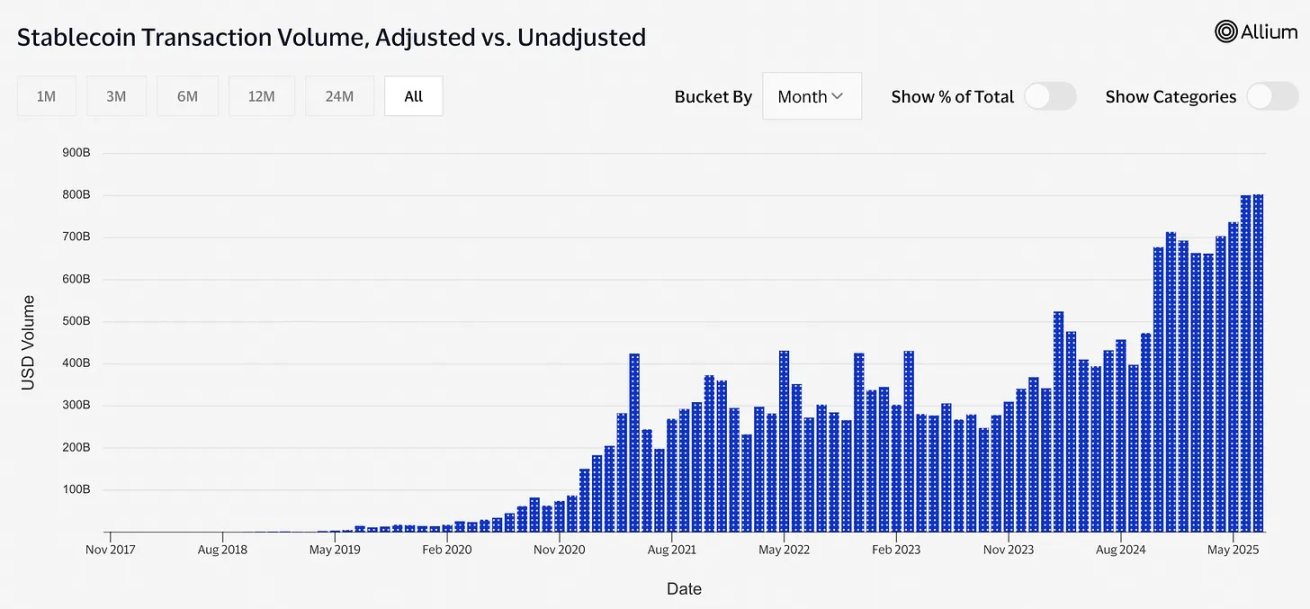
每发行一枚 USDC,就意味着多卖出一份国债。2420 亿美元的稳定币,意味着数百亿美元直接流入华盛顿,推高全球对美国国债的需求。每一笔跨境支付都避开了欧元或日元,每一个上架受监管美国稳定币的外汇市场,都是美国货币帝国的又一个「加盟店」。

《GENIUS 法案》是最精妙的外交政策操作,却伪装成了国内金融监管。

这引出了一些有趣的问题:当整个加密生态系统沦为美国货币政策的附属品,会发生什么?我们是在构建更去中心化的金融体系,还是在打造全球最复杂的美元分销网络?若 99% 的稳定币与美元挂钩,任何有意义的创新都需要美国货币监理署批准,我们是不是不小心把革命性技术变成了法定货币的终极出口生意?若加密货币的反叛能量被引向提升现有货币体系的效率,而非取代它,只要支付结算更快,大家都能赚钱,真的有人会在意吗?这些未必是问题,只是和这场运动刚开始时人们想解决的问题相去甚远。

我一直在调侃这事,但事实是,这可能真的行得通。就像 19 世纪 30 年代的自由银行制度演变成联邦储备系统一样,加密货币或许正在从混乱的青春期走向成熟,成为金融基础设施中具有系统重要性的一部分。

说实话,对 99.9% 的人来说,他们只想快速、低成本地转账,根本不在乎货币理论或去中心化理念。

银行已经在布局,准备成为这些新监管稳定币的主要发行者。摩根大通、美国银行、花旗集团据说都在筹备向客户提供稳定币服务。那些本应被加密货币颠覆的机构,如今成了加密监管合法化的最大受益者。

这不是任何人预期的革命,但或许是我们最终得到的革命。说来也怪,这也挺「天才」的。
Letture associate

Grayscale Report: Financial Privacy in the AI Era, Why Zcash Should Not Be Overlooked?

Title: Grayscale Report: Financial Privacy in the AI Era – Why Zcash Should Not Be Overlooked The article argues that privacy is a fundamental, not niche, attribute of functional money. It highlights that technological shifts, like the rise of AI and stablecoins, are driving a new wave of public focus on financial privacy. Zcash, a decentralized digital currency similar to Bitcoin but with built-in privacy via zero-knowledge proofs, is positioned to address this need. Unlike transparent blockchains, Zcash offers users the option to conduct "shielded" transactions that hide sender, receiver, and amount while remaining verifiable. The report details Zcash's evolution, noting key upgrades that improved usability and security. It points to rising on-chain usage of privacy features as evidence of real demand. Currently, ZEC holds a minimal share (~0.4%) of the total crypto market cap. Grayscale suggests this reflects a market assumption that privacy is a marginal concern. The investment thesis hinges on a potential market re-evaluation: if privacy is recognized as a core monetary feature in an era of enhanced surveillance, Zcash's current valuation represents significant upside potential. Key risks discussed include regulatory challenges, historical trusted setup concerns for older pools (mitigated by newer protocols), quantum computing threats, and execution risks associated with future technical upgrades. The conclusion is that while the future scale of private digital currency is uncertain, the market currently prices in little chance of its value increasing substantially, presenting a potential opportunity for investors.

marsbit39 min fa

Grayscale Report: Financial Privacy in the AI Era, Why Zcash Should Not Be Overlooked?

marsbit39 min fa

Vitalik Moves to Local Mixing as Obfuscation Series Reaches Third Stage

Ethereum co-founder Vitalik Buterin published the third part of his series on cryptographic obfuscation, focusing on a method called "local mixing." This method abandons lattices and elliptic curves in favor of ideas borrowed from hash function design. Buterin described local mixing as a "completely different way of cryptography," free from elliptic curves, prime factorization, and lattices, making it more akin to symmetric cryptography used in everyday encryption. The process begins with a circuit of logic gates like XOR, AND, and NOT. It undergoes a pipeline that ensures a correct output while obscuring any trace of the internal logic. Key steps include adding reversibility, strengthening, mechanization, mixing, and finally obfuscation. The mixing step scatters extra logic gates and shuffles their arrangement. Reversibility is foundational, allowing gates to be rewritten as other reversible gates with similar behavior. Buterin acknowledged local mixing is a "wild and risky undertaking," lying on the "graveyard of failed attempts at white-box cryptography." However, its proponents argue it needs more research effort and a willingness to accept higher overhead costs. Buterin suggested AI could accelerate its development. He called obfuscation the "final boss of cryptography," with the most complex constructions having runtimes exceeding the universe's age. The article concludes by explaining obfuscation's utility: it can encrypt a program so it still functions with normal inputs and outputs while hiding the code. Combined with blockchain, this moves toward a "trusted third party that requires no trust," enabling applications like private, collusion-resistant voting without relying on a trusted committee.

cryptonews.ru1 h fa

Vitalik Moves to Local Mixing as Obfuscation Series Reaches Third Stage

cryptonews.ru1 h fa

India Orders Closure of Hundreds of Google Firebase Accounts Used in Banking Frauds

India's cybercrime agency ordered Google to block hundreds of accounts on its Firebase app development platform. The move came after investigators traced numerous fake banking apps and phishing websites to the service. The Indian Cyber Crime Coordination Centre (I4C) sent multiple notices to Google, identifying at least 57 websites and databases on Firebase allegedly used to distribute malware and steal victims' financial data. Among these, seven were phishing pages mimicking login screens of major Indian banks like State Bank of India, ICICI Bank, and Axis Bank. The rest were reportedly data collection points for stolen information like credit card numbers and one-time passwords. The fraud scheme involved Android malware disguised as legitimate banking apps, luring victims with promises of new credit cards, rewards, or credit limit increases. Once installed, the app secretly forwarded device data to a Firebase database controlled by scammers, granting them access to other apps and the victim's funds. One scam specifically targeted beneficiaries of a government farmer aid program. This action marks a shift in India's approach. Previously focused on blocking individual fraudulent websites, authorities are now targeting the broader infrastructure enabling these scams. The move highlights how fraudsters exploit widely accessible platforms like Firebase, attracted by its free tier and database capabilities, to target India's vast digital payment user base.

cryptonews.ru1 h fa

India Orders Closure of Hundreds of Google Firebase Accounts Used in Banking Frauds

cryptonews.ru1 h fa

Trading

Spot
活动图片