Ethereum Price Prediction 2025: ETH at Crossroads

ccn.comPubblicato 2025-07-27Pubblicato ultima volta 2025-07-28

Introduzione

On May 15, 2025, one wallet held more than 50% of ETH’s supply.

Key Takeaways

  • Ethereum (ETH) is the second-biggest cryptocurrency in the world.
  • Ethereum traded above $4,000 in December 2024 but has fallen since.
  • Our Ethereum price prediction suggests ETH could return above $3,000.

Ethereum launched the Pectra upgrade on May 7, its most significant upgrade since Dencun. This upgrade had the unintended consequence of making the ETH supply inflationary.


Pectra aims to remedy this by doubling the number of Blobs, which has already had a deflationary effect on the ETH supply.


Ethereum’s price has reacted positively to the upgrade, increasing by over 50%.


Let’s examine our price predictions for ETH, made on May 15, 2025. We will also examine the history of ETH prices and explain what ETH is and what it does.

Ethereum Price Prediction


Here are the Ethereum price predictions from CCN on May 15, 2025. The projections are made using the wave count method, while the minimum and maximum targets depend on the price movement during each specific year.


Minimum Ethereum Price Prediction Average Ethereum Price Prediction Maximum Ethereum Price Prediction 2025 $1,385 $2,600 $3,750 2026 $740 $1,100 $2,400 2030 $5,000 $7,230 $15,000


The most likely wave count suggests that Ethereum has completed a five-wave upward movement since 2016 and corrected inside a W-X-Y structure (red) since its all-time high in 2021.


If the count is accurate, Ethereum is in sub-wave B (black) of the final wave Y. Giving wave Y the same length as wave X leads to a low of $740.


The Fib Time Zone tool suggests ETH will reach the low in June 2026.


During this projected upward movement, the wave count method predicts an Ethereum price of $2,600 by the end of 2025.

Ethereum Prediction

ETH/USDT Weekly Chart | Credit: Valdrin Tahiri/TradingView Then, we will use the daily rate of increase for the past seven years to make an Ethereum price prediction for the end of 2026 and 2030.


Ethereum’s price has increased by 370% in the past seven years, for a daily rate of 0.225%. Projecting this rate of increase forward from the June 2026 low leads to prices of $1,100 and $7,230 for the end of 2026 and 2030, respectively.


Ethereum Price Prediction for 2025


The wave count method predicts that Ethereum’s price will range between $1,385 and $3,750 by the end of 2025.


Ethereum Price Prediction for 2026


The wave count method and the daily rate of increase predict that Ethereum’s price will range between $740 and $2,400 by the end of 2026.


Ethereum Price Prediction for 2030


The wave count method and the daily rate of increase predict that Ethereum’s price will range between $5,000 and $15,000 by the end of 2026.


Ethereum Price Analysis


Ethereum’s price has completed a five-wave upward movement with an unusually extended wave five since April 7.


While the movement became parabolic on May 10, it has lost some momentum this week, becoming much more gradual.


Furthermore, technical indicators are showing weakness. The Relative Strength Index (RSI) and Moving Average Convergence/Divergence (MACD) created bearish divergences, a characteristic of wave five tops.


If the analysis is accurate, the ETH price has started an A-B-C correction (red), which can end at three support levels.


An extremely shallow retracement would reach the $2,420 area, a Fibonacci and horizontal support.

ETH Wave Count

ETH/USDT Six-Hour Chart | Credit: Valdrin Tahiri/TradingView

A deeper retracement could bring the $2,220 and $2,060 levels into play, coinciding with an ascending parallel channel.

Because of the highly extended wave five, it is unlikely that Ethereum’s price will fall below $2,060 without invalidating the count.


Short-term ETH Price Prediction


The Ethereum price prediction for the next 24 hours is bearish. ETH will likely retrace toward $2,060 before eventually resuming its upward movement.


Ethereum Average True Range (ATR): ETH Volatility


The Average True Range (ATR) measures market volatility by averaging the largest of three values: The current high minus the current low, the absolute value of the current high minus the previous close, and the absolute value of the current low minus the previous close over a period, typically 14 days.


A rising ATR indicates increasing volatility, while a falling ATR indicates decreasing volatility.

ETH ATR

Ethereum ATR | Credit: Valdrin Tahiri/TradingView On Jan. 3, 2025, ETH’s ATR was 44, a sign of average volatility.


ETH Relative Strength Index (RSI): Is ETH Overbought or Oversold?


The Relative Strength Index (RSI) is a momentum indicator that traders use to determine whether an asset is overbought or oversold. Movements above 70 and below 30 show over- and undervaluation, respectively.


Movements above and below the 50 line indicate whether the trend is bullish or bearish.

Ethereum RSI

ETH Weekly RSI | Credit: Valdrin Tahiri/TradingView On May 15, 2025, Ethereum’s RSI was 52, suggesting a neutral trend gradually turning bullish.


ETH Market Cap to TVL Ratio


The Market Cap to Total Value Locked (TVL) ratio measures the valuation of a decentralized finance project by comparing its market capitalization to the total value of assets locked in its smart contracts. This ratio shows the project’s utilization and links the platform’s health to locked asset value.


A ratio above 1.0 indicates overvaluation because the market cap exceeds the value of assets used in the platform. A ratio below 1.0 indicates undervaluation because the market cap is lower than the value of locked assets.
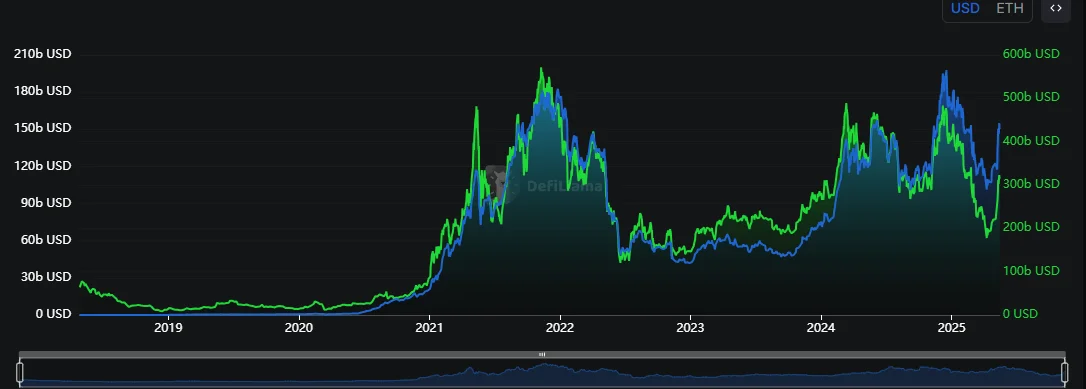
Market Cap to TVL

ETH MCAP/TVL | Credit: DeFiLlama On May 15, 2025, the Ethereum TVL ratio was 2.12, indicating a slight overvaluation.


CCN Strength Index


The CCN Strength Index combines an array of advanced market signals to measure the strength of individual cryptocurrencies over the last 30 days.
Every day, it assigns a strength score, ranging from 0 to 100, to the top 500 assets by market capitalization on CoinMarketCap, focusing on both trend direction and the intensity of price movements.

  • 0 to 24: Assets exhibit significant weakness, showing signs of sustained downtrend behavior.
  • 25 to 35: The price tends to move within stable bounds with minimal volatility.
  • 36 to 49: Assets begin a stable uptrend but without strong surges.
  • 50 to 59: Consistent growth with moderate price advances, building momentum.
  • 60+: Sharp price movements and high demand indicate more volatility and trend shifts.

The index dynamically adapts to rapid changes. For example, an asset experiencing a 100% increase within a short timeframe would see a sharp jump in its score to reflect the intensity of the rise.


However, should that asset stabilize at this new price level, the score will gradually taper down and align with the dampened momentum as the movement normalizes.
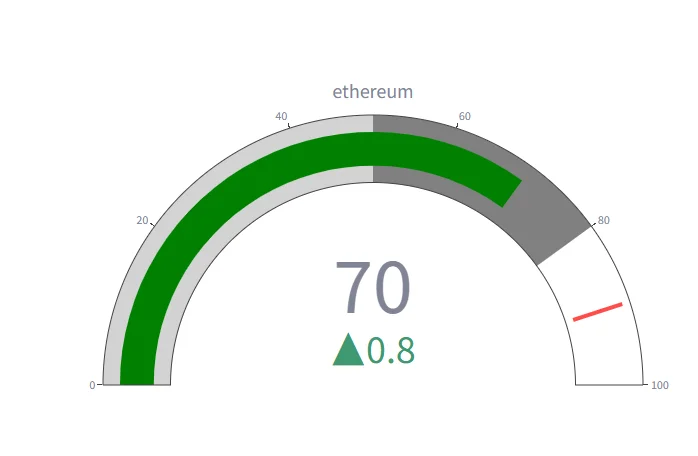
CCN Index

ETH CCN Index | Credit: CCN May 15, 2025, Ethereum scored 70 on the CCN Index, suggesting strong momentum.


Best Days and Months to Buy


We looked at the ETH price history and found the times when the price was at its lowest across certain days, months, quarters, and even weeks in the year, indicating the best times to buy Ethereum.


Time to Buy ETH Days, Weeks, Months, and Quarters Best Day Wednesday Best Week 33 Best Month January Best Quarter First


ETH Price Performance Comparison


Ethereum is a blockchain that deals with smart contracts, so let’s compare its performance with similar projects.


Current Price One Year Ago Price Change Ethereum $2,552 $3,035 -12.1% Solana $170.52 $158.01 +17.6% Cardano $0.77 $0.45 +76.9% Avalanche $23.79 $34.63 -27.8%
Advantages and Disadvantages


CCN’s Senior Research Analyst, Toghrul Aliyev, studied Ethereum in depth and found its advantages and disadvantages.


Advantages of Ethereum


Development

  • Ethereum ranks number one across multiple key development metrics: 112,535 repositories, 1,540 sub-ecosystems, 43,475 weekly commits, and 2,913 active developers. These numbers demonstrate Ethereum’s extensive range of applications and projects. The active development results in fewer bugs, faster issue resolution, and the ability to swiftly meet user demands and stay ahead of competitors.

Centralization and Decentralization

  • The 2016 The DAO hack led to the theft of 3.6 million ETH. In response, Ethereum implemented a hard fork to restore the stolen funds. Critics argue this decision contradicted Ethereum’s decentralized ethos. However, the hard fork demonstrated true decentralization only after achieving majority consensus through extensive community discussions and voting. With 14% of the total supply at risk and the ecosystem’s future in jeopardy, the move was not a bailout. In contrast, no hard fork was implemented when the Parity multi-signature wallet was exploited in 2017. Other critics compare The DAO hack to the Mt. Gox collapse, but this comparison misses key differences. When MtGox’s losses were revealed, the funds had already been widely dispersed, making a simple revert impossible. In the case of The DAO, the funds were locked for several weeks after the transfer, allowing for a different response.

Market Position

  • The approval of ETH ETFs makes Ethereum accessible to institutional investors like pension funds, mutual funds, and insurance companies. As a result, Ethereum is now part of traditional finance, which enhances its liquidity and price stability.
  • Ethereum ranks 1st in DEX trading volume, holding a 33.4% market share in the first quarter of 2024, with $144.2 billion in trades.


DEX Trading Volume

2024 Spot DEX Trading Volume Q1, 2024. Credit: CoinGecko

  • Ethereum leads in real-world asset tokenization. It has an almost 72% market share in tokenized US Treasuries. Ethereum also holds more than 98% of the commodities and more than 53% of the stablecoin supply on its network.

US Treasuries Stablecoins Commodities Ethereum $1384.49M $88604.92M $864.89M Stellar $433.27M $226.43M $9.83M Solana $47.96M $3199.73M – Mantle $39.72M – – Polygon $10.32M $361.26M – Arbitrum $5.22M $1309.82M – Gnosis $2.23M – – TRON – $61680.08M – BNB Smart Chain – $4994.37M – Base – $2,972.77 – Avalanche – $2185.47M – NEAR – $714.01M –

  • Positive: Ethereum dominates the DeFi sector by total value locked, holding more than 56% of the market share.

total Value Locked (TVL) all chains

Total Value Locked – All Chains. Source: DefiLlama Supply and Scalability

  • Positive: Users can stake Ethereum to earn rewards by participating in the network’s validation process.
  • Positive: Ethereum’s burning mechanism, introduced through the EIP-1559 upgrade, reduces the total supply of ETH over time. Each transaction on the Ethereum network includes a base fee, which gets burned, permanently removing that ETH from circulation. If the rate of ETH being burned is greater than the rate at which new ETH is created, the total supply of ETH decreases, leading to increased scarcity and potentially higher value per token.

Disadvantages of Ethereum


Development

  • When problems arise in the Ethereum network, solutions often involve outsourcing tasks to external organizations. This practice can compromise the protocol’s integrity because it relies on outside parties rather than the community or core developers. It creates a situation where external companies have significant influence over the network, leading to conflicts of interest and reducing the system’s trustworthiness.
  • Layer 2 solutions offer faster and cheaper transactions, causing users and developers to focus on them rather than the Ethereum network. As a result, developers prioritize creating and enhancing Layer 2 or Layer 3 solutions, shifting their innovation and development efforts away from Ethereum itself.
  • Ethereum developers focus on long-term solutions that take years to implement, mainly concentrating on Layer 2s and Layer 3s. Meanwhile, competitors are addressing Ethereum’s issues more quickly, thus attracting more users, developers, and investment. The dynamic leads to a loss of market share for Ethereum as other platforms offer immediate improvements and capture more of the market.

Centralization and Decentralization

  • Liquid staking lets users stake Ether and receive tokens representing their staked assets, which can be traded or used in other DeFi applications. However, it poses a risk to the protocol’s health. If too much Ether concentrates in liquid staking services, a few entities could gain significant control over the network. This is already a reality because Lido and Coinbase control over 40% of the market share in Ethereum’s staking. For proof-of-stake platforms, control by more than 33% of the stake is problematic because it increases the risk of collusion and potential network compromise.


Ethereum Stakers

Credit: Dune Analytics/Hildobby

  • As the hardware requirements for running a node on the Ethereum network increase, only entities with large data centers can afford to keep up. Smaller, individual node operators may find it too expensive to continue participating. This trend leads to a more centralized network, where a few large players dominate, reducing the network’s resilience and decentralization. As of July 2024, five ISPs—Amazon, Hetzner Online, OVH SAS, Comcast Cable, and Spectrum—are responsible for 1/3 of the network’s nodes out of 893 providers. The situation has improved since August 2022, when three ISPs hosted 2/3 of the nodes . However, this improvement still does not fully resolve the centralization issue.


Ethereum Node Distribution

Credit: Ethernodes.org

  • MEV refers to the profit miners can make by reordering, including, or excluding transactions within the blocks they produce. Instead of finding ways to solve this problem, Ethereum has started accommodating it by supporting proprietary MEV builders. The focus on MEV builders gives them precedence over local, smaller block producers, which can lead to a more centralized and unfair system.
  • Staking requires a minimum of 32 ETH, equivalent to $112,000 at an Ethereum price of $3,500, making it inaccessible for the average retail investor. The barrier reduces the level of decentralization, as fewer individuals can participate in securing the network.
  • Ethereum’s decision-making relies heavily on a small group of developers, which centralizes control and slows the decision-making process. The absence of on-chain governance means fewer community voices influence major updates, leading to less flexible responses to challenges. A centralized structure hampers Ethereum’s ability to adapt quickly and increases the risk of users and developers moving to more responsive platforms.

Market Position

  • Negative: Year-to-date inflows and outflows of Ethereum have resulted in a net outflow of $0.85 billion. More money leaving the chain than coming in indicates that investors and users prefer other chains over Ethereum, which could lead to decreased network activity and hinder its growth and development.

Inflows and Outflows

Inflows and outflows: Credit: Artemis.xyz Supply and Scalability

Ethereum Average Transaction Fee

ETH Average Transaction Fee. Source: Etherscan

  • Ethereum relies on Layer 2 solutions like Arbitrum and Optimism to handle more transactions. These help reduce congestion and fees but make Ethereum less viable as a standalone option. The significant market share of these Layer 2 platforms indicates a preference for alternatives. Although these solutions operate within the Ethereum ecosystem, relying on external chains instead of in-house solutions is not ideal. 
  • Due to congestion and inefficiency, Ethereum’s inability to scale results in a poor user experience. Additionally, fragmentation across Layer-2 solutions complicates dApp interoperability. It also complicates integrating new projects with existing ones, while reduced composability hampers innovation and growth within the ecosystem.
  • Ethereum’s focus on being a secure data availability layer for Layer 2 solutions highlights its scalability limitations. The mainnet remains less scalable, affecting the efficiency of the DA Layer. Meanwhile, scalable blockchains can process more transactions, capture higher revenue, and enhance security. This puts Ethereum at a competitive disadvantage as it struggles to match the performance and efficiency of more scalable blockchains.
  • Successful Layer 2 solutions may abandon Ethereum for more scalable Layer 1 blockchains. If Ethereum doesn’t provide sufficient revenue for these protocols to thrive, they will likely migrate to other platforms that offer better scalability and profitability, further weakening Ethereum’s ecosystem.
  • Due to scalability issues, congestion, and high fees, Ethereum’s DEX trading volume market share has been chipped away by other chains, mainly its Layer 2 solution, Arbitrum, and Ethereum’s biggest competition, Solana. In October 2023, Ethereum’s DEX trading volume market share was 56.49%, but by March 2024, it had dropped to 33.4%.
  • Recently, interest in Ethereum has dropped, leading to inflation exceeding the amount of ETH burned. Since April 2024, the net increase in ETH supply has been about 60,000 ETH monthly. If this trend continues, by Dec. 2024, the total supply of ETH could return to the levels seen at the time of the Merger.

Ethereum Price History


Now, look at some key dates in the ETH price history . While past performance is not an indicator of future results, knowing what the token has done can help provide context when making or interpreting an Ethereum price prediction.


Period Ethereum Price Last Week (May 8, 2025) $1,939 Last Month (April 15, 2025) $1,645 Three months ago (Feb. 15, 2025) $2,704 One year ago (May 15, 2024) $3,035 Five years ago (Jan. 3, 2020) $207.85 Launch price (Aug. 7, 2015) $2.83 All-time high (Nov. 16, 2021) $4,891 All-time low (Oct. 21, 2015) $0.42


Ethereum Market Cap


The market capitalization, or market cap, is the sum of the total ETH in circulation multiplied by its price.

Ethereum Market Cap

Ethereum market cap for the last 12 months | Credit: CoinMarketCap On May 15, 2025, Ethereum’s market cap was $306 billion, making it the second-largest crypto by that metric.
Who Owns the Most Ethereum (ETH)?
On May 15, 2025, one wallet held more than 50% of ETH’s supply.

Richest ETH Wallet Addresses


As of May 15, 2025, the five richest ETH wallets were

  • 0x00000000219ab540356cbb839cbe05303d7705fa. This wallet held 61,413,109 ETH, or 50.86% of the supply.
  • 0xc02aaa39b223fe8d0a0e5c4f27ead9083c756cc2. This wallet held 2,694,435 ETH, or 2.23% of the supply.
  • 0xbe0eb53f46cd790cd13851d5eff43d12404d33e8. This wallet, listed as Binance, held 1,996,008 ETH, or 1.65% of the supply.
  • 0x40b38765696e3d5d8d9d834d8aad4bb6e418e489. This wallet held 1,376,695 ETH, or 1.14% of the supply.
  • 0x49048044d57e1c92a77f79988d21fa8faf74e97e. This wallet held 1,107,296 ETH, or 0.92% of the supply.


Crypto di tendenza

Letture associate

The Impact of OUSD on Circle, Tether, and Paxos: Not a Simple Negative, but a More Complex Competitive Landscape

OUSD's Impact on Circle, Tether, and Paxos: A Nuanced Competitive Reshuffle The launch of OUSD, a new stablecoin initiative, has complex implications for the stablecoin market. For Circle (CRCL), the initial 15-20% stock drop reflects legitimate competitive concerns but is not a "death sentence." Circle retains deep liquidity, existing integrations, and first-mover advantages. A potential restructuring or termination of its Coinbase partnership could even double its net revenue in the short term, providing more competitive freedom. However, OUSD, backed by Stripe's engineering and product strengths, could become the default stablecoin within the Stripe ecosystem for new adopters, challenging USDC's position. OUSD does not solve the core barrier for corporate adoption: it remains a credit exposure to its issuer (likely a Bridge-related entity), which, like Circle, is not an investment-grade entity. Large banks and asset managers could still capture the most lucrative enterprise use cases. Circle must accelerate its payment/fintech product development and consider defensive M&A. For Tether, OUSD targets a different market segment. Tether will continue focusing on distribution channels not prioritized by Stripe or Circle. Its market share may decline over time, but within a significantly growing total market. Paxos faces the greatest pressure. OUSD undermines the key selling points of its USDG stablecoin, and Paxos's regulatory advantages may diminish as frameworks mature. This poses a more existential challenge, explaining Paxos's recent shift back to its brokerage-as-a-service business.

marsbit17 min fa

The Impact of OUSD on Circle, Tether, and Paxos: Not a Simple Negative, but a More Complex Competitive Landscape

marsbit17 min fa

OUSD's Impact on Circle, Tether, and Paxos: Not a Simple Negative, but a More Complex Competitive Reshuffle

This article analyzes the impact of the newly announced stablecoin OUSD, backed by a consortium including Stripe, on major incumbents like Circle (USDC), Tether (USDT), and Paxos (USDG). For Circle, the announcement is not a simple negative. While the initial market reaction was rational, it's not a "death sentence." Circle retains deep liquidity, existing integrations, and first-mover advantage. A potential restructuring or termination of its exclusive revenue-sharing deal with Coinbase could even near-double its net income in the short term, providing more competitive flexibility. However, within the Stripe ecosystem, OUSD, with its strong engineering and product focus, could become the default choice, displacing USDC for new integrations. Circle must accelerate its own fintech product development and consider defensive M&A. OUSD does not directly threaten Tether's core markets, which focus on different distribution channels. Tether's market share may decline over time but within a significantly growing overall market. Paxos faces the greatest pressure. OUSD undermines the primary value proposition of its USDG stablecoin, and Paxos's regulatory advantages may erode as frameworks mature, posing a more existential challenge. This explains Paxos's recent strategic pivot towards brokerage-as-a-service. A fundamental unresolved issue for enterprise adoption remains: if issued by a Bridge-related entity, OUSD, like USDC, still represents a credit exposure to a non-investment-grade issuer, unless a parent company guarantee is provided. Large banks and asset managers entering the space later could still compete for the most lucrative enterprise use cases.

链捕手18 min fa

OUSD's Impact on Circle, Tether, and Paxos: Not a Simple Negative, but a More Complex Competitive Reshuffle

链捕手18 min fa

Trading

Spot

Articoli Popolari

Cosa è ETH 3.0

ETH3.0 e $eth 3.0: Un'Analisi Approfondita del Futuro di Ethereum Introduzione Nel panorama in rapida evoluzione delle criptovalute e della tecnologia blockchain, ETH3.0, spesso indicato come $eth 3.0, è emerso come un argomento di considerevole interesse e speculazione. Il termine comprende due concetti principali che warrantono chiarimenti: Ethereum 3.0: Questo rappresenta un potenziale futuro aggiornamento volto ad aumentare le capacità dell'attuale blockchain di Ethereum, concentrandosi principalmente sul miglioramento della scalabilità e delle prestazioni. ETH3.0 Meme Token: Questo progetto di criptovaluta distinto cerca di sfruttare la blockchain di Ethereum per creare un ecosistema incentrato sui meme, promuovendo il coinvolgimento all'interno della comunità delle criptovalute. Comprendere questi aspetti di ETH3.0 è essenziale non solo per gli appassionati di criptovalute, ma anche per coloro che osservano tendenze tecnologiche più ampie nello spazio digitale. Che cos'è ETH3.0? Ethereum 3.0 Ethereum 3.0 è pubblicizzato come un aggiornamento proposto per la rete Ethereum già stabilita, che è stata la spina dorsale di molte applicazioni decentralizzate (dApps) e contratti smart sin dalla sua nascita. I miglioramenti previsti si concentrano principalmente sulla scalabilità, integrando tecnologie avanzate come lo sharding e le prove a conoscenza zero (zk-proofs). Queste innovazioni tecnologiche mirano a facilitare un numero senza precedenti di transazioni al secondo (TPS), potenzialmente raggiungendo milioni, affrontando così una delle limitazioni più significative della tecnologia blockchain attuale. Il miglioramento non è meramente tecnico, ma anche strategico; è volto a preparare la rete Ethereum per un'adozione e un'utilità diffuse in un futuro contrassegnato da un aumento della domanda di soluzioni decentralizzate. ETH3.0 Meme Token Al contrario di Ethereum 3.0, l'ETH3.0 Meme Token si avventura in un dominio più leggero e giocoso, combinando la cultura dei meme di internet con la dinamica delle criptovalute. Questo progetto consente agli utenti di acquistare, vendere e scambiare meme sulla blockchain di Ethereum, fornendo una piattaforma che promuove il coinvolgimento della comunità attraverso la creatività e interessi condivisi. L'ETH3.0 Meme Token mira a dimostrare come la tecnologia blockchain possa intersecarsi con la cultura digitale, creando casi d'uso che siano sia divertenti che finanziariamente praticabili. Chi è il Creatore di ETH3.0? Ethereum 3.0 L'iniziativa verso Ethereum 3.0 è principalmente propulsa da un consorzio di sviluppatori e ricercatori all'interno della comunità di Ethereum, tra cui Justin Drake. Conosciuto per le sue intuizioni e contributi all'evoluzione di Ethereum, Drake è stato una figura di spicco nelle discussioni riguardanti la transizione di Ethereum verso un nuovo livello di consenso, chiamato “Beam Chain.” Questo approccio collaborativo allo sviluppo significa che Ethereum 3.0 non è il prodotto di un creatore singolo, ma piuttosto una manifestazione di ingegno collettivo focalizzato sul progresso della tecnologia blockchain. ETH3.0 Meme Token I dettagli riguardanti il creatore dell'ETH3.0 Meme Token sono attualmente non rintracciabili. La natura dei token meme conduce spesso a una struttura più decentralizzata e guidata dalla comunità, il che potrebbe spiegare la mancanza di attribuzione specifica. Questo si allinea con l'etica della comunità crypto più ampia, dove l'innovazione spesso nasce da sforzi collaborativi piuttosto che individuali. Chi sono gli Investitori di ETH3.0? Ethereum 3.0 Il supporto per Ethereum 3.0 proviene principalmente dalla Ethereum Foundation insieme a una comunità entusiasta di sviluppatori e investitori. Questa associazione fondamentale fornisce un considerevole grado di legittimità e migliora le prospettive di implementazione di successo poiché sfrutta la fiducia e la credibilità costruite nel corso degli anni di operazioni della rete. Nel clima in rapida evoluzione delle criptovalute, il supporto della comunità gioca un ruolo cruciale nello sviluppo e nell'adozione, posizionando Ethereum 3.0 come un serio contenditore per i futuri progressi della blockchain. ETH3.0 Meme Token Sebbene le fonti attualmente disponibili non forniscano informazioni esplicite riguardo ai fondamenti o alle organizzazioni di investimento che sostengono l'ETH3.0 Meme Token, ciò è indicativo del modello di finanziamento tipico per i token meme, che spesso si basa sul supporto di base e sul coinvolgimento della comunità. Gli investitori in tali progetti sono tipicamente individui motivati dal potenziale per innovazioni guidate dalla comunità e dallo spirito di cooperazione trovato all'interno della comunità crypto. Come Funziona ETH3.0? Ethereum 3.0 Le caratteristiche distintive dell'Ethereum 3.0 risiedono nella sua proposta di implementazione della tecnologia di sharding e zk-proof. Lo sharding è un metodo di partizionamento della blockchain in pezzi più piccoli e gestibili o “shard,” che possono elaborare transazioni in modo concorrente piuttosto che sequenziale. Questa decentralizzazione dell'elaborazione aiuta a prevenire la congestione e garantisce che la rete rimanga reattiva anche sotto un carico pesante. La tecnologia delle prove a conoscenza zero (zk-proof) contribuisce con un ulteriore livello di sofisticazione consentendo la validazione delle transazioni senza rivelare i dati sottostanti coinvolti. Questo aspetto non solo migliora la privacy, ma aumenta anche l'efficienza complessiva della rete. Si parla anche di incorporare una macchina virtuale Ethereum a conoscenza zero (zkEVM) in questo aggiornamento, amplificando ulteriormente le capacità e l'utilità della rete. ETH3.0 Meme Token L'ETH3.0 Meme Token si distingue capitalizzando sulla popolarità della cultura dei meme. Stabilisce un mercato per gli utenti che desiderano partecipare al trading di meme, non solo per divertimento, ma anche per potenziale guadagno economico. Integrando funzioni come lo staking, la fornitura di liquidità e meccanismi di governance, il progetto promuove un ambiente che incentiva l'interazione e la partecipazione della comunità. Offrendo una miscela unica di intrattenimento e opportunità economica, l'ETH3.0 Meme Token mira ad attrarre un pubblico variegato, che va dagli appassionati di crypto ai semplici intenditori di meme. Timeline di ETH3.0 Ethereum 3.0 11 Novembre 2024: Justin Drake accenna al prossimo aggiornamento ETH 3.0, incentrato sui miglioramenti della scalabilità. Questo annuncio segna l'inizio delle discussioni formali riguardo l'architettura futura di Ethereum. 12 Novembre 2024: La proposta attesa per Ethereum 3.0 dovrebbe essere svelata a Devcon a Bangkok, preparando il terreno per un feedback più ampio della comunità e potenziali passi successivi nello sviluppo. ETH3.0 Meme Token 21 Marzo 2024: L'ETH3.0 Meme Token viene ufficialmente elencato su CoinMarketCap, segnando il suo ingresso nel dominio pubblico delle criptovalute e aumentando la visibilità per il suo ecosistema basato sui meme. Punti Chiave In conclusione, Ethereum 3.0 rappresenta una significativa evoluzione all'interno della rete Ethereum, concentrandosi sul superamento delle limitazioni riguardanti scalabilità e prestazioni attraverso tecnologie avanzate. I suoi aggiornamenti proposti riflettono un approccio proattivo alle future esigenze e usabilità. D'altra parte, l'ETH3.0 Meme Token incarna l'essenza della cultura guidata dalla comunità nello spazio delle criptovalute, sfruttando la cultura dei meme per creare piattaforme coinvolgenti che incoraggiano la creatività e la partecipazione degli utenti. Comprendere gli scopi e le funzionalità distinte di ETH3.0 e $eth 3.0 è fondamentale per chiunque sia interessato ai continui sviluppi nello spazio crypto. Con entrambe le iniziative che tracciano percorsi unici, esse sottolineano collettivamente la natura dinamica e multifacetica dell'innovazione blockchain.

199 Totale visualizzazioniPubblicato il 2024.04.04Aggiornato il 2024.12.03

Cosa è ETH 3.0

Cosa è ETHEREUM

HarryPotterTrumpHomerSimpson777Inu: Panoramica di un Progetto Crypto Web3 Introduzione Nel mondo in rapida evoluzione delle criptovalute e della finanza decentralizzata, progetti innovativi emergono frequentemente, catturando l'interesse della comunità degli investitori e degli appassionati di crypto. Uno di questi progetti è HarryPotterTrumpHomerSimpson777Inu, una criptovaluta che si trova all'incrocio tra cultura popolare e tecnologia blockchain. Questo token guidato dalla comunità mescola personaggi e figure politiche ben noti, con l'obiettivo di creare una piattaforma coinvolgente e promuovere un'adozione diffusa. Che cos'è HarryPotterTrumpHomerSimpson777Inu? HarryPotterTrumpHomerSimpson777Inu è un token costruito sulla blockchain di Ethereum, progettato per essere accessibile e divertente per un pubblico diversificato. L'unicità di questo progetto deriva dal suo approccio tematico, che intreccia elementi di fantasia, politica e intrattenimento. Sfruttando il fascino nostalgico di personaggi amati, il progetto cerca di creare un'esperienza di criptovaluta coinvolgente, incoraggiando il coinvolgimento e la partecipazione della comunità. L'obiettivo principale di HarryPotterTrumpHomerSimpson777Inu è stabilire un token che risuoni con gli utenti a livello personale, promuovendo sia il divertimento che il coinvolgimento nell'ambito crypto. Questo branding distintivo mira ad attrarre individui che in precedenza potrebbero non essersi interessati alle criptovalute, facilitando un nuovo punto di ingresso per utenti potenziali. Creatore di HarryPotterTrumpHomerSimpson777Inu L'identità del creatore dietro HarryPotterTrumpHomerSimpson777Inu rimane sconosciuta. Questa non è una pratica rara nel dominio delle criptovalute, dove l'anonimato è spesso preferito dai fondatori come mezzo di protezione della privacy e promozione di un ethos decentralizzato. Questa oscurità non diminuisce il valore del progetto; al contrario, riflette una tendenza più ampia all'interno del settore, dove molti progetti di successo sono emersi da origini anonime. Investitori di HarryPotterTrumpHomerSimpson777Inu Le informazioni pubbliche riguardo agli investitori di HarryPotterTrumpHomerSimpson777Inu sono limitate. La natura del progetto, incentrata sul coinvolgimento della comunità, suggerisce una dipendenza da investimenti di piccole dimensioni da parte di singoli appassionati piuttosto che da sostegni sostanziali da fondazioni di investimento consolidate o corporation. Questo livello di trasparenza nel finanziamento è tipico di molti progetti di criptovaluta guidati dalla comunità, dove il supporto spesso proviene da movimenti di base piuttosto che da investitori istituzionali. Come Funziona HarryPotterTrumpHomerSimpson777Inu? Operando sulla blockchain di Ethereum, HarryPotterTrumpHomerSimpson777Inu sfrutta la sua solida infrastruttura per facilitare transazioni e promuovere interazioni tra gli utenti all'interno della comunità. Ciò che distingue questo progetto è il suo posizionamento tematico: canalizzando il carisma di personaggi iconici provenienti da diversi ambiti culturali, crea un'identità di marca distintiva. Questo approccio non solo attrae gli utenti, ma coltiva anche una comunità fedele attorno al token. Le meccaniche operative del progetto si concentrano sul coinvolgimento della comunità. Adotta un modello decentralizzato che incoraggia la partecipazione, consentendo agli utenti di interagire attraverso vari canali mentre promuovono lo scambio di idee e esperienze. Inoltre, il progetto abbraccia i principi del Web3, privilegiando la sovranità degli utenti e la decentralizzazione, che sono i pilastri del futuro di Internet. Timeline di HarryPotterTrumpHomerSimpson777Inu La storia di HarryPotterTrumpHomerSimpson777Inu è segnata da diversi eventi decisivi: 12 agosto 2023: L'inizio di HarryPotterTrumpHomerSimpson777Inu, segnando il suo ingresso nell'ecosistema delle criptovalute. Fase di Sviluppo: Un periodo focalizzato sulla costruzione di una strategia completa per stimolare la crescita guidata dalla comunità e il coinvolgimento degli utenti. Listing sugli Scambi: Sebbene i dettagli specifici di listing non siano stati divulgati, il progetto è stato reso accessibile su vari scambi di criptovalute, migliorando la sua visibilità nel mercato. Coinvolgimento della Comunità: Sforzi continui per coinvolgere attivamente la comunità, stabilendo canali di dialogo e promuovendo la partecipazione attraverso varie attività, tra cui concorsi, discussioni e votazioni comunitarie. Aspetti Chiave di HarryPotterTrumpHomerSimpson777Inu Focus sulla Comunità Un tratto distintivo di HarryPotterTrumpHomerSimpson777Inu è la sua forte enfasi sul coinvolgimento della comunità. Il progetto incoraggia attivamente gli utenti a partecipare a discussioni, condividere idee e contribuire all'evoluzione del progetto. Questa interazione coltiva un senso di appartenenza e di ownership tra i membri della comunità, essenziale per la sostenibilità a lungo termine del token. Utilizzo della Blockchain di Ethereum La scelta di costruire sulla blockchain di Ethereum consente a HarryPotterTrumpHomerSimpson777Inu di sfruttare le sue caratteristiche di sicurezza ben consolidate e architettura decentralizzata. Questa base garantisce affidabilità per le transazioni e fornisce un framework affidabile su cui sviluppare varie funzionalità. Approccio Tematico Unico Fusione di elementi della cultura pop nella sua identità, HarryPotterTrumpHomerSimpson777Inu crea una narrazione coinvolgente che lo differenzia da altre criptovalute. L'amalgama di personaggi e temi genera riconoscimento e intrigo immediati, rendendo il token relazionabile a un'ampia gamma di utenti potenziali. Anonimato nello Sviluppo Il creatore anonimo del progetto rimane una caratteristica ricorrente in molte iniziative di criptovaluta. Questo aspetto evidenzia un ethos di decentralizzazione, introducendo anche un livello di mistero che potrebbe affascinare un segmento della comunità crypto, attirando l'attenzione sul progetto e invitando l'impegno da parte di utenti che supportano l'idea di un'iniziativa decentralizzata e gestita dalla comunità. Conclusione HarryPotterTrumpHomerSimpson777Inu si presenta come un'aggiunta distintiva al panorama delle criptovalute, combinando il fascino della cultura popolare con le meccaniche innovative della tecnologia blockchain. Sebbene i dettagli riguardanti il creatore e gli investitori specifici rimangano non divulgati, il focus del progetto sulla comunità e il suo approccio tematico lo contraddistinguono come un potenziale attore influente nel contesto del Web3 e delle criptovalute. Man mano che l'ecosistema delle criptovalute continua ad espandersi, iniziative come HarryPotterTrumpHomerSimpson777Inu ci ricordano le molteplici modalità in cui la blockchain può connettere le comunità globali attraverso narrazioni e valori condivisi.

1.0k Totale visualizzazioniPubblicato il 2024.04.06Aggiornato il 2024.12.03

Cosa è ETHEREUM

Come comprare ETH

Benvenuto in HTX.com! Abbiamo reso l'acquisto di Ethereum (ETH) semplice e conveniente. Segui la nostra guida passo passo per intraprendere il tuo viaggio nel mondo delle criptovalute.Step 1: Crea il tuo Account HTXUsa la tua email o numero di telefono per registrarti il tuo account gratuito su HTX. Vivi un'esperienza facile e sblocca tutte le funzionalità,Crea il mio accountStep 2: Vai in Acquista crypto e seleziona il tuo metodo di pagamentoCarta di credito/debito: utilizza la tua Visa o Mastercard per acquistare immediatamente EthereumETH.Bilancio: Usa i fondi dal bilancio del tuo account HTX per fare trading senza problemi.Terze parti: abbiamo aggiunto metodi di pagamento molto utilizzati come Google Pay e Apple Pay per maggiore comodità.P2P: Fai trading direttamente con altri utenti HTX.Over-the-Counter (OTC): Offriamo servizi su misura e tassi di cambio competitivi per i trader.Step 3: Conserva Ethereum (ETH)Dopo aver acquistato Ethereum (ETH), conserva nel tuo account HTX. In alternativa, puoi inviare tramite trasferimento blockchain o scambiare per altre criptovalute.Step 4: Scambia Ethereum (ETH)Scambia facilmente Ethereum (ETH) nel mercato spot di HTX. Accedi al tuo account, seleziona la tua coppia di trading, esegui le tue operazioni e monitora in tempo reale. Offriamo un'esperienza user-friendly sia per chi ha appena iniziato che per i trader più esperti.

3.0k Totale visualizzazioniPubblicato il 2024.12.10Aggiornato il 2026.06.02

Come comprare ETH

Discussioni

Benvenuto nella Community HTX. Qui puoi rimanere informato sugli ultimi sviluppi della piattaforma e accedere ad approfondimenti esperti sul mercato. Le opinioni degli utenti sul prezzo di ETH ETH sono presentate come di seguito.

活动图片