XRP Price Can Still Cross $3, But It Needs To Hold This Level Against Bears

bitcoinistPubblicato 2025-07-03Pubblicato ultima volta 2025-07-04

Introduzione

XRP’s recent rally to $2.30 has been followed by a cooling-off period, with the price falling back to $2.18 after...

Trusted Editorial content, reviewed by leading industry experts and seasoned editors. Ad Disclosure

XRP’s recent rally to $2.30 has been followed by a cooling-off period, with the price falling back to $2.18 after slipping below the short-lived $2.25 support. Although this pullback might raise concern, it comes on the back of a week-long steady increase that took XRP from $1.93 early last week back to the $2.33 resistance level that has held firm in the past 30 days.

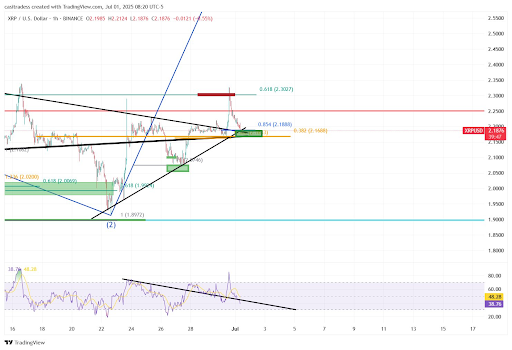
Crypto analyst CasiTrades shared an updated outlook with a chart to show how a test of the consolidation zone between $2.18 and $2.16 could determine whether XRP reclaims its bullish momentum to $3 or enters into a deeper reset.

$2.16–$2.18 Zone Determines XRP’s Direction

According to CasiTrades, who posted her technical analysis on the social media platform X, XRP’s recent retest around $2.16–$2.18 is not yet a breakdown, but it marks a defining moment. After reaching $2.30 resistance, the price wasn’t able to hold the $2.25 support level. Instead, it pulled back to retest. 

Notably, this zone was previously the top of a major consolidation structure, and holding above it would suggest that XRP is a simple backfill structure after a breakout.  This is a very common pattern where a crypto price rejects a key resistance, retests the initial breakout zone, and resumes the trend if momentum holds.
XRP
Source: CasiTrades on X

In the analyst’s view, the market needs to respect this range to confirm that XRP is still in breakout mode. The importance of this level is also echoed in the chart shared by the analyst, where a rising wedge intersects with the highlighted horizontal support at $2.1688 around the 0.382 Fibonacci retracement level. 

On the other hand, a failure to hold would shift the outlook drastically from a bullish perspective. As noted by the analyst, if the altcoin fails to hold above $2.16, it could initiate a pullback toward $1.90 and potentially invalidate the bullish setup that has been building over the past week.

RSI Divergence Points To Higher Chance Of Rebound

One of the early encouraging signs for XRP bulls is in the Relative Strength Index (RSI), which has been diverging from price. This is an excellent signal of seller exhaustion, which supports the analyst’s claim that the current move could be more of a cooldown than another crash to $1.90.

CasiTrades believes XRP would be ready for its next extension wave if bulls can defend the $2.16 to $2.18 range and reclaim $2.25. The price targets in view are $2.69 and $3.04, both based on Fibonacci levels. The first resistance level is at $2.3027 around the 0.618 Fibonacci extension. This price level is also a milestone for confirming the strength of the rally before a broader move to $3 and possibly above.

Interestingly, the altcoin’s price action in the past 12 hours has seen it already reclaiming bullish momentum after bouncing off an intraday low of $2.17. At the time of writing, XRP is trading at $2.27, up by 3.7% in the past 24 hours. This shows that buyers are already working to flip the $2.25 price level.

XRP
XRP trading at $02.28 on the 1D chart | Source: XRPUSDT on Tradingview.com
Featured image from Getty Images, chart from Tradingview.com
Editorial Process for bitcoinist is centered on delivering thoroughly researched, accurate, and unbiased content. We uphold strict sourcing standards, and each page undergoes diligent review by our team of top technology experts and seasoned editors. This process ensures the integrity, relevance, and value of our content for our readers.

Scott Matherson is a leading crypto writer at Bitcoinist, who possesses a sharp analytical mind and a deep understanding of the digital currency landscape. Scott has earned a reputation for delivering thought-provoking and well-researched articles that resonate with both newcomers and seasoned crypto enthusiasts. Outside of his writing, Scott is passionate about promoting crypto literacy and often works to educate the public on the potential of blockchain.

Letture associate

IOSG: Q-Day Countdown, Will Quantum Computing End Cryptocurrency?

IOSG: The Q-Day Countdown – Will Quantum Computing End Cryptocurrency? This analysis explores the looming threat quantum computing poses to blockchain technology. Quantum computers, leveraging Shor's algorithm, could theoretically break the elliptic curve cryptography (ECC) underpinning cryptocurrencies like Bitcoin and Ethereum. The article outlines a hypothetical "Q-Day" scenario where exposed public keys from dormant assets are compromised, leading to fund theft and a deep governance crisis. The core risk is not the complete erasure of blockchains but a systemic reset of public-key cryptography. Bitcoin faces significant challenges due to its "code-is-law" ethos and the immense social consensus required for migration. Its primary vulnerability lies in legacy UTXOs with publicly exposed keys. Ethereum's path involves a more complex, full-stack cryptographic agility upgrade across execution, consensus, and data layers. The industry has a limited "engineering comfort window" of 5-8 years to coordinate a migration to post-quantum cryptography (PQC), such as lattice-based or hash-based signatures. While the existential threat is often overstated, the real bottleneck is the immense coordination required across protocol developers, node operators, wallet providers, exchanges, and custodians. Market repricing of crypto assets may occur well before an actual Q-Day if quantum hardware roadmaps accelerate or regulatory pressure mounts. The article concludes that quantum computing is not a doomsday weapon but a severe stress test for blockchain's foundational security model and governance structures.

marsbit16 min fa

IOSG: Q-Day Countdown, Will Quantum Computing End Cryptocurrency?

marsbit16 min fa

Why 2026 could redefine Ethereum, Solana, Base and Avalanche

Blockchain infrastructure is undergoing a major coordinated transformation, driven by institutional demand for reliability, compliance, and predictable settlement. Over $30 billion in Real-World Assets (RWA) on-chain has exposed network weaknesses. Major blockchains are responding with foundational upgrades, moving beyond incremental speed improvements. Ethereum's "Glamsterdam" upgrade, planned for H1 2026, will significantly increase gas limits and introduce features like PBS (pre-blocked state) for enhanced settlement and parallel execution. Solana's "Alpenglow," targeting a mainnet launch in H2 2026, focuses on reducing finality time dramatically and freeing network resources to improve reliability. Beyond speed, compliance is critical. Base's "Beryl" upgrade in Q3 2026 will introduce a standardized, regulatory-compliant token framework (B20). Avalanche's "Octane" upgrade aims to boost transaction processing and reduce costs for enterprise applications. Even Bitcoin is evolving with the potential activation of OP_CAT by late 2026/early 2027. The competition is shifting. While technical upgrades are widespread, institutions will ultimately allocate capital based on proven execution, operational resilience, and regulatory compatibility during market stress. Ethereum currently leads in tokenized assets, while networks like Base and Solana are strengthening their institutional offerings. The blockchain that best delivers reliable, compliant, and uninterrupted service is poised to attract the greatest share of future institutional capital.

ambcrypto54 min fa

Why 2026 could redefine Ethereum, Solana, Base and Avalanche

ambcrypto54 min fa

Tiger Research: Take RWA Tokenization Overseas First

This article discusses the strategic choices facing financial institutions in jurisdictions lacking mature regulatory frameworks for Real-World Asset (RWA) tokenization. With the market growing rapidly, institutions must choose between waiting for local legislation, using regulatory sandboxes, or—the recommended priority—expanding into overseas markets to gain early experience. Successfully launching cross-border RWA tokenization requires meticulous preparation across six key areas: establishing an overseas base (e.g., Hong Kong, Singapore, the U.S.), securing necessary licenses, defining the tokenized asset (with bonds being simpler than non-standard assets), defining the target investor scope, deciding on settlement currencies/payment flows, and designing operational requirements like custody and on-chain governance. The article outlines two primary strategic paths: a direct "onshore" path and a "native on-chain" path. The direct path involves setting up a legal entity and obtaining licenses in a mature jurisdiction like Hong Kong, Singapore, or the U.S., leveraging existing platforms (e.g., DigiFT, Securitize) for efficiency. The alternative native on-chain path involves partnering with compliant, decentralized platforms (e.g., Ondo, Plume Nest) that use structures like offshore SPVs to facilitate tokenization and access DeFi liquidity, offering speed and broader reach but with greater structural complexity. The core argument is that institutions should not wait for perfect domestic regulation. A detailed hypothetical case study illustrates the multi-step, 6-12 month process of launching an overseas tokenized bond. The key takeaway is that the essence of a tokenization business lies not in the technology but in successfully executing the entire sales and operational process. The market is moving forward, and the time to act is now.

marsbit1 h fa

Tiger Research: Take RWA Tokenization Overseas First

marsbit1 h fa

Trading

Spot
活动图片