Осторожный оптимизм. 96,7% предложения биткоина оказалось «в плюсе»

cryptonews.ruPubblicato 2023-12-02Pubblicato ultima volta 2025-07-02

По состоянию на конец июня 96,7% предложения первой криптовалюты находилось в прибыли, что указывает на высокий риск волатильности. Об этом говорится в отчете Glassnode.
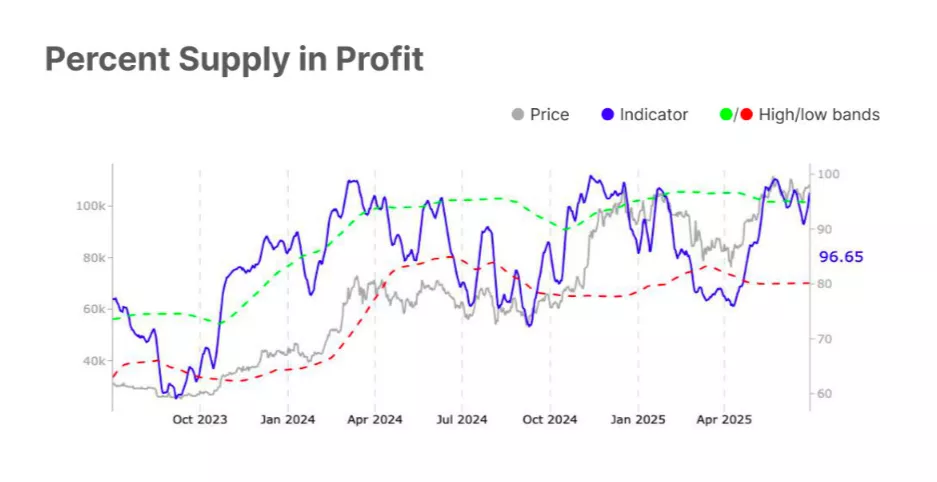
Доля предложения биткоина в прибыли. Данные: Glassnode.

Исторически такие высокие уровни приводят к давлению продаж, поскольку растет потенциал фиксации прибыли, отметили исследователи. Текущая обстановка отражает «бычий настрой инвесторов, но с сохранением осторожности в отношении ценовых коррекций».

С 22 по 30 июня коэффициент реализованной прибыли и убытков по биткоину подскочил с 1,1 до 2,8 пунктов.
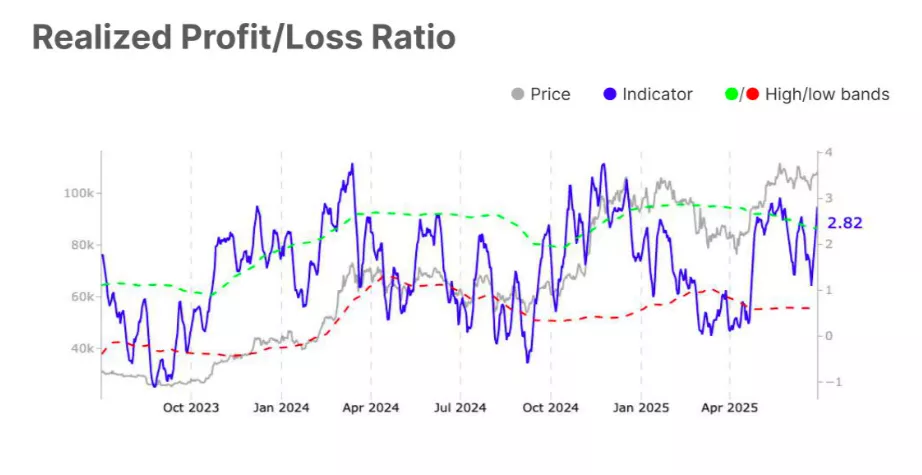
Коэффициент реализованной прибыли и убытков биткоина. Данные: Glassnode.

«Похоже, рынок вошел в режим осторожного оптимизма с более сильными позициями институциональных игроков и возобновлением накоплений», — добавили в Glassnode.

По мнению экспертов, для поддержания ралли необходимы постоянный спрос и более широкое доверие рынка.

В недельном отчете компании сказано, что общая «бумажная прибыль» биткоин-инвесторов достигла $1,2 трлн, приблизившись к историческому максимуму конца 2024 года в $1,3 трлн.
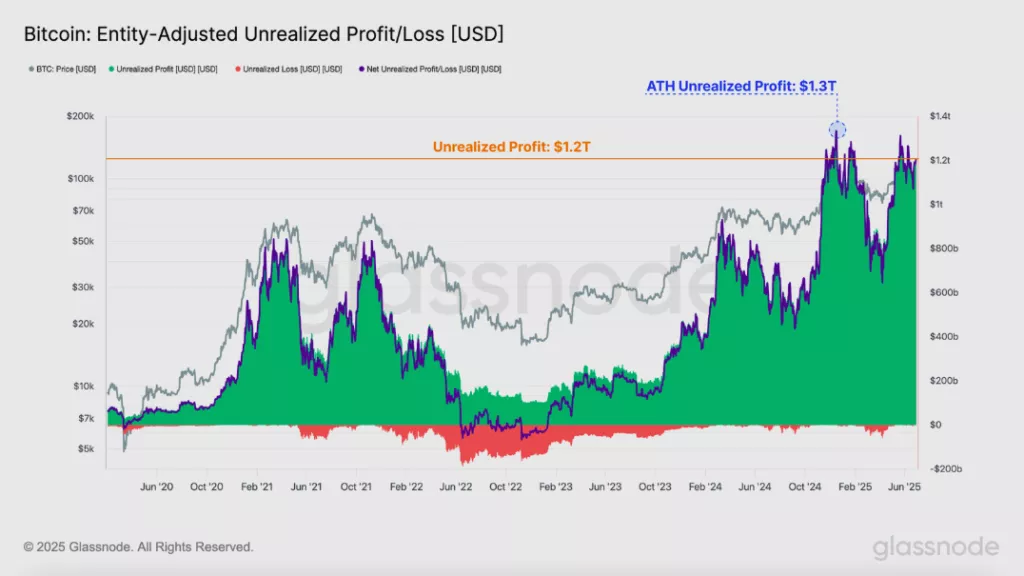
Нереализованная прибыль биткоина. Данные: Glassnode.

Средняя нереализованная прибыль держателя цифрового золота составляет 125%. Перед максимумом показатель составлял 180%.

«Ходлинг, по-видимому, является доминирующей рыночной механикой по множеству метрик расходов», — заключили аналитики.

Такая динамика приводит к снижению реализованной прибыли биткоина и росту объема монет у долгосрочных держателей. Метрика почти приблизилась к рекорду.
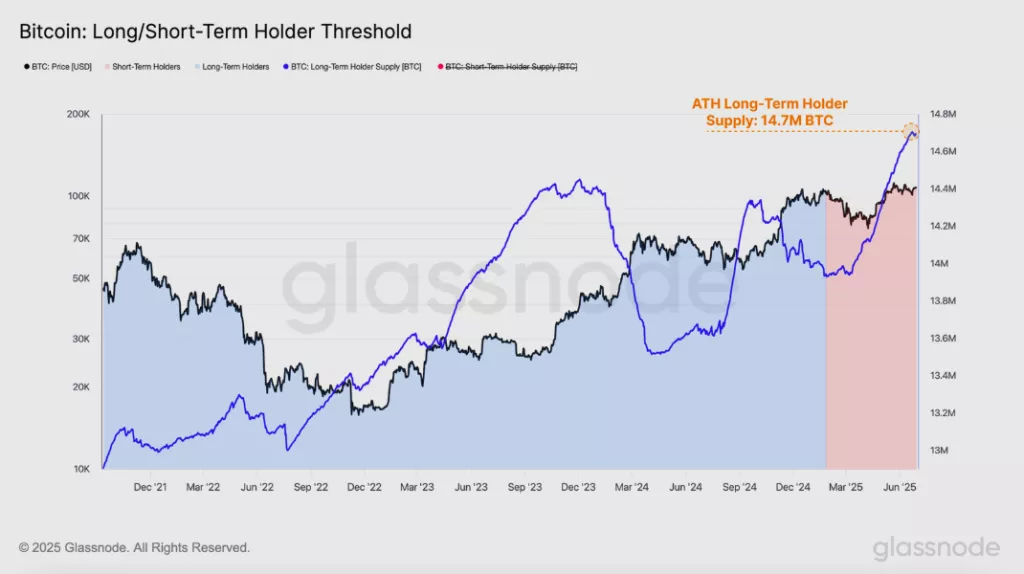
Данные: Glassnode.

В Glassnode также обратили внимание на резкое снижение продаж со стороны краткосрочных держателей после роста биткоина до уровней около исторического максимума в мае 2025 года.
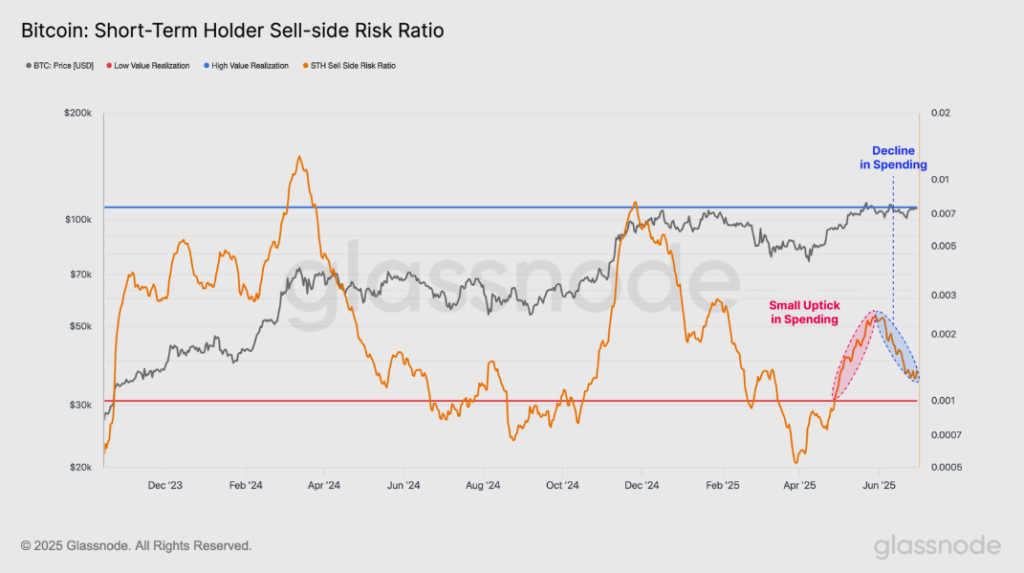
Давление продаж краткосрочных инвесторов. Данные: Glassnode.

«Это еще раз говорит о том, что текущий ценовой диапазон недостаточно привлекателен для инвесторов и продолжения продаж с их стороны, а значит рынку, возможно, придется подняться (или опуститься), чтобы разблокировать дополнительное предложение», — подчеркнули исследователи.

Напомним, аналитики банка Standard Chartered заявили, что халвинг больше не повлияет на цикл первой криптовалюты, и спрогнозировали ее рост до $200 000 к концу 2025 года.


Letture associate

In the AI Era, What's Left for Bitcoin?

As Bitcoin falls below $60,000, the author reflects on the relationship between AI and Bitcoin, seeing them as two sides of the same coin. In the AI era, the cost of generating content has plummeted, making fake text, images, and videos increasingly easy and cheap to produce. This has led to a fundamental shift: while AI dramatically lowers the cost of information production, it also undermines trust and authenticity online. What becomes truly valuable is not more content, but the ability to verify what is real—"verifiability." This perspective offers a new lens for Bitcoin. Its massive energy consumption, often criticized as wasteful, is reinterpreted. While AI burns energy to enhance "capability" and efficiency, Bitcoin burns energy to produce "verifiability." Its purpose is not to be trusted but to enable a system where no trust in intermediaries—banks, platforms, or developers—is needed. Every transaction and the entire ledger's history is secured by cryptography and a decentralized network of nodes, making it independently verifiable. AI cannot forge a transaction on the Bitcoin network because the system is designed for proof, not generation. The author draws a historical parallel to the Renaissance: the printing press drastically reduced the cost of copying knowledge, while double-entry bookkeeping reduced the cost of trust in commerce. Today, AI is the new printing press, reducing content creation costs to near zero. Blockchain, and Bitcoin as its pioneer, may be the modern equivalent of double-entry bookkeeping—a foundational technology for verifying digital asset ownership and historical records without centralized authorities. Thus, AI and blockchain are not competitors. AI lowers the cost of creation; blockchain lowers the cost of verification. In an age where AI can generate anything, true scarcity may lie not in more content, but in independently verifiable facts. Whether the market will reprice Bitcoin accordingly remains uncertain, but its core value proposition as a "machine for producing verifiability" becomes strikingly relevant.

marsbit1 h fa

In the AI Era, What's Left for Bitcoin?

marsbit1 h fa

In the Age of AI, What's Left for Bitcoin?

Author: Sevclub, Seven Research Amid Bitcoin's recent drop below $60k, the author reflects on a growing sense that AI and Bitcoin are two sides of the same coin. Today, encountering any content triggers a new default question: "Was this made by AI?" The cost of generating convincing text, images, and video is now negligible. While the internet lowered information *distribution* costs, AI is crashing information *production* costs to near zero. The consequence is a flood of content where truth and falsehood are increasingly indistinguishable. In this environment, what becomes truly valuable is not more information, but the ability to verify what is real—"verifiability." This reframes the common criticism that Bitcoin "wastes electricity." AI consumes power to produce "capability" (e.g., more powerful models). Bitcoin consumes power to produce something else: "verifiability." Bitcoin's core purpose isn't about belief or trust in any institution, developer, or even its creator. It's about enabling independent verification. Every bitcoin's origin, every transaction, and the integrity of the entire ledger are secured by mathematics, cryptography, and a global network of nodes. AI can fabricate convincing media, but it cannot falsify a transaction on the Bitcoin network. The expended energy makes篡改历史 (tampering with history) prohibitively expensive, purchasing a globally verifiable ledger. The author draws a historical parallel to the Renaissance. The printing press drastically reduced the cost of copying knowledge, while double-entry bookkeeping reduced the cost of trust in commerce—one enabled creation, the other verification. Today, AI is the new printing press, driving content production costs toward zero. The question becomes: what is this era's "double-entry bookkeeping"? Blockchain appears to be the leading candidate. It doesn't verify which news is true or which image is real, but it provides a foundational layer for independently verifying asset ownership and historical records in the digital realm without centralized authorities. Therefore, AI and blockchain are not in competition. AI lowers the cost of *generation*. Blockchain (and Bitcoin as a prime example) lowers the cost of *verification*. One creates, the other proves. Whether Bitcoin ultimately succeeds remains uncertain, facing potential challenges from quantum computing, regulation, and technical evolution. However, the author now sees it less as a "machine for making bitcoin" and more as a "machine for making verifiability." In an age where AI can generate anything, true scarcity may no longer be "more content," but "more independently verifiable facts." Whether the market will price this accordingly is a separate question.

链捕手1 h fa

In the Age of AI, What's Left for Bitcoin?

链捕手1 h fa

Trading

Spot
活动图片