Bank Of Korea Halts CBDC Project As Lawmakers Focus On Stablecoin Regulation

bitcoinistPubblicato 2025-07-01Pubblicato ultima volta 2025-07-01

Introduzione

The Bank of Korea (BOK) has reportedly halted its Central Bank Digital Currency (CBDC) project following the South Korean government’s...

Trusted Editorial content, reviewed by leading industry experts and seasoned editors. Ad Disclosure

The Bank of Korea (BOK) has reportedly halted its Central Bank Digital Currency (CBDC) project following the South Korean government’s focus on stablecoins. The shift has left project participants with “no long-term roadmap” and banks pivoting to this sector.

BOK Suspends Second Phase Of CBDC Testing

On Sunday, local news outlet Yonhap News Agency reported that the Bank of Korea had notified banks participating in the Han River Project that the second phase of CBDC testing would be suspended.

The BOK and seven banks began the first phase of testing in April, targeting 100,000 financial consumers and planning to complete it by June 30. Originally, the project was scheduled to start its second phase at the end of the year, testing peer-to-peer transfers, expanding payment merchant locations, and simplifying authentication methods.

However, banks reportedly raised concerns about the “excessive cost burden without concrete plans for commercialization,” leading to the project’s pause. Notably, the banking sector is bearing the cost of the project and recently demanded that the Bank of Korea provide a clear long-term roadmap with plans for commercialization.

Banks requested the BOK to “establish a ‘CBDC General User Real-Transaction Test Task Force’ involving all relevant departments of the Bank of Korea and banks to develop a long-term roadmap including post-test commercialization plans, and then realistically adjust the project schedule based on this roadmap.”

As a result, the BOK has concluded that it must clarify its internal stance and schedule regarding digital assets, as stablecoin momentum grows and discussions in the National Assembly and the private sector intensify.

According to a senior official at a commercial bank, the Bank of Korea explained that it would “wait and see how the situation develops, given that the legalization of stablecoins is currently underway, while it is unclear how CBDC, stablecoins, and deposit tokens differ and can coexist.”

Similarly, another senior official affirmed that the atmosphere is shifting toward stablecoins, detailing that “Until the dinner meeting between Bank of Korea Governor Lee Chang-yong and bank presidents on the 23rd, the atmosphere was not like this, but the situation has changed significantly since then.”

Nonetheless, the Han River Project could be reconsidered in 2026, according to another bank official, who claimed that the Bank of Korea mentioned the possibility of revisiting CBDC testing and “pushing forward with it around the first half of next year.”

Banks Prepare For Stablecoin Legislation

Following this development, banks participating in the CBDC project are expected to shift to stablecoin issuance as related legislation gains support, preparing for issuance with other banks or non-bank entities.

 At the start of the month, a member of South Korea’s ruling party, Min Byeong-deok, introduced a comprehensive bill to establish a more structured regulatory framework for crypto assets in the country.

As reported by Bitcoinist, the Democratic Party of Korea (DPK) lawmaker proposed the Digital Assets Basic Act to complement the Virtual Asset Investor Protection Act and offer a broader legal foundation for the industry.  Additionally, it focuses on implementing a licensing system for stablecoin issuers and clear rules.

The banking sector is considering a business model in which banks establish a joint venture to collectively issue stablecoins, while contacting various non-bank companies to prepare for the legalization and issuance of stablecoins.

A bank official affirmed that “It is unclear whether banks or big tech (large IT companies) and fintech (financial technology companies) will be the issuers of stablecoins,” adding that they “have no choice but to prepare for both scenarios before legalization.”

Another bank official stated that it is necessary to collaborate with fintech companies for scalability, explaining that banks are “not only discussing stablecoins with the Bank of Korea and other banks, but also meeting regularly with ‘payment’ companies, cryptocurrency exchanges, and blockchain companies to prepare for the issuance of stablecoins.”
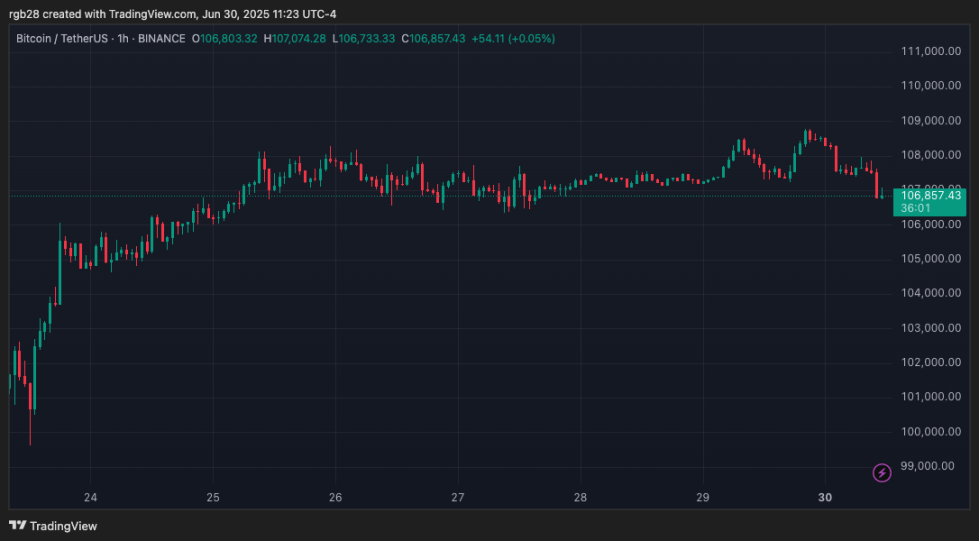
stablecoin, Bitcoin, btc, btcusdt

Bitcoin (BTC) trades at $106,857 in the one-week chart. Source: BTCUSDT on TradingView
Featured Image from Unsplash.com, Chart from TradingView.com
Editorial Process for bitcoinist is centered on delivering thoroughly researched, accurate, and unbiased content. We uphold strict sourcing standards, and each page undergoes diligent review by our team of top technology experts and seasoned editors. This process ensures the integrity, relevance, and value of our content for our readers.

Rubmar is a crypto enthusiast who likes learning and improving constantly. She enjoys reporting on the latest news and developments in the crypto industry. Rubmar also enjoys scrapbooking, crafting, simulation games, and watching football.

Crypto di tendenza

Letture associate

Founder of Baixing.com: The Notion That Large Language Models Will Devour Everything, I Believe Half of It

Founder of Baixing.com: I Only Half-Believe the Saying “Large Language Models Will Devour Everything” Author: Wang Jianshuo, Founder of Baixing.com Many proclaim that large models are everything, but the author is skeptical. He argues that such sweeping claims often stem from a limited understanding of the future. Drawing parallels to past technologies like electricity and the internet—which were predicted to “devour everything” but didn’t—he suggests that large language models (LLMs) are better seen as a foundational base. Like electricity, this base is essential for modern development, but its real value emerges only when applied to specific scenarios through various “machines” or “tools” (e.g., Claude Code for programming, Claude Design for design). The author acknowledges that LLMs may indeed replace many existing software systems built on rigid rules, workflows, and forms (e.g., CRMs, SaaS tools), as these are precisely what LLMs excel at processing. However, he emphasizes that beyond software, elements like customer data, execution capabilities (e.g., booking a flight), trust, and physical-world interactions will not be “devoured.” Instead, he foresees that after streamlining existing software, LLMs will open up a larger space for innovative, next-generation applications. These new tools will likely feature fluid interfaces and rely less on fixed rules, unleashing greater creativity. The author cautions against short-sightedness, recalling how in 2004 many believed internet giants like Sina, Sohu, and NetEase would monopolize the market—only to be proven wrong by subsequent disruptions. In conclusion, while LLMs are a crucial foundation and a current focal point, the true mainstream of this wave lies in the diverse applications built atop them to solve concrete problems. The phrase “devour everything” is imprecise; the real opportunity lies in identifying and leveraging the areas where LLMs do bring transformative change.

marsbit2 h fa

Founder of Baixing.com: The Notion That Large Language Models Will Devour Everything, I Believe Half of It

marsbit2 h fa

Founder of Baixing.com: I Only Half Believe in the Notion that Large Language Models Devour Everything

The founder of Baixing Wang states that while large language models (LLMs) are an extremely important foundational technology—akin to electricity or the internet—he only "half believes" the notion that they will "consume everything." He argues that LLMs provide a base layer of intelligence, but real-world value and transformation come from integrating this intelligence into specific applications and devices designed for particular scenarios—like how electricity powers various appliances from washing machines to TVs. He agrees LLMs will likely consume or replace a significant portion of existing rule-based, workflow-driven software (e.g., many SaaS systems, CRMs), as these are precisely what LLMs excel at handling. However, numerous other elements—such as customer data, execution capabilities (e.g., booking a flight), trust, and physical-world interactions—will not be consumed. Wang emphasizes that after LLMs absorb certain software layers, they will open up a much larger space for innovation: new types of "streaming" software with less rigid interfaces, where fixed rules are managed by AI. This next wave of applications built on top of the stable LLM foundation is where the true mainstream opportunity lies. He cautions against the short-sightedness of declaring any technology as all-consuming, drawing parallels to past premature predictions about internet giants monopolizing the web. The key is to find opportunities within the areas LLMs do transform.

链捕手2 h fa

Founder of Baixing.com: I Only Half Believe in the Notion that Large Language Models Devour Everything

链捕手2 h fa

Trading

Spot

Articoli Popolari

Cosa è $BANK

Banca AI: Un Passo Rivoluzionario nel Futuro della Banca Introduzione In un'era caratterizzata da rapidi progressi tecnologici, Banca AI si trova all'incrocio tra intelligenza artificiale (AI) e servizi bancari. Questo progetto innovativo mira a ridefinire il panorama finanziario, migliorando l'efficienza operativa, le misure di sicurezza e le esperienze dei clienti attraverso il potere dell'AI. Mentre ci impegniamo in questa esplorazione di Banca AI, esamineremo cosa comporta il progetto, le sue dinamiche operative, il suo contesto storico e i traguardi significativi. Cos'è Banca AI? Alla sua essenza, Banca AI rappresenta un'iniziativa trasformativa volta a integrare l'intelligenza artificiale in varie operazioni bancarie. Questo progetto sfrutta le capacità dell'AI per automatizzare processi, migliorare i protocolli di gestione del rischio e potenziare l'interazione con i clienti attraverso servizi personalizzati. Gli obiettivi principali di Banca AI includono: Automazione delle Funzioni Bancarie: Sfruttando le tecnologie AI, Banca AI mira ad automatizzare compiti di routine, riducendo il carico sulle risorse umane e aumentando l'efficienza. Miglioramento della Gestione del Rischio: Il progetto utilizza algoritmi AI per prevedere e identificare i rischi, rafforzando così le misure di sicurezza contro le frodi e altre minacce. Personalizzazione dei Servizi Bancari: Banca AI si concentra sull'offrire prodotti e servizi finanziari su misura analizzando i dati e i comportamenti dei clienti. Miglioramento dell'Esperienza del Cliente: L'implementazione di soluzioni guidate dall'AI, come chatbot e assistenti virtuali, mira a fornire agli utenti interazioni più umane, rivoluzionando il modo in cui i clienti si relazionano con le banche. Con questi obiettivi, Banca AI si posiziona come un attore cruciale nel rendere la banca più efficiente, sicura e centrata sull'utente. Chi è il Creatore di Banca AI? I dettagli riguardanti il creatore di Banca AI rimangono sconosciuti. Pertanto, non è stata identificata alcuna persona o organizzazione specifica nelle informazioni disponibili. L'anonimato che circonda la nascita del progetto solleva domande, ma non sminuisce la sua ambiziosa visione e obiettivi. Chi sono gli Investitori di Banca AI? Simile al creatore del progetto, informazioni specifiche riguardo gli investitori o le organizzazioni di supporto di Banca AI non sono state divulgate. Senza queste informazioni, è difficile delineare il sostegno finanziario e istituzionale che potrebbe spingere il progetto in avanti. Tuttavia, l'importanza di avere una solida base di investimento è fondamentale per sostenere lo sviluppo in un campo così innovativo. Come Funziona Banca AI? Banca AI opera su più fronti innovativi, concentrandosi su fattori unici che la differenziano dai framework bancari tradizionali. Di seguito sono riportate le caratteristiche operative chiave: Automazione: Applicando algoritmi di machine learning, Banca AI automatizza vari processi manuali all'interno delle banche. Ciò si traduce in una riduzione dei costi operativi e consente ai lavoratori umani di reindirizzare i propri sforzi verso attività più strategiche. Gestione Avanzata del Rischio: L'integrazione dell'AI nelle pratiche di gestione del rischio fornisce alle banche strumenti per prevedere con precisione potenziali minacce come le frodi, garantendo che le informazioni e i beni dei clienti rimangano al sicuro. Raccomandazioni Finanziarie Personalizzate: Attraverso l'apprendimento continuo dalle interazioni con i clienti, i sistemi AI sviluppano una comprensione sfumata delle esigenze degli utenti, consentendo loro di offrire consigli su misura per le decisioni finanziarie. Interazioni Migliorate con i Clienti: Utilizzando chatbot e assistenti virtuali alimentati dall'AI, Banca AI consente un'esperienza cliente più coinvolgente, permettendo agli utenti di risolvere rapidamente le loro richieste, riducendo così i tempi di attesa e migliorando i livelli di soddisfazione. Tutte queste caratteristiche operative posizionano Banca AI come un pioniere nel settore bancario, stabilendo nuovi standard per la fornitura di servizi e l'eccellenza operativa. Timeline di Banca AI Comprendere la traiettoria di Banca AI richiede uno sguardo al suo contesto storico. Di seguito è riportata una timeline che evidenzia traguardi e sviluppi importanti: Inizio 2010: La concettualizzazione dell'integrazione dell'AI nei servizi bancari ha cominciato a guadagnare attenzione mentre le istituzioni bancarie riconoscevano i potenziali benefici. 2018: Si è verificato un aumento significativo nell'implementazione delle tecnologie AI quando le banche hanno iniziato a utilizzare strumenti AI come i chatbot per servizi clienti di base e sistemi di gestione del rischio per migliorare la sicurezza. 2023: La sofisticazione dell'AI ha continuato ad avanzare, con l'introduzione dell'AI generativa per compiti più complessi come l'elaborazione di documenti e l'analisi degli investimenti in tempo reale. Quest'anno ha segnato un significativo salto nelle capacità offerte alle banche dalla tecnologia AI. 2024-Stato Attuale: A partire da quest'anno, Banca AI è su una traiettoria ascendente, con ricerche e sviluppi in corso pronti a migliorare ulteriormente le capacità nelle operazioni bancarie. L'esplorazione continua delle applicazioni AI suggerisce sviluppi entusiasmanti in arrivo. Punti Chiave su Banca AI Integrazione dell'AI nella Banca: Banca AI si concentra sull'adozione dell'intelligenza artificiale per snellire i processi bancari e migliorare le esperienze degli utenti. Focus su Automazione e Gestione del Rischio: Il progetto enfatizza fortemente queste aree, mirando a spostare il carico di compiti di routine mentre migliora le strutture di sicurezza attraverso analisi predittive. Soluzioni Bancarie Personalizzate: Sfruttando i dati dei clienti, Banca AI consente servizi bancari su misura che si adattano alle esigenze individuali degli utenti. Impegno per lo Sviluppo: Banca AI rimane impegnata in sforzi di ricerca e sviluppo continuativi, garantendo la sua adattabilità e rilevanza continua man mano che la tecnologia continua a evolversi. Conclusione In sintesi, Banca AI rappresenta un passo cruciale in avanti nell'industria bancaria, sfruttando l'intelligenza artificiale per rimodellare i paradigmi operativi, migliorare la sicurezza e promuovere la soddisfazione del cliente. Nonostante le lacune nelle informazioni riguardo il creatore e gli investitori, gli obiettivi chiari e i meccanismi funzionali di Banca AI forniscono una solida base per la sua continua evoluzione. Mentre la tecnologia AI continua ad avanzare e fondersi con il settore bancario, Banca AI è ben posizionata per avere un impatto significativo sul futuro dei servizi finanziari, migliorando il modo in cui comprendiamo e interagiamo con la banca.

124 Totale visualizzazioniPubblicato il 2024.04.06Aggiornato il 2024.12.03

Cosa è $BANK

Come comprare BANK

Benvenuto in HTX.com! Abbiamo reso l'acquisto di Lorenzo Protocol (BANK) semplice e conveniente. Segui la nostra guida passo passo per intraprendere il tuo viaggio nel mondo delle criptovalute.Step 1: Crea il tuo Account HTXUsa la tua email o numero di telefono per registrarti il tuo account gratuito su HTX. Vivi un'esperienza facile e sblocca tutte le funzionalità,Crea il mio accountStep 2: Vai in Acquista crypto e seleziona il tuo metodo di pagamentoCarta di credito/debito: utilizza la tua Visa o Mastercard per acquistare immediatamente Lorenzo ProtocolBANK.Bilancio: Usa i fondi dal bilancio del tuo account HTX per fare trading senza problemi.Terze parti: abbiamo aggiunto metodi di pagamento molto utilizzati come Google Pay e Apple Pay per maggiore comodità.P2P: Fai trading direttamente con altri utenti HTX.Over-the-Counter (OTC): Offriamo servizi su misura e tassi di cambio competitivi per i trader.Step 3: Conserva Lorenzo Protocol (BANK)Dopo aver acquistato Lorenzo Protocol (BANK), conserva nel tuo account HTX. In alternativa, puoi inviare tramite trasferimento blockchain o scambiare per altre criptovalute.Step 4: Scambia Lorenzo Protocol (BANK)Scambia facilmente Lorenzo Protocol (BANK) nel mercato spot di HTX. Accedi al tuo account, seleziona la tua coppia di trading, esegui le tue operazioni e monitora in tempo reale. Offriamo un'esperienza user-friendly sia per chi ha appena iniziato che per i trader più esperti.

709 Totale visualizzazioniPubblicato il 2025.05.09Aggiornato il 2026.06.02

Come comprare BANK

Discussioni

Benvenuto nella Community HTX. Qui puoi rimanere informato sugli ultimi sviluppi della piattaforma e accedere ad approfondimenti esperti sul mercato. Le opinioni degli utenti sul prezzo di BANK BANK sono presentate come di seguito.

活动图片