В иске Genesis утверждается, что в DCG игнорировали предупреждения о рисках

cryptonews.ruPubblicato 2025-04-25Pubblicato ultima volta 2025-06-25

Недавно обнародованная жалоба обанкротившегося криптокредитора Genesis раскрывает внутренние коммуникации в его материнской компании Digital Currency Group (DCG), свидетельствующие о том, что руководители знали о финансовых злоупотреблениях и надвигающихся юридических рисках, связанных с их контролем над Genesis.

Согласно заявлению, поданному в Канцелярию суда штата Делавэр, финансовый директор DCG Майкл Крэйнс признал риск того, что Genesis может считаться «альтер эго» DCG.

В конфиденциальной записке, представленной бывшему генеральному директору Genesis Майклу Моро и другими руководителям, Крэйнс изложил соображения по подготовке к юридическим аргументам, которые может выдвинуть будущий истец, если Genesis рухнет. Записка, приложенная к жалобе, отражает претензии, которые сейчас являются центральными в иске.

«Вопрос, который у меня на уме, звучит так: «Если Genesis каким-то образом взорвет себя, может ли это каким-то образом погубить DCG, нанеся огромный ущерб ее совету директоров и акционерам?» Мои предварительные соображения здесь таковы», — написал Крэйнс Моро, дав понять, что они готовятся к неминуемому судебному разбирательству.
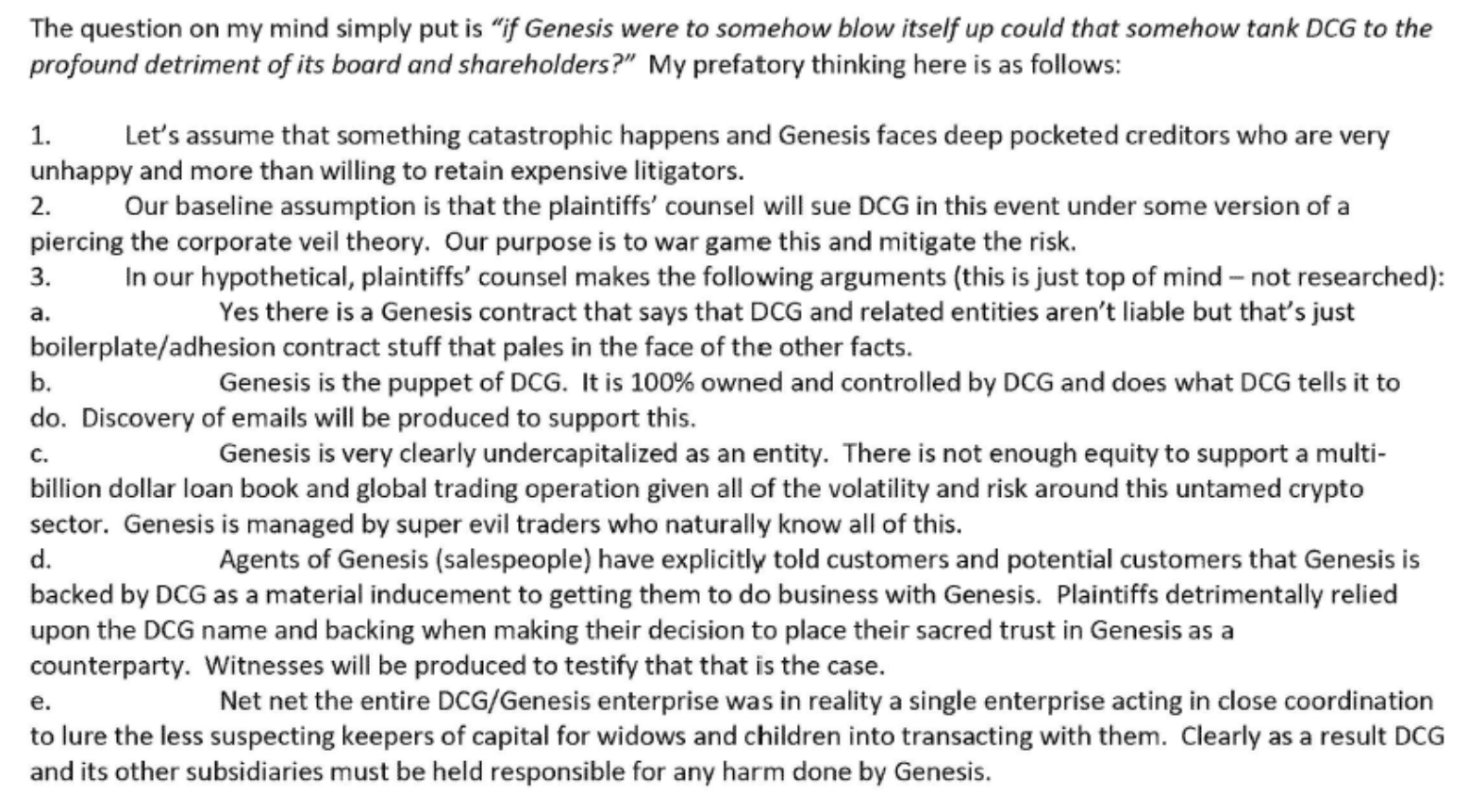
Записка, которую Крэйнс написал Моро. Источник: Genesis.

DCG проигнорировал предупреждения о рисках

В заявлении также раскрывается, что DCG наняла сторонних консультантов по рискам, которые выдавали предупреждения, которые либо игнорировались, либо учитывались слишком поздно. Внутренние документы показывают, что DCG признала, что Genesis «летела вслепую», когда ее кредитный портфель раздулся с 4 миллиардов долларов до 12 миллиардов долларов.

Внешние аудиторы еще в 2020 году выявили «существенные недостатки и слабости» в системе финансового контроля Genesis.

Сторонние консультанты по рискам выносят DCG серьезные предупреждения. Источник: Genesis.

В Genesis был сформирован так называемый комитет по риску «заражения», чтобы смягчить воздействие. Однако его первое заседание состоялось лишь через девять месяцев после одобрения советом DCG. Сообщается, что Крейнс пошутил, что задержка «просто немного облегчила мне будущую дачу показаний».

В жалобе также описывается токсичная корпоративная культура, в которой от сотрудников Genesis ожидалось, что они будут служить интересам DCG в ущерб надлежащему управлению.

Один из инсайдеров написал, что DCG поддерживала Genesis в живых, «чтобы она могла разграбить баланс… поддержать Genesis, создать вид стабильности, а затем занять, пока они могли бы, чтобы получить из нее наличные». Сотрудники Genesis внутри компании называли обстановку в фирме «культурой подчинения».

«Это не просто технические споры по поводу внутрифирменного учета, — заявил Комитет по надзору за судебными разбирательствами Genesis. — Жалоба Делавэра раскрывает преднамеренную схему DCG и Барри Силберта по разграблению Genesis в момент ее краха».

Публичный обман и спорные транзакции

В иске также утверждается, что имел место публичный обман. Персоналу Genesis было приказано читать заготовленные сообщения после краха Three Arrows Capital (3AC), в то время как руководители DCG, включая Барри Силберта, ретвитнули посты, в которых преуменьшался кризис.

Кроме того, жалоба проливает свет на две спорные сделки. Они включают в себя вексель от 30 июня 2022 года и сделку «туда и обратно» от сентября 2022 года, обе из которых были оформлены как попытки скрыть неплатежеспособность и ввести в заблуждение кредиторов.

Genesis пытается взыскать более 3,3 млрд долларов с DCG, Силберта и других инсайдеров.

Letture associate

Galaxy Research: Can SEC's New Regulations Usher in a New Era for Token Financing?

**SEC Proposes New Framework for Token Offerings, Potentially Unlocking Legal Paths for U.S. Crypto Fundraising** On August 18, the U.S. Securities and Exchange Commission (SEC) proposed new rules, dubbed "Reg Crypto," specifically tailored for crypto asset offerings. This framework marks a departure from applying traditional securities rules designed for stocks to tokens. It creates a potential legal pathway for token sales to the U.S. public, including non-accredited investors, without full registration. The proposed rules apply to crypto assets that are not themselves securities but were sold as part of an investment contract where the issuer promised to build a product, network, or ecosystem. It establishes a four-phase lifecycle: Raise, Disclose, Build, and Exit. The "Raise" phase includes two new fundraising exemptions: a startup exemption allowing up to $5 million over four years and a larger, Regulation A-based exemption for up to $20 million or $75 million over 12 months. The "Disclose" phase requires specific token-related disclosures like supply schedules, governance, and development progress. After the issuer completes its promised development work and files a transition report, the "Exit" phase allows the associated investment contract to terminate, even if the token continues to trade. The analysis highlights that the framework's most immediate impact may be providing a formal "exit" path for existing tokens with unclear legal status, rather than immediately sparking a new wave of U.S.-based token offerings. It offers advantages over traditional private placements by allowing public sales and immediate token transferability but imposes ongoing disclosure and reporting obligations. A key hurdle is that the larger exemption requires a substantial U.S. operational presence, which may deter projects with offshore structures. Overall, the proposal is seen as a constructive step toward regulatory clarity, acknowledging that token offerings differ from equity offerings and require tailored investor disclosures. However, it remains a proposal subject to a 60-day public comment period, and its long-term stability may ultimately depend on congressional action.

marsbit2 h fa

Galaxy Research: Can SEC's New Regulations Usher in a New Era for Token Financing?

marsbit2 h fa

Bitcoin and Ethereum Soar Together! Eight Altcoins Worth Watching in the Later Market

Bitcoin and Ethereum Surge, Fueling Altcoin Speculation. Bitcoin Eyes $77,000, Ethereum Gains 20% in a Single Day. Market anticipates capital rotation from major cryptos to high-beta altcoins, but a selective rise is expected, favoring projects with genuine users, protocol revenue, and healthy tokenomics. Analysts highlight eight altcoins across key sectors: **High-Performance Blockchains:** * **SOL (Solana):** Market cap ~$51.88B. A dominant player with a strong ecosystem. Considered a relatively safe bet for potential catch-up growth. * **SUI (Sui):** Market cap ~$3.03B. High volatility potential but faces risks from its low circulating supply and future token unlocks. **DeFi Lending:** * **UNI (Uniswap):** Market cap ~$2.38B. Transitioning to a revenue-capturing asset post-fee switch implementation. * **AAVE (Aave):** Market cap ~$1.53B. Features balanced tokenomics and revenue but has seen significant recent gains. * **MORPHO:** Market cap ~$1.50B. Rapid protocol growth but weaker token value capture and opaque supply data. **Perpetual DEX:** * **HYPE (Hyperliquid):** Market cap ~$16.41B. The clear sector leader with strong revenue but high valuation and a large portion of tokens still locked, warranting caution. **RWA & On-Chain Finance Infrastructure:** * **LINK (Chainlink):** Market cap ~$8.09B. A key oracle provider positioned to benefit from multiple trends like RWA and institutional adoption, offering strong fundamentals. * **ONDO (Ondo Finance):** Market cap ~$1.77B. Shows strong business growth but carries high risks due to concentrated token holdings and a massive unlock scheduled for 2027. **Conclusion:** The altcoin rally is expected to be selective. Recommendations include a medium position in SOL, small allocations to SUI and UNI/AAVE for DeFi exposure, and caution with HYPE and ONDO due to their specific risks. LINK is suggested as a core holding for the RWA thematic.

marsbit4 h fa

Bitcoin and Ethereum Soar Together! Eight Altcoins Worth Watching in the Later Market

marsbit4 h fa

Shanghai's $10 Billion Unicorn Is About to Go Public

Shanghai-based automotive-grade millimeter-wave radar chip unicorn Calterah Microelectronics Technology (Shanghai) Co., Ltd. has filed for an IPO on Shanghai's STAR Market, aiming to raise 3.49 billion yuan. Founded in 2014 by Chen Jiashu, a UC Berkeley PhD graduate, and his professor Ali Niknejad, Calterah pioneered CMOS technology for 77GHz radar chips, breaking the decades-long monopoly of international giants like Texas Instruments. Its low-cost, highly integrated solutions enabled millimeter-wave radar to move from luxury to mass-market vehicles. By 2025, Calterah captured a 31.1% share in China's automotive millimeter-wave radar chip market (second domestically, fourth globally), with cumulative shipments exceeding 30 million units. Its client list includes BYD, Geely, Nio, and Volvo. The company has undergone 11 funding rounds, attracting high-profile investors such as the National Integrated Circuit Industry Investment Fund Phase II, China Capital Management, and GD Capital. Its valuation has reached tens of billions of yuan, with a projected post-IPO valuation of approximately 14 billion yuan. Despite rapid revenue growth—increasing from 206 million yuan in 2023 to 632 million yuan in 2025 with a 75.28% CAGR—Calterah remains unprofitable. It reported net losses of 323 million yuan, 334 million yuan, and 193 million yuan from 2023 to 2025, accumulating over 900 million yuan in losses over three and a half years. These losses are primarily attributed to heavy R&D investment, which totaled over 1.039 billion yuan in the reporting period, often exceeding annual revenue. The company faces significant risks, including high customer concentration (its top five customers accounted for over 99% of revenue from 2023-2025, with BYD alone representing over 50% in 2025) and supply chain concentration. Revenue pressure from key customers and dependencies on overseas suppliers for EDA tools and IP pose challenges to sustainable growth. The IPO is seen as crucial for securing capital to expand production, diversify its customer base, and reduce supply chain dependencies.

marsbit5 h fa

Shanghai's $10 Billion Unicorn Is About to Go Public

marsbit5 h fa

Trading

Spot
活动图片