特朗普的加密马戏团:当华尔街之狼遇上区块链过山车

marsbitPubblicato 2025-06-23Pubblicato ultima volta 2025-06-24

如同 4 月初一般,特朗普再次挥动着自己的“市场魔法棒”,上演了一出“强势行动激化矛盾,快速妥协放出利好”的拿手好戏,加密市场也随之经历了一场过山车式的行情变动。多头空头你方唱罢我登场,一时间加密市场热闹非凡。Odaily星球日报将于本文汇总近期的多空两大联盟的代表性巨鲸/机构,供读者参考。

多军占据上风,空头惨遭挨打:ETH 多头卷土重来,空军头子利润大幅回撤

在经历了此前伊以冲突等地缘政治带动的行情下跌之后,不少多头押注市场将强势反弹,而随着伊以在特朗普的调停下达成停火协议,市场果然如期反弹,由此,多军开始重新占据市场上风。

最惨倒霉蛋:ETH 多军出手,但做空 BTC 损失遭重

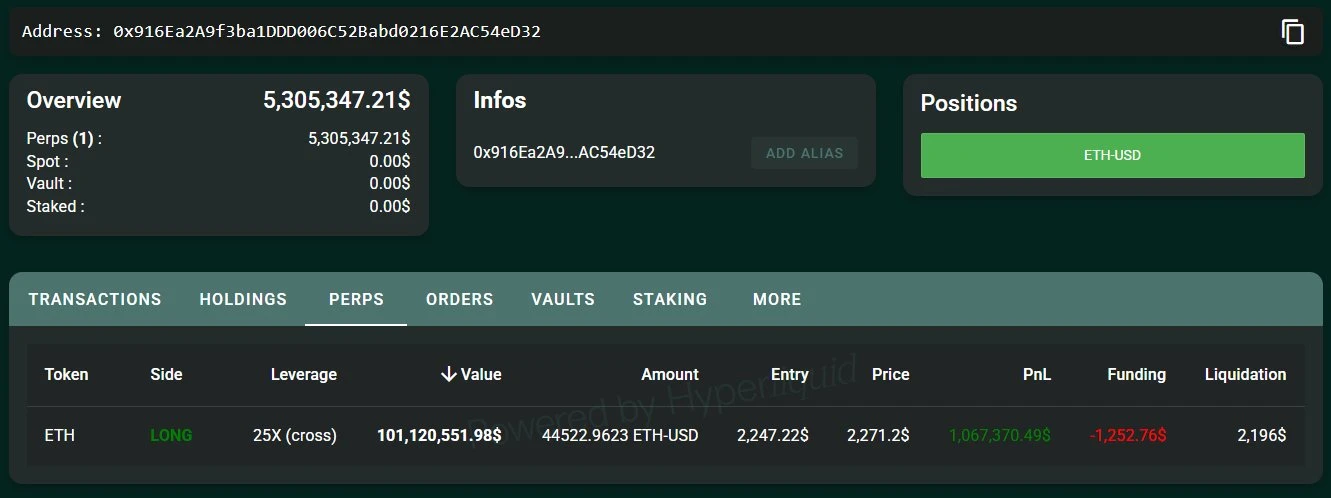
6 月 23 日,某鲸鱼向 Hyperliquid 存入 428 万枚 USDC,并开设了一个名义价值 1.01 亿美元的以太坊多头仓位,杠杆倍数为 25 倍,清算价 2196 美元。彼时,随着 ETH 的价格反弹,其累计浮盈一度高达 106 万美元。
空单

鲸鱼开单信息

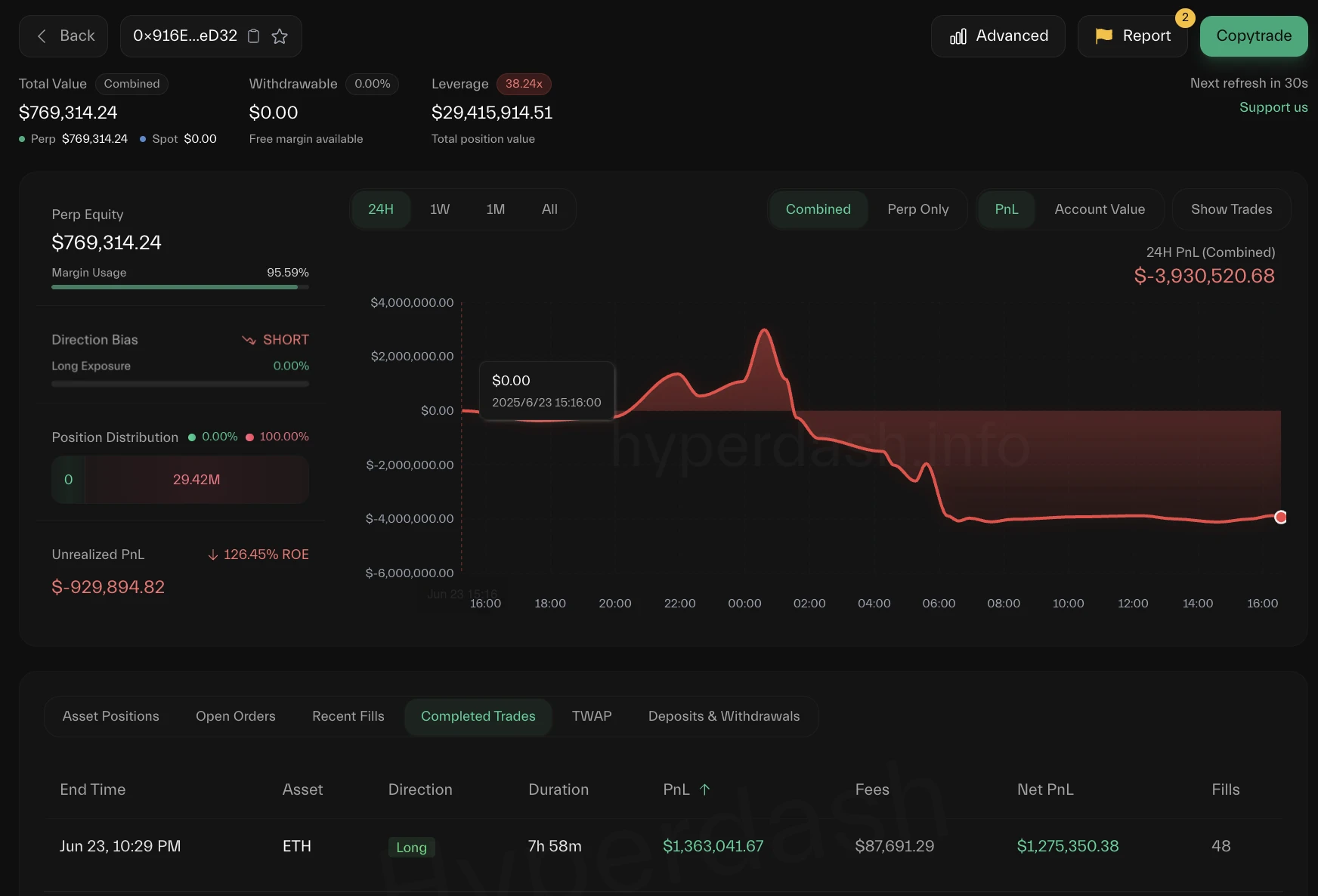
随后,该鲸鱼选择在 ETH 价格 2255 美元时挂上限价单,最终成功获利 136 万美元,剔除 8.7 万美元的手续费后,净盈利为 127 万美元。
空单

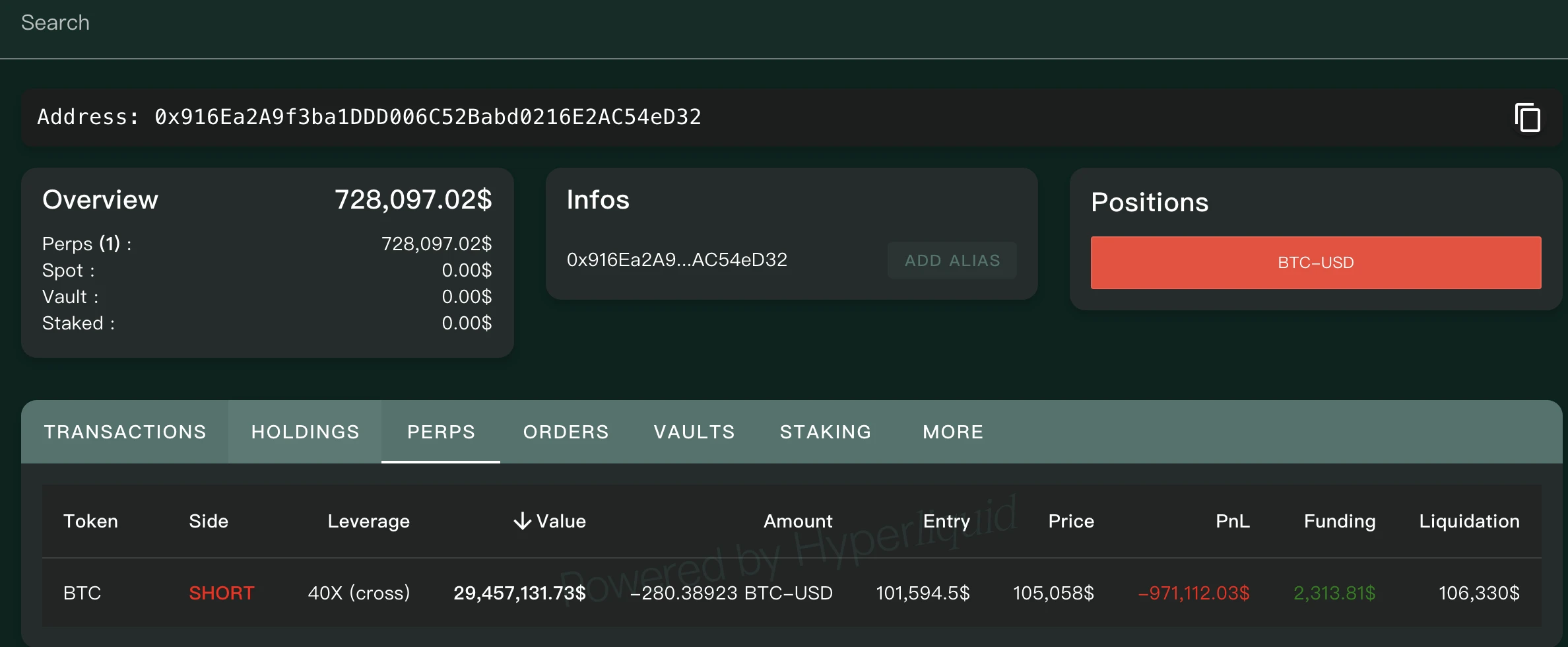
但令人意想不到的是,该鲸鱼转而开仓以 40 倍杠杆做空 BTC,并最终在“特朗普利好”刺激下不得不频频平仓止损。目前,该地址 40 倍 BTC 空单浮亏约 97 万美元,而其整体亏损则增加至约 356 万美元,堪称“最惨交易员”。
空单

地址:0x916Ea2A9f3ba1DDD006C52Babd0216E2AC54eD32

ETH 聪明钱: 10 倍做空 ETH,利润回撤 500 万美元

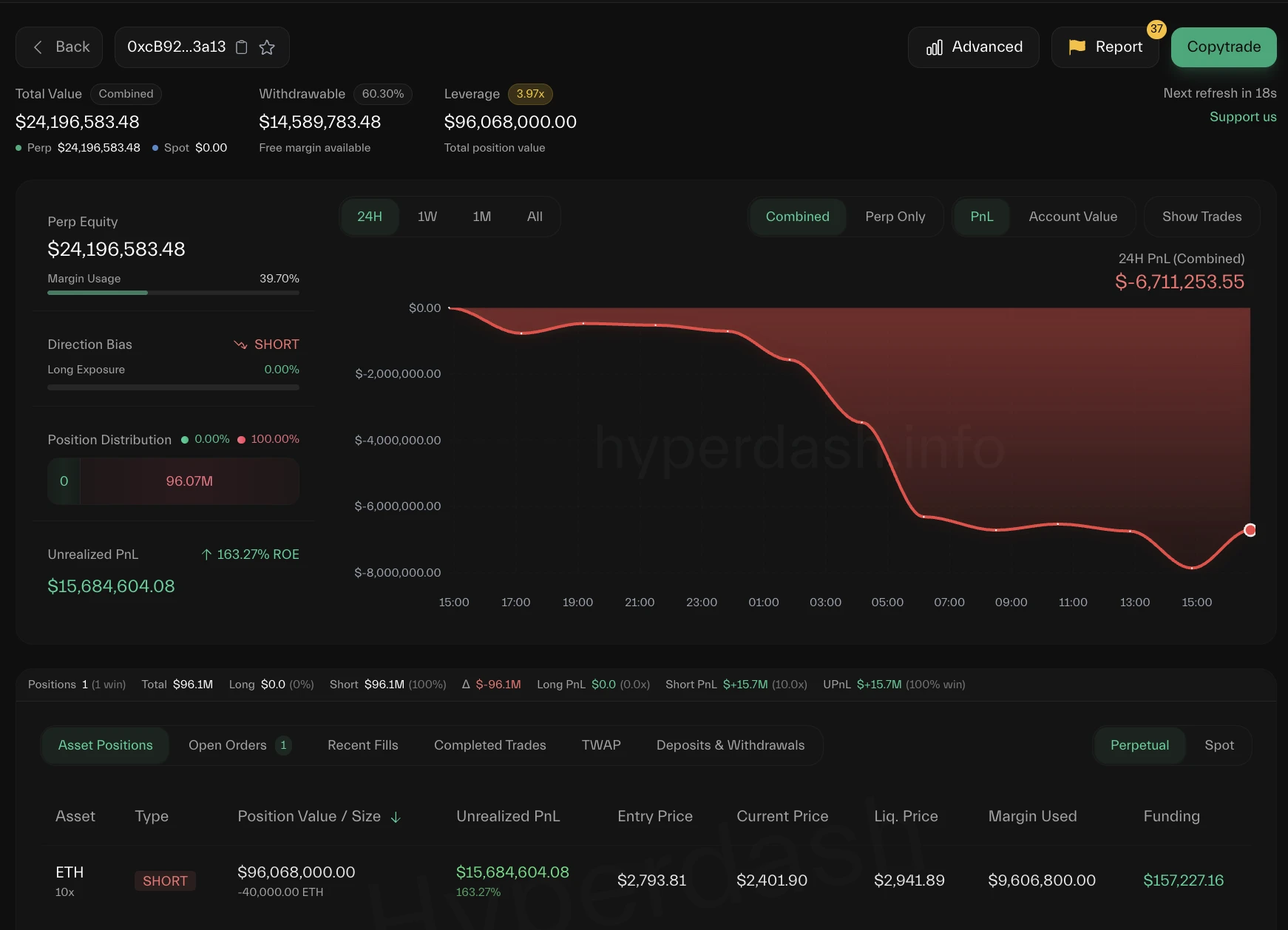
如果你要玩 ETH 合约,那么这个地址毫无疑问是必须关注的指标之一。正如我们此前在《空军牛市来了?地缘冲突下的加密投资操作大赏》一文中提到的那样,该地址过去 2 个月内多次踩中 ETH 低点与顶点,曾一个月内狂赚 2000 万美元。

目前,该地址仍持有 10 倍杠杆做空 ETH 订单,持仓高达 40000 枚 ETH,名义价值高达 9600 万美元左右,而其浮盈也从此前的 2000 多万美元回撤至 1560 万美元左右。
空单

地址:0xcB92C5988b1D4f145a7B481690051F03EaD23a13

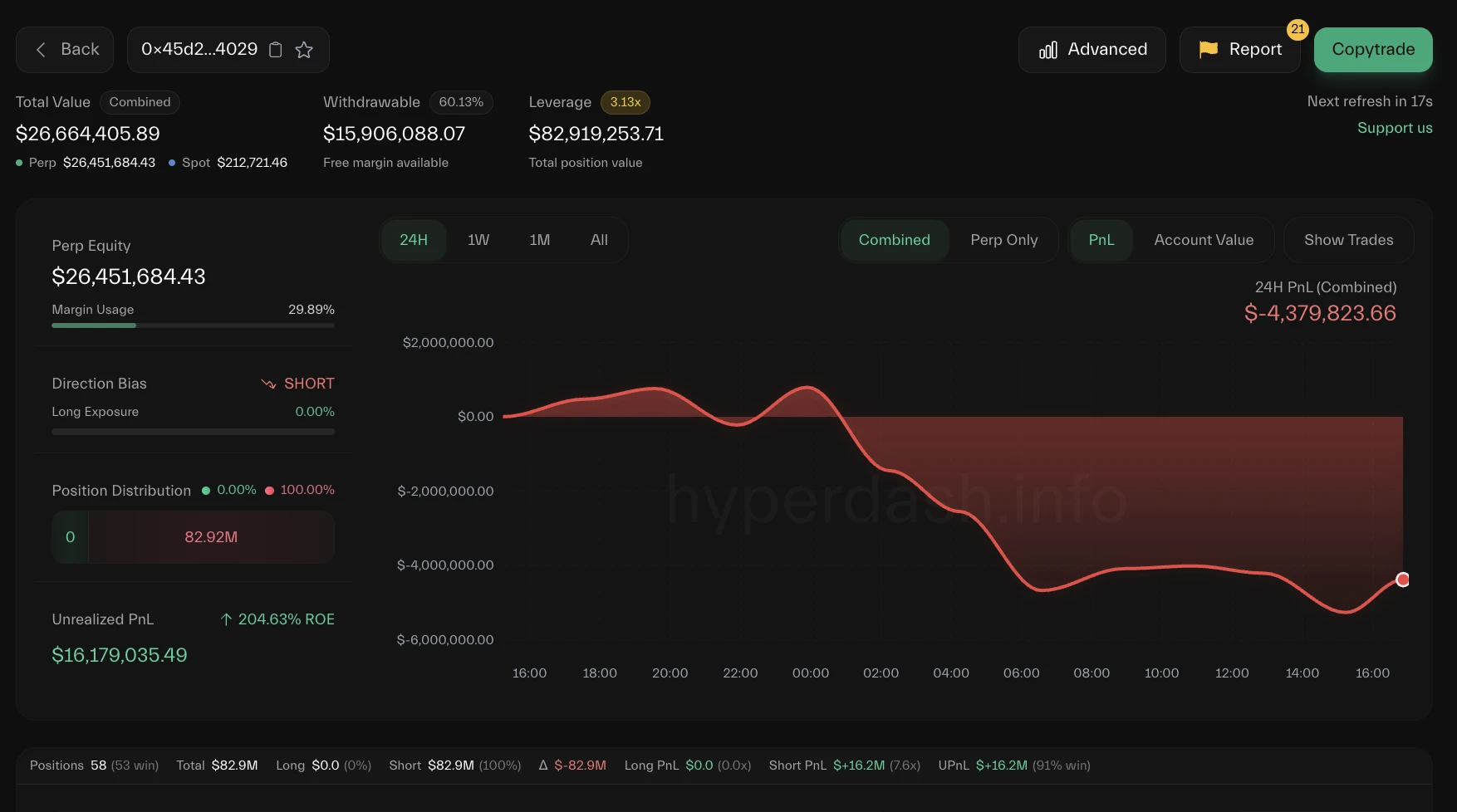
58 种代币做空头子:利润回撤 400 万美元

此前在 Hyperliquid 上开空 58 个币种(包括 BTC、ETH、SOL、XRP、PEPE、FARTCOIN、DOGE、AAVE、HYPE 等)的某巨鲸/机构浮盈从此前的 2134 万美元回撤至现在的 1617 万美元, 58 个空单中的浮亏仓位也从此前的 2 个增加到目前的 5 个,其中:

  • HYPE 空单累计浮亏 470 万美元;
  • MKR 空单浮亏 2 万美元;
  • WIF 空单浮亏 1.5 万美元;
  • AAVE 空单浮亏 5.6 万美元;
  • Neiro 空单浮亏 1800 美元。

空单

地址:0x45d26f28196d226497130c4bac709d808fed4029

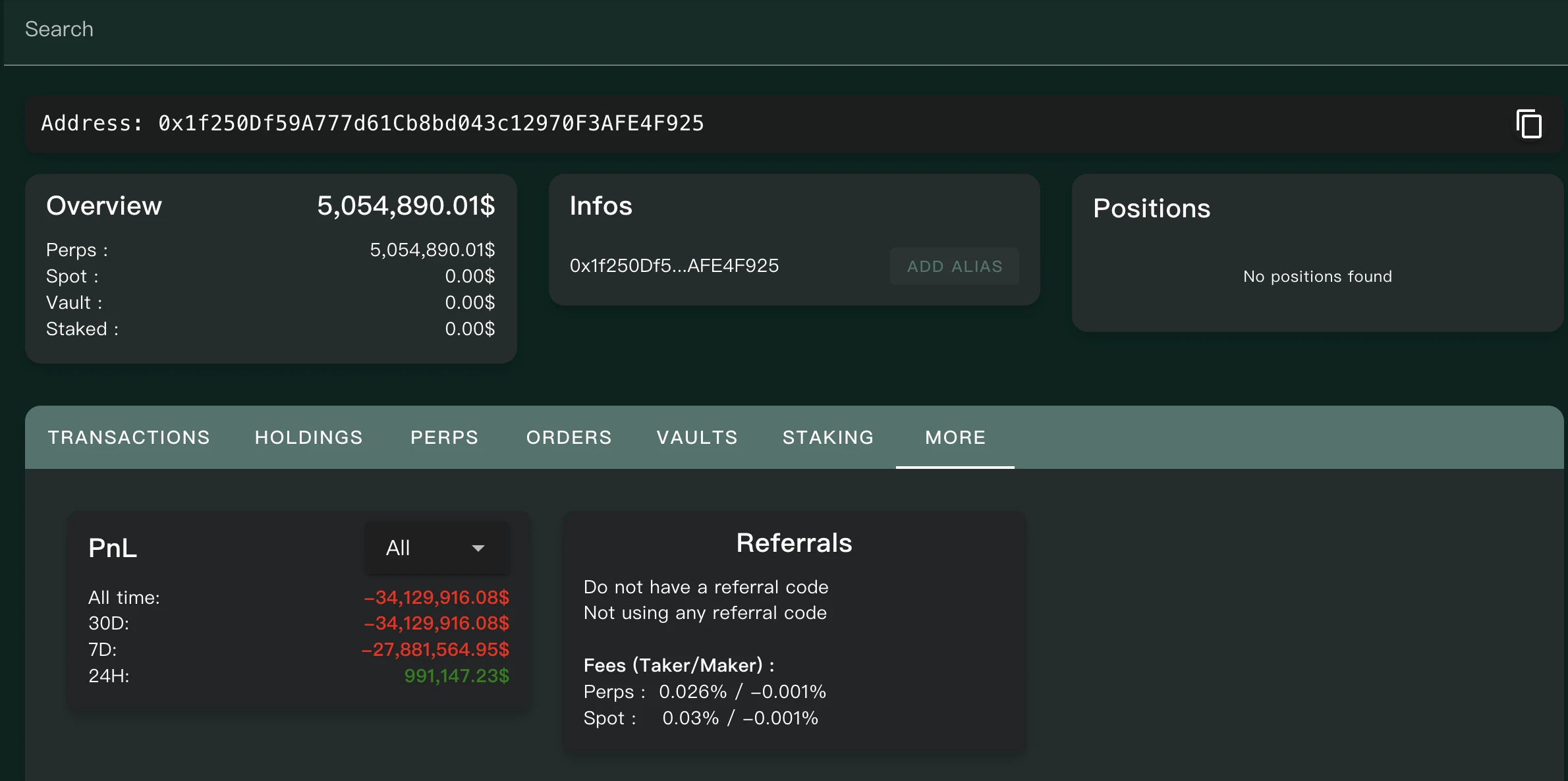
传奇交易员 AguilaTrades:多次开单成市场反指, 30 天内亏损 3400 万美元

此前,交易员 AguilaTrades 于 6 月 20 日 19: 30 将其 BTC 多单仓位加仓至逾 4 亿美元,当时 BTC 价格约为 106000 美元。此后,BTC 价格一路下行,最低触及 102340 美元,AguilaTrades 也因此第三次在大额加仓后遭遇回撤。

颇为传奇的是,AguilaTrades 堪称“小 James Wynn”,此前曾频频开单,多空都做,一度浮盈超 300 万美元,但最终,其高频交易还是难敌震荡多变的加密市场,据 Hypurrscan 数据,其 30 日内亏损高达 3400 万美元左右。

最新数据显示,其最近一笔多单平仓发生于下午 4 点 11 分,为盈利状态, 24 小时累计盈利约 100 万美元。
空单

地址:0x1f250Df59A777d61Cb8bd043c12970F3AFE4F925

16 个代币做空头子:利润回撤近 400 万美元

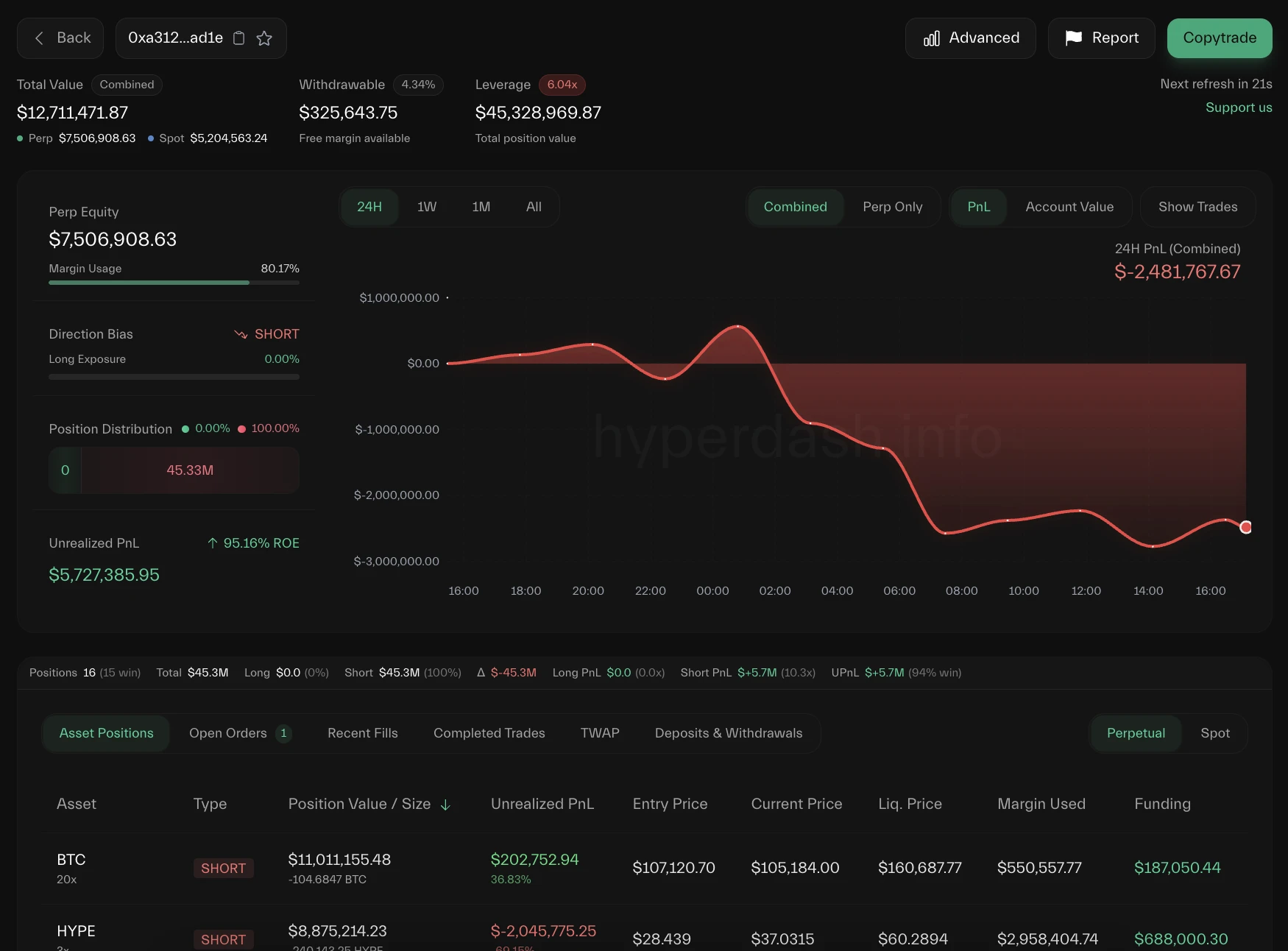
此前在 Hyperliquid 上做空 16 个山寨币的“空军头子”也迎来了自己的“阶段性滑铁卢”——

其浮盈从此前的 968 万美元大幅回撤至 572 万美元, 24 小时累计浮亏约 248 万美元;

尽管如此,目前,其 16 个持仓中仍有 15 个为浮盈状态,仅 HYPE 的 3 倍空单浮亏约 205 万美元。
空单

地址:0xa312114b5795dff9b8db50474dd57701aa78ad1e

多空转换的“漏网之鱼”:及时平空止盈,再度开启多单

据链上分析师余烬监测,某鲸鱼在凌晨 1 点反弹前最低点处获利平仓 BTC 及 ETH 空单,然后反手买入了 ETH 现货。

彼时,其持有价值 6280 万美元的空单:BTC 平仓价在 101, 400 美元左右,ETH 平在 2, 224 美元左右,累计盈利 307 万美元。

值得一提的是,该鲸鱼于下午 3 点 35 分再次开仓 20 倍杠杆做多 ETH,持仓 5000 枚 ETH,名义价值 1200 万美元,目前小幅盈利。
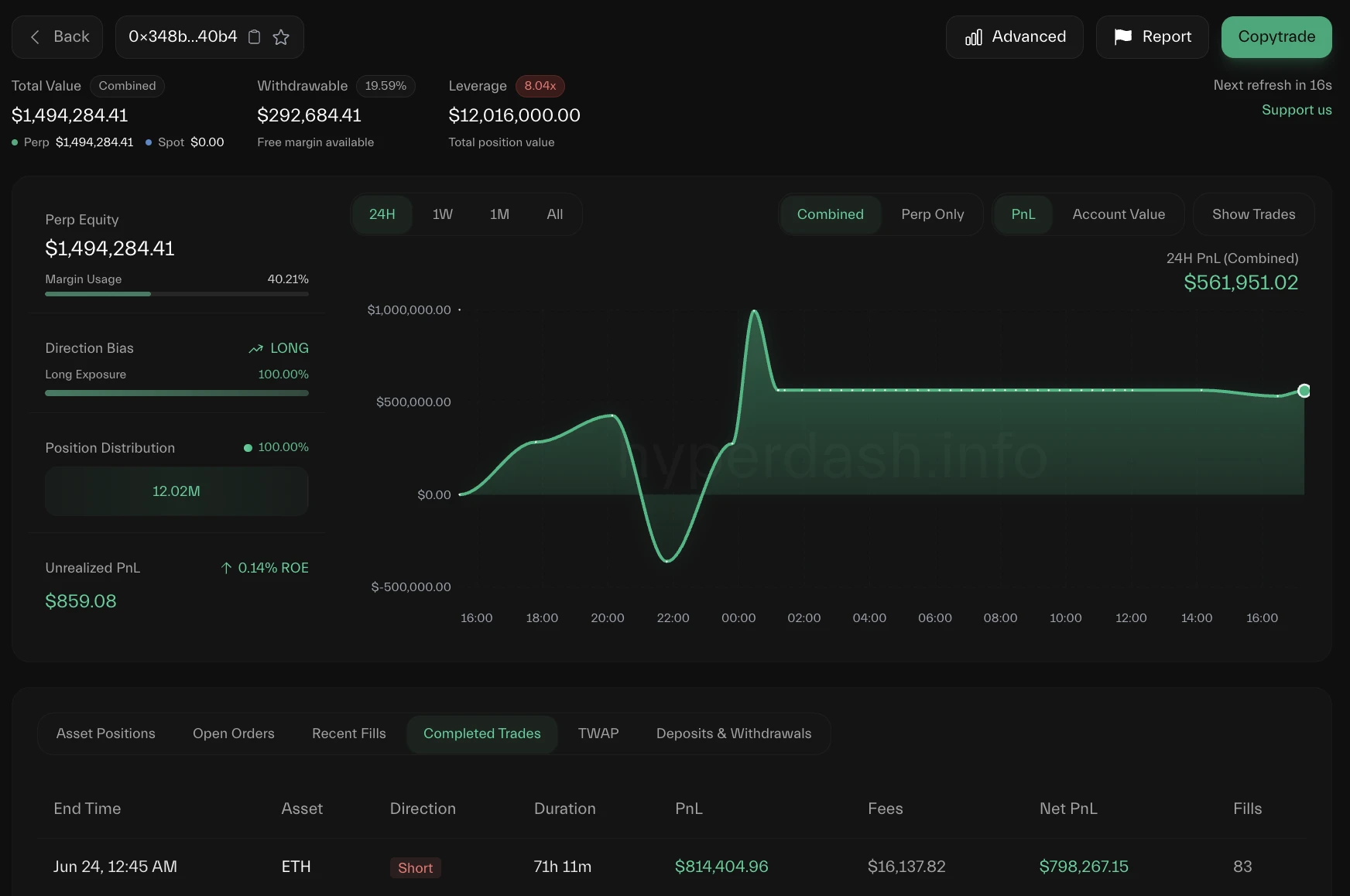
空单

地址:0x348bb306e6887d244450cbb9fd608e7f8d0a40b4

BTC 做空巨鲸:平空获利 169.5 万美元,持有 40 倍 BTC 空单

据链上分析师 Ai 姨监测,自 2025 年 3 月以来多次做空 BTC 的一位巨鲸于今日凌晨 00: 00 至 01: 00 期间(几乎为反弹起点)平仓 314 枚 BTC 空单,获利 169.5 万美元。近一个月内,该巨鲸累计盈利已达 1004.8 万美元。

目前,该巨鲸仍持有价值 5400 万美元的 BTC 40 倍杠杆空单,浮盈约 100 万美元。
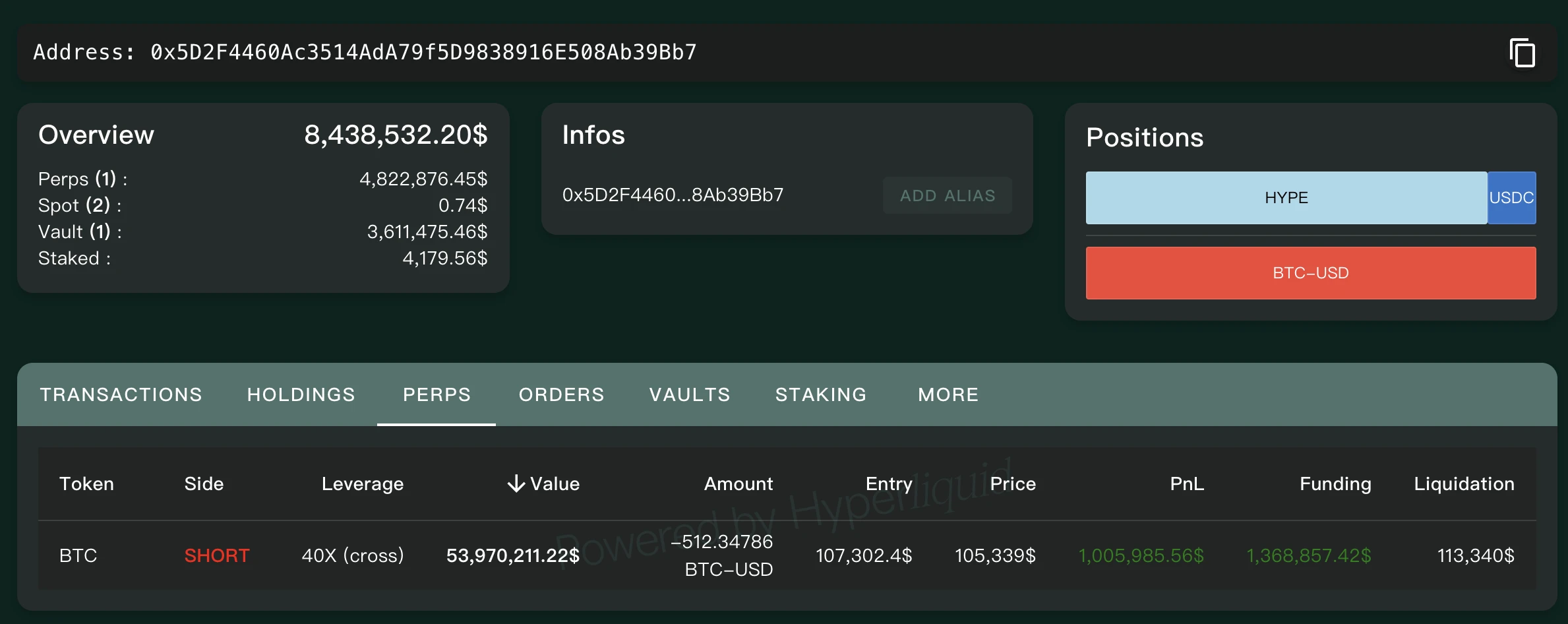

空单

地址:0x5D2F4460Ac3514AdA79f5D9838916E508Ab39Bb7

ETH 快枪手:凌晨买入 1388 万美元的 ETH

据链上分析师 Ai 姨监测,一巨鲸于今天凌晨在 ETH 价格快速反弹期间,以均价 2299 美元买入 6037.24 枚 ETH,成交金额约为 1388 万美元。

目前,ETH 价格反弹至 2421 美元,按照改价格计算,该地址已浮盈约 73 万美元。但该地址已将 ETH 转出至地址 0x7C2c5e739dc8351D718C8719Eb8E20D325B2Ff01,随后部分资金存入 AAVE。
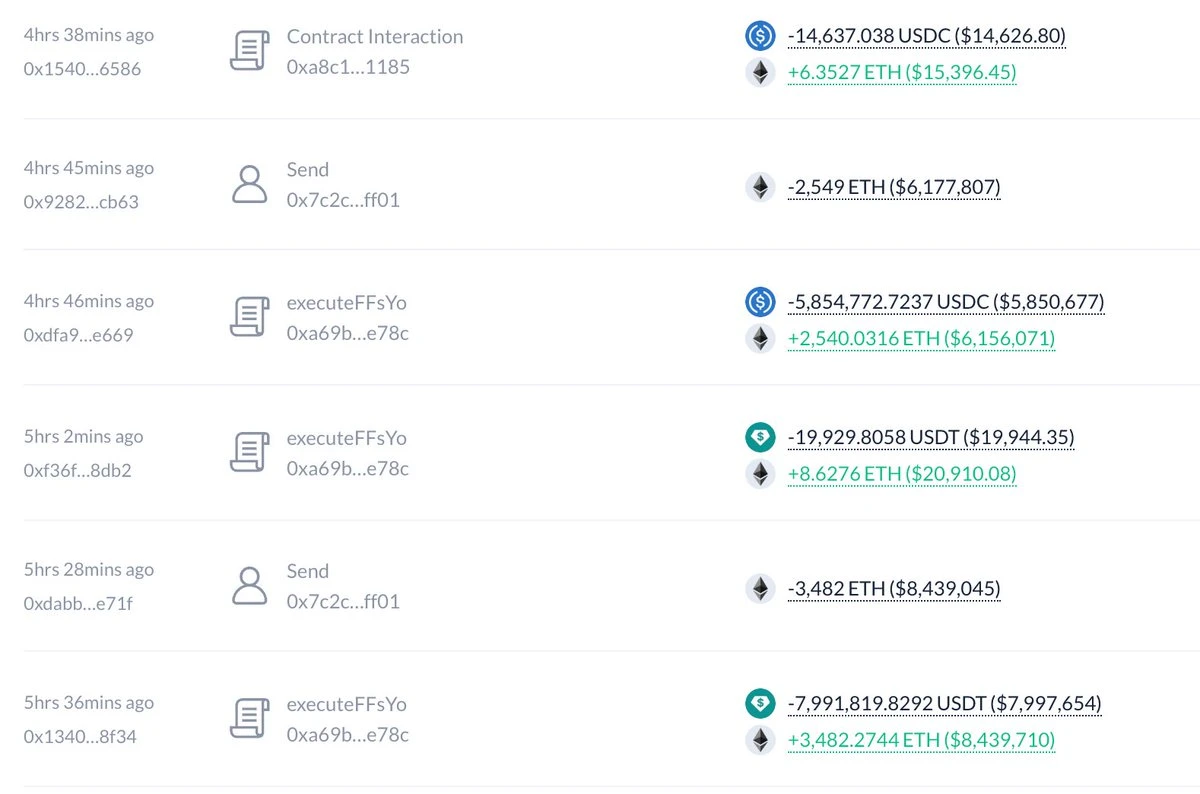
空单

地址:0x349d6bfb2E0577233359e3734B1d67ef5B37c9d4

Letture associate

Hyperliquid's Compliance Journey: From Permissionless to Permissioned via HIP-3

Hyperliquid’s Compliance Path: From Permissionless to Permissioned HIP-3 Hyperliquid currently blocks U.S. access because its permissionless, on-chain infrastructure conflicts with U.S. market structure laws, which restrict futures trading to registered exchanges, clearinghouses, and brokers. Through its Hyperliquid Policy Center (HPC), the project is advocating for regulatory modernization, proposing that regulated entities be allowed to build products on HyperCore (its exchange and clearing layer) while fulfilling their compliance obligations. The platform’s modular stack separates roles like a traditional exchange (DCM), clearinghouse (DCO), and broker (FCM), but reconstructs them on-chain with code. This enables permissionless access, self-custody, and 24/7 global trading, but clashes with U.S. rules requiring KYC, specific margin models, and custodial arrangements. To resolve this, HPC is engaging with U.S. regulators (CFTC, SEC) to seek clarity that deploying on-chain software does not itself trigger licensing, and to establish exemptions allowing non-custodial wallets to route users to regulated derivatives. Recent political signals suggest openness to this approach. On the technical side, Hyperliquid Labs has introduced permissioned HIP-3 deployers on testnet. These allow regulated entities to launch markets, perform KYC, and whitelist compliant users. While these create separate order books, whitelisted market makers can bridge liquidity between them, ensuring deep, shared liquidity across the same L1. Features like payload-based “PA” permissions enable DEX-level account controls (e.g., reduce-only orders), mirroring traditional broker authorities. The strategy is not to open the native, permissionless front-end to U.S. users, but to position Hyperliquid as neutral infrastructure that U.S. regulated firms can use while meeting their legal duties. This paves a compliant path for U.S. investor access while preserving the protocol’s core, permissionless nature.

marsbit3 min fa

Hyperliquid's Compliance Journey: From Permissionless to Permissioned via HIP-3

marsbit3 min fa

Two Funding Rounds in Three Months: The Chinese Version of Palantir is on Fire

Investment Community AI has learned that Beijing Zhongshu Ruizhi Technology Co., Ltd., a domestic industrial-grade causal intelligence and high-reliability decision-making AI company, has recently completed a strategic financing round worth hundreds of millions of RMB. This round saw participation from China Internet Investment Fund, Suzhou Chuangtou National Social Security Fund, Financial Street Capital, ICBC Capital, Kunlun Capital, among others, with existing shareholders also increasing their investment. This follows a Series B funding round in the hundreds of millions completed just three months prior. The rapid succession of two major funding rounds signifies strong market recognition of the company's underlying original technology and scaled commercial implementation. Often referred to as the "Chinese version of Palantir," Zhongshu Ruizhi is entering a new phase of accelerated technological iteration, widespread scenario replication, and scaled performance release, mirroring the explosive growth of China's AI market. Founded in April 2020 by Dr. Han Han, a Tsinghua University Ph.D. and former core drafter of national AI policies, the company is mission-driven to "move AI from the digital world to the physical world." It focuses on the high-reliability, strong-decision industrial AI track and enterprise-grade AI Agent full-stack infrastructure. The team tackles the challenge of applying AI to China's vast and complex industrial and energy systems by developing a new intelligent operating system from scratch. Its core technological breakthrough lies in three proprietary底层 technologies: meta-causal cognitive theory, causal models, and a dynamic ontology engine. These address critical pain points of generative large models in industrial settings—such as AI hallucinations, insufficient reasoning, lack of temporal logic, unverifiable decisions, and multi-source rule conflicts—thereby providing trustworthy, explainable, and executable智能决策 capabilities. Commercially, Zhongshu Ruizhi has achieved scaled deployment, serving over 50 central state-owned enterprises and industrial groups in sectors like power, petroleum, and aerospace, with implementations in more than 800 highly complex production scenarios. The company reported doubled revenue in 2025, demonstrating strong self-sufficiency and a viable business model—a rarity among new-generation AI firms. The latest funds will be allocated towards advancing foundational theoretical research, replicating successful application models to expand market presence (including overseas), and attracting top-tier talent. Lead investor China Internet Investment Fund highlighted that in the current shift from general AI capability contests to deep industrial empowerment, industrial-grade causal intelligence is crucial for building China's modern digital foundation and fostering new quality productive forces. They expressed support for the company's efforts to define decision-making paradigms and trustworthy standards for industrial intelligence, aiming to secure a rule-making voice in the global physical AI arena.

marsbit13 min fa

Two Funding Rounds in Three Months: The Chinese Version of Palantir is on Fire

marsbit13 min fa

The Biggest Political Economy Question in the AI Era: As Robots Become More Capable, How Do Humans Share the Value?

In the AI era, the most pressing political economy question is: as machines become increasingly capable, how can humanity share in the value they create? An article originally critiquing China's tech focus has sparked a deeper debate on this global challenge. Historically, industrial progress improved efficiency but still relied on human labor for wealth creation and distribution. AI is fundamentally different—it is now replacing cognitive and knowledge work. As AI and robots take over more tasks, economic growth may continue while direct human participation in value creation shrinks, creating a core tension between productivity gains and widespread income generation. The issue is not unique to China. While leading tech companies amass enormous wealth, labor's share of income is declining globally. The core problem is a broken link: technological innovation and corporate profits are not translating into sufficient consumer income and demand. Three potential paths forward are outlined: a traditional capitalist model where profits primarily go to capital owners; a state-capitalist approach with public investment in AI; and more innovative models like digital sovereign wealth funds, universal shareholding, or AI-era basic income schemes to directly distribute AI-generated value. The future competitive advantage may lie not just in technological supremacy, but in which society can build a new, inclusive distribution system for the intelligent economy. The ultimate challenge is ensuring that as AI creates value, humans have a means to obtain income and share in the resulting widespread social benefits.

marsbit23 min fa

The Biggest Political Economy Question in the AI Era: As Robots Become More Capable, How Do Humans Share the Value?

marsbit23 min fa

Generating Profits for Seven Consecutive Quarters, Emerging Markets Carry Trade Outperforms Everything

For the seventh consecutive quarter, dollar-funded emerging market carry trades have delivered positive returns, marking the longest winning streak since 2008. According to Bloomberg's index, this strategy has gained approximately 22% since late 2024, outperforming U.S. Treasuries, emerging market sovereign, and corporate dollar debt. The core of the trade involves borrowing low-interest currencies like the U.S. dollar, euro, or yen to invest in high-yielding emerging market assets, such as Turkish lira bonds offering over 40% returns. Returns were amplified by favorable currency moves, with the dollar weakening against most emerging market currencies and other traditional funding currencies. For instance, the trade gained 48% on the Colombian peso in the past year. A key test came in August 2024 with a historic joint U.S.-Japan currency intervention, which caused only a modest 1% dip in the carry trade risk premium as investors shifted funding from the yen to the euro and Swiss franc. Looking ahead, the primary risk is the timing of Federal Reserve policy changes. While persistent inflation allows the Fed to hold rates, a rapid rise in long-term U.S. yields could threaten the trade. Another concern is crowding, as massive inflows increase vulnerability to a sudden reversal. High interest rates in regions like Latin America and Eastern Europe, supported by external factors like Middle East tensions and energy prices, continue to sustain the opportunity. Major investors remain engaged, favoring currencies like the Mexican peso, South African rand, and Turkish lira.

marsbit38 min fa

Generating Profits for Seven Consecutive Quarters, Emerging Markets Carry Trade Outperforms Everything

marsbit38 min fa

Trading

Spot
活动图片