HyperLiquid-кит получил $2,5 млн убытка после $10 млн «бумажной» прибыли

cryptonews.ruPubblicato 2025-02-18Pubblicato ultima volta 2025-06-18

После достижения нереализованной прибыли на $10 млн трейдер на HyperLiquid под ником AguilaTrades зафиксировал $2,5 млн убытка.

AguilaTrades(@AguilaTrades) seems a bit greedy and never takes profits.

Last week, he was up $5.8M on a $BTC long but didn’t cash out and ended up losing $12.47M.

This week, he did it again—up $10M yesterday, didn’t cash out, now down over $2.5M.https://t.co/HbffHEbY1f pic.twitter.com/t2g3XvWAB3

— Lookonchain (@lookonchain) June 17, 2025

Незадолго до случившегося участник рынка упустил $5,8 млн «бумажной» прибыли по лонгу на цифровое золото — потери составили $12,47 млн, согласно Lookonchain.

AguilaTrades открыл длинную позицию по биткоину на уровне $106 000 и удерживал ее до максимума понедельника в $108 800. После этого цена внезапно просела до $104 000.

Волатильность первой криптовалюты остается относительно низкой на протяжении последних нескольких месяцев — котировки колеблются в диапазоне $100 000-110 000.

«Это не смущает трейдеров деривативами, которые продолжают ставить на рост с плечом, регулярно оказываясь в просадке на фоне узкого ценового коридора», — прокомментировали в CoinDesk.
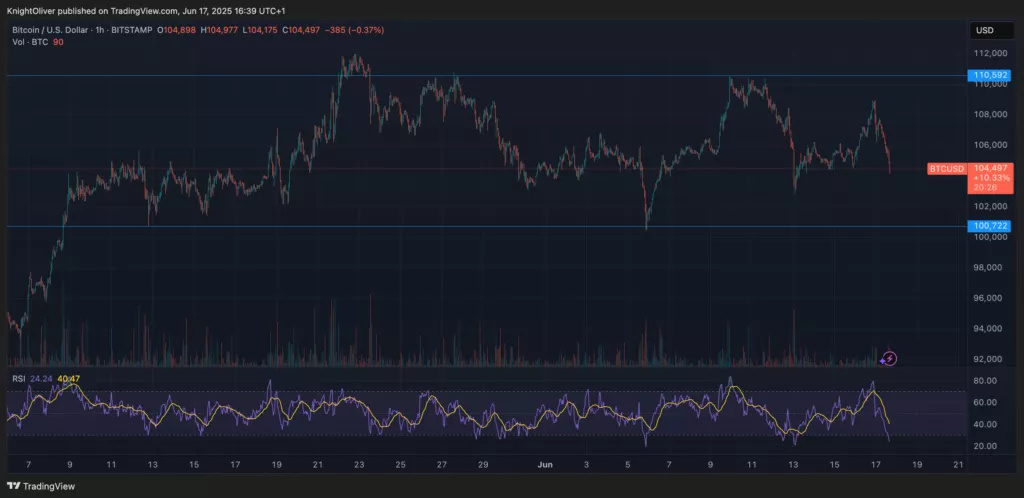
Ценовой коридор биткоина. Данные: часовой график BTC/USDT биржи Bitstamp от TradingView.

На первый взгляд стратегия выглядит обоснованной, отметили аналитики издания. Биткоин удерживается выше психологического уровня $100 000, несмотря на рост напряженности на Ближнем Востоке. Подобные события обычно оказывают давление на рисковые активы.

«Однако стратегия игнорирования направленного движения и простая тактика покупки у поддержки, продажи у сопротивления принесла бы куда лучшие результаты. С 9 мая цифровое золото торгуется в этом диапазоне, неоднократно тестируя нижнюю и верхнюю границы [ценового диапазона]», — написали эксперты.

На момент написания цена биткоина у отметки $105 400, согласно CoinGecko. С начала года актив вырос на 12,7%.

Напомним, в конце мая «самопровозглашенный король фьючерсов» Джеймс Уинн объявил об уходе с Hyperliquid с $25 млн прибыли, но потом передумал. В итоге получил многомиллионные убытки.

Восхождение неогрифтера: кто такой Джеймс Уинн и при чем здесь Эндрю Тейт

Letture associate

"King of Shilling" Hayes Strikes Again, This Time Setting His Sights on Deribit

On June 29, BitMEX co-founder Arthur Hayes acquired approximately 6.16 million SYN tokens via OTC platform Flowdesk, valued at around $2.2 million. Subsequently, Hayes publicly endorsed SYN on X, calling it one of the most asymmetric investments he's seen since HYPE and declaring it time for an on-chain options DEX to challenge industry leader Deribit, naming Hypercall as that challenger. The article details the evolution of the Synapse Protocol, originally launched in 2021 as a cross-chain messaging and liquidity network. While its TVL peaked above $1 billion during the last bull market, it has since declined. The protocol's team has since built Hypercall, an on-chain options trading platform on Hyperliquid's HyperEVM, which supports trading options on "any asset" with features like 24/7 trading and defined risk limited to the premium paid. Deribit, founded in 2016, is highlighted as the dominant centralized crypto options exchange, commanding roughly 85% market share in BTC and ETH options. Its strengths include deep liquidity and professional tools, though it faces critiques over custody risk, KYC requirements, and regulatory uncertainty. The analysis suggests Hypercall's potential lies in decentralization, permissionless access, and transparency, potentially carving a niche in DeFi-native and emerging asset options. However, it faces significant challenges competing with Deribit's established network effect and liquidity depth. The piece concludes by noting Hayes's recent and mixed "call" history, referencing his previous promotion and subsequent sale of HYPE, as well as a controversial price target report for CARDS from his family office, Maelstrom, which was followed by a significant price drop for the asset. This activity has drawn criticism, with some accusing Hayes of creating exit liquidity for his followers.

Foresight News14 min fa

"King of Shilling" Hayes Strikes Again, This Time Setting His Sights on Deribit

Foresight News14 min fa

One Year After the Crash of Crypto Treasury Companies, Copycats Are Already Making a Comeback

One year after the collapse of digital asset treasury (DAT) companies, which wiped out up to 99% for early investors, the scheme has returned in a new guise. Recently, Triller Group announced it would become a "SpaceX treasury company," causing its market cap to surge. This follows the rebranding of another firm, LGHL, now targeting a token called HYPE. The original model, popularized by MicroStrategy (MSTR) and its "Bitcoin yield" narrative, saw companies trading at massive premiums to their underlying crypto holdings. However, most followers like TwentyOne, Metaplanet, and Nakamoto have crashed 80-95%+ from their peaks, erasing nearly all value for late investors. The author argues these structures have no fundamental reason to trade at premiums when low-fee Bitcoin ETFs or direct ownership exist. The cycle persists due to speculative demand driven by FOMO, gamification, and a belief the system is rigged, met by insiders and promoters who profit from the pump-and-dump dynamics. Drawing a parallel to the 1637 Tulip Mania, the piece concludes that such frenzies are not a bug but a recurring product of markets, where greater fools provide demand and insiders supply the schemes. Despite holding Bitcoin personally, the author condemns this specific packaging of assets into leveraged corporate vehicles marketed as innovation, a cycle seemingly unstoppable until a major crash.

marsbit25 min fa

One Year After the Crash of Crypto Treasury Companies, Copycats Are Already Making a Comeback

marsbit25 min fa

Trading

Spot
活动图片