Шиба-ину использует технологии NVIDIA и Alibaba для продвижения искусственного интеллекта на фоне проблем с ценой токенов

cryptonews.ruPubblicato 2024-03-13Pubblicato ultima volta 2025-06-13

  • Проект Shiba Inu объявил о крупном партнерстве для выхода на рынок игр с использованием искусственного интеллекта.
  • Новая платформа «Shib.fun» будет работать на базе облачной инфраструктуры NVIDIA и Alibaba.
  • Эта новость появилась на фоне того, что токен SHIB находится на критическом уровне технической поддержки.

Ведущий разработчик Shiba Inu Шитоши Кусама подтвердил растущее внимание экосистемы к искусственному интеллекту (ИИ), объявив о стратегическом партнерстве с TokenPlayAI, игровой платформой на базе ИИ, разработанной Astra Nova.

В своем заявлении Ситоши Кусама также намекнул на более широкие амбиции, выходящие за рамки этого первоначального шага, предположив, что в ближайшее время планируется больше интеграций ИИ и новый, ориентированный на ИИ, документ.

Новая игровая платформа с искусственным интеллектом для породы сиба-ину

Новое партнерство дебютирует на Shib.fun, платформе без кода, которая позволит пользователям создавать и играть в блокчейн-игры. Платформа будет разработана Astra Nova и будет использовать ее технологию TokenPlayAI. Эта система работает на высокопроизводительной инфраструктуре от NVIDIA и Alibaba Cloud, что свидетельствует о приверженности созданию передовых игровых возможностей с использованием искусственного интеллекта.

Твит Кусамы намекнул на более широкие амбиции, предполагая, что это только первая из нескольких интеграций ИИ. С более чем 22 000 регистраций в листе ожидания, ожидание растет. Скоро ожидается новый технический документ, ориентированный на ИИ, который, как предполагает Кусама, будет описывать дорожную карту экосистемы и знакомить с новыми партнерствами.

#ShibaInu Lead Shares Big News You Might’ve Missed. 🧵🧵🧵 pic.twitter.com/GD5xc1LKuE

— TheCryptoBasic (@thecryptobasic) June 13, 2025

Члены сообщества считают, что это может стать основным катализатором движения SHIB к мифической отметке $0,01. Поскольку токен SHIB теряет 50-дневную и 20-дневную экспоненциальные скользящие средние, первым подтверждением бычьего движения станет возвращение монетой-мемой этих EMA.

Анализ цены SHIB: токен колеблется на критической поддержке

SHIB в настоящее время торгуется на уровне $0,00001173, зависнув чуть выше ключевой зоны поддержки около уровня коррекции Фибоначчи 0,0 ($0,00001199), согласно данным CoinMarketCap. Неспособность удержать этот уровень может открыть дверь к более глубоким потерям.

Цели роста находятся на расширениях Фибоначчи, а сопротивление наблюдается около $0,00001648 (0,786 Фибоначчи) и $0,00002123 (1,618 Фибоначчи). Более широкая зона прорыва лежит между $0,00002695 и $0,00003619, что будет означать массивный бычий разворот.
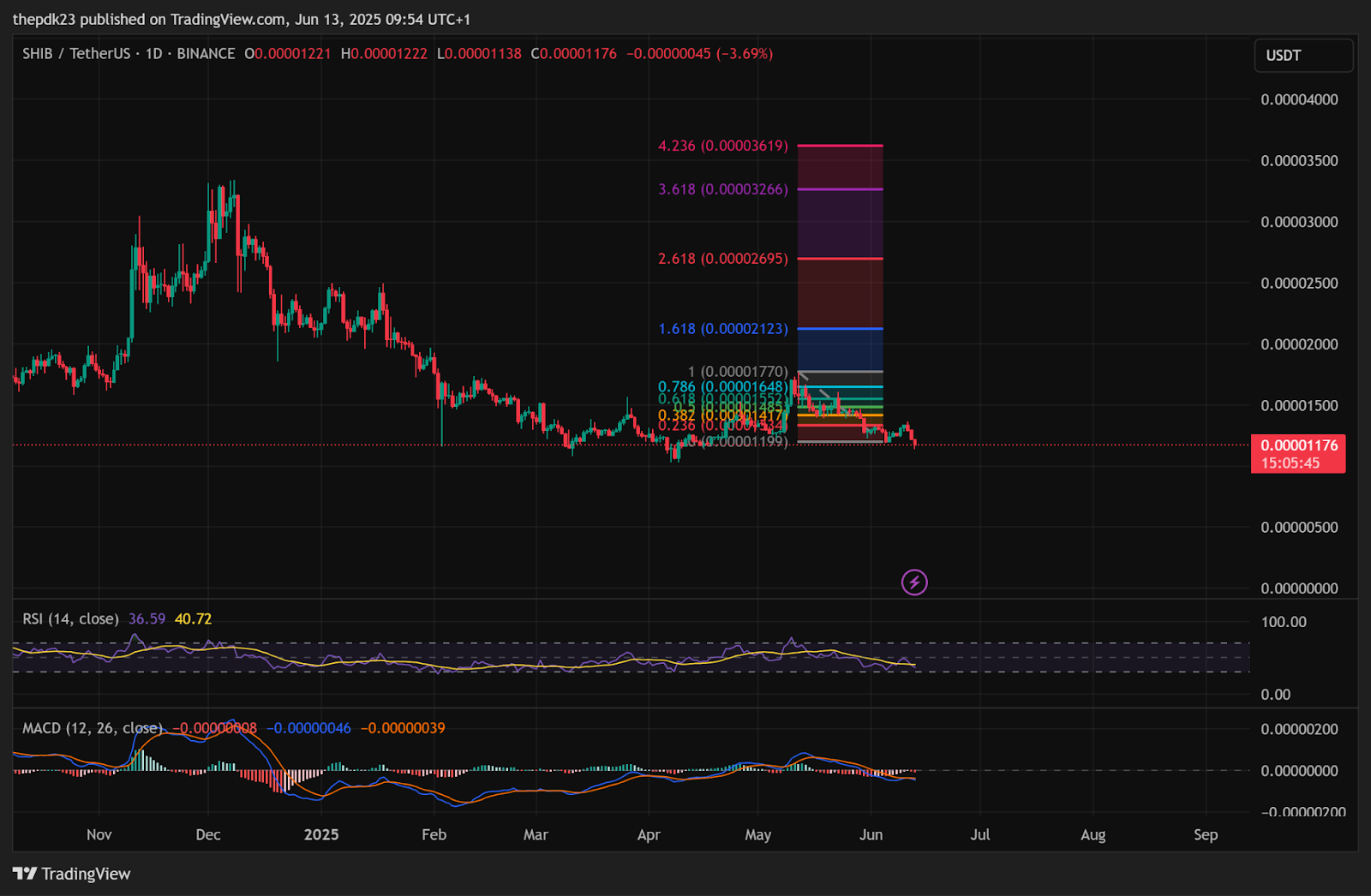
Источник: TradingView

С другой стороны, RSI находится на уровне 36,40, показывая, что SHIB приближается к зоне перепроданности, но еще не вошел в нее полностью. Это сигнализирует об ослаблении импульса, хотя разворот может произойти, если быки защитят текущую зону поддержки.

Индикатор MACD показывает, что линия MACD (синяя) остается ниже сигнальной линии (оранжевой), и обе они находятся ниже нуля. Это пересечение указывает на продолжающийся медвежий импульс, но сглаживающаяся гистограмма может намекать на возможное истощение тренда в краткосрочной перспективе.


Letture associate

BIS Report Compliance Observations: The True Risks of Stablecoins Go Beyond 'De-pegging'

The BIS report, "Anchoring trust in money: innovation beyond stablecoins," highlights that the primary risks of stablecoins extend beyond potential de-pegging. It argues that the core challenge is whether stablecoins can be integrated into a financial system that is identifiable, monitorable, accountable, and regulatable. While acknowledging efficiency gains like faster payments and programmability, BIS emphasizes that money requires an institutional framework—including legal certainty, liquidity support, and financial integrity controls—which many stablecoins currently lack. The report details compliance risks, noting that while blockchain transactions are transparent, address visibility does not equate to identity or purpose clarity. This creates a systemic risk as pseudonymity, non-custodial wallets, and cross-chain bridges can undermine AML/CFT controls. Furthermore, these risks can spill over into the traditional financial system through on- and off-ramps. The future direction, per BIS, is not to prohibit innovation but to embed regulatory rules—such as identity verification and transaction screening—directly into the technological infrastructure of tokenized finance. The key takeaway for compliance is that any new financial instrument must clearly address questions of customer identification, transaction monitoring, accountability, and cross-border rule consistency to be viable as a mainstream payment tool.

marsbit49 min fa

BIS Report Compliance Observations: The True Risks of Stablecoins Go Beyond 'De-pegging'

marsbit49 min fa

When US Giants Collectively "Defect" to Chinese AI Models

When Silicon Valley Giants Turn to Chinese AI Models to Cut Costs A surprising trend is emerging: major U.S. tech companies are significantly reducing AI costs by switching to Chinese models. Coinbase, the largest U.S. cryptocurrency exchange, reportedly halved its AI spending after migrating to China's GLM-5.2 and Kimi 2.7 models, despite increasing usage. They achieved this through a sophisticated three-part strategy: implementing an automatic routing system to select the most cost-effective model per task, boosting cache hit rates from 5% to 60% to reuse computations, and employing "context engineering" to provide AI with more precise, less cluttered information. They are not alone. AI startup Lindy switched from Claude to DeepSeek, saving millions, while Snowflake's tests found GLM-5.2 solved 66% of coding tasks compared to Claude Opus's 67%—but at a fraction of the cost (output pricing is 5-7 times lower). While the top Western models may offer slightly better stability, the massive price differential is leading many businesses to reconsider their value proposition. This shift signals a deeper change in the AI industry, moving beyond pure performance benchmarks to a fierce cost competition. As pressure mounts, even OpenAI and Anthropic have begun slashing prices. For users, this means more choices, lower costs, and a crucial lesson: using multiple models based on task complexity, optimizing with caching, and keeping contexts lean are now key to leveraging AI efficiently and affordably.

marsbit55 min fa

When US Giants Collectively "Defect" to Chinese AI Models

marsbit55 min fa

BIS Report Compliance Watch: The Real Risks of Stablecoins Are Not Just 'De-pegging'

BIS Report Compliance Observations: The real risks of stablecoins go beyond "depegging" The BIS report "Anchoring trust in money: innovation beyond stablecoins" argues that while stablecoins and tokenization offer efficiency gains, their primary risk lies in fitting into an identifiable, monitorable, accountable, and regulatable financial system. Money's trust stems not just from technology but from institutional arrangements: a common unit of account, guaranteed redemption at par, liquidity support, regulatory frameworks, and financial integrity requirements. Stablecoins, operating on permissionless blockchains with pseudo-anonymity and non-custodial wallets, create systemic compliance gaps: unclear customer identity, incomplete fund origins, unexplained transaction purposes, fragmented cross-chain paths, and ambiguous liability. On-chain transparency does not equal compliance transparency. Public addresses don't reveal identity or intent. While blockchain analytics aid law enforcement, they cannot replace routine, large-scale AML/CFT controls. Effective compliance requires a closed-loop process encompassing customer onboarding, transaction monitoring, investigation, reporting, and audit. Stablecoin risks are not confined to the blockchain; they re-enter the traditional financial system via on/off-ramps, exchanges, and payment institutions. This forces banks to monitor client accounts for activity linked to virtual assets. The future direction is not to prohibit innovation but to embed rules into the technology. Tokenized finance should integrate with the existing two-tier monetary system, embedding compliance—like customer identification, pre-transaction screening, and auditable data trails—directly into the transaction flow. For compliance professionals, the key takeaway is that any new financial instrument must answer core questions: Who identifies the customer? Who monitors transactions? Who handles exceptions? Who is liable? Compliance is not the antithesis of innovation but the essential infrastructure for its sustainable growth.

链捕手56 min fa

BIS Report Compliance Watch: The Real Risks of Stablecoins Are Not Just 'De-pegging'

链捕手56 min fa

When American Giants 'Defect' to Chinese AI Models

Summary: The trend of major U.S. technology firms adopting more cost-effective Chinese AI models is gaining momentum. A prime example is Coinbase, the largest U.S. cryptocurrency exchange, which reportedly halved its AI expenditure by switching to Chinese models GLM-5.2 and Kimi 2.7, while its usage volume increased. This was achieved through a sophisticated cost-saving system featuring intelligent model routing (selecting the most suitable model per task), dramatically improving cache hit rates from 5% to 60%, and implementing "Context Engineering" to streamline prompts. This shift is not isolated. Other companies like the AI startup Lindy and data cloud firm Snowflake are making similar moves, drawn by the significant price disparity. For instance, GLM-5.2 costs $1.40/$4.40 per million tokens (input/output), compared to $5/$25 for Claude Opus 4.7. While top Western models may offer slightly higher stability or speed in complex tasks, the performance gap is narrowing, making the price difference harder to justify for many enterprise use cases. The implications are significant for both businesses and individual users. It highlights the importance of a multi-model strategy based on task requirements, the value of caching and reusing outputs, and the effectiveness of providing concise context. Ultimately, this migration signals a potential reshaping of the AI industry's pricing model, moving competition from pure performance benchmarks to practical cost-effectiveness, with increased choice and downward price pressure benefiting end-users.

链捕手1 h fa

When American Giants 'Defect' to Chinese AI Models

链捕手1 h fa

Trading

Spot
活动图片