Three Key Bitcoin On-Chain Metrics to Watch Now

tokeninsight_enPubblicato 2025-06-08Pubblicato ultima volta 2025-06-11

Introduction

Understanding Bitcoin’s market goes beyond just watching price movements. On-chain metrics provide deeper insights into investor behavior and market cycles by analyzing blockchain data directly. This article explores three key on-chain indicators – MVRV (Market Value to Realized Value), Bitcoin balance on exchanges, and the 1+ year HODL wave – and how they help paint a data-driven picture of Bitcoin’s market health.

MVRV Z-Score (Market Value to Realized Value)

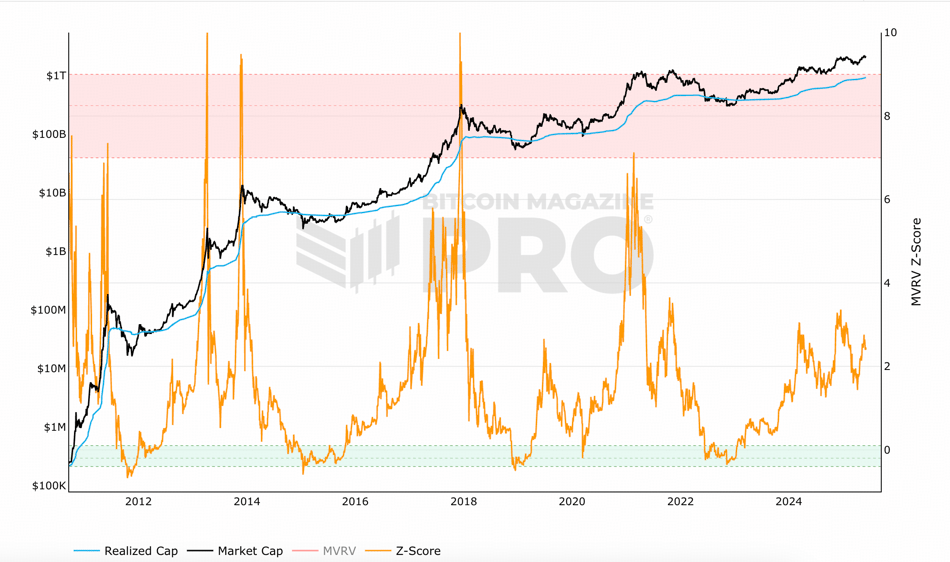
Bitcoin’s MVRV Z-Score chart, showing that current levels remain well below historical peaks. Higher MVRV Z-Score values (red areas) signaled past cycle tops, while low values (green) coincided with bear market lows.
Source: https://www.bitcoinmagazinepro.com/charts/mvrv-zscore/

What is MVRV?

MVRV stands for Market Value to Realized Value. In simple terms, it’s the ratio of Bitcoin’s total market capitalization to its realized capitalization. The market cap is just the current price times the circulating supply. The realized cap, in contrast, values each coin at the price when it last moved on-chain (essentially an aggregate “cost basis” for all BTC). By comparing these, MVRV shows the gap between current price and the average price at which coins were acquired. If the ratio is high, the average holder is in profit – on average, coins are worth much more now than what their owners paid. If MVRV is low or below 1.0, it means many holders would be sitting on losses if they sold at current prices.

Why is MVRV important?

This metric is a barometer of market sentiment and valuation extremes. A high MVRV indicates the market value is far above the aggregated cost basis, suggesting potential overvaluation – in such periods investors have large unrealized profits, so there may be greater temptation to sell (historically, MVRV spikes have aligned with major price tops). Conversely, a very low MVRV (especially below 1) means the market is trading near or even under the average on-chain cost basis, indicating possible undervaluation or capitulation – past bear market bottoms saw MVRV in this low range when most investors were underwater on their positions. In practice, analysts consider MVRV as a gauge of fair value vs. hype: it helps identify when Bitcoin is extremely overvalued or undervalued relative to what holders actually paid.

MVRV Z-Score

The MVRV Z-Score is a statistical refinement of the basic MVRV ratio. It compares Bitcoin’s market value to its realized value and then normalizes the difference using the historical standard deviation of that difference.

While MVRV gives a simple ratio, the Z-Score adds statistical depth, identifying extremes more precisely. Historically:

  • A Z-Score above 7–8 has aligned with market tops (euphoria, overvaluation).
  • A Z-Score near or below 0 has marked bottoms (despair, capitulation).

Unlike raw MVRV, which can drift over time due to structural shifts in realized cap, the Z-Score accounts for historical volatility, making it more robust for cycle analysis.

Potential Problem

The fundamental problem with the MVRV-Z Score lies in the fact that it is constructed entirely from on-chain data. Today, a substantial majority of Bitcoin trading occurs off-chain — particularly on centralized exchanges, ETFs as well as in the derivatives markets.

For example, if a large investor accumulates Bitcoin on Coinbase but leaves it in the exchange wallet without withdrawing to self-custody, there will be no on-chain movement. As a result, the realized value component of MVRV-Z does not update. Yet the market is clearly absorbing a large buy-side volume, a signal that MVRV-Z fails to capture.

MVRV-Z Score remains a powerful tool for identifying long-term valuation extremes based on historical price behavior and UTXO flows, it is fundamentally constrained by its on-chain-only perspective.

Bitcoin Balance on Exchanges

Total BTC held on exchanges over time (orange) versus Bitcoin’s price (black). Exchange balances grew steadily until 2020, peaking around 3.4 million BTC, then began declining. By 2025, exchange reserves have fallen near multi-year lows (signaling more coins in self-custody).

What is the “balance on exchanges” ?

This simply measures how much Bitcoin is held in wallets belonging to centralized exchanges. On-chain analytics can identify known exchange addresses and sum up all BTC in those wallets. The result is an estimate of the total supply sitting on exchanges available for trading.

Why is this important?

Exchange balance is often interpreted as an indicator of selling pressure and investor sentiment. The logic goes: when lots of BTC are parked on exchanges, those coins are just one quick sell order away from hitting the market – indicating potential supply overhang. Conversely, when the exchange balance drops, it means investors are pulling coins into cold storage, making them less immediately available for sale – a sign of accumulation and confidence (investors are comfortable holding, not looking to liquidate).

Historical trends support this view: rising exchange reserves have tended to coincide with bear markets or price declines (investors send BTC to exchanges, presumably to sell), whereas sustained declines in exchange-held BTC have often accompanied bull markets (coins moving off exchanges as people HODL for the long term).

Potential Problem

The landscape of custody is evolving. In late 2024–2025, a significant new factor was the rise of Bitcoin ETFs and institutional custodians. These products led to coins moving out of retail exchanges into custodial cold storage for ETFs. The exchange balance metric saw a drop (because those coins left exchanges), but this wasn’t due to individual hodlers—it was a shift in where coins are held.

According to Glassnode's analysis, when you combine exchange holdings with ETF custodial wallets, the total has remained relatively stable around ~3 million BTC, meaning the apparent outflows were largely a transfer from one type of custodian to another rather than a true supply squeeze.

Declining Exchange Balances Are Enhancing the Accuracy of MVRV Z-Score

One of the most frequently cited limitations of the MVRV Z-Score lies in its exclusive reliance on on-chain data. As a metric that compares Bitcoin’s market capitalization to its realized capitalization (where realized cap tracks the aggregated cost basis of all coins based on their last on-chain movement), the MVRV Z-Score fails to capture any activity that occurs off-chain.

In such a context, if large volumes of Bitcoin are bought and held within exchange wallets without being withdrawn to self-custody, those transactions remain invisible to the realized cap component. The result is a potential distortion: the metric may suggest under- or overvaluation based on incomplete data about actual cost basis and market sentiment.

However, this core limitation may be becoming less severe in the current market environment. A significant structural shift has occurred in Bitcoin custody patterns since 2020, as evidenced by the sharp and sustained decline in the total BTC balance held on centralized exchanges.

This mass withdrawal behavior has important implications for the MVRV Z-Score. As more BTC leaves exchanges, those movements typically generate on-chain activity. These withdrawals register new timestamps and prices for the UTXOs involved, thereby updating the realized cap. As a result, a growing portion of market activity that was previously invisible to MVRV is now being incorporated into its dataset. The consequence is that the MVRV Z-Score may now more accurately reflect market sentiment and aggregated cost basis than it did during earlier periods of heavy exchange dominance.

However, the rise of ETFs and institutional custodianship introduces new layers of abstraction: while coins may leave retail exchanges, they often move into large custodial aggregators whose on-chain patterns may be difficult to interpret, limiting the granularity of insight available from realized cap updates.

Most U.S.-based spot Bitcoin ETFs were launched in early 2024, during the early phase of a bull market. Since their inception, these ETFs have primarily been in an accumulation phase, buying large quantities of BTC from exchanges and transferring them into institutional-grade custodial wallets. These are first-time acquisitions, meaning they involve on-chain settlement: coins are purchased (often OTC or via prime brokers), then withdrawn from exchange wallets and deposited into ETF custodians’ wallets—triggering UTXO updates in the process.

Because these transactions involve actual on-chain movements—either withdrawals from exchange hot wallets or direct transfers into segregated custody—they are captured in the realized cap calculation. Thus, the MVRV Z-Score does reflect the cost basis of these ETF-acquired coins, even though those coins now sit in wallets that may appear relatively static afterward.

1+ Year HODL Wave (Long-Term Holder Supply)

Bitcoin “1+ Year HODL Wave” – percentage of supply untouched for at least one year. In prior cycle peaks (2017, 2021), this percentage dropped significantly as long-term holders sold off, whereas currently it remains elevated, indicating many are still holding their coins.

Source: https://www.bitcoinmagazinepro.com/charts/1-year-hodl-wave/

What is the 1+ Year HODL Wave?

The term HODL waves refers to a visualization of Bitcoin’s supply divided by the last time each coin moved (its “age”). The 1+ year HODL wave specifically measures the proportion of Bitcoin that hasn’t been moved from one address to another in at least one year. In plain language, it’s the share of BTC being held by long-term holders (LTHs) – people who haven’t touched their coins for a year or more.

Why is it important?

The HODL wave is a window into holder behavior and market cycles. Generally, long-term holders set the floor and ceiling of cycles: they accumulate during bear markets (increasing the 1y+ wave as coins age without moving), and they distribute during bull markets (spending some of those old coins, which shrinks the 1y+ percentage).

A rising 1+ year HODL wave indicates coins aging and staying put – a sign of accumulation and strong conviction. This often happens in bear phases when prices are low and patient investors or “smart money” keep buying or holding. Conversely, when the 1+ year band starts to decline, it means previously dormant coins are on the move – typically indicating profit-taking by long-term holders as the market heats up.

In bull markets, long-term holders gradually sell or redistribute coins to newer buyers, which shows up as a drop in the percentage of 1y+ old coins. Thus, this metric provides insight into where we are in the cycle: if the long-term HODLer cohort is at all-time highs, it suggests we’re still in a strong-hands, accumulation-heavy phase; if that cohort rapidly shrinks, it can signal a distribution phase associated with market tops.

Potential Problem

On its own, the HODL wave doesn’t tell you if those long-term holders will continue to hold or are about to sell en masse. It’s a bit like looking at a reservoir of water without knowing when the dam will open. You know a lot of water (supply) is stored up, but timing the release requires other data. The metric is most powerful when combined with others – for example, pairing a decline in HODL wave with a spike in exchange inflows and a high MVRV would strongly indicate a top forming. But the HODL wave by itself is more informative about the past and present state of holdings than the immediate future.

Combining Metrics for Deeper Insights

No single metric can capture the full complexity of Bitcoin’s market. Each of the three indicators above – MVRV, exchange balances, and the HODL wave – shines light on one dimension of market behavior. MVRV is about investors’ profitability (and thus greed/fear), exchange balance is about traders’ positioning (liquid vs. cold storage), and HODL wave is about long-term holder conviction. Taken together, they give a holistic view of the market’s state.

At major cycle tops, you tend to see confluence in these metrics: MVRV will be very high (signaling overvaluation and big unrealized profits), HODL wave will start dropping (long-term holders finally spending coins), and exchange balances may tick up (coins flowing to exchanges to be sold). No single metric is a perfect sell signal, but together these paint a powerful warning.

Current data (mid-2025) from these metrics collectively points to a robust market: valuations aren’t at extreme danger levels, supply on exchanges is constrained, and hodlers remain historically resolute.


Crypto di tendenza

Letture associate

In Just 11 Days, Claude Rewrote Millions of Lines of Code, an Epic AI Engineering Feat Sparks Fury

In just 11 days, Bun's founder Jarred Sumner used Anthropic's Claude AI models to rewrite its million lines of code from Zig to Rust. This move sparked significant controversy, particularly from Zig's creator, Andrew Kelley, who publicly criticized Sumner's engineering practices and the decision to use AI for such a massive rewrite. Bun, a high-performance JavaScript/TypeScript runtime and rival to Node.js, was originally written in Zig. After Anthropic acquired Bun, the team encountered persistent stability and memory safety bugs in the Zig codebase. These issues, combined with Zig's strict policy against LLM-generated code, led to the decision to rewrite in Rust. The rewrite was executed using Claude AI tools at an estimated API cost of $165,000, dramatically reducing the expected time and financial cost. Andrew Kelley's response was scathing. He blamed the original bugs on poor engineering habits, calling Bun's Zig code a collection of "hacks on top of hacks." He expressed relief that Bun was no longer associated with Zig, fearing it would misrepresent the language and attract low-quality, AI-generated contributions. The tech community is divided; some view Kelley's critique as unprofessional, while others see it as a defense of engineering integrity. A major concern about the AI-driven rewrite is the resulting code quality. The translation from Zig left approximately 27,000 lines of unsafe Rust code, raising fears about long-term maintainability and technical debt. The debate centers on whether this project is a milestone in AI-assisted development or a future maintenance nightmare.

marsbit51 min fa

In Just 11 Days, Claude Rewrote Millions of Lines of Code, an Epic AI Engineering Feat Sparks Fury

marsbit51 min fa

From Auto Finance to Bitcoin to AI Engines: An Analysis of Cango's 'What Not to Do' Strategy

From Auto Finance to Bitcoin and Now AI: Cango's "What Not to Do" Strategy Cango, a Chinese auto finance platform that went public on the NYSE in 2018, is undergoing its third major transformation. After selling its entire auto business in 2024, it pivoted to become a large-scale Bitcoin miner, acquiring 50 exahash of mining rigs from Bitmain. However, its true goal was never Bitcoin, but owning and controlling energy infrastructure. Now, Cango is pivoting again. While most listed Bitcoin miners are leasing power to giant hyperscalers for AI training clusters, Cango is taking the opposite path. It has launched an AI inference subsidiary called EcoHash, focusing not on training but on distributed inference. The company's strategy hinges on the insight that over 70% of mining industry power is controlled by small, independent sites (10-50 MW), which are too small for hyperscalers but ideal for low-latency AI inference. Cango aims to partner with these small operators, providing the AI technology, customers, and financing through its EcoLink software layer, which can distribute workloads across sites for reliability. Cango maintains a hybrid model, running roughly 31.7 EH/s of Bitcoin mining for cash flow while aggressively cleaning its balance sheet—slashing long-term debt by 94.5% to $30.6 million and raising $75 million for its AI venture. Its first AI deployment will be at a 50 MW site in Georgia. The strategy faces skepticism, given the high costs of converting mining sites and the potential for an AI bubble. However, Cango's leadership believes discipline around "what not to do"—avoiding direct competition with hyperscalers in training—positions it to capture the long-tail demand for distributed AI inference power.

Foresight News1 h fa

From Auto Finance to Bitcoin to AI Engines: An Analysis of Cango's 'What Not to Do' Strategy

Foresight News1 h fa

Strategy's Bitcoin Sales Cap Far Exceeds $1.25 Billion: A Detail the Market Overlooked

The article discusses how MicroStrategy's potential Bitcoin sales go far beyond the announced $1.25 billion "reserve-building capacity." It clarifies a key distinction in the company's "BTC Monetization Program": selling Bitcoin to *build* a new dollar reserve (the $1.25B cap) versus selling to *replenish* the existing USD Reserve after it's used for expenses like preferred share dividends. The recent $216M BTC sale for dividend payments was a "replenishment," leaving the headline $1.25B building quota untouched. The plan actually outlines three potential funding pools from BTC sales: 1) Building the reserve ($1.25B cap), 2) Covering preferred share/ debt costs (no specified cap), and 3) Funding buyback programs (up to $20B). This means the structured sales potential exceeds $30 billion, not including uncapped replenishment sales. The piece argues this marks MicroStrategy's shift from a passive "buy-and-hold" Bitcoin proxy to an actively managed entity using BTC as a balance-sheet tool to manage its complex capital structure (common stock, preferred shares, debt, reserve). This creates new dynamics and potential conflicts, as actions benefiting one part (e.g., selling BTC to pay dividends) may pressure another (e.g., undermining the "never sell" narrative). Investors must now parse the company's specific terminology ("build" vs. "replenish") to understand the true scope of future BTC sales, which is significantly larger than the market initially perceived.

marsbit1 h fa

Strategy's Bitcoin Sales Cap Far Exceeds $1.25 Billion: A Detail the Market Overlooked

marsbit1 h fa

Goldman Sachs Report Deconstructs the Competitive Landscape of China's AI Large Models: Who Will Be the Long-Term Winner?

Goldman Sachs analyzes China's AI large language model (LLM) landscape, identifying key players and a strategic shift towards efficiency and global expansion. The report highlights that Chinese open-source/open-weight models are closing the performance gap with top global proprietary models at significantly lower cost, driven by architectural innovations like MoE. This enables a "two-tier" market: a high-end segment (e.g., GLM5.2, Qwen3.7 Max) with pricing at ~$1 per million tokens, and a low-end, price-sensitive global segment. Open-source strategies aid adoption but limit monetization, as deployments via third-party platforms (e.g., AWS Bedrock, Alibaba Cloud) may not generate direct revenue for model creators. The industry is thus moving towards "open-weight + community license" models with revenue-sharing to improve unit economics. Internationally, the focus is shifting from "token maximization" to ROI-driven enterprise adoption, particularly in non-U.S. markets. Major cloud platforms are integrating Chinese models (e.g., DeepSeek, MiniMax). Using a competitive framework based on pricing power, cost advantage, and financial strength, Goldman Sachs identifies **Zhipu AI** and **DeepSeek** as leaders in foundational text models, and **ByteDance** (with Seedance) leading in multimodal/video generation. **MiniMax** and **Kuaishou** are also rated favorably. The firm forecasts China's AI model API/subscription revenue growing from ~RMB 35bn (2026E) to RMB 879bn by 2030.

marsbit1 h fa

Goldman Sachs Report Deconstructs the Competitive Landscape of China's AI Large Models: Who Will Be the Long-Term Winner?

marsbit1 h fa

Trading

Spot

Articoli Popolari

Cosa è BITCOIN

Comprendere HarryPotterObamaSonic10Inu (ERC-20) e la sua posizione nel mondo delle criptovalute Negli ultimi anni, il mercato delle criptovalute ha assistito a un aumento della popolarità delle meme coin, catturando l'interesse non solo dei trader, ma anche di coloro che cercano coinvolgimento comunitario e valore di intrattenimento. Tra questi token unici c'è HarryPotterObamaSonic10Inu (ERC-20), un progetto intrigante che mescola riferimenti culturali nel tessuto delle criptovalute. Questo articolo esplora gli aspetti chiave di HarryPotterObamaSonic10Inu, analizzando i suoi meccanismi, l'etica guidata dalla comunità e il suo coinvolgimento con il panorama crittografico più ampio. Che cos'è HarryPotterObamaSonic10Inu (ERC-20)? Come suggerisce il suo nome, HarryPotterObamaSonic10Inu è una meme coin costruita sulla blockchain di Ethereum, classificata secondo lo standard ERC-20. A differenza delle criptovalute tradizionali che possono enfatizzare l'utilità pratica o il potenziale investimento, questo token prospera grazie al valore di intrattenimento e alla forza della sua comunità. Il progetto mira a creare un ambiente in cui gli utenti coinvolti possono riunirsi, condividere idee e partecipare ad attività ispirate a diversi fenomeni culturali. Una caratteristica notevole di HarryPotterObamaSonic10Inu è la zero tassa sulle transazioni. Questo elemento allettante tende a incoraggiare il trading e il coinvolgimento della comunità, privo di costi aggiuntivi che possono scoraggiare i trader di piccole dimensioni. L'offerta totale della moneta è fissata a un miliardo di token, un numero che segna la sua intenzione di mantenere una circolazione sostanziale all'interno della comunità. Creatore di HarryPotterObamaSonic10Inu (ERC-20) Le origini di HarryPotterObamaSonic10Inu sono avvolte in un certo mistero; i dettagli sul creatore rimangono sconosciuti. Lo sviluppo di questo token non presenta un team identificabile o un piano esplicito, cosa non rara nel settore delle meme coin. Invece, il progetto è emerso organicamente, con il suo progresso fortemente dipendente dall'entusiasmo e dalla partecipazione della sua comunità. Investitori di HarryPotterObamaSonic10Inu (ERC-20) Per quanto riguarda investimenti esterni e finanziamenti, HarryPotterObamaSonic10Inu rimane ambiguo. Il token non elenca alcuna fondazione di investimento conosciuta o un sostegno organizzativo significativo. Invece, la linfa vitale del progetto è la sua comunità di base, che informa la sua crescita e sostenibilità attraverso azioni collettive e coinvolgimento nello spazio crittografico. Come funziona HarryPotterObamaSonic10Inu (ERC-20)? In quanto meme coin, HarryPotterObamaSonic10Inu opera principalmente al di fuori delle strutture tradizionali che governano spesso il valore degli asset. Ci sono diversi aspetti distintivi che definiscono il funzionamento del progetto: Transazioni senza tasse: Senza costi fiscali sulle transazioni, gli utenti possono comprare e vendere liberamente il token senza preoccuparsi di costi nascosti. Coinvolgimento della comunità: Il progetto prospera sull'interazione della comunità, sfruttando le piattaforme social per creare entusiasmo e facilitare il coinvolgimento. Discussioni, condivisione di contenuti e coinvolgimento sono elementi cruciali che aiutano ad espandere la sua portata e a favorire la lealtà tra i sostenitori. Nessuna utilità pratica: Va notato che HarryPotterObamaSonic10Inu non offre un'utilità concreta all'interno dell'ecosistema finanziario. Piuttosto, è classificato come un token principalmente per attività di intrattenimento e comunitarie. Riferimento culturale: Il token incorpora astutamente elementi della cultura pop per attirare interesse, collegandosi a appassionati di meme e seguaci delle criptovalute. HarryPotterObamaSonic10Inu esemplifica come le meme coin operino in modo diverso rispetto ai progetti di criptovalute più tradizionali, entrando nel mercato come costrutti sociali innovativi piuttosto che come asset utilitari. Cronologia di HarryPotterObamaSonic10Inu (ERC-20) La storia di HarryPotterObamaSonic10Inu è segnata da diversi traguardi notevoli: Creazione: Il token è emerso da un meme virale, catturando l'immaginazione di molti appassionati di criptovalute. Le date di creazione specifiche non sono disponibili, sottolineando la sua crescita organica. Inserimento negli scambi: HarryPotterObamaSonic10Inu ha fatto il suo ingresso in vari scambi, consentendo un accesso e un trading più facili da parte della comunità. Iniziative di coinvolgimento della comunità: Attività in corso volte a migliorare l'interazione della comunità, comprese gare, campagne sui social media e generazione di contenuti da parte di fan e sostenitori. Piani di espansione futura: La tabella di marcia del progetto include il lancio di una collezione NFT, merchandising e un sito di eCommerce relativo ai suoi temi culturali, coinvolgendo ulteriormente la comunità e cercando di aggiungere più dimensioni al suo ecosistema. Punti chiave su HarryPotterObamaSonic10Inu (ERC-20) Natura guidata dalla comunità: Il progetto dà priorità al contributo collettivo e alla creatività, garantendo che il coinvolgimento degli utenti sia al centro del suo sviluppo. Classificazione come meme coin: Rappresenta l'epitome delle criptovalute basate sull'intrattenimento, distinguendosi dai veicoli d'investimento tradizionali. Nessuna affiliazione diretta con Bitcoin: Nonostante la somiglianza nel nome del ticker, HarryPotterObamaSonic10Inu è distintivo e non ha alcuna relazione con Bitcoin o altre criptovalute consolidate. Focus sulla collaborazione: HarryPotterObamaSonic10Inu è progettato per creare uno spazio per la collaborazione e la condivisione di storie tra i suoi detentori, fornendo un canale per la creatività e il legame comunitario. Prospettive future: L'ambizione di espandersi oltre il suo presupposto iniziale verso NFT e merchandising delinea un percorso per il progetto per potenzialmente entrare in strade più mainstream all'interno della cultura digitale. Poiché le meme coin continuano a catturare l'immaginazione della comunità crittografica, HarryPotterObamaSonic10Inu (ERC-20) si distingue per i suoi legami culturali e il suo approccio centrato sulla comunità. Anche se potrebbe non adattarsi al modello tipico di un token orientato all'utilità, la sua essenza risiede nella gioia e nella camaraderia coltivate tra i suoi sostenitori, evidenziando la natura in evoluzione delle criptovalute in un'epoca sempre più digitale. Con la continuazione dello sviluppo del progetto, sarà importante osservare come le dinamiche della comunità influenzano la sua traiettoria nel panorama in continuo cambiamento della tecnologia blockchain.

1.8k Totale visualizzazioniPubblicato il 2024.04.01Aggiornato il 2024.12.03

Cosa è BITCOIN

Come comprare BTC

Benvenuto in HTX.com! Abbiamo reso l'acquisto di Bitcoin (BTC) semplice e conveniente. Segui la nostra guida passo passo per intraprendere il tuo viaggio nel mondo delle criptovalute.Step 1: Crea il tuo Account HTXUsa la tua email o numero di telefono per registrarti il tuo account gratuito su HTX. Vivi un'esperienza facile e sblocca tutte le funzionalità,Crea il mio accountStep 2: Vai in Acquista crypto e seleziona il tuo metodo di pagamentoCarta di credito/debito: utilizza la tua Visa o Mastercard per acquistare immediatamente BitcoinBTC.Bilancio: Usa i fondi dal bilancio del tuo account HTX per fare trading senza problemi.Terze parti: abbiamo aggiunto metodi di pagamento molto utilizzati come Google Pay e Apple Pay per maggiore comodità.P2P: Fai trading direttamente con altri utenti HTX.Over-the-Counter (OTC): Offriamo servizi su misura e tassi di cambio competitivi per i trader.Step 3: Conserva Bitcoin (BTC)Dopo aver acquistato Bitcoin (BTC), conserva nel tuo account HTX. In alternativa, puoi inviare tramite trasferimento blockchain o scambiare per altre criptovalute.Step 4: Scambia Bitcoin (BTC)Scambia facilmente Bitcoin (BTC) nel mercato spot di HTX. Accedi al tuo account, seleziona la tua coppia di trading, esegui le tue operazioni e monitora in tempo reale. Offriamo un'esperienza user-friendly sia per chi ha appena iniziato che per i trader più esperti.

4.1k Totale visualizzazioniPubblicato il 2024.12.12Aggiornato il 2026.06.02

Come comprare BTC

Cosa è $BITCOIN

ORO DIGITALE ($BITCOIN): Un'Analisi Completa Introduzione all'ORO DIGITALE ($BITCOIN) L'ORO DIGITALE ($BITCOIN) è un progetto basato su blockchain che opera sulla rete Solana, con l'obiettivo di combinare le caratteristiche dei metalli preziosi tradizionali con l'innovazione delle tecnologie decentralizzate. Sebbene condivida un nome con Bitcoin, spesso definito “oro digitale” a causa della sua percezione come riserva di valore, l'ORO DIGITALE è un token separato progettato per creare un ecosistema unico all'interno del panorama Web3. Il suo obiettivo è posizionarsi come un asset digitale alternativo valido, anche se i dettagli riguardanti le sue applicazioni e funzionalità sono ancora in fase di sviluppo. Cos'è l'ORO DIGITALE ($BITCOIN)? L'ORO DIGITALE ($BITCOIN) è un token di criptovaluta esplicitamente progettato per l'uso sulla blockchain di Solana. A differenza di Bitcoin, che fornisce un ruolo di stoccaggio di valore ampiamente riconosciuto, questo token sembra concentrarsi su applicazioni e caratteristiche più ampie. Aspetti notevoli includono: Infrastruttura Blockchain: Il token è costruito sulla blockchain di Solana, nota per la sua capacità di gestire transazioni ad alta velocità e a basso costo. Dinamiche di Offerta: L'ORO DIGITALE ha un'offerta massima fissata a 100 quadrilioni di token (100P $BITCOIN), sebbene i dettagli riguardanti la sua offerta circolante siano attualmente non divulgati. Utilità: Sebbene le funzionalità precise non siano esplicitamente delineate, ci sono indicazioni che il token potrebbe essere utilizzato per varie applicazioni, potenzialmente coinvolgendo applicazioni decentralizzate (dApp) o strategie di tokenizzazione degli asset. Chi è il Creatore dell'ORO DIGITALE ($BITCOIN)? Attualmente, l'identità dei creatori e del team di sviluppo dietro l'ORO DIGITALE ($BITCOIN) rimane sconosciuta. Questa situazione è tipica tra molti progetti innovativi nel settore blockchain, in particolare quelli allineati con la finanza decentralizzata e i fenomeni delle meme coin. Sebbene tale anonimato possa favorire una cultura guidata dalla comunità, intensifica le preoccupazioni riguardo alla governance e alla responsabilità. Chi sono gli Investitori dell'ORO DIGITALE ($BITCOIN)? Le informazioni disponibili indicano che l'ORO DIGITALE ($BITCOIN) non ha alcun sostenitore istituzionale noto o investimenti di venture capital prominenti. Il progetto sembra operare su un modello peer-to-peer incentrato sul supporto e sull'adozione della comunità piuttosto che su percorsi di finanziamento tradizionali. La sua attività e liquidità si trovano principalmente su exchange decentralizzati (DEX), come PumpSwap, piuttosto che su piattaforme di trading centralizzate consolidate, evidenziando ulteriormente il suo approccio di base. Come Funziona l'ORO DIGITALE ($BITCOIN) Le meccaniche operative dell'ORO DIGITALE ($BITCOIN) possono essere elaborate in base al suo design blockchain e alle caratteristiche della rete: Meccanismo di Consenso: Sfruttando il proof-of-history (PoH) unico di Solana combinato con un modello di proof-of-stake (PoS), il progetto garantisce una validazione efficiente delle transazioni contribuendo all'alta performance della rete. Tokenomics: Sebbene meccanismi deflazionistici specifici non siano stati dettagliati ampiamente, l'ampia offerta massima di token implica che potrebbe soddisfare microtransazioni o casi d'uso di nicchia che devono ancora essere definiti. Interoperabilità: Esiste il potenziale per l'integrazione con l'ecosistema più ampio di Solana, inclusi vari piattaforme di finanza decentralizzata (DeFi). Tuttavia, i dettagli riguardanti integrazioni specifiche rimangono non specificati. Cronologia degli Eventi Chiave Ecco una cronologia che evidenzia traguardi significativi riguardanti l'ORO DIGITALE ($BITCOIN): 2023: Il dispiegamento iniziale del token avviene sulla blockchain di Solana, contrassegnato dal suo indirizzo di contratto. 2024: L'ORO DIGITALE guadagna visibilità poiché diventa disponibile per il trading su exchange decentralizzati come PumpSwap, consentendo agli utenti di scambiarlo contro SOL. 2025: Il progetto assiste a un'attività di trading sporadica e a un potenziale interesse per impegni guidati dalla comunità, sebbene non siano state documentate partnership significative o avanzamenti tecnici fino ad ora. Analisi Critica Punti di Forza Scalabilità: L'infrastruttura sottostante di Solana supporta alti volumi di transazioni, il che potrebbe migliorare l'utilità di $BITCOIN in vari scenari di transazione. Accessibilità: Il potenziale basso prezzo di trading per token potrebbe attrarre investitori al dettaglio, facilitando una partecipazione più ampia grazie a opportunità di proprietà frazionata. Rischi Mancanza di Trasparenza: L'assenza di sostenitori, sviluppatori o di un processo di audit pubblicamente noti potrebbe generare scetticismo riguardo alla sostenibilità e all'affidabilità del progetto. Volatilità del Mercato: L'attività di trading è fortemente dipendente dal comportamento speculativo, il che può comportare una significativa volatilità dei prezzi e incertezze per gli investitori. Conclusione L'ORO DIGITALE ($BITCOIN) emerge come un progetto intrigante ma ambiguo all'interno dell'evolvente ecosistema di Solana. Sebbene tenti di sfruttare la narrativa dell'“oro digitale”, la sua partenza dal ruolo consolidato di Bitcoin come riserva di valore sottolinea la necessità di una chiara differenziazione della sua utilità e struttura di governance. L'accettazione e l'adozione future dipenderanno probabilmente dall'affrontare l'attuale opacità e dalla definizione più esplicita delle sue strategie operative ed economiche. Nota: Questo rapporto comprende informazioni sintetizzate disponibili a ottobre 2023, e potrebbero essersi verificati sviluppi oltre il periodo di ricerca.

132 Totale visualizzazioniPubblicato il 2025.05.13Aggiornato il 2025.05.13

Cosa è $BITCOIN

Discussioni

Benvenuto nella Community HTX. Qui puoi rimanere informato sugli ultimi sviluppi della piattaforma e accedere ad approfondimenti esperti sul mercato. Le opinioni degli utenti sul prezzo di BTC BTC sono presentate come di seguito.

活动图片