Why A Sweep At $2 Is Important For XRP Price To Continue Rallying

bitcoinistPubblicato 2025-06-07Pubblicato ultima volta 2025-06-08

Introduzione

The XRP price is currently dipping into a crucial $2 liquidation zone amid rising short pressure. As long positions get...

Trusted Editorial content, reviewed by leading industry experts and seasoned editors. Ad Disclosure

The XRP price is currently dipping into a crucial $2 liquidation zone amid rising short pressure. As long positions get liquidated and shorts pile in, a subsequent surge in open interest hints at a looming short squeeze. A clean sweep of $2 has analysts believing that it may be the trigger XRP needs to ignite a fresh price rally. 

XRP Price Eyes $2 Sweep To Fuel Next Rally

A new technical analysis by Cryptoinsightuk on X (former Twitter) reveals that XRP has recently retraced into a key liquidity zone near the $2 mark. This move has raised speculation about a possible bullish reversal that could set the stage for a major price rally. 

According to the analyst’s 1-hour XRP chart, the altcoin’s drop into this liquidity zone was not random—it aligned perfectly with a dense liquidity cluster near the $2 level, as shown on the heatmap data. This zone acted as a magnet for price action, where a significant number of buy and sell orders were concentrated, suggesting that market participants have been targeting this area for some time.
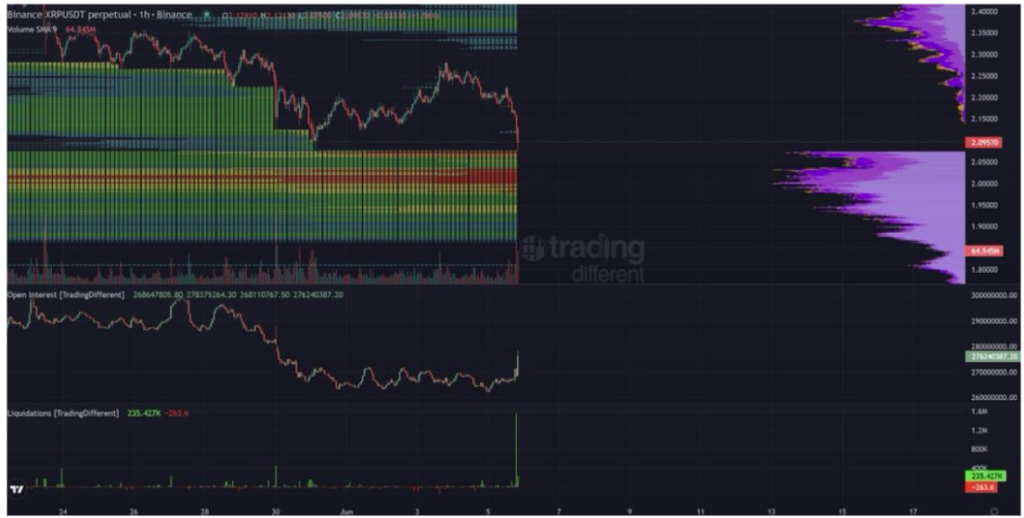
As XRP entered this key liquidity zone, Cryptoinsightuk revealed that a large number of long positions were liquidated. This spike, displayed primarily on the liquidation indicator at the bottom of the chart, confirms that many traders were caught in overly aggressive long positions and forced out of the market as prices dropped. This led to severe sell pressure, allowing XRP to reach the targeted liquidity range more swiftly.

Simultaneously, XRP’s Open Interest (OI) metric began to rise. Rather than showing a decline, which would indicate traders exiting the market, Open Interest moved upward, suggesting that new positions were being opened despite the downturn. 

XRP is currently trading at $2.18. Chart: TradingView

Typically, an increase in OI during a dip into a high-liquidity zone is seen as a warning sign for short sellers. If the price reverses from here, those short positions could be forced to close rapidly, triggering a short squeeze. Such a move could lead to a fast and aggressive price rally as shorts are liquidated and buy pressure intensifies. 

Overall, the $2 price point has become more than just a psychological barrier but a convergence of liquidation events, rising open interest, and concentrated liquidity. A clean sweep below this level could complete the liquidity hunt, shake out remaining weak hands, and potentially set the stage for a bullish reversal in the XRP price. 

Next Stop For XRP: Explosive Rise To $46?

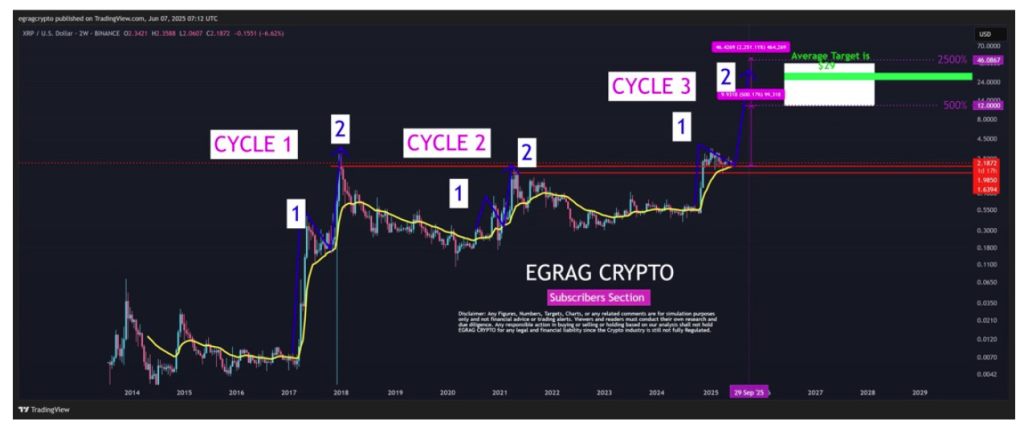
While some analysts take a conservative stance on XRP’s near-term price, market experts like Egrag Crypto stand out with a bold forecast of a $46 all-time high by 29 September 2025. The analyst predicts that XRP’s bullish run could begin in July, projecting three ambitious short-term price targets before the end of the year. 

Once it breaks bearish barriers, XRP is expected to rally to an initial target of $12, marking a 500% increase from its price of $2.18 at the time of the analysis. Following this, Egrag Crypto predicts an average target of $24 for XRP before a potentially explosive rise to the $46 peak, which represents a whopping 2,500% surge from current levels. 
Featured image from Unsplash, chart from TradingView

Editorial Process for bitcoinist is centered on delivering thoroughly researched, accurate, and unbiased content. We uphold strict sourcing standards, and each page undergoes diligent review by our team of top technology experts and seasoned editors. This process ensures the integrity, relevance, and value of our content for our readers.

Scott Matherson is a leading crypto writer at Bitcoinist, who possesses a sharp analytical mind and a deep understanding of the digital currency landscape. Scott has earned a reputation for delivering thought-provoking and well-researched articles that resonate with both newcomers and seasoned crypto enthusiasts. Outside of his writing, Scott is passionate about promoting crypto literacy and often works to educate the public on the potential of blockchain.

Letture associate

From Auto Finance to Bitcoin to AI Engines: An Analysis of Cango's 'What Not to Do' Strategy

From Auto Finance to Bitcoin and Now AI: Cango's "What Not to Do" Strategy Cango, a Chinese auto finance platform that went public on the NYSE in 2018, is undergoing its third major transformation. After selling its entire auto business in 2024, it pivoted to become a large-scale Bitcoin miner, acquiring 50 exahash of mining rigs from Bitmain. However, its true goal was never Bitcoin, but owning and controlling energy infrastructure. Now, Cango is pivoting again. While most listed Bitcoin miners are leasing power to giant hyperscalers for AI training clusters, Cango is taking the opposite path. It has launched an AI inference subsidiary called EcoHash, focusing not on training but on distributed inference. The company's strategy hinges on the insight that over 70% of mining industry power is controlled by small, independent sites (10-50 MW), which are too small for hyperscalers but ideal for low-latency AI inference. Cango aims to partner with these small operators, providing the AI technology, customers, and financing through its EcoLink software layer, which can distribute workloads across sites for reliability. Cango maintains a hybrid model, running roughly 31.7 EH/s of Bitcoin mining for cash flow while aggressively cleaning its balance sheet—slashing long-term debt by 94.5% to $30.6 million and raising $75 million for its AI venture. Its first AI deployment will be at a 50 MW site in Georgia. The strategy faces skepticism, given the high costs of converting mining sites and the potential for an AI bubble. However, Cango's leadership believes discipline around "what not to do"—avoiding direct competition with hyperscalers in training—positions it to capture the long-tail demand for distributed AI inference power.

Foresight News11 min fa

From Auto Finance to Bitcoin to AI Engines: An Analysis of Cango's 'What Not to Do' Strategy

Foresight News11 min fa

Strategy's Bitcoin Sales Cap Far Exceeds $1.25 Billion: A Detail the Market Overlooked

The article discusses how MicroStrategy's potential Bitcoin sales go far beyond the announced $1.25 billion "reserve-building capacity." It clarifies a key distinction in the company's "BTC Monetization Program": selling Bitcoin to *build* a new dollar reserve (the $1.25B cap) versus selling to *replenish* the existing USD Reserve after it's used for expenses like preferred share dividends. The recent $216M BTC sale for dividend payments was a "replenishment," leaving the headline $1.25B building quota untouched. The plan actually outlines three potential funding pools from BTC sales: 1) Building the reserve ($1.25B cap), 2) Covering preferred share/ debt costs (no specified cap), and 3) Funding buyback programs (up to $20B). This means the structured sales potential exceeds $30 billion, not including uncapped replenishment sales. The piece argues this marks MicroStrategy's shift from a passive "buy-and-hold" Bitcoin proxy to an actively managed entity using BTC as a balance-sheet tool to manage its complex capital structure (common stock, preferred shares, debt, reserve). This creates new dynamics and potential conflicts, as actions benefiting one part (e.g., selling BTC to pay dividends) may pressure another (e.g., undermining the "never sell" narrative). Investors must now parse the company's specific terminology ("build" vs. "replenish") to understand the true scope of future BTC sales, which is significantly larger than the market initially perceived.

marsbit17 min fa

Strategy's Bitcoin Sales Cap Far Exceeds $1.25 Billion: A Detail the Market Overlooked

marsbit17 min fa

Goldman Sachs Report Deconstructs the Competitive Landscape of China's AI Large Models: Who Will Be the Long-Term Winner?

Goldman Sachs analyzes China's AI large language model (LLM) landscape, identifying key players and a strategic shift towards efficiency and global expansion. The report highlights that Chinese open-source/open-weight models are closing the performance gap with top global proprietary models at significantly lower cost, driven by architectural innovations like MoE. This enables a "two-tier" market: a high-end segment (e.g., GLM5.2, Qwen3.7 Max) with pricing at ~$1 per million tokens, and a low-end, price-sensitive global segment. Open-source strategies aid adoption but limit monetization, as deployments via third-party platforms (e.g., AWS Bedrock, Alibaba Cloud) may not generate direct revenue for model creators. The industry is thus moving towards "open-weight + community license" models with revenue-sharing to improve unit economics. Internationally, the focus is shifting from "token maximization" to ROI-driven enterprise adoption, particularly in non-U.S. markets. Major cloud platforms are integrating Chinese models (e.g., DeepSeek, MiniMax). Using a competitive framework based on pricing power, cost advantage, and financial strength, Goldman Sachs identifies **Zhipu AI** and **DeepSeek** as leaders in foundational text models, and **ByteDance** (with Seedance) leading in multimodal/video generation. **MiniMax** and **Kuaishou** are also rated favorably. The firm forecasts China's AI model API/subscription revenue growing from ~RMB 35bn (2026E) to RMB 879bn by 2030.

marsbit18 min fa

Goldman Sachs Report Deconstructs the Competitive Landscape of China's AI Large Models: Who Will Be the Long-Term Winner?

marsbit18 min fa

Trading

Spot
活动图片