Юрист Coinbase назвал дело Орегона против биржи «копией» иска SEC

cryptonews.ruPubblicato 2024-06-05Pubblicato ultima volta 2025-06-05

Coinbase обратилась к федеральному судье США с просьбой рассмотреть иск от генерального прокурора Орегона, заявив, что это копия предыдущего иска Комиссии по ценным бумагам и биржам, который должен рассматриваться в федеральном суде.

В ходатайстве от 2 июня, поданном в федеральный суд Портленда, Coinbase заявила, что апрельский иск генерального прокурора Орегона Дэна Рэйфилда, обвиняющий фирму в продаже незарегистрированных ценных бумаг жителям штата, превысил его полномочия и является «попыткой вторгнуться в область федерального закона».

Криптовалютная биржа заявила, что иск Рэйфилда является «копией» иска SEC 2023 года против фирмы, которая утверждала, что продавала незарегистрированные ценные бумаги. В феврале SEC согласилась прекратить дело, одно из многих дел, связанных с криптовалютами, которые она прекратила при администрации Трампа.

«Недовольный недавними решениями федерального правительства по обеспечению соблюдения нормативных требований, новый генеральный прокурор Орегона решил диктовать будущее цифровых активов и общенациональных платформ, на которых они торгуются, — на выбранных им условиях, в установленные им сроки и в рамках своей сферы влияния», — написала Coinbase.

Во время подачи иска Рейфилд заявил, что подал в суд на Coinbase, поскольку биржа «продавала высокорисковые инвестиции без надлежащей проверки для защиты потребителей» и что якобы продаваемые ею незарегистрированные ценные бумаги «уязвимы для схем накачки и сброса и мошенничества».

В ходатайстве Coinbase заявила, что пыталась встретиться с Рейфилдом после того, как он уведомил фирму о том, что планирует подать в суд на биржу в течение 48 часов, но Рейфилд отказался.

Главный юридический директор Coinbase Пол Гревал заявил в сообщении на X от 3 июня, что «претензии Орегона поднимают фундаментальные федеральные вопросы, такие как значение термина «инвестиционный контракт», которые, как он добавил, должны решаться федеральным судом.
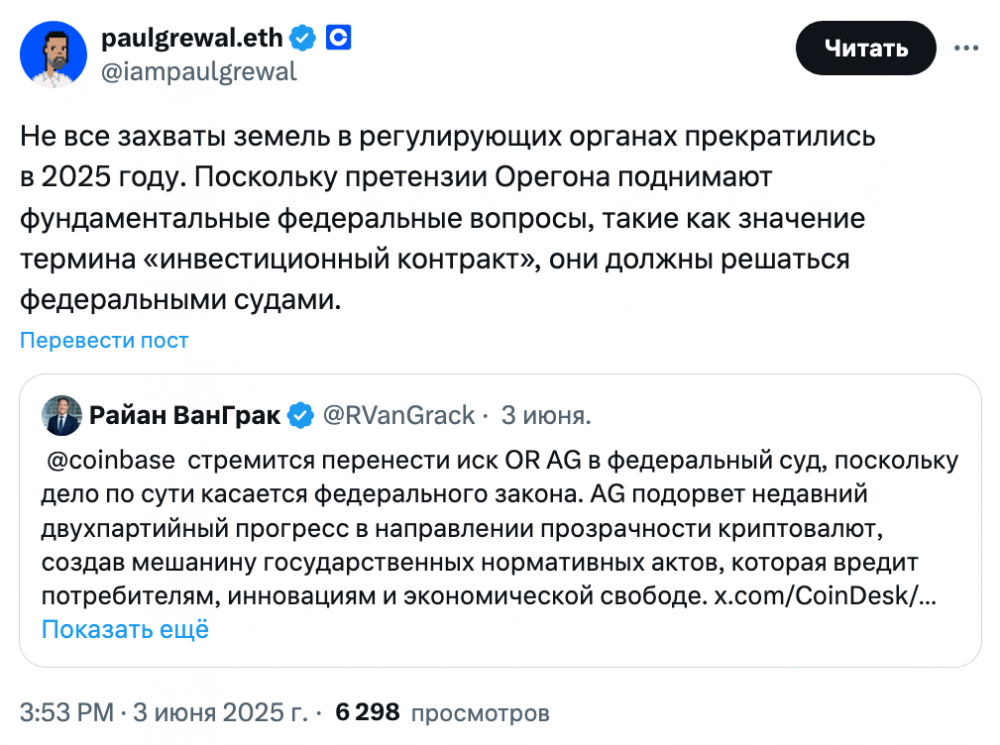

Источник: Пол Гревал.

«Штаты должны заполнить вакуум правоприменения»

Рэйфилд сказал, что его жалоба на Coinbase поступила после того, как SEC прекратила свое дело против биржи, и агентство направило своего главного юриста по криптовалютам в ИТ-отдел агентства после того, как Дональд Трамп вошел в Белый дом.

Он сказал, что штаты «должны заполнить вакуум правоприменения, оставленный федеральными регуляторами, которые сдаются при новой администрации и отказываются от этих важных дел».

За последние месяцы несколько штатов США отказались от своих исков против Coinbase, а Кентукки стал третьим штатом после Вермонта и Южной Каролины, который отказался от судебных исков против биржи.


Letture associate

AI Folding: Fable 5 and GPT-5.6 Are Becoming the Privilege of a Few

【AI Accessibility Gap Widens: Elite Tools Like Fable 5 and GPT-5.6 Are Becoming Privileged】 We are witnessing a growing "AI divide." A stark reality is emerging: a tiny fraction of elites, primarily in tech, are using powerful next-generation models like Fable 5 or the upcoming GPT-5.6, while the vast majority of the public only has access to "toys" - free, limited models equivalent to ChatGPT's basic versions (8B to 30B parameters). This creates a massive experiential chasm and cognitive dissonance. Industry outsiders see AI as overhyped and ineffective, unable to grasp its transformative potential, while insiders leverage these advanced models for a decisive competitive edge. The gap isn't just about model quality but product functionality. Free users get a simple chatbot. Paying elites get integrated workflow systems—capable of creating specialized agents, processing complex data, and handling real-world tasks like management, coding, and planning. Demos showcasing AI planning weddings or building apps feel disconnected from everyday needs like managing bills, groceries, or health. The cost barrier is immense, with reports of engineers spending $1000 daily on Fable 5 inference. Elite users employ sophisticated multi-model workflows, combining different AIs for ideation, architecture, execution, and review, completing complex projects in minutes instead of weeks. This divide extends to critical areas like healthcare, where free models are dangerously unreliable for medical queries. However, some argue that for 90% of common business tasks, mid-tier models like GPT-5.5 are sufficient; the perceived limitation often stems from poor integration and lack of context, not model intelligence. Ultimately, unequal access to cutting-edge AI is creating a new form of social stratification, where the most powerful tools are becoming the exclusive privilege of a few.

marsbit11 min fa

AI Folding: Fable 5 and GPT-5.6 Are Becoming the Privilege of a Few

marsbit11 min fa

Cathie Wood's June $77M Investment: Are Crypto Stocks a True 'Substitute' for Bitcoin?

In June, Cathie Wood's ARK Invest purchased $77 million worth of publicly traded crypto-related stocks, including Coinbase, Circle, and Bullish, during Bitcoin's worst monthly performance in four years. This aligns with the investment thesis that such stocks offer a compliant way to gain exposure to the crypto cycle without directly holding Bitcoin. However, data analysis reveals significant drawbacks. A group of nine U.S.-listed crypto companies showed 30-day annualized realized volatility between 68% and 90%, nearly double Bitcoin's 37.6%. Over 90 days, Circle's volatility reached 103.6% versus Bitcoin's 37.8%. Drawdowns were also more severe for stocks like Circle (-51.4%) and MicroStrategy (-48.6%) compared to Bitcoin's -36.4% from its January high. Correlation analysis shows most stocks share only a moderate link to Bitcoin. For example, Circle, Robinhood, and Bullish have a 90-day correlation coefficient of just 0.55–0.58 with BTC, meaning only about one-third of their price movement is explained by Bitcoin's action. The rest stems from company-specific risks: earnings, competition, fundraising, and equity dilution. MicroStrategy (MSTR) is the notable exception, acting as a leveraged Bitcoin proxy with a beta of 1.59 and 0.85 correlation. Coinbase offers relatively balanced exposure. Circle exemplifies "crypto-wrapped" corporate risk, with its recent crash tied to stablecoin competition, not Bitcoin. Robinhood's diversified business insulates it from crypto downturns but also limits upside. Bitcoin miners like RIOT and MARA have posted significant gains year-to-date, driven primarily by their pivot to AI compute services, not Bitcoin's price. The article highlights that investing in crypto stocks often means accepting amplified volatility or layering on business-specific risks absent from direct Bitcoin ownership. For instance, MicroStrategy's recent challenges—its market value falling below its Bitcoin holdings (mNAV <1) and facing potential Bitcoin sales for liquidity—demonstrate equity-specific hazards like dilution and financing pressures not faced by a direct Bitcoin holder. ARK's buying spree represents a bet on a basket of different business models with varying crypto exposure, not a simple, lower-risk substitute for holding Bitcoin.

marsbit11 min fa

Cathie Wood's June $77M Investment: Are Crypto Stocks a True 'Substitute' for Bitcoin?

marsbit11 min fa

Crypto Welcomes the 'July Rebound'? On-Chain Bottom Signals Align, Reversal Still Requires Breakthrough Above $70k

The cryptocurrency market is showing signs of a potential "July rebound," with Bitcoin leading a recovery above $63,000 and total market cap rising. This bounce is attributed to improved macro expectations (weaker US jobs data easing Fed hike fears), a short squeeze in derivatives, and signs of whale accumulation. Key on-chain metrics signal a potential bottom, including the Sharpe Ratio hitting extreme lows, the AHR999 index nearing historic buy zones, and miner pressure reaching significant levels. However, analysts caution this is likely a corrective rebound rather than a confirmed trend reversal. Persistent challenges include weak spot demand, negative Coinbase Premium indicating institutional caution, and ongoing selling pressure in the altcoin market. Market sentiment remains in "extreme fear" territory, and the AVIV ratio suggests the average active Bitcoin investor is still at a loss. For a true bullish reversal, Bitcoin needs to convincingly break above the key $70,000 level (aligned with the Short-Term Holder Realized Price). The path to a new parabolic bull market is seen as dependent on attracting substantially more capital, as capital efficiency has declined. While prices may be approaching a cyclical bottom zone (with estimates between $37k-$60k), the market requires more sustained positive signals for a definitive uptrend.

marsbit42 min fa

Crypto Welcomes the 'July Rebound'? On-Chain Bottom Signals Align, Reversal Still Requires Breakthrough Above $70k

marsbit42 min fa

Trading

Spot
活动图片