Трейдер Джеймс Уинн вновь открыл лонг по биткоину на $100 млн

cryptonews.ruPubblicato 2024-06-03Pubblicato ultima volta 2025-06-03

Криптотрейдер Джеймс Уинн вновь открыл маржинальную позицию по бессрочным фьючерсам на базе биткоина на платформе Hyperliquid почти на $100 млн.

Это произошло спустя несколько дней после ликвидации аналогичной сделки на фоне падения цифрового золота ниже $105 000.

По данным агрегатора Hypurrscan, очередной лонг с левериджем 40х ликвидируют, если цена первой криптовалюты опустится ниже $103 630. На момент написания нереализованный убыток по сделке превышает $400 000.
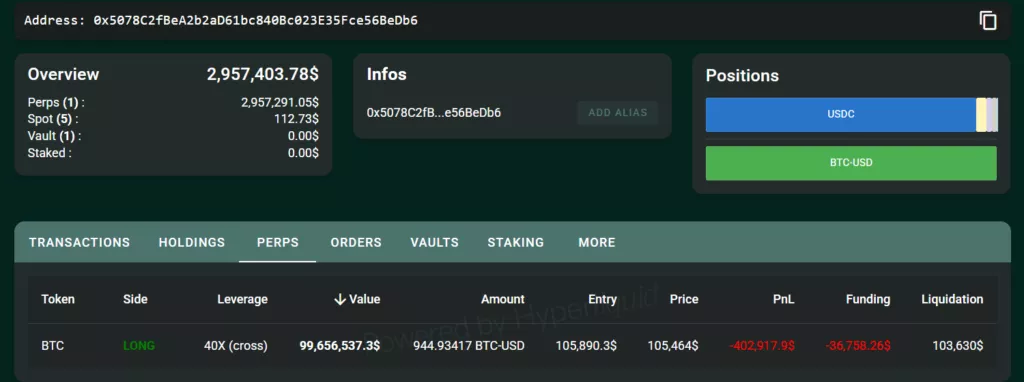
Данные: Hypurrscan.

Уинн заявил, что его уровень принудительного закрытия стал мишенью для крупных участников рынка.

They’re coming for me again.

Liq price: 103,640

Buy the fucking dip.

Don’t let these evil bastards liquidate me. pic.twitter.com/WKzL2ZwPEq

— James Wynn (@JamesWynnReal) June 2, 2025

«Они снова идут за мной», — написал трейдер.

Он призвал активно «откупать на чертовых низах», чтобы его не ликвидировали.

Инфлюенсер под ником Altcoin Gordon предположил, что вторая сделка Уинна на $100 млн может свидетельствовать о рыночных манипуляциях.

James Wynn opened another $100M BTC long

Within seconds the shady market makers dumped the price towards his liquidation price of $104,580

Why are they so desperate to see him lose? 🤔 pic.twitter.com/YY8ebG7v38

— Gordon (@AltcoinGordon) June 2, 2025

«В течение нескольких секунд теневые маркетмейкеры обрушили цену до уровня ликвидации в $104 580», — отметил он.

Некоторые трейдеры начали отправлять пожертвования на адрес Уинна, чтобы помочь ему финансировать маржинальные позиции. По данным ончейн-аналитика под ником dethective, как минимум 24 пользователя перевели стейблкоины на кошелек трейдера. Самое крупное пожертвование составило почти $8000.

James Wynn, a multimillionaire gambler, is asking for more money to support his gambling.

Surprisingly, people are actually sending him money.

We might be looking at a list of the most retarded people ever. pic.twitter.com/Ddtj4P8xm9

— dethective (@dethective) June 2, 2025

Ранее Уинн уже просил криптосообщество о донатах в «стабильных монетах» для «борьбы с картелем маркетмейкеров», пообещав вернуть пожертвования каждому в случае победы. Он также сообщил, что некоторые его личные аккаунты на криптовалютных биржах были «закрыты за одну ночь» без очевидных причин.

Несмотря на ситуацию, Уинн выразил оптимизм относительно будущего биткоина.

Bearish momentum is weakening on the 8hr, 12hr and daily candles for $BTC.

Everyone will be caught off guard. The pumps will be ferocious. When bitcoin moves it moves hard and fast.

— James Wynn (@JamesWynnReal) June 3, 2025

«Медвежий импульс ослабевает», — написал он.

Трейдер также спрогнозировал грядущее ралли первой криптовалюты, которое «застанет инвесторов врасплох».

Напомним, в марте высокорисковые позиции поставили под угрозу не только стабильность площадки, но и сохранность клиентских средств в Hyperliquidity Provider Vault.


Letture associate

A Decade of Change: The Demise of Crypto Startups

"The Decade-Long Transformation: The Demise of Crypto Startups" The article traces the dramatic evolution of the cryptocurrency industry from its anarchic beginnings to its current highly regulated and institutionalized state. In the early days (circa 2017), launching a crypto startup was remarkably simple: a whitepaper, a GitHub repository, and a Telegram group could attract thousands of retail investors via an Initial Coin Offering (ICO). Founders operated anonymously with near-zero regulatory and financial barriers, enabling rapid, global innovation but also widespread fraud. By 2026, the landscape is fundamentally different. To operate in major markets like the US, EU, and Asia, crypto businesses must now navigate a complex web of regulations akin to traditional finance. Compliance costs are prohibitive: estimates for a US multi-state operation range from $750,000 to $1.2 million in the first three years, with annual costs exceeding $2 million thereafter. Regulations like MiCA in the EU and New York's BitLicense have created high capital and operational hurdles that act as barriers to entry. Simultaneously, venture capital investment has shifted dramatically. Following the collapses of Terra and FTX, funding has concentrated in later-stage, established companies, creating a "barbell market." Early-stage and seed funding has shrunk significantly, while mega-funds like Andreessen Horowitz's $15 billion pool dominate. Most capital now flows to trading platforms, lending infrastructure, and B2B services. This environment favors mergers and acquisitions as the primary path for growth. Companies like Coinbase and Ripple are acquiring firms like Deribit and Hidden Road not for their technology, but for their licenses, banking relationships, and institutional trust—assets far more valuable than code. Distribution channels, compliance, and brand reputation have become the new moats, overshadowing pure technical innovation. The industry's maturation brings benefits: reduced scams, increased institutional participation, and clearer regulatory frameworks. However, it comes at a cost. The low-barrier, experimental ethos that defined crypto's first decade is fading. Entrepreneurs without substantial capital, pre-existing licenses, or institutional connections face immense challenges. Funding for exploratory fields like decentralized social media or novel governance models is drying up. Ultimately, the crypto industry is replicating the consolidation pattern seen in banking and tech after the 2008 financial crisis. While this brings stability and legitimacy, it raises a critical question: in this new, resource-intensive reality, is there still room for the disruptive, from-scratch innovation that gave birth to the sector?

Foresight News1 h fa

A Decade of Change: The Demise of Crypto Startups

Foresight News1 h fa

Trading

Spot
活动图片