Pi Network Price Soars 35% to $1.29 in Last 24 Hours

TheCryptoTimesPubblicato 2025-05-14Pubblicato ultima volta 2025-05-14

Introduzione

Whale moves 90M Pi coins spark a 278% volume spike, driving Pi Network’s price surge and retail interest to over $1 billion in trading.

The crypto market has been shocked by the dramatic 35% surge of Pi Network, which managed to recoup the $1 level and peak at $1.29. As a result of the rally, Pi’s total market value surpassed $8 billion, surpassing Litecoin (LTC) and Bitcoin Cash (BCH), according to CoinMarketCap.

Underlying this surge is a wave of large coin movements by whales. One whale moved 70 million Pi coins off exchanges, resulting in the first surge, and another 20 million Pi were moved from OKX shortly after.
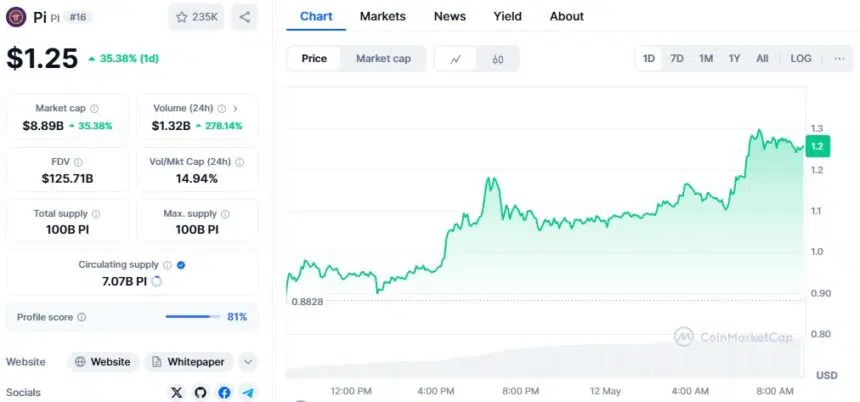
Due to these massive transfers, retail interest skyrocketed, sending trading volumes over $1 billion, a 278% increase in activity. Pi Coin, on the other hand, appreciated greatly, while Litecoin and Bitcoin Cash only increased moderately, highlighting Pi’s extraordinary growth. Pi has jumped to 14th rank following the surge, and if this momentum continues, it can even enter the top 10 ranking by CoinMarketCap.

Traders are focusing on the mid-May Consensus Summit because it could become a pivotal point for launching a long-term Pi rally.

In turn, the Pi Core Team is aggressively buying Pi from the exchanges to help stabilize the price following the latest token distribution. An expectation of a major announcement on May 14 is driving up investor excitement.

There are rumors flying around about a potential Binance listing, triggered by so-called test transactions. While fundamentals are strong and investor confidence increases, Pi Coin’s momentum continues unabated.


Letture associate

White-Label Stablecoins: More Than Just a Logo Change

"White-Label Stablecoins: Beyond a Logo Change" The article clarifies the often-misunderstood concept of "white-label stablecoins," which refers to businesses leveraging established providers like Circle or Coinbase to offer stablecoin functionality under their own brand. It details four distinct models, emphasizing that this is not a simple branding exercise but involves complex legal and operational responsibilities split across issuance, reserves, custody, and distribution. The four primary models are: 1. **Circle xReserve**: Enables blockchains (L1/L2) to launch their own stablecoin backed 1:1 by USDC locked in a Circle smart contract. The chain deploys and operates the token contract. 2. **Circle Partner Stablecoins**: Connects existing regional stablecoin issuers to Circle's global payment and liquidity network (e.g., StableFX). The local issuer remains responsible for issuance, reserves, and compliance. 3. **Circle Digital Asset Accounts**: Provides businesses with branded digital asset accounts where users hold established stablecoins (like USDC). Circle handles custody, conversion, and compliance; the business manages the front-end user experience. 4. **Coinbase Custom Stablecoins**: The model closest to a true "white-label" stablecoin. Coinbase manages the issuance, reserves, smart contracts, and redemption for a new, custom-branded stablecoin (e.g., Flipcash's USDF), while the partner business handles branding, distribution, and user-facing scenarios. The article stresses that legal and regulatory risks depend heavily on the specific model and the partner's role. Key concerns include clear user disclosure about the issuer and redemption rights, managing consumer perceptions, careful structuring of any revenue-sharing or yield features, and navigating local regulatory frameworks for payments, distribution, and marketing—responsibilities that cannot be outsourced simply by using a "white-label" service.

marsbit12 min fa

White-Label Stablecoins: More Than Just a Logo Change

marsbit12 min fa

Farewell to Speculation: The Graham Moment of the Crypto Industry

"Farewell to Speculation: The Graham Moment for the Crypto Industry" The article draws a parallel between today's cryptocurrency market and the speculative, unregulated US stock market of the 1920s. That era lacked mandatory corporate disclosure, enabling rampant manipulation and turning stocks into gambling tools. The 1929 crash led to foundational reforms: the Securities Acts of 1933/34 mandated transparent, audited financial reporting, and Benjamin Graham's "Security Analysis" provided a framework for fundamental valuation. Together, they created modern investing, requiring both reliable data and a methodology to value assets. Similarly, the crypto market is currently driven by narratives and speculation. However, it possesses a key advantage: unlike 1920s corporations, blockchain protocols have inherently transparent, on-chain data for revenue, treasury, and activity. The core obstacle is not transparency, but the lack of legal claim to that value. Due to regulatory uncertainty (primarily the Howey Test), most tokens are deliberately stripped of economic rights like profit-sharing to avoid being classified as securities. This creates a paradox where protocols generate revenue, but token holders have no right to it. The turning point, argues the author, is imminent US legislation. The already-passed GENIUS Act provides a framework for stablecoins. The crucial CLARITY Act, currently in advanced legislative stages, aims to clearly categorize digital assets and define their regulatory treatment (SEC vs. CFTC). This would allow developers to legally design tokens with enforceable economic rights, such as profit distribution. If passed, this would enable a shift from speculation to fundamental investment. Analysis would focus on protocol revenue sustainability, network effects, valuation multiples, and the specific rights encoded in a token's contract—mirroring traditional equity analysis. The article notes significant legislative hurdles and timelines (1-3 years for rulemaking post-passage), but emphasizes the direction is set. A deeper challenge remains: building decentralized, legally enforceable governance and ownership structures to protect token holder rights, akin to corporate law. This will be a core development focus. The transformation applies mainly to revenue-generating protocol tokens, not to assets like Bitcoin (digital gold). The article concludes that the industry's question has evolved from "can tokens create value?" to "who gets to allocate that value?". Solving the latter, as in the 1920s, will mark crypto's transition to a legitimate asset class for fundamental investment.

Foresight News34 min fa

Farewell to Speculation: The Graham Moment of the Crypto Industry

Foresight News34 min fa

Quantum Computing "Manhattan Project" Unveiled: Is the Encryption Industry at a Critical Turning Point?

"Quantum Computing 'Manhattan Project' Launched: Is the Crypto Industry at a Critical Juncture?" On June 22, former U.S. President Donald Trump signed two executive orders. The first mandates all federal agencies upgrade their cryptographic systems to new, quantum-resistant standards by 2030. The second orders the Department of Energy to lead the development of a national quantum computer, signaling a shift from laboratory research to a state-enforced national agenda. This creates a hard deadline. A powerful quantum computer could break current encryption. The threat is compounded by "harvest now, decrypt later" attacks, where encrypted data is stored today for future decryption. Federal agencies must appoint migration officers and complete post-quantum cryptography (PQC) upgrades for key establishment by 2030 and digital signatures by 2031. Procurement rules will also be changed, forcing government contractors to comply. The crypto industry faces a direct threat. Bitcoin's ECDSA signatures are theoretically vulnerable. Research indicates millions of Bitcoin with exposed public keys are at risk if quantum computers advance. While projects like Bitcoin Quantum testnets and efforts by Ethereum, Solana, NEAR, and Zcash are exploring quantum-resistant solutions, achieving consensus in decentralized networks remains a major challenge. The centralized U.S. government has started a 5-year countdown. For decentralized crypto networks, the real test is whether they can complete this anti-quantum upgrade before the theoretical threat becomes a practical reality.

Foresight News56 min fa

Quantum Computing "Manhattan Project" Unveiled: Is the Encryption Industry at a Critical Turning Point?

Foresight News56 min fa

Trading

Spot
Futures
活动图片