MATIC’s last 80 days have this to say about the crypto’s fortunes

AmbcryptoPubblicato 2022-06-21Pubblicato ultima volta 2022-06-21

Introduzione

Traders and investors holding on to Polygon may have spotted a 10% uptick in price over the last 24 hours. In doing so, they may have assumed that a bullish run was underway. Unfortunately, they would be wrong.

Traders and investors holding on to Polygon [MATIC] may have spotted a 10% uptick in price over the last 24 hours. In doing so, they may have assumed that a bullish run was underway. Unfortunately, they would be wrong.

With an index price of $0.3637, the crypto has dropped back to its April 2021 levels. With the MACD poised for a bearish run, the three month-long decline in price might be far from over.

A tale of 80 days…

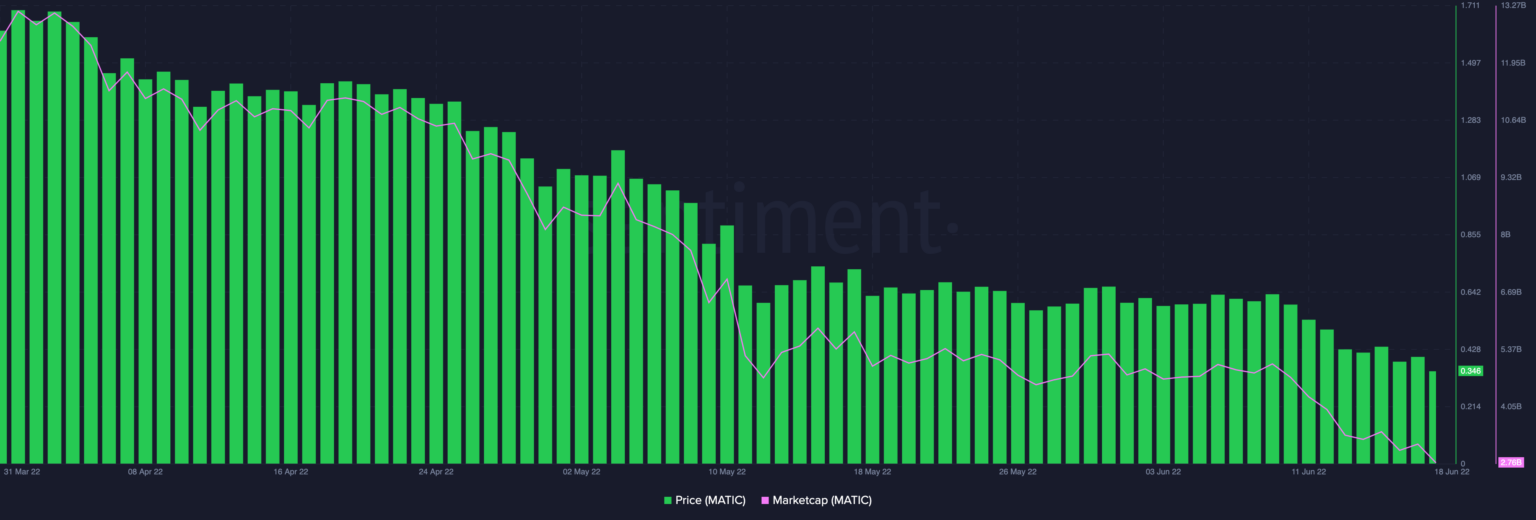
Before the plague hit, MATIC started the month at an index price of $1.62. Over the last 80 days, the altcoin has lost 77% of its value to mark a spot at $0.372.

Over the last 24 hours, the alt’s price registered a 10% uptick. Within the 80-day period, the market capitalization also declined from $12.45 billion to $2.98 billion, at the time of writing.
Source: Santiment

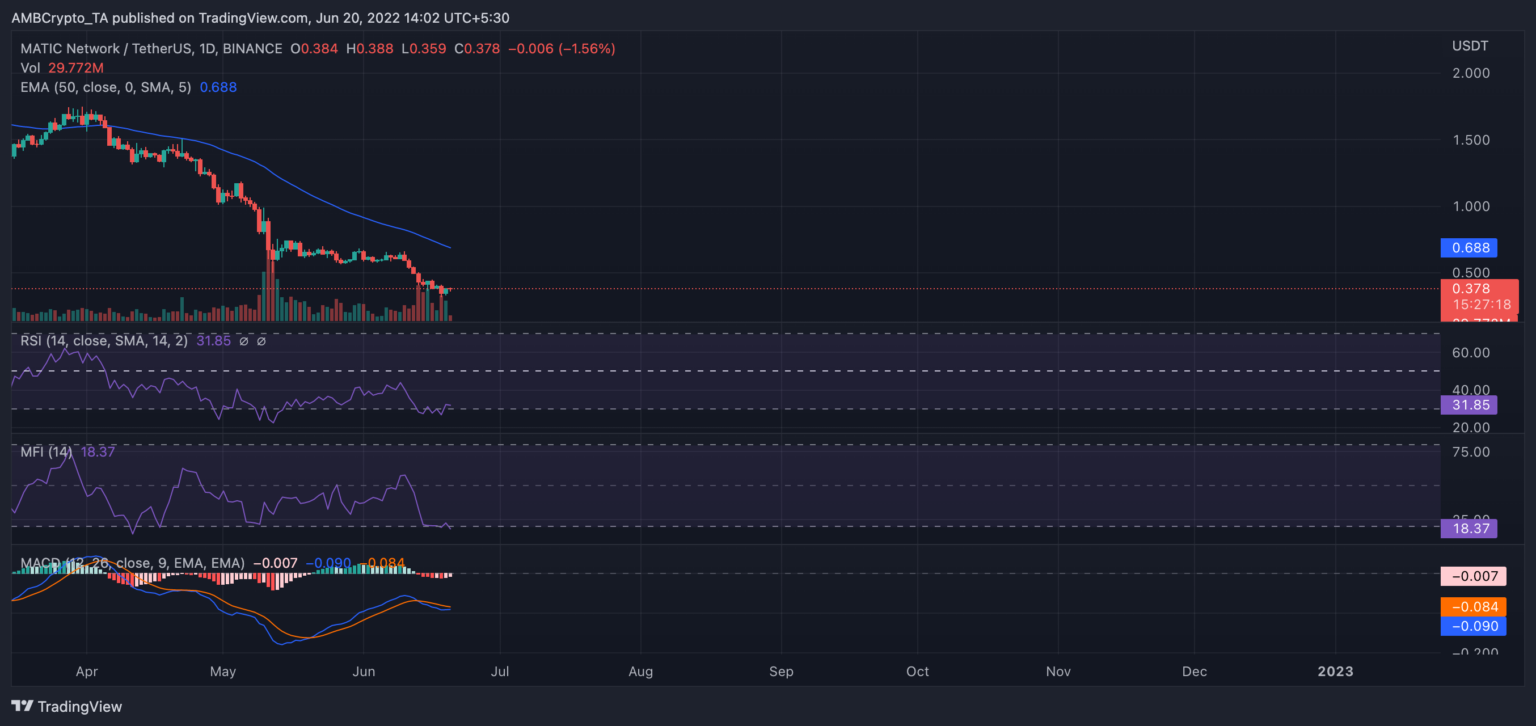
Struggling to keep the bears at bay, the Relative Strength Index (RSI) and the Money Flow Index (MFI) have been stationed below 50 for three months. Within that period, the RSI went as low as 22 on 12 May. The MFI also touched a low of 13 on 11 April. At press time, the RSI and MFI were deeply oversold at 31 and 18, respectively.

While the latest uptick in the price of MATIC might give investors a false sense of recovery, it is trite to point out that recovery is still far from sight. Looking at the 50 EMA showed the EMA line resting comfortably above the price.

This is indicative of a bearish bias. Also, implying a renewed bear run, the MACD line on 12 June intersected the trendline in a downward curve.
Source: TradingView

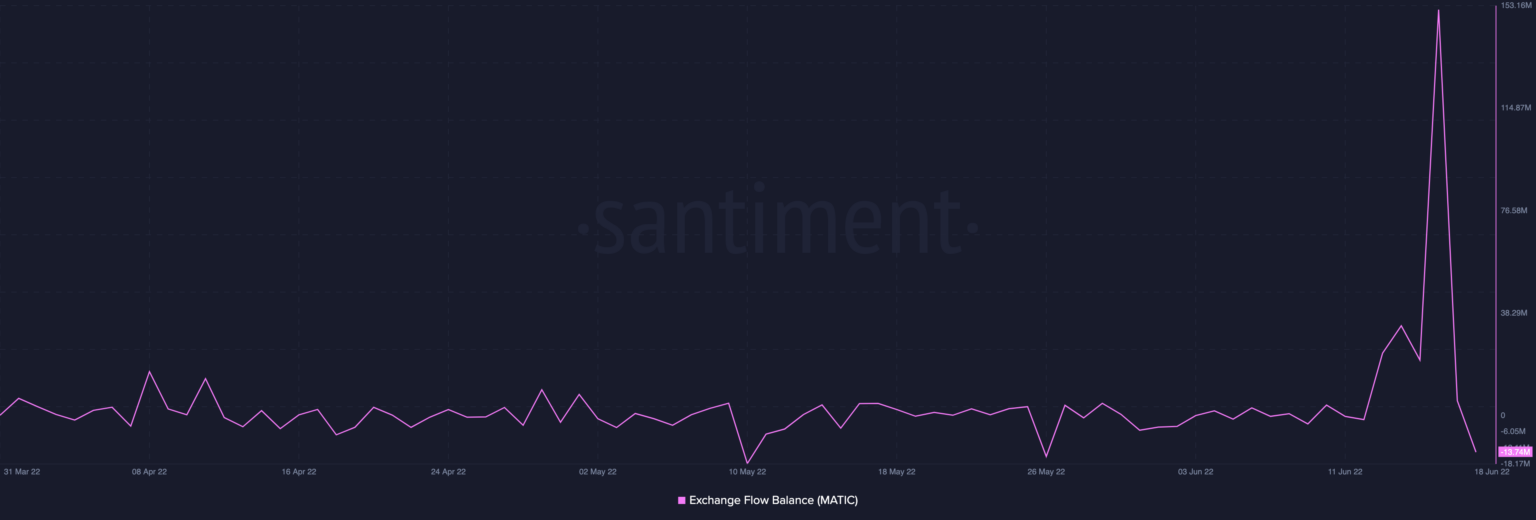
The position of the exchange flow balance metric for MATIC lent credence to its bearish outlook. With a reading of -13.74 million at press time, a price drop down seemed imminent.
Source: Santiment

On-chain analysis

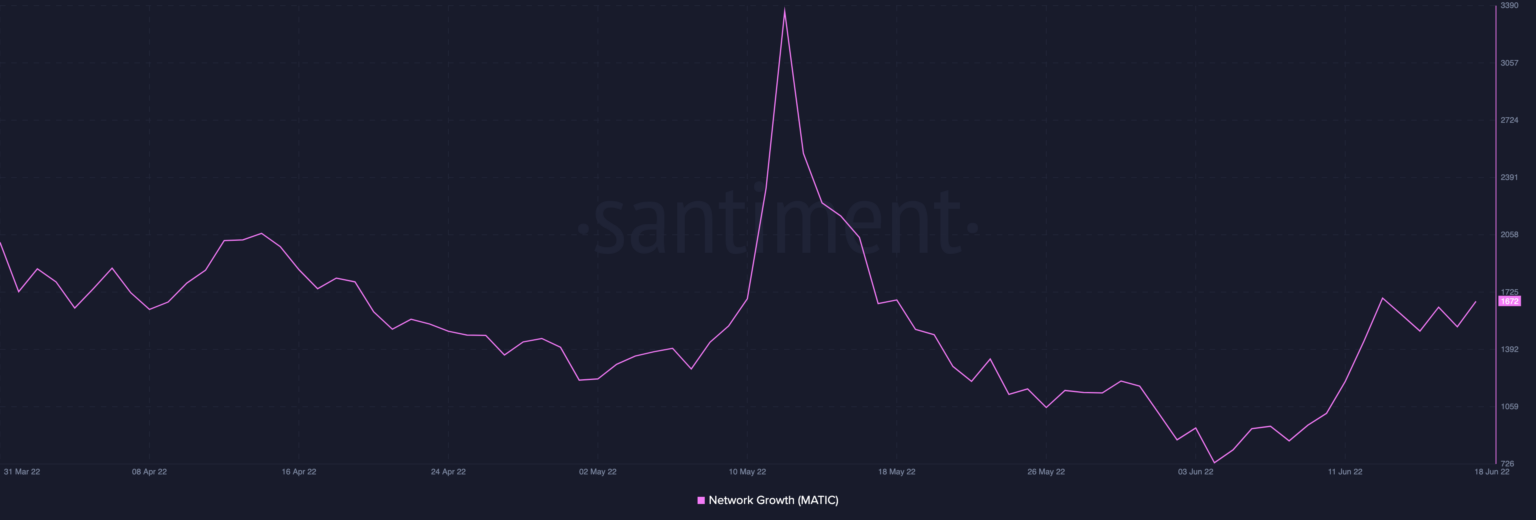
A review of MATIC’s on-chain performance over the last three months revealed a decline in the number of new addresses created on the network daily.

After registering a high of 3357 on 12 May, the network’s growth took on a downtrend. At the time of writing, it had recorded a 50% drop to be pegged at 1,672 new addresses.
Source: Santiment

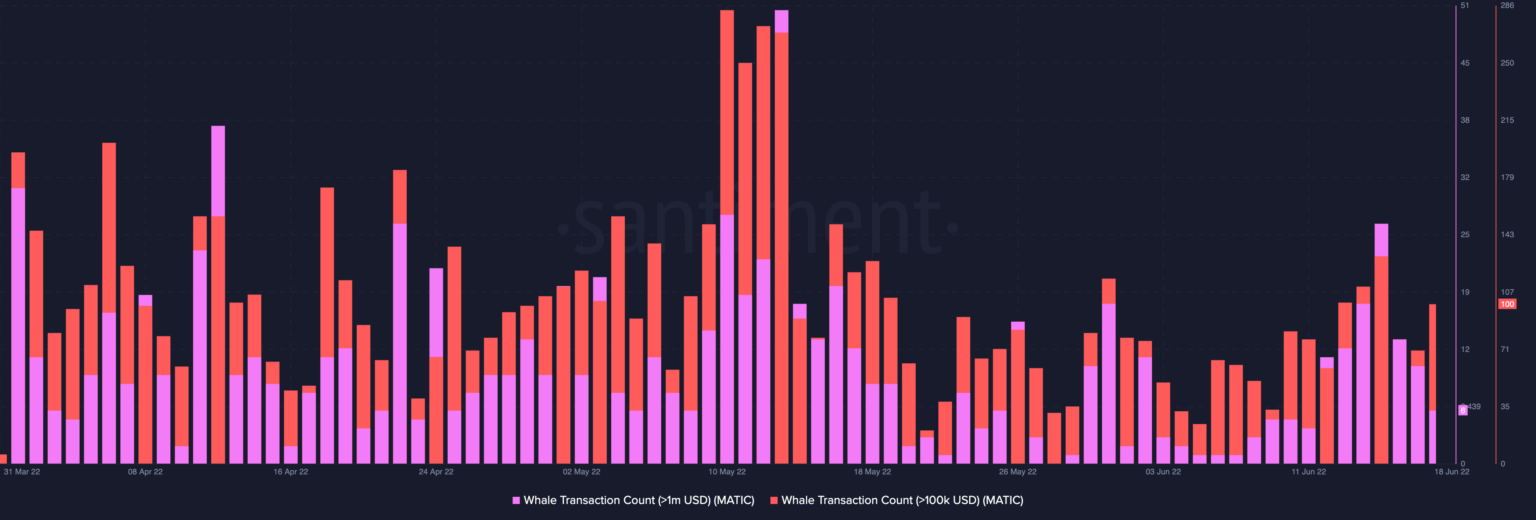
Whale accumulation of the altcoin has embarked on a steady decline since mid-May. After recording a total count of 1,079 transactions between 10 and 13 of May, the count for whale transactions above $100k has since taken a beating.

Since 13 May, a 62% decline has been registered. For transactions above $1 million, an 88% drop in count has been recorded since the high on 13 May.
Source: Santiment

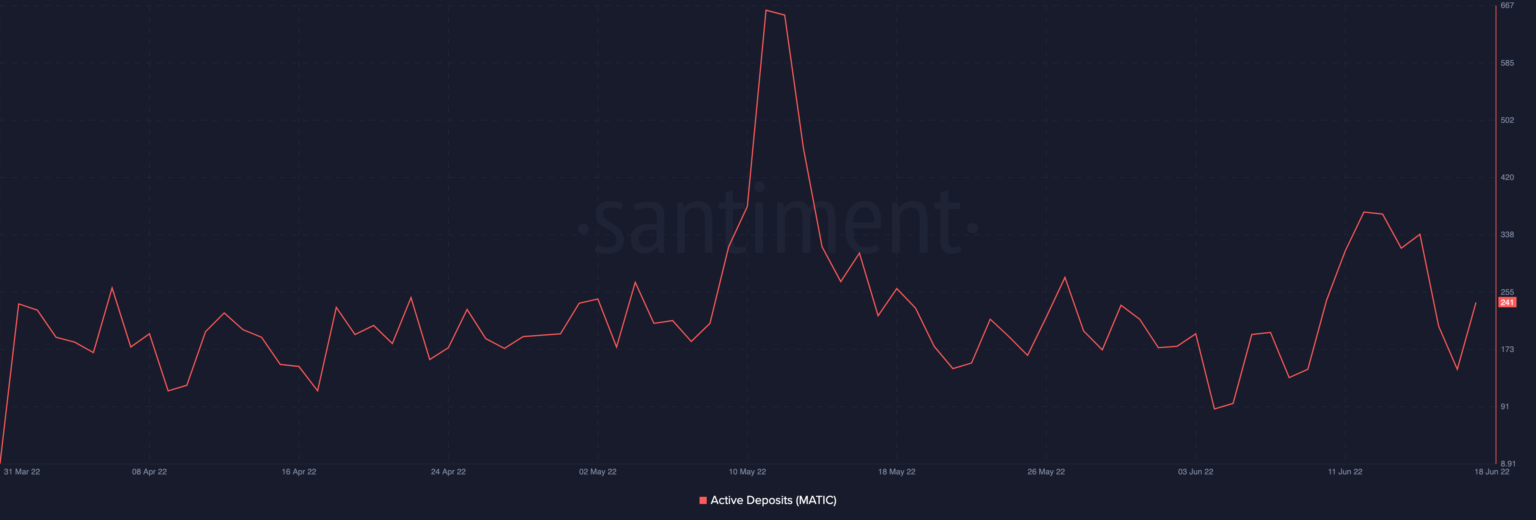
In addition to this, active deposits on the network have dropped steadily since 11 May after a high of 661.
Source: Santiment

So far this year, the Polygon Network has introduced some updates to its ecosystem. These updates include the Green Manifesto and its Carbon Neutral project. However, with a sustained decline in price, more has to be done by the network in order to retain its investors.


Letture associate

Podcast Notes: Hyperliquid Has Become the Top Interest Point for Traditional Hedge Funds

Empire Podcast hosts Jason Yanowitz and Santiago Santos discuss the surging institutional interest in Hyperliquid, a decentralized perpetual exchange, marking the highest level of engagement from traditional hedge fund managers since Paul Tudor Jones endorsed Bitcoin in 2020. The primary driver is the demand for weekend trading of commodities like oil, especially during geopolitical tensions such as the Iran conflict, as Hyperliquid provides the only active price discovery venue when traditional markets are closed. Trade XYZ, a front-end on Hyperliquid, has seen significant growth, with weekend oil price predictions having a median error of only 50 basis points. Santos predicts commodity trading volume on Hyperliquid will surpass Bitcoin within the year and that its market cap could rise from $25 billion to $100 billion. Other key points include Kraken raising $200 million at a reduced valuation of $13.3 billion, and the SEC clarifying that self-custodied DeFi frontends like MetaMask are not subject to broker-dealer rules, resolving a major regulatory uncertainty. The hosts also note the strong correlation between crypto and macro markets, with the S&P 500 posting one of its best 10-day rallies since 1950. They highlight MicroStrategy's continued Bitcoin acquisitions and the potential of real-world asset (RWA) tokenization as a key trend. The discussion concludes with skepticism towards many L2 projects, predicting a wave of protocols truly going to zero as capital concentrates in proven assets like Bitcoin and Hyperliquid.

marsbit4 h fa

Podcast Notes: Hyperliquid Has Become the Top Interest Point for Traditional Hedge Funds

marsbit4 h fa

a16z: The Next Frontier of AI, The Triple Flywheel of Robotics, Autonomous Science, and Brain-Computer Interfaces

a16z presents a comprehensive investment thesis for the next frontier of AI: Physical AI, centered on a synergistic flywheel of robotics, autonomous science, and novel human-computer interfaces (HCIs) like brain-computers. While the current AI paradigm scales on language and code, the most disruptive future capabilities will emerge from three adjacent fields leveraging five core technical primitives: 1) learned representations of physical dynamics (via models like VLA, WAM, and native embodied models), 2) embodied action architectures (e.g., dual-system designs, diffusion-based motion generation, and RL fine-tuning like RECAP), 3) simulation and synthetic data as scaling infrastructure, 4) expanded sensory channels (touch, neural signals, silent speech, olfaction), and 5) closed-loop agent systems for long-horizon tasks. These primitives converge to power three key domains: * **Robotics:** The literal embodiment of AI, requiring all primitives for real-world physical interaction and manipulation. * **Autonomous Science:** Self-driving labs that conduct hypothesis-experiment-analysis loops, generating structured, causally-grounded data to improve physical AI models. * **Novel HCIs:** Devices (AR glasses, EMG wearables, BCIs) that expand human-AI bandwidth and act as massive data-collection networks for real-world human experience. These domains form a mutually reinforcing flywheel: Robotics enable autonomous labs, which in turn generate valuable data for robotics and materials science. New interfaces provide rich human-physical interaction data to train better robots and scientists. Together, they represent a new scaling axis for AI, moving beyond the digital realm to interact with and learn from physical reality, promising significant emergent capabilities and value.

marsbit4 h fa

a16z: The Next Frontier of AI, The Triple Flywheel of Robotics, Autonomous Science, and Brain-Computer Interfaces

marsbit4 h fa

Trading

Spot
Futures
活动图片