«Слишком много позитива». Аналитик рассказал о перспективах крипторынка

RBK-cryptoPubblicato 2025-05-05Pubblicato ultima volta 2025-05-05

На какие сигналы стоит обратить внимание трейдерам в текущей ситуации неопределенности, объяснил аналитик рынка криптовалют Анатолий Радченко

«РБК-Крипто» не дает инвестиционных советов, материал опубликован исключительно в ознакомительных целях. Криптовалюта — это волатильный актив, который может привести к финансовым убыткам.

Текущее состояние крипторынка, прогнозы по биткоину, а также факторы, которые будут влиять на курсы криптовалют в ближайшие дни — обо всем этом рассказал автор Telegram-канала «Финансовый кружок» Анатолий Радченко в новом видео от 5 мая, записанном специально для участников Форума РБК Крипто.

На Форуме РБК-Крипто появилась новая ветка — Обзор рынка с Анатолием Радченко. Опытный трейдер и автор Telegram-канала «Финансовый кружок» будет регулярно в ней проводить аналитику крипторынка, а также разборы ключевых событий и рыночных сценариев.

Участники форума могут задать Анатолию вопросы напрямую и обсудить его прогнозы в комментариях.

По его словам, неделя обещает быть интересной благодаря решению американского правительства по ставке рефинансирования. Оно будет вынесено в среду, и, наверное, никаких сюрпризов не будет — рынок закладывает вероятность в примерно 98% на то, что Федеральная резервная система США (ФРС) оставит ставку без изменений, уточнил эксперт.

Он добавил, что самое важное — сигнал рынку, который даст глава ФРС Джером Пауэлл в своей речи, которую он обычно говорит примерно через 30 минут после решения по ставке. Скорее всего, сигнал этот будет неопределенный, поскольку в текущей ситуации неясно, чего ожидать от внешней политики США относительно торговых тарифов.

«Я думаю, что Пауэлл будет достаточно сдержан, попытается рынок успокоить. Но в целом на рынке будет достаточно негативная реакция. Я думаю, что позитива здесь не найти, поэтому рынок за последние время очень много позитива уже заложил в идею о том, что Китай с Америкой попытается договориться», — считает Радченко.

Он отметил, что в текущей ситуации «слишком много позитива» уже заложено в цене криптовалюты — с середины апреля биткоин вырос с $83 тыс. до $94 тыс.

Рост альткоинов

В то же время, другие криптовалюты росли не так сильно. Ethereum (ETH), по словам эксперта, «спасибо, что живой». В основном на прошедшей неделе дорожали так называемые мидкэпы (активы во средней капитализацией) и смолкэпы (с маленькой капитализацией).

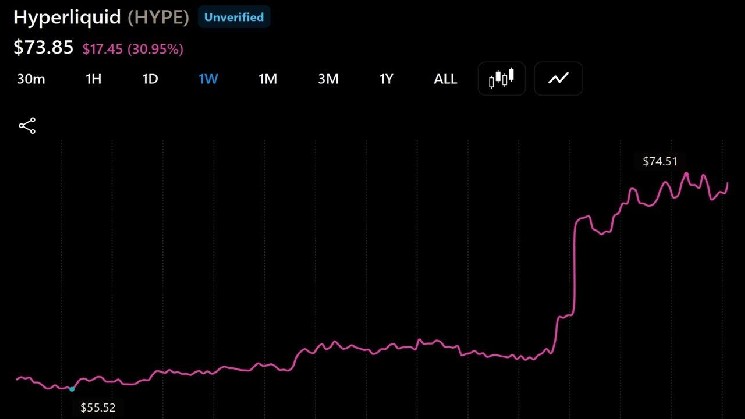
Из них показали рост те проекты, которые связаны с технологиями искусственного интеллекта (AI) и с мемами — такие как Fartcoin (FARTCOIN), Virtuals Protocol (VIRTUAL) и aixbt by Virtuals (AIXBT). Некоторые монеты на прошлой недели выросли только «на хайпе» — это Hyperliquid (HYPE) и Monero (XMR).

Телеграм-канал «РБК-Крипто» — подпишитесь и будьте в курсе самых главных и актуальных новостей о криптовалюте.

Присоединяйтесь к форуму «РБК-Крипто» в Telegram для обсуждения новостей и тенденций криптомира.

Покупки Strategy

Радченко также отметил, что рост биткоина наблюдается после того, как компания Strategy Майкла Сэйлора отчитываетя о покупках биткоинов по понедельникам.

«Когда он покупает биткоин, а последние покупки были довольно-таки большие, на $1,5 млрд, то мы видим рост в биткоине. И отчасти чуть-чуть это переносится на рост в альткоины. Это даже не покупка альткоинов, это ослабление давления со стороны продавцов в надежде на рост цен», — сказал эксперт.

28 апреля Strategy отчиталась о покупке 15 355 биткоинов на сумму $1,42 млрд. 5 мая компания Сэйлора сообщила, что приобрела еще 1895 биткоинов на $180,3 млн. По данным на 4 мая, на балансе Strategy 555 450 биткоинов (около 2,6% от общей эмиссии), на приобретение которых с 2020 года компания потратила около $38,08 млрд при средней цене покупки $68 550 за 1 BTC.

По его оценкам, состояние биткоина сейчас держится в руках Майкла Сэйлора, а все альткоины держатся за биткоин «на одной руке, свисая как со скалы». В свою очередь, говорит Радченко, вся эта конструкция держится на американской финансовой системе, которая никак не найдет решение, за чей счет ей жить дальше — за счет пошлин в 145% из Китая, либо за счет Канады с Мексикой, может быть, за счет Европы.

Широкий диапазон

По словам эксперта, ситуация очень далека от какого-то исхода, и на рынке будет наблюдаться достаточно волатильные движения в ближайшее время. Радченко отметил, что сейчас курс BTC находится в верхней границе диапазона, и далее возможны безболезненные для рынка коррекции.

Эксперт рекомендует отказаться от кардинальных мнений по поводу того, что курсы пойдут только вверх или только вниз. По его оценкам, диапазон широк — от $80 тыс. до $98 тыс., и вряд ли можно сейчас говорить о какой-то большей определенности.

Спрос на биткоин

По словам Радченко, все большое компаний следуют примеру Strategy, и это позитивно влияет на монету. Майкл Сэйлор на конференции Token2049 в Дубае сообщал о том, что планирует в этом году привлечь еще $84 млрд для дальнейших покупок биткоинов. Японская Metaplanet, американские майнеры, новый фонд Twenty One, в который инвестировали Tether и Bitfinex — это неполный список компаний, куда «биткоин продолжают стекать», напомнил эксперт.

Отчасти он связывает это с тем, что биткоин — крупнейшая криптовалюта, а в США начали вести активную деятельность с целью стать явным лидером в этой сфере и контролировать рынок цифровых активов, контролируя биткоин.

Рынок стейблкоинов также интересен Штатам, поскольку регулируя его, они постараются сохранить гегемонию доллара, говорит эксперт. США хотят диктовать свои условия, поэтому текущая ситуация на крипторынке — это «игра в долгую», считает Радченко.

Летние каникулы

Эксперт напомнил также про известную среди трейдеров поговорку «sell in May and go away» — продавай в мае и уходи отдыхать на летние каникулы. Он пояснил, что традиционно в летние месяцы, если не происходит форс-мажоров, трейдеры стараются не делать резких движений. Фонд-менеджеры и институциональные инвесторы стараются передвинуть свои дела на сентябрь—октябрь.

По словам Радченко, следует готовиться к чоппи-маркету (choppy market) — состоянию рынка, при котором цены значительно колеблются вверх и вниз, но без явного тренда в каком-либо направлении, без объемов, без серьезных покупателей и продавцов.

Киргизия выпустит обеспеченный золотом Минфина долларовый стейблкоин

Курс биткоина начал неделю с падения. Что случилось на крипторынке

Биткоин как инструмент для ЦРУ. Как разведка видит криптовалюту

Letture associate

The "Impossible Triad" Is Fundamentally a Pseudo-Problem

The article argues that blockchain's fundamental limitation is not the scalability trilemma (decentralization, scalability, security), which has been largely solved, but the lack of **privacy** and, until recently, clear **legitimacy**. Blockchain is described as a slow, expensive, globally shared computer whose core value is censorship resistance and verifiability. While ideal for native digital assets like money (e.g., stablecoins), its default transparency acts as a **tax**, exposing all transactions and enabling MEV extraction, which deters serious institutional capital. Simultaneously, its permissionless nature created regulatory ambiguity. The piece contends that **privacy** is the missing critical feature. It rejects the false choice between total transparency and complete anonymity. Modern cryptography (like zero-knowledge proofs) enables **compliant privacy**: users can prove facts (solvency, KYC status, compliance) without revealing the underlying sensitive data (specific holdings, identities). This preserves auditability for regulators and eliminates the leak of financial information. With recent regulatory progress (e.g., the GENIUS Act) addressing legitimacy, adding default, provably compliant privacy becomes a pure upgrade. It transforms blockchain from a costly, public ledger into a confidential settlement layer, finally bridging the gap to mainstream institutional and individual adoption of on-chain finance.

链捕手2 h fa

The "Impossible Triad" Is Fundamentally a Pseudo-Problem

链捕手2 h fa

Optical Chips: Collective Capacity Expansion

The global optical chip industry is experiencing a massive wave of expansion driven by surging AI data center demand. Major players across the US, Japan, Europe, and China are aggressively investing to ramp up production capacity. In the US, Coherent is expanding its 6-inch Indium Phosphide (InP) semiconductor fab in Texas, supported by CHIPS Act funding and a $2 billion strategic investment from NVIDIA. Lumentum is building a new factory for InP optical devices, and Nokia is scaling its advanced photonic chip packaging and testing capabilities. NVIDIA's investments aim to secure future supply of critical lasers and optical interconnect products for AI infrastructure. Japan's JX Advanced Metals, a leading InP substrate supplier, plans a multi-billion yen investment to increase its capacity 7-10 times, strengthening its grip on the crucial upstream materials market. In Europe, IQE and Tower Semiconductor settled a patent dispute and signed a multi-year InP epitaxial wafer supply agreement, highlighting that next-generation silicon photonics platforms will integrate high-performance InP components. STMicroelectronics and Sivers Semiconductors are also expanding silicon photonics production and partnerships. China is rapidly building out its domestic supply chain. Dongshan Precision's subsidiary, Source Photonics, announced a $12 billion project to expand optical chip and module production. Companies like Sanan Optoelectronics and Yunnan Germanium are scaling up InP chip manufacturing and substrate production, moving towards vertical integration from materials to modules. While debate continues around the exact future architecture—whether CPO (Co-Packaged Optics), NPO, or pluggables will dominate—analysts like Morgan Stanley argue the underlying driver is unchangeable: the explosive growth in bandwidth demand. This will inevitably increase the volume of optical engines, lasers, and related content per GPU, regardless of the final technical path. The competition for "more light" in the AI era has intensified into a global, full-chain capacity race.

marsbit5 h fa

Optical Chips: Collective Capacity Expansion

marsbit5 h fa

Stablecoins Finally Find Real Yield: An In-Depth Look at On-Chain Reinsurance Re | A Conversation with Re Founder Karan Saroya

Stablecoin Real Yield Found: A Deep Dive into On-Chain Reinsurance with Re's Karan Saroya As stablecoin supply exceeds $170 billion, the search for sustainable, non-speculative yield intensifies. Re, an on-chain reinsurance platform, provides an answer: connecting stablecoin capital to the trillion-dollar traditional reinsurance market. Re operates as a regulated reinsurer, accepting stablecoin deposits as collateral to back US insurance companies. These insurers pay premiums, generating yield that flows back to on-chain depositors. Currently supporting 35 insurers and underwriting $500 million, Re projects scaling to over $1 billion soon. Key insights from a Bankless podcast with founder Karan Saroya and investor Avichal of Electric Capital: 1. **Uncorrelated, Real-World Yield:** Re offers stablecoin holders access to reinsurance returns (targeting 12-14%+), an asset class entirely separate from crypto or equity markets. 2. **Operational Efficiency via Smart Contracts:** Re replaces traditional, labor-intensive capital fundraising with smart contracts, allowing a ~12-person team to compete with industry giants. 3. **Regulatory Leverage:** For every $1 of collateral, regulations allow backing $5-7 in written premiums. This leverage amplifies returns from the underlying risk-free rate. 4. **DeFi Integration:** Depositors receive receipt tokens, which can be used in protocols like Morpho for "looping," potentially pushing yields to 18-20%+. 5. **The "DeFi Mullet" Model:** A compliant front-end (regulated reinsurer) paired with a decentralized back-end (smart contracts, DeFi capital markets). 6. **RE Governance Token:** Modeled on Lloyd's of London, the token governs the central capital pool's allocation, counterparty acceptance, and parameters. 7. **Real Economic Impact:** Capital funds real-world productivity (factories, clinics, businesses) via insurance, moving beyond crypto's internal loops. The discussion highlights a pivotal moment: DeFi's supply-side infrastructure is now met by real demand for productive yield, potentially kickstarting a flywheel where vast on-chain stablecoin capital seeks these real-world returns.

链捕手6 h fa

Stablecoins Finally Find Real Yield: An In-Depth Look at On-Chain Reinsurance Re | A Conversation with Re Founder Karan Saroya

链捕手6 h fa

1996 or 1999? Walsh's First Test is 'How to View AI'

"1996 or 1999? Wall's First Big Test Is 'How to View AI'" Federal Reserve Chairman Wall's initial challenge is not whether to raise or cut rates, but a more fundamental judgment: what kind of boom is the current AI boom? This will determine the Fed's policy path and define his legacy. Economics is split between two opposing views, according to reporter Nick Timiraos. One sees imminent productivity gains that will increase supply and cool inflation, allowing the Fed to hold steady. The other argues that while productivity benefits are distant, demand shocks are here now, and waiting for data confirmation risks missing the intervention window, forcing sharper rate hikes later. Wall has signaled a leaning toward the first view, echoing 1996-era Alan Greenspan, who embraced strong, productivity-driven growth without fear of inflation. However, Wall faces a different macro environment than Greenspan did, with tariff pressures, expanding fiscal deficits, and diminishing globalization benefits, which could force more significant inflation pressures even if AI benefits materialize. Wall's logic, expressed before taking office, is that AI-driven productivity gains won't show in official data for years. If the Fed waits for confirmation, it might mistakenly tighten policy and choke off the very growth that could suppress inflation. This argues for using forward-looking narratives over lagging data. Chicago Fed President Austan Goolsbee presents a key counter-argument. He distinguishes between expected and unexpected productivity booms. A widely anticipated boom, like the current AI wave, can cause people to spend future wealth gains in advance, overheating the economy before productivity actually rises, thus requiring preemptive rate hikes. He cites rising costs for AI data centers as evidence of such overheating. Fed Governor Christopher Waller offers a rebuttal to Goolsbee, noting the "expected spending" mechanism only works if people can borrow against future income, which many households cannot do due to borrowing constraints. Wall also faces a paradox related to his desire to reduce the Fed's use of "forward guidance" (pre-announcing policy moves). This practice was established in 1999 when Greenspan began signaling hikes to avoid market shocks. If the economy follows a less optimistic path, Wall may be forced to choose between using the guidance he wants to abolish or risking market volatility by staying silent. The ultimate question defining Wall's first major test remains: Is this 1996 or 1999?

marsbit7 h fa

1996 or 1999? Walsh's First Test is 'How to View AI'

marsbit7 h fa

Trading

Spot
Futures
活动图片