Руководитель Fireblocks: «Спрос на недолларовые стейблкоины растет по всему миру»

cryptonews.ruPubblicato 2021-09-01Pubblicato ultima volta 2025-05-01

Правительства за пределами США, включая Сингапур, все больше интересуются стейблкоинами, не привязанными к доллару США, несмотря на их ограниченную ликвидность, сказала директор по политике Fireblocks Деа Маркова на Token2049.

Маркова описала конкуренцию со стейблкоинами, привязанными к доллару, как «все дело в суверенитете». Она сравнила ситуацию с более ранней напряженностью между правительствами и американскими платежными гигантами, такими как Visa и Mastercard.

«Сейчас мы наблюдаем ту же динамику со стейблкоинами — пока в меньших масштабах — но они определенно становятся новой ареной для суверенных проблем», — сказала она.

По словам Марковой, стейблкоины, привязанные к доллару, работающие в Европейском союзе, уже «испытывают огромную головную боль», особенно со стороны центральных банков.

«Хотя они соответствуют нормативным требованиям и регулируются, они испытывают постоянное сопротивление», — сказала она.

Европейский центральный банк усиливает давление, чтобы ускорить разработку цифрового евро, ссылаясь на опасения по поводу системного влияния стейблкоинов, привязанных к доллару, в еврозоне.

29 апреля Банк Италии опубликовал отчет, в котором говорится, что зависимость стейблкоинов, привязанных к доллару, от казначейских облигаций США может увеличить уязвимости системного риска.

В рыночной капитализации стейблкоинов доминируют монеты, привязанные к доллару, особенно Tether (USDT) и USD Coin (USDC) от Circle. По данным DefiLlama, эти две монеты в совокупности составляют 210,9 млрд долларов США (или 87,2%) от общей рыночной капитализации таких токенов в размере 241,8 млрд долларов США. Фактически, все 10 ведущих стейблкоинов привязаны к доллару США.
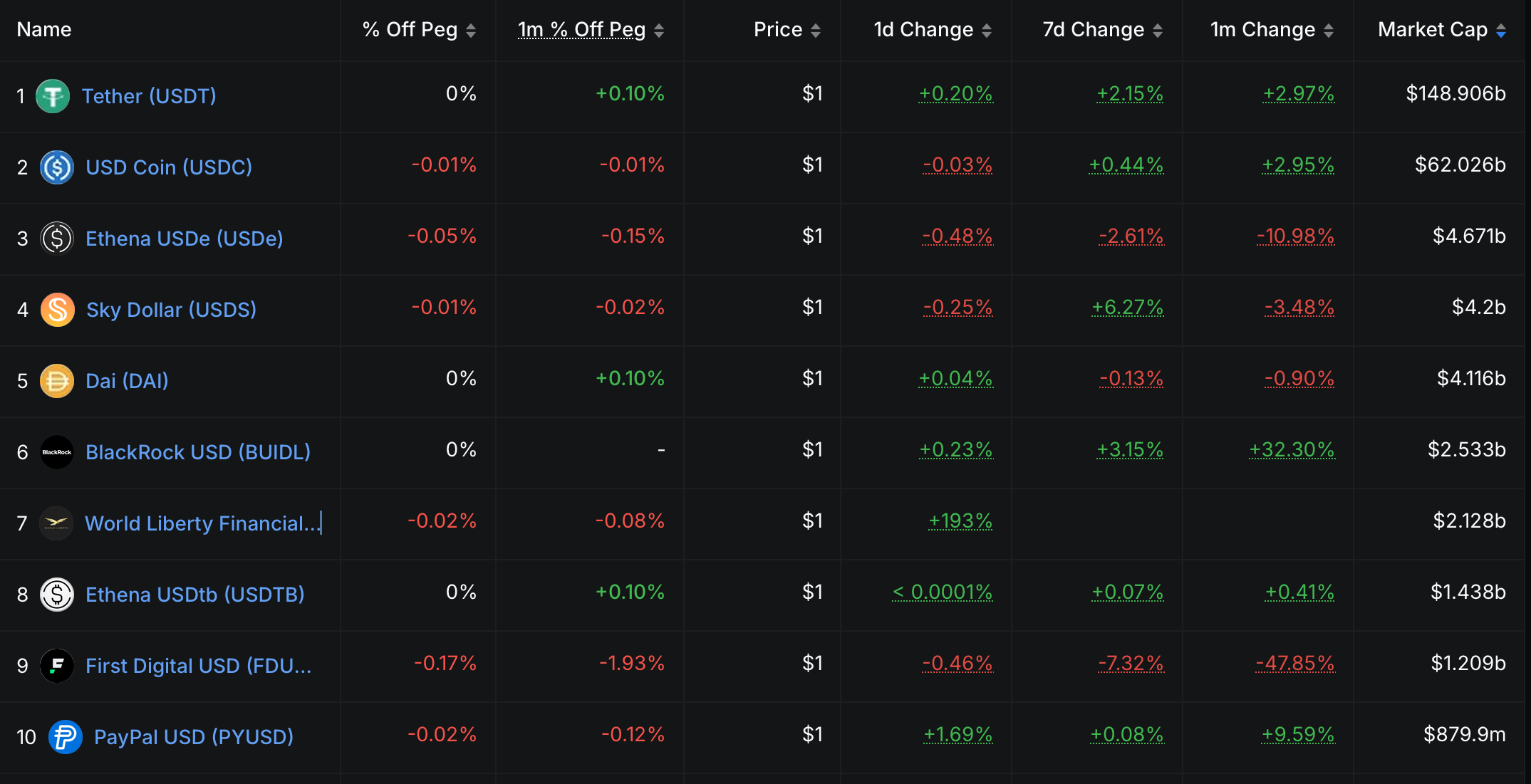

10 лучших стейблкоинов по рыночной капитализации. Источник: DefiLlama.

По мнению Марковой, ситуация похожа на предыдущие конфликты между правительствами и американскими платежными гигантами, такими как Visa и Mastercard.

«Сейчас мы наблюдаем ту же динамику со стейблкоинами — пока в меньших масштабах — но они определенно становятся новой ареной для суверенных проблем», — сказала она.

ОАЭ впереди в «регулятивном мышлении»

Маркова добавила, что Объединенные Арабские Эмираты «определенно впереди в своем регуляторном мышлении» в отношении стейблкоинов. Она привела в пример Абу-Даби, отметив, что эмират не требует, чтобы эмитенты стейблкоинов имели локальный адрес или лицензию, в отличие от подхода к регулированию в Европе.

Маркова объяснила, что подход Абу-Даби заключается в проведении комплексной проверки глобальных стейблкоинов и принятии решения о том, могут ли местные биржи их предложить.

«Это гораздо более разумный подход, чтобы предоставить местным предприятиям доступ к глобальной ликвидности и платежам», — заключила она.

В декабре 2024 года USDT был одобрен в качестве признанного виртуального актива в Абу-Даби, а 29 апреля Circle получил регулирующее одобрение для USDC. Тем временем учреждения Абу-Даби сотрудничают в запуске регулируемого стейблкоина, привязанного к дирхаму.

Letture associate

Opinion: Altcoins Might Still Have a Chance, but VC-Backed Coins Are Truly Hopeless

Author: Haotian. Through deep discussions with experienced on-chain investors, a consensus has emerged on survival strategies for the current market cycle: the focus has decisively shifted from "narratives and speculation" to "cash flow and tangible validation." Several key principles are outlined: 1) Prioritize assets with genuine value capture. In a bear market, sustainable protocol fees and a proven record of using them for token buybacks, burns, or dividends are essential. Examples include launchpad tokens like $UNI, $PUMP, $PONS, and the notable buyback token $HYPE. 2) Choose only projects with proven Product-Market Fit (PMF) and a complete operational loop. The next cycle's narratives, likely around "real-world asset tokenization" and the "Agentic Economy," will favor practical validation over technical roadmaps. Projects must demonstrate real users, transaction volume, and revenue. Examples such as $ONDO, $VVV, and $VIRTUAL will be evaluated on metrics like Assets Under Management (AUM) and fee generation. 3) Opt for assets with strong, organically developed "consensus." True consensus is market-driven and survives multiple cycles, not manufactured through marketing. Examples include enduring meme coins like $DOGE, $PEPE, $PEOPLE, or established sector leaders like $ZEC and $TAO, which benefit from resilient communities and sustained liquidity. 4) Avoid purely venture-capital (VC)-backed tokens. Unlike general altcoins which may cycle back, VC coins are seen as particularly problematic. Their typical high Fully Diluted Valuation (FDV), low circulating supply, and continuous large unlock schedules often lead to post-unlock sell pressure, especially if the project lacks inherent value capture. This dynamic is a key factor in the current cycle's restrained rallies and deep corrections, discouraging retail participation. *Note: This is a summary of personal discussions. Mentioned tokens are examples only, not investment advice.*

marsbit13 min fa

Opinion: Altcoins Might Still Have a Chance, but VC-Backed Coins Are Truly Hopeless

marsbit13 min fa

Wall Street Morning Report: Philadelphia Semiconductor Index Falls Nearly 3%, Nvidia's 'Circular Financing' Concerns Trigger Tech Stock Correction, Optical Communication and Chip Stocks Plunge

Wall Street Morning Report: The Philadelphia Semiconductor Index fell nearly 3%, and concerns over Nvidia's "revolving financing" sparked a tech stock pullback, with optical communications and chip stocks declining sharply. U.S. stocks retreated from record highs on Monday amid geopolitical tensions and AI financing doubts. The Dow fell 0.11%, the Nasdaq 0.32%, and the S&P 500 was nearly flat. Hopes for reopening the Strait of Hormuz dimmed after Trump demanded war reparations from Iran, pushing Brent crude above $87 and WTI above $82. Spot gold broke above $4400/oz. Treasury yields rose, with the market pricing in a ~54% chance of a September Fed hike. The semiconductor and AI infrastructure sectors were hit hard. The Philly Semiconductor Index dropped nearly 3%, with the semiconductor ETF down 2.28%. Optical communication was the worst-performing AI sub-sector, with Coherent plunging over 14%. The sell-off centered on Nvidia, which fell 2.86% on reports it is collaborating with major financial institutions to mobilize over $500 billion in third-party capital for AI infrastructure. Market concerns focused on whether this creates a circular financing loop and if future AI facilities can generate sufficient cash flow. Other notable moves: Intel dropped over 4% on a new share offering. Microsoft rose 1.21% on plans for its next-gen Maia 300 chip. The software sector outperformed, with Palantir up 1.85%. Energy stocks rallied nearly 4.7% on geopolitical risks. Key upcoming events include the RBA rate decision on Aug 11 and earnings from Lumentum, CoreWeave, and Super Micro Computer after the close on Aug 12, which will test the real demand for AI infrastructure.

marsbit1 h fa

Wall Street Morning Report: Philadelphia Semiconductor Index Falls Nearly 3%, Nvidia's 'Circular Financing' Concerns Trigger Tech Stock Correction, Optical Communication and Chip Stocks Plunge

marsbit1 h fa

Trading

Spot
活动图片