Arthur Hayes Predicts Last Chance to Buy BTC under $100K

TheCryptoTimesPubblicato 2025-04-21Pubblicato ultima volta 2026-07-08

Arthur Hayes is betting that the next wave of Treasury buybacks will ignite a Bitcoin rally straight through the $100K barrier.

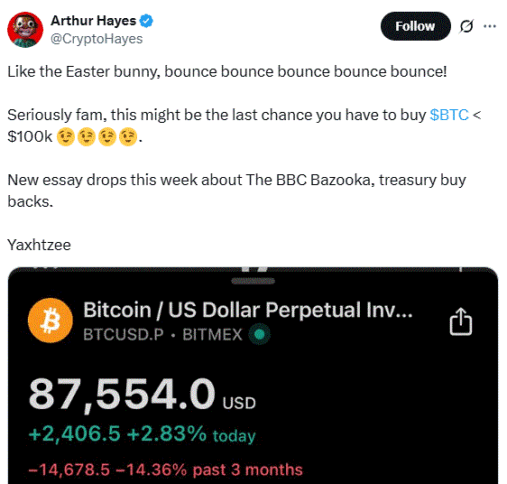
In the recent post on X, he says U.S. Treasury buybacks, where the government repurchases its debt, will inject more money into the market, boosting Bitcoin and other risky assets.
Arthur Hayes Predicts Last Chance To Buy Btc Under $100K
Arthur Hayes Predicts Last Chance to Buy BTC under $100K, Source: X

Hayes called these buybacks a “bazooka” for Bitcoin, warning that this could be the last time people can buy BTC for less than $100,000. Bitcoin jumped over 3% after the April 20 weekly close, hitting $87,705 — its highest price in almost three weeks.

Experts like Jamie Coutts from Real Vision say the expanding money supply (M2) is helping push Bitcoin higher. He expects that BTC will reach $132,000 this year. Even with global tensions and market ups and downs, more institutions are investing in Bitcoin, which is pushing the price upward.

Bitcoin rose to around $87,700, its highest in nearly three weeks, thanks to a weakening U.S. dollar. Analysts say the drop in the dollar, along with gold’s strong performance, is making Bitcoin more attractive as a safe investment. Some are calling it a return to the “digital gold” narrative.

Major companies from the United Kingdom and Japan continue to invest extensively in Bitcoin. This shows that institutional trust in BTC remains strong. If the current trend continues, Bitcoin could face its next big price resistance at $90, and potentially go much higher in 2025.

Economist Timothy Peterson thinks Bitcoin could hit $138,000 within three months, based on past patterns during similar market conditions. Gold is also performing well, trading about $3,400 per ounce, up nearly 30% this year, and Bitcoin appears to be following suit.

With political pressure mounting, especially from Donald Trump calling for the firing of Fed Chair Jerome Powell, the Federal Reserve’s future moves are unclear. Markets are now expecting a possible rate cut in June, which could further weaken the dollar and benefit Bitcoin.

Not everyone is fully bullish just yet. Analyst Michaël van de Poppe warned that weekend price jumps like this one can be misleading. He thinks Bitcoin might dip before truly breaking through to new highs.

Key resistance is around $91,000, and until BTC breaks that level, short-term sellers could still bring the price down.


Also Read: Strategy buys 6,556 Bitcoins worth $555 Million


Letture associate

Collateral Dollars: How Does a 'Second-Layer Dollar' Above Stablecoins Form?

Collateral Dollars: How Does a "Second Layer of Dollars" Form on Top of Stablecoins? Most assume stablecoins replicate Eurodollar functions, expanding the offshore dollar system. However, stablecoins primarily replace specific functions like operational dollar balances for settlement. They do not inherently create new dollar credit; they substitute existing claims. The key question is: what happens when financial intermediaries use stablecoins as collateral to create a new layer of dollar-denominated claims? This "collateral dollar" channel operates through secured lending, not direct money creation. A money-like event only occurs when a liability issued against the controlled stablecoin is funded, rolled over, or accepted at near-par value by another balance sheet. The discount (haircut) prices the gap between "effective control over the token" and "reliable convertibility to bank dollars." Elasticity stems not from the stablecoin itself but from the liability issued against it and the willingness of third-party balance sheets to treat that liability as a near-par asset. Compared to the traditional Eurodollar system—where elasticity originates from bank deposit creation—the stablecoin collateral chain is structurally different. Eurodollar deposits are credit-expansive from inception. Stablecoins are initially substitutive; elasticity emerges later if an intermediary's liability against them gains monetary acceptance. Stablecoins disrupt specific tiers of the offshore dollar system, mainly replacing operational settlement balances. They do not replace the need for full dollar balance-sheet capacity (credit lines, hedging, maturity transformation). For systemic impact, the second-layer liability must pass three tests: transferability, funding capacity, and monetary acceptance (being fundable or held at par by others). Pressure transmission also differs. In the Eurodollar system, stress moves up a hierarchy of claims. In a stablecoin collateral chain, the second-layer liability can lose its money-like status well before the underlying stablecoin faces a run, often triggered by haircut increases and margin calls that create a dynamic spiral of falling token prices and rising discounts. In conclusion, the "collateral dollar" is not the stablecoin itself. It is the second-layer liability issued against a controlled token balance that is willing to be funded and maintained at near-par value. Its existence depends on that liability surviving the leap from "token liquidity" to "bank dollar liquidity."

marsbit1 h fa

Collateral Dollars: How Does a 'Second-Layer Dollar' Above Stablecoins Form?

marsbit1 h fa

Trading

Spot
活动图片