Инвесторы выбирают золото: рекордные $80 млрд притока средств на фоне падения биткоина

cryptonews.ruPubblicato 2025-02-16Pubblicato ultima volta 2025-04-16

Цена на золото установила новый исторический максимум около $3,3 тыс. за унцию 16 апреля, в то время как биткоин продолжает бороться за сохранение позиций на фоне торговой войны США. Инвесторы массово переходят в золото как надежное убежище от макроэкономической нестабильности.
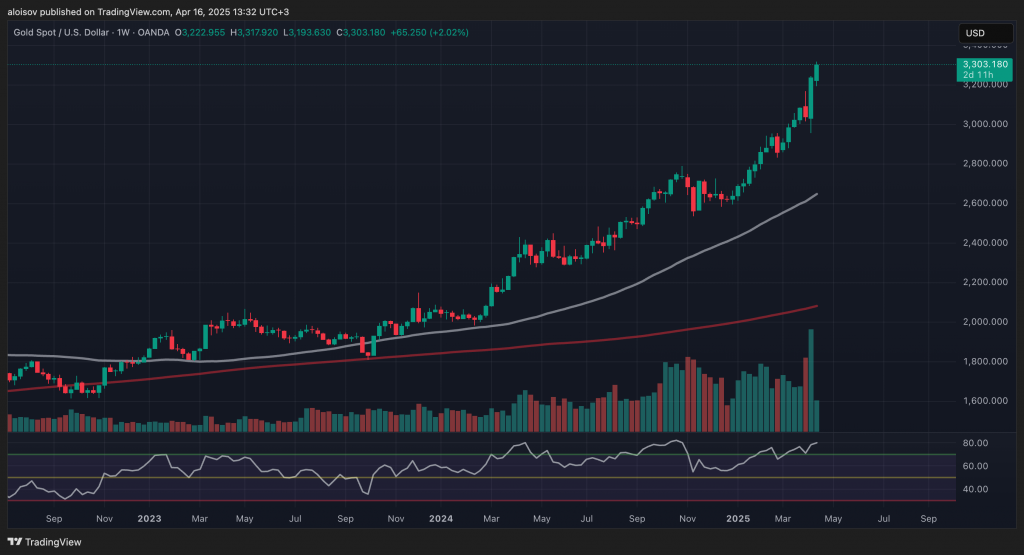
1-недельный график XAU/USD

Данные Bank of America, опубликованные аналитическим ресурсом The Kobeissi Letter в соцсети X 15 апреля, подтверждают лучшую серию золота с 2013 года. Приток средств в золотые фонды достиг рекордных $80 млрд с начала года, что в 2 раза превышает предыдущий максимум, установленный за весь 2020 год.

«Инвесторы вкладывают деньги в золото рекордными темпами, поскольку рыночная неопределенность резко возросла. В результате цены на золото выросли на 22% с начала года и превзошли все другие основные классы активов», — отметил Kobеissi.

Биткоин отстает от золота

Динамика цены биткоина показывает совершенно иную картину. Несмотря на появление спотовых биткоин-ETF в США и растущую глобальную интеграцию, курс BTC/USD достиг пятимесячного минимума в начале апреля.
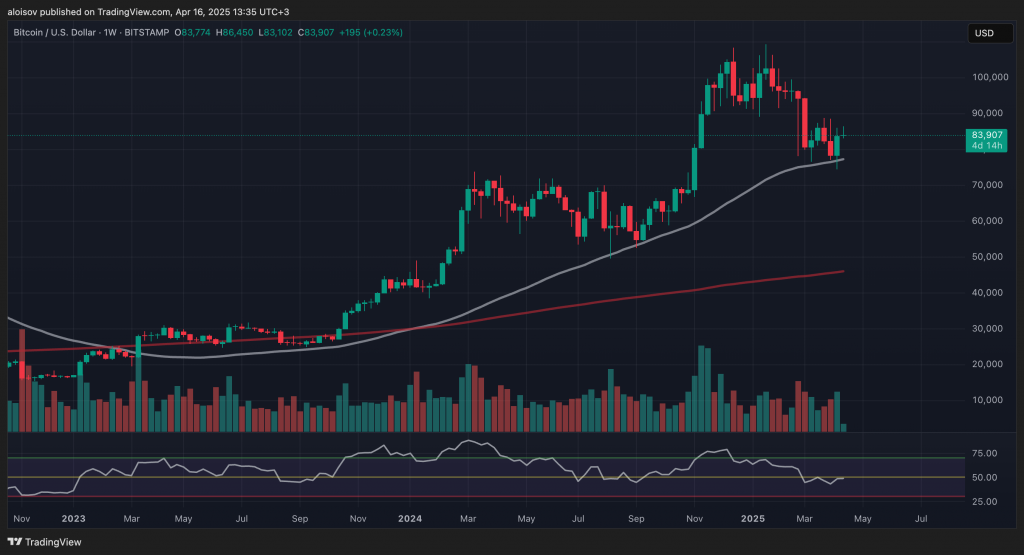
1-недельный график BTC/USD

Данные аналитической платформы Glassnode показывают, что совокупные активы под управлением ETF снизились со $106 млрд в начале года до $92 млрд на этой неделе.

«Цены на золото также достигли пятидесяти двух исторических максимумов за последний год, продемонстрировав лучшую серию за 12 лет», — подытожил Kobеissi. «Золото — это глобальное безопасное убежище».

Признаки завершения золотого ралли

Несмотря на обновление максимумов, рыночные комментаторы уже предсказывают завершение беспрецедентного роста золота. Опытный трейдер Питер Брандт (Peter Brandt) заявил в соцсети X на, что конец ралли XAU/USD уже близок.

«Золото теперь вошло в свою стадию взрывного роста», — резюмировал он. «Такое быстрое продвижение придет к терминальной вершине, но попытка определить максимум может быть очень дорогостоящей. Взрывные вершины могут выходить далеко за пределы способности медведей отвечать на требования по марже».

Снижение золота может освободить место для биткоина, согласно популярной теории, которая утверждает, что BTC/USD копирует тренды золота с задержкой в несколько месяцев.

«Никто на самом деле не знает, почему это происходит», — заявил основатель и генеральный директор Professional Capital Management Энтони Помплиано (Anthony Pompliano) в интервью CNBC 15 апреля.

Помплиано предположил, что традиционным финансовым организациям либо не разрешено, либо они просто «не привыкли» к идее использования биткоина как защиты от макроэкономической неопределенности.

«Однако мы видим, что когда золото растет, примерно через 100 дней биткоин не только догоняет его, но обычно растет намного сильнее, и поэтому вы получаете более высокую волатильность», — добавил он.

Торговая война США и высокий уровень макроэкономической неопределенности продолжают влиять на рынки активов. Золото укрепило свой статус главного защитного актива, в то время как биткоин пока не смог проявить свой потенциал в качестве альтернативного хеджа против волатильности.


Letture associate

AI Billing Black Box Exposed: 1.7 Million Overcharged, Anthropic Refunds But Doesn’t Admit Fault

A startup named Vaudit, founded by former Oracle director Michael Hahn, audits AI bills for companies and claims to have identified approximately $1.7 million in overcharges across 60 businesses, totaling $34 million in reviewed bills. The alleged discrepancies primarily involve charges for Anthropic's Claude Code. Common issues cited include billing for newer, more expensive models when older, cheaper ones were used; charging for failed or errored requests; and "retry storms" where AI agents silently retry failed tasks, accumulating costs unnoticed. Major clients like Panasonic, HP, and Honda were among those audited. While Vaudit reports that around 80% of the disputed charges were refunded by providers like Amazon, Google, Microsoft, Anthropic, and OpenAI after申诉, the AI companies largely deny systemic problems. Anthropic stated overcharges do not appear widespread and it does not bill for uncompleted requests or errors, while OpenAI said it found no evidence of such issues affecting its customers. The situation highlights the inherent opacity and complexity of AI billing, which is based on token usage that is difficult to track and predict, especially with multi-agent, multi-model workflows. This complexity is creating a new market for third-party AI bill auditing services like Vaudit, which charges fees based on recovered amounts. Separately, Anthropic faces a proposed class-action lawsuit alleging its high-tier subscription plans deliver far less usage than advertised. The case underscores growing scrutiny over AI service pricing and transparency as major providers prepare for IPOs.

marsbit15 min fa

AI Billing Black Box Exposed: 1.7 Million Overcharged, Anthropic Refunds But Doesn’t Admit Fault

marsbit15 min fa

Tencent Buys Baidu Chips

China's internet giants, once defined by building closed, self-sufficient empires, are undergoing a fundamental shift. A key signal is Baidu's plan to spin off its AI chip unit, Kunlun Xin, for a Hong Kong IPO targeting a $50 billion valuation, potentially exceeding its parent company's worth. Concurrently, Alibaba's T-Head is also pursuing independence. Most significantly, reports indicate that rival Tencent has become a major customer for Kunlun Xin's chips. This move, where competitors begin procuring each other's core technologies, marks a decisive break from the past era of internal duplication and isolation. It signals the maturation of China's AI industry into a more open, specialized ecosystem. The underlying driver is the immense and clear cost of AI infrastructure, particularly the exploding demand for inference compute driven by AI agents and applications. Hardware is no longer just an internal cost center but a profitable, strategic business in itself. Globally, a parallel trend is evident as OpenAI, Google, Amazon, and others develop their own AI chips to control costs and optimize performance. The competition has moved beyond model benchmarks to a deeper, foundational war over token cost efficiency, inference cluster performance, and secure, scalable computing power. Baidu and Alibaba aren't dismantling their empires but are instead decoupling non-core, capital-intensive infrastructure to participate in and shape a larger, collaborative industrial base. The era of the all-encompassing super-app is giving way to an age of strategic specialization and open ecosystem building in the AI race.

marsbit31 min fa

Tencent Buys Baidu Chips

marsbit31 min fa

The Token Itself Is an Asset: Three Types of Tokenized Stocks, Which One Suits You?

"Tokenized Stocks: Three Types, Which One Fits You? For investors outside the US, buying stocks like SpaceX or Nvidia is difficult, requiring brokers, cross-border transfers, and often accredited investor status. Blockchain offers an alternative through tokenized stocks, a term encompassing three distinct products with vastly different ownership, voting, and profit rights. 1. **Full Real Ownership**: Companies like Superstate register native equity directly on-chain (e.g., Solana). Holders are on the official shareholder registry, with full voting rights, dividends, and legal ownership. This offers maximum rights but potentially less DeFi flexibility. 2. **SPV-Backed Tokens (Surrendered Ownership for DeFi Composability)**: Issuers like Backed (xStocks) and Ondo use offshore Special Purpose Vehicles (SPVs) to hold underlying shares 1:1 and issue tracking tokens. Investors get price exposure and dividends (reinvested as more tokens) but hold a claim on the SPV, not direct stock ownership. This enables use as collateral in DeFi protocols (Kamino, Morpho) and 24/7 minting/redemption, but carries SPV counterparty risk (highlighted by the PreStocks collapse). 3. **Perpetual Futures (Pure Price Speculation)**: Platforms like TradeXYZ (on Hyperliquid) and Ostium offer perpetual contracts. These are synthetic derivatives with no underlying stock ownership, using funding rates to track spot prices. They require only a price oracle, allowing extremely fast listing (e.g., SpaceX pre-IPO) and high leverage, attracting speculators. Their trading volume far exceeds tokenized spot products. The core value of tokens is that they don't need to replicate full stock ownership. Most retail investors never vote. Tokenization creates layered financial tools: full equity for institutions, composable tokens for DeFi users, and perpetuals for leveraged traders."

marsbit31 min fa

The Token Itself Is an Asset: Three Types of Tokenized Stocks, Which One Suits You?

marsbit31 min fa

AI as the Boss: Nearly Bankrupts 10 Companies...

A recent study from Princeton University tested 14 AI models, including large language models (LLMs) and a rule-based algorithm, in a simulation where they acted as CEOs of a virtual SaaS startup over 500 days. The goal was to grow an initial $1 million capital. The results were stark: only four "CEOs" ended with a profit. The top performer was Claude Fable 5, multiplying the capital 47-fold to $47.15 million. Claude Opus 4.8 and GPT-5.5 followed. Notably, the fourth profitable entity was a simple, pre-programmed rule-based algorithm, which outperformed many advanced LLMs with $15.76 million in profit. Five other models, including several major LLMs, went bankrupt before the simulation ended. Key takeaways from the research highlight that successful AI CEOs demonstrated a tendency for exploration and adaptation over caution. They excelled in discovering hidden information, predicting future cash flow, adapting quickly to changes (like competitor moves), and engaging in strategic "if-then" planning. The study also found that equipping LLMs with programming-agent frameworks, optimized for coding tasks, actually harmed their performance in this CEO role, suggesting a need for domain-specific adaptations. The article concludes by contrasting AI's current operational proficiency within defined frameworks with the type of visionary, intuitive decision-making—exemplified by figures like Steve Jobs—that truly drives transformative business strategy. This critical "matrix-drawing" capability, it argues, remains uniquely human.

marsbit41 min fa

AI as the Boss: Nearly Bankrupts 10 Companies...

marsbit41 min fa

Trading

Spot
活动图片