«Самый длинный» бычий сигнал только что появился на графиках альткоинов

cryptonews.ruPubblicato 2025-02-15Pubblicato ultima volta 2025-04-15

  • График общей капитализации рынка криптовалют сформировал бычий паттерн «падающий клин».
  • Аналитик также выделил бычью дивергенцию на графике рыночной капитализации альткоинов.
  • В последний раз подобная ситуация наблюдалась в 2020 году, когда наблюдался масштабный рост альткоинов.

После месяцев застоя и медвежьих настроений ситуация, наконец, может измениться в пользу альткоинов.

Эксперты-аналитики, проанализировавшие графики, предполагают, что долгожданный «сезон альткоинов» приближается.

Какая историческая модель сигнализирует о всплеске альткоинов?

Известный криптоаналитик Михаэль ван де Поппе недавно поделился убедительной диаграммой, подчеркивающей масштабное расхождение в динамике рыночной капитализации альткоинов по сравнению с биткоином (TOTAL3/BTC).

В своем посте ван де Поппе отметил, что бычья дивергенция относительно капитализации рынка альткоинов «остается актуальной».
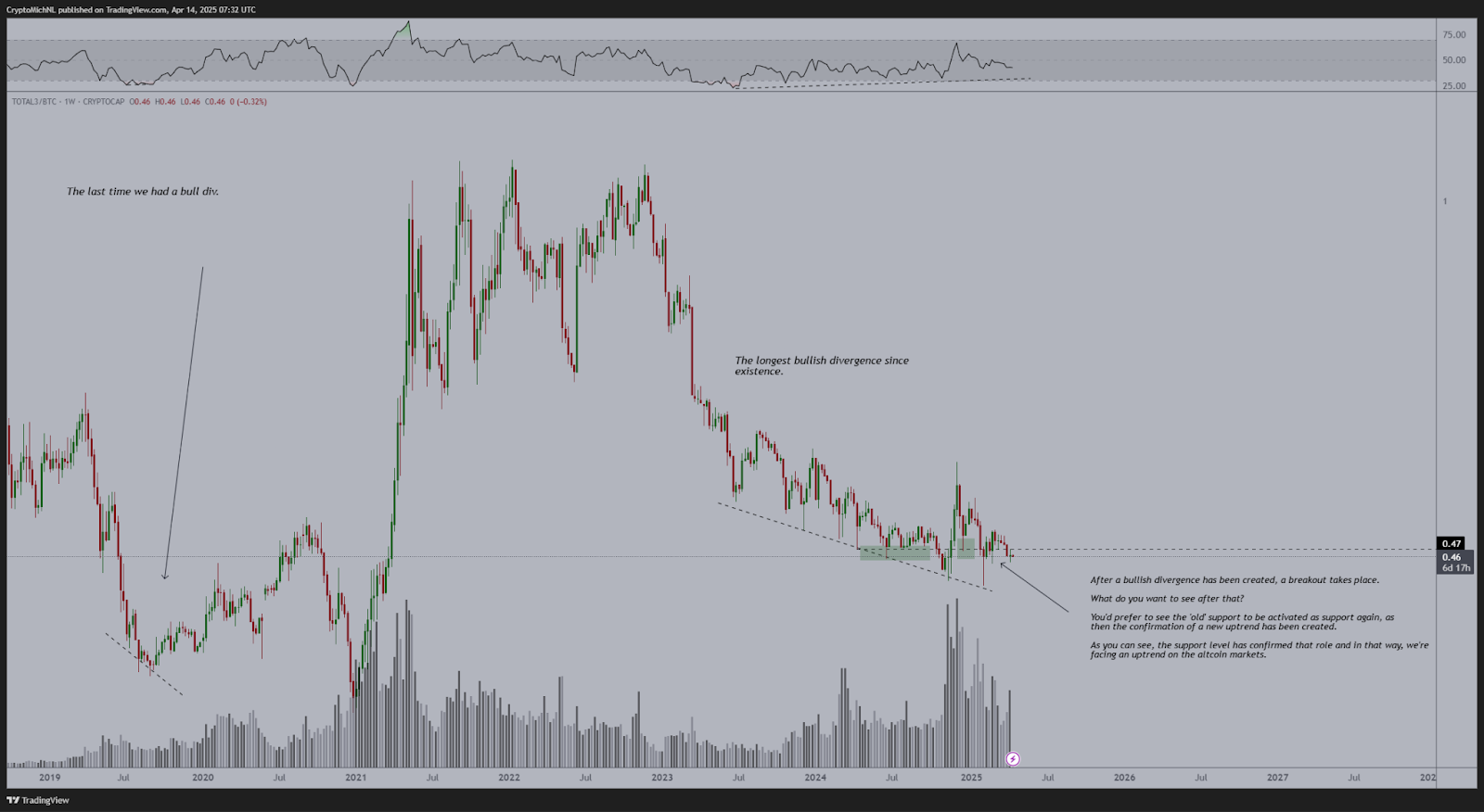
Ван де Поппе определил многолетнюю модель падающего клина — структуру, которая часто сигнализирует о бычьем развороте цены. В последний раз, когда наблюдалась такая бычья дивергенция, за ней последовал параболический всплеск в 2020 году, ознаменовавший начало одного из крупнейших бычьих забегов альткоинов.

Аналитик также подчеркнул, что текущий рынок демонстрирует самую длинную бычью дивергенцию в истории альткоинов. RSI (индекс относительной силы) последовательно формировал более высокие минимумы, в то время как цена достигала более низких минимумов — классическая установка, намекающая на разворот цены.

По теме: Массовое падение JTO, TRUMP, TON и CO. — купить страх или бежать в укрытие?

Важно отметить, что прорыв уже произошел, и цена восстановила сопротивление клина и повторно протестировала его в качестве поддержки. Этот повторный тест, похоже, держится, что, по мнению ван де Поппе, может быть подтверждением нового восходящего тренда на рынке альткоинов.

Как выглядит график рыночной капитализации альткоинов?

График TOTAL2 (общая капитализация рынка криптовалют без учета биткоина) показывает, что по состоянию на 14 апреля TOTAL2 отскочил от зоны в 830 миллиардов долларов и сейчас колеблется вблизи отметки в 960 миллиардов долларов, демонстрируя признаки жизни после недель бокового движения.

Это ценовое действие восстановило уровень коррекции Фибоначчи 0,382 и пытается пробиться выше ключевых уровней 0,5 и 0,618, которые обычно отслеживаются при развороте тренда.
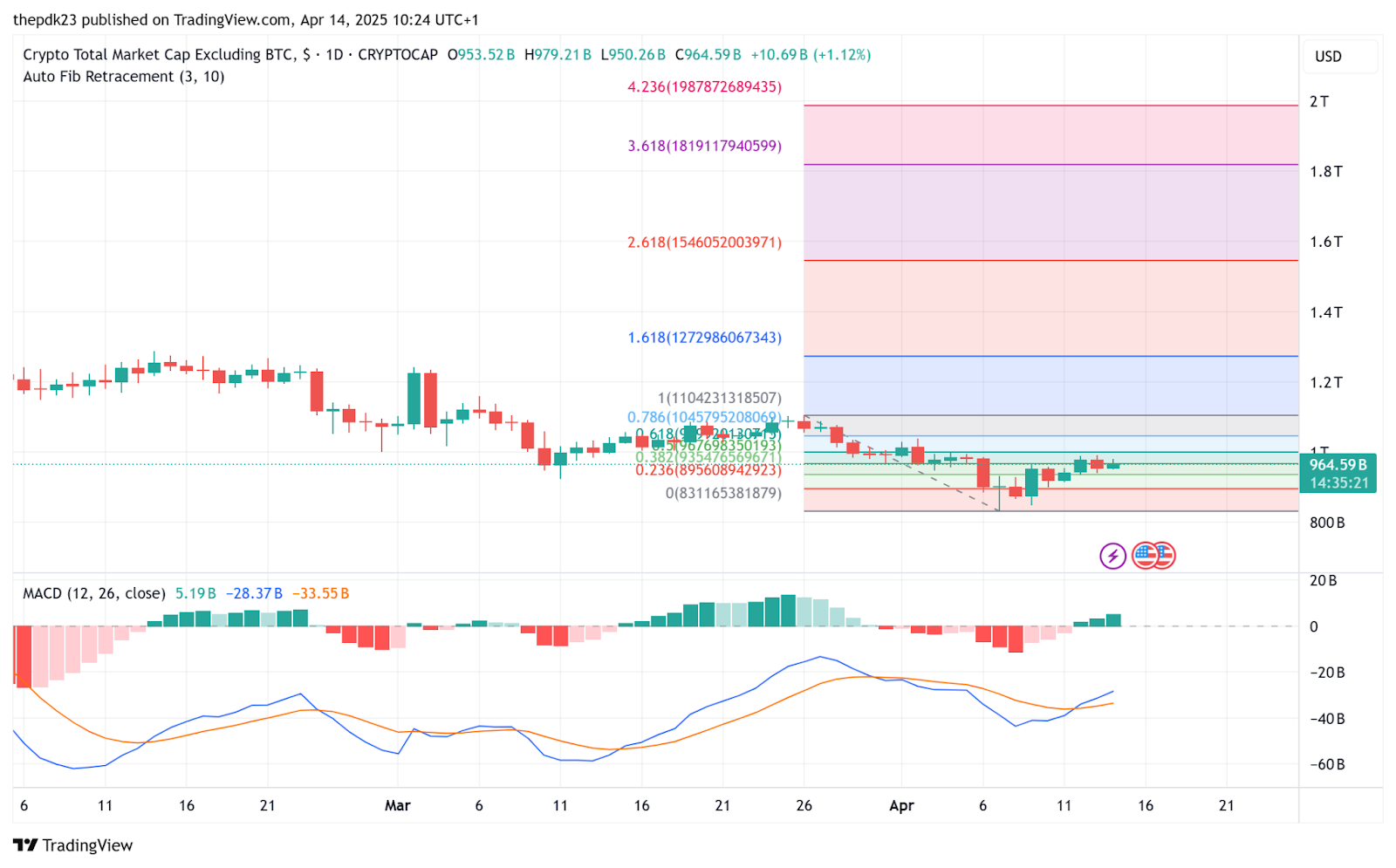
Кроме того, MACD (схождение-расхождение скользящих средних) пересек бычий тренд, при этом столбцы гистограммы стали зелеными, а импульс сместился вверх, что указывает на потенциальное продолжение, если на рынок выйдет последующий объем.

Если рыночная капитализация TOTAL2 сможет решительно пробиться и удержаться выше отметки $1,02 трлн (0,618 Фибоначчи), аналитики видят потенциал для ралли к $1,27 трлн (расширение Фибоначчи 1,618). Этот сценарий становится более вероятным, если цена биткоина стабилизируется или консолидируется.

По теме: Биткоин и альткоины падают, так как повышение пошлин США на Китай пугает мировые рынки

В бычьем случае TOTAL2 может повторно протестировать исторические максимумы около $1,6–2 трлн в течение следующих 6–12 месяцев. С другой стороны, медвежий случай будет включать в себя еще один отскок на уровне 0,618 Фибо, отправляя цены обратно к поддержке $830 млрд.


Letture associate

From SpaceX to Galaxy Digital: A Detailed Look at 37 New AI Companies and 7 Crypto Dark Horses Added to the Russell Indexes

On June 26th, following its annual reconstitution, the Russell US Indexes finalized their new components, with changes taking effect for market trading on June 29th. The Russell 3000 Index, representing approximately 98% of the investable US equity market, saw significant turnover. A record $334 billion was traded during Nasdaq's closing cross on reconstitution day, highlighting the massive passive fund flows tied to these benchmarks. Companies newly added to the index are set to benefit from mandatory buying by these funds. The reconstitution raised the market cap threshold between the large-cap Russell 1000 and small-cap Russell 2000 by 24% to $5.7 billion. Overall, 224 new companies entered the Russell 3000. Of these, 19 joined the Russell 1000, and 205 joined the Russell 2000, while 118 firms were removed. Notably, among the newcomers, approximately 37 are companies operating in the AI and semiconductor ecosystem, accounting for roughly 17% of new additions. The most prominent is SpaceX, which, following its recent IPO and soaring valuation, was fast-tracked directly into the Russell 1000 and Top 200 indexes. Additionally, about 7 cryptocurrency-related companies were newly included, representing about 3% of new entrants. These include Galaxy Digital, Bitmine, and Tron, among others. The inclusion of several Decentralized Autonomous Trust (DAT) entities signals the model's sustained market presence. For these smaller AI and crypto firms, index inclusion boosts visibility, potentially attracting further institutional investment and supporting their stock performance.

Odaily星球日报4 min fa

From SpaceX to Galaxy Digital: A Detailed Look at 37 New AI Companies and 7 Crypto Dark Horses Added to the Russell Indexes

Odaily星球日报4 min fa

Token Uneconomical

"Token Inefficiency" explores the rising economic burden of AI model token usage in enterprises, where escalating costs often fail to match tangible productivity gains. Major companies like Microsoft, Uber, and Meta are facing "token inefficiency"—characterized by budget overruns for tools like Claude Code with unclear returns. This inefficiency stems from supply-side factors like strategic model price hikes by leaders (e.g., Anthropic) and price increases in budget-friendly models, alongside technical waste in Agent systems through context traps, tokenizer inflation, redundant skill calls, and multi-Agent coordination overhead. A deeper demand-side challenge limits token value: their primary utility remains confined to highly digitalized domains like programming, which benefits from automatic, low-cost feedback loops. Extending tokens to physical world tasks or less digitalized industries faces the "Sim-to-Real Gap," where real-world validation is costly and slow, unlike in code compilation. The article warns that this inefficiency concentrates financial risk in mid-tier model developers, potentially fueling circular financing schemes and shadow credit bubbles. It also highlights societal externalities, as data center expansion strains local power grids and inflates utility costs for residents. To achieve a positive net token economy, the path forward requires dual efforts: technical optimizations (context compression, skill reduction, model routing, budget constraints) and business-side discipline (governance, cost attribution, ROI focus). The ultimate goal is shifting from showcasing AI capabilities to maximizing value per token, finding scalable commercial applications that justify the investment and bridge the digital-physical divide.

marsbit22 min fa

Token Uneconomical

marsbit22 min fa

Stock Price Halved in 45 Days, Is Circle Actually the "DeFi Barometer"?

Over a 45-day period, Circle's stock price plummeted by approximately 50% to around $63, coinciding with a significant $70 billion decline in the circulation of its USDC stablecoin from its peak. In contrast, Tether's USDT saw a much smaller reduction. Analyst Ed Engel posits that Circle acts as a barometer for DeFi activity, as a high correlation exists between USDC supply and ETH price movements. The vast majority of USDC is concentrated within crypto exchanges and DeFi protocols for yield generation, rather than for widespread daily use in payments or commerce, unlike USDT which has stronger real-world adoption in various regions. The recent contraction in DeFi Total Value Locked (TVL), following security incidents like the Kelp DAO attack, appears to mirror Circle's declining stock performance. While Circle is actively promoting USDC's use as a settlement asset on platforms like Hyperliquid and in institutional payment corridors—where its organic transfer volume surpasses USDT's—these efforts have not sufficiently driven growth in USDC's overall supply. The company's revenue remains heavily tied to DeFi's expansion. For Circle's investment narrative to change, it must either significantly reduce its reliance on the volatile DeFi sector or demonstrably prove that real-world adoption can substantially and sustainably increase USDC circulation. In the near term, market confidence hinges on DeFi addressing its inherent risk-reward imbalances.

marsbit55 min fa

Stock Price Halved in 45 Days, Is Circle Actually the "DeFi Barometer"?

marsbit55 min fa

Trading

Spot
活动图片