Next Crypto to Explode as $TRUMP Token Faces $320M Unlock Pressure

bitcoinistPubblicato 2025-04-14Pubblicato ultima volta 2025-04-14

Introduzione

On April 18, a hefty 40M of $TRUMP (worth $320M) will be unlocked, triggering sell-offs but also potentially revealing the...

Trusted Editorial content, reviewed by leading industry experts and seasoned editors. Ad Disclosure

On April 18, a hefty 40M of $TRUMP (worth $320M) will be unlocked, triggering sell-offs but also potentially revealing the next crypto to explode.

As a series of $TRUMP token unlocks hits the market, an extra 493K worth $4M will be released every day.

The $TRUMP Token Unlocks Might Trigger Sell-Offs

Industry observers anticipate increased selling pressure owing to the fact that the first batch of unlocked tokens will be given to team members at no cost. They’ll likely want to sell their tokens to realize a profit when the unlock occurs.

This wave of sell-offs could intensify downward pressure and create volatile short-term moves.

But the outlook isn’t all doom and gloom. When a significant token like $TRUMP faces enhanced selling pressure, investors often rotate their capital into other meme coins with stronger prospects.

Consequently, some of the best meme coins on presale could be the next crypto to explode during this volatile period. Let’s look at $BTCBULL, $SOLX, and $LCAI; some of the hottest contenders right now.

1. BTC Bull Token ($BTCBULL) – Stabilizes Its Supply With $BTC Airdrops & Ongoing Token Burns

$BTCBULL’s name says it all. It’s possibly one of the most bullish Bitcoin-based projects because it dishes out free $BTC every time the blueprint token breaks a new record – $100K, $150K, and $200K.

To top it off, you can anticipate free $BTCBULL airdrops when $BTC eventually hits its $250K milestone. For airdrop eligibility, there’s a slight catch. You must purchase $BTCBULL on the Best Wallet app.

As the world’s first crypto wallet to feature presale tokens, you can buy coins at their lowest prices before they attract mainstream attention. In fact, it has much to offer, as pinpointed in our Best Wallet review.

In stark contrast to $TRUMP, $BTCBULL burns or removes a percentage of its token supply instead of adding new tokens to the market. Fewer tokens in circulation makes them scarcer, which can lead to higher prices if demand stays the same or increases.

$BTC acts as a burn trigger. causing $BTCBULL to be removed when the OG coin hits $125K, $175K, and $225K.

Besides profiting from token airdrops and possibly deflationary price action, you can also stake $BTCBULL at an 89% APY. That means you can earn passive income simply by holding onto the token. Plus, you’ll help stabilize the Bitcoin Bull ecosystem.
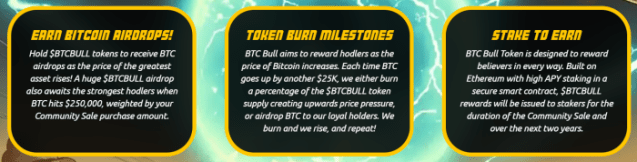
BTC Bull Token airdrops, burns, and staking
Source: BTC Bull Token

Get behind BTC’s rise to $250k and beyond. Find out how to buy $BTCBULL on presale for just $0.00246. Our $BTCBULL price predictions see it reaching $0.00835 by this year’s end (a 239%+ uplift compared to its current price), so it’s prime buying time.

Solaxy ($SOLX) – Behind the First Ever Solana L2; Presale Just Hit $30M

Looking like the next crypto to explode is $SOLX. It’s accelerating rapidly, having just hit over $30M on presale!

Solaxy has raised $30M on presale
Source: Solaxy

Attracting the eyes of investors is its being the entry point to Solaxy, the world’s first Solana L2 network currently in development.

Despite Solana’s reputation for speed (50K tps), low cost, and scalability, its recent performance has faltered – especially during periods of high demand.

For example, when $TRUMP launched in January, the overwhelming 24-hour demand resulted in a $21.9B trading volume and triggered transaction failures across the network.

This is where Solaxy steps into the scene. Addressing Solana’s pain points, it aims to enhance the blockchain’s scalability and overall efficiency by bundling transactions onto a side chain.

Moreover, enabling cross-chain transfers between Solana and Ethereum will unlock greater liquidity and dApp opportunities. This includes DeFi platforms, NFT marketplaces, Web3 games, and easy access to the best crypto to buy now.

To keep you engaged before the L2 networks initiation, you can also stake $SOLX at a 135% APY.

Now’s an opportune time to buy $SOLX on presale for just $0.001694. This is especially true when considering the SOLX price is predicted to reach $0.032 before 2026 kicks off (a 3,100% increase compared to its initial $0.0010 valuation!).

You wouldn’t be the only one betting on the coin’s success. Less than 24 hours ago, two major whale buyers funneled $31K+ and $29K+ into the project, helping $SOLX to achieve its $30M+ raise.

3. Lightchain AI ($LCAI) – The Backbone of Fully Decentralized & Scalable AI Applications

$LCAI is the backbone of Lightchain AI, a decentralized ecosystem to support and accelerate AI development and applications.

Interestingly, it uses a novel consensus mechanism – Proof of Intelligence (PoI) – that rewards participants (nodes) for performing valuable AI computations. Such tasks include model training, interference, and optimization.

Lightchain AI Proof of Intelligence (PoI)
Source: Lightchain AI

At the platform’s core is the Artificial Intelligence Virtual Machine (AIVM), a cutting-edge computational layer designed to facilitate hassle-free AI-specific tasks on the blockchain.

By purchasing $LCAI, you can access AI model training, the interface, and other machine-learning services held on the AIVM.

Moreover, you can partake in the PoI to earn rewards and contribute to the network’s security and overall efficiency.

You’ll also get governance rights to influence protocol updates and ecosystem development.

$LCAI is currently in its presale phase. Although the coin is yet to launch on exchanges, it’s already raised over $19M. One coin costs as little as $0.007125 and can be bought in exchange for $USDT or $ETH.

Suppose you’re conscious of blockchain technology’s environmental impact. In that case, you’ll be relieved to hear that Lightchain AI’s operations should be more sustainable by October 2025, when its energy-efficient system optimizations are planned.

$BTCBULL Token Burns Over $TRUMP Supply Surge

The meme coin market is bracing for turbulence as the $TRUMP token unlocks loom.

However, with volatility comes opportunity. $BTCBULL, $SOLX, and $LCAI could be the next crypto to explode as traders look for new options.

$BTCBULL, in particular, flips $TRUMP’s script. Instead of flooding the market with new tokens, it reduces its supply to capitalize on scarcity.

Still, this isn’t investment advice. You must always DYOR and beware that all crypto investments can be volatile and pose significant risks.

Editorial Process for bitcoinist is centered on delivering thoroughly researched, accurate, and unbiased content. We uphold strict sourcing standards, and each page undergoes diligent review by our team of top technology experts and seasoned editors. This process ensures the integrity, relevance, and value of our content for our readers.

Bitcoinist is the ultimate news and review site for the crypto currency community!

Letture associate

Token Budget Wars: Enterprise AI Enters the 'Accounting Era'

Token Budget Wars: Enterprise AI Enters the "Accounting Era" Enterprise AI is shifting from the question of "whether to adopt" to "how to account for it." As AI inference costs evolve from experimental budgets into ongoing operational expenses, CEOs and CFOs are demanding proof of value: what tangible results does each dollar spent on tokens deliver? The core of "Token Budget Wars" is not simply about reducing AI bills, but about intelligently allocating compute resources. It involves determining which business processes warrant more computational power, which tasks can use cheaper models, which can be outsourced or handled manually, and which are merely inefficient consumption. A key insight is that AI usage (token consumption) does not equal value. While SaaS usage indicated software adoption, AI token usage only indicates the "meter is running." The same workflow can cost vastly different amounts due to factors like prompt quality, context, model choice, and retries. The critical metric for scaling is "marginal token utility"—the business value created per additional dollar of inference cost. However, this is difficult to measure due to challenges like the long tail of retries, context inflation (where costs can scale quadratically with context length), and inefficient model routing (defaulting to the most powerful model for all tasks). The competition for token allocation is intensifying because, in the AI era, influence is tied to how much intelligence one can command, not just team size. AI spending is essentially competing with labor costs, whether for replacing external BPOs, internal staff, or generating new revenue. BPO contracts provide a clearer benchmark as they are priced per completed unit. The missing layer is attribution from tokens to business outcomes. Companies need a system that connects inference spending to completed work and results, capturing the agent's decision trajectory—what it saw, retrieved, tried, and why it succeeded or failed. This recorded rationale becomes a valuable asset. Ultimately, those who master token-to-outcome attribution will control the allocation of AI resources within enterprises, deciding which workflows get more compute, which are capped, or which revert to humans. The first phase of enterprise AI proved models could do the work. The next phase will determine how much of that work is worth paying for.

marsbit13 min fa

Token Budget Wars: Enterprise AI Enters the 'Accounting Era'

marsbit13 min fa

US Debt Exceeds $39 Trillion, Surpassing GDP for First Time: The 'Gray Rhino' Every Investor Must Face by 2026

The U.S. national debt has exceeded $39 trillion, with the debt-to-GDP ratio surpassing 100% in 2026 for the first time since WWII. The annual interest payment is projected to reach $1.039 trillion. Driven by structural factors like tax cuts, rising entitlement spending (Social Security, Medicare), and compounding interest, the deficit persists. The Congressional Budget Office warns the current fiscal path is unsustainable, projecting debt could reach 175% of GDP by 2056. While the U.S. is unlikely to default as it issues its own currency, the consequences include persistent inflation pressure, higher long-term interest rates (e.g., 30-year Treasury yields at 5.2%), and potential crowding out of private investment. A fiscal crisis could manifest as a sudden, sharp spike in borrowing costs if market confidence erodes. Major credit rating agencies have downgraded U.S. debt, reflecting these concerns. For investors, this signals the end of the era of permanently low interest rates. Equity investors should favor companies with strong current earnings over high-growth stocks reliant on low discount rates. Bond investors face headwinds for long-term Treasuries due to increased supply, making shorter-duration bonds and investment-grade corporates relatively attractive. Gold and real assets can provide a hedge against currency debasement risks. Three broad scenarios are possible: gradual stabilization through fiscal reform (unlikely given political gridlock), a slow-burn of high debt and interest rates dragging on growth (the most probable baseline), or a sudden loss of market confidence triggering a crisis. Key indicators to watch include CBO report updates, Treasury auction demand, and the 30-year Treasury yield. The core takeaway for investors is the need to adjust portfolios for a world of sustained higher government borrowing costs and interest rates.

marsbit36 min fa

US Debt Exceeds $39 Trillion, Surpassing GDP for First Time: The 'Gray Rhino' Every Investor Must Face by 2026

marsbit36 min fa

A 10,000-Word Interpretation of the "Optical Interconnect" Industry Chain: The AI Infrastructure Bottleneck Obscured by GPU Glare

**Summary: The Rise of Optical Interconnect in AI Infrastructure** This analysis explores the critical, yet often overlooked, role of optical interconnects in large-scale AI data centers. While GPUs provide raw computational power, the efficiency of AI clusters depends heavily on high-speed data transfer between thousands of cooperating GPUs during both training and inference tasks. Copper-based electrical connections are hitting physical limits in bandwidth, distance, and power consumption. Fiber optics, using light signals, offer a superior solution with exponentially higher bandwidth and lower energy use over longer distances. This shift is driving rapid growth in the optical interconnect market. The core translation device is the pluggable optical transceiver (or module), which converts electrical signals from GPUs into optical signals for fiber transmission and vice versa. Its manufacturing involves two distinct semiconductor domains: indium phosphide (InP) for optical chips (lasers, modulators, detectors) and silicon for digital signal processing (DSP) chips. A transformative next-generation technology is Co-Packaged Optics (CPO). CPO moves the optical engine (a silicon photonic integrated circuit, or PIC) much closer to the GPU or switch inside the same chip package, drastically reducing power loss and latency. CPO necessitates an external laser source and relies on silicon photonics (using Silicon-on-Insulator/SOI wafers) for integration with silicon chips. The optical interconnect ecosystem is highly fragmented, unlike the concentrated GPU market. Key bottlenecks and players span the entire supply chain: InP substrates (e.g., AXT), epitaxial wafers (e.g., IQE), laser chips (e.g., Sivers, Lumentum, Coherent), silicon photonics foundries (e.g., Tower Semiconductor), SOI wafers (e.g., Soitec), DSP/switch chips (e.g., Broadcom, Marvell), and underlying fiber (e.g., Corning). The article posits that AI infrastructure competition is extending from "who has more GPUs" to "who can secure the scarce optical interconnect supply chain." CPO represents the largest potential growth variable, with projections suggesting it could become a market worth tens of billions of dollars by 2028. Investment opportunities vary from conservative (large, diversified players) to aggressive (small, high-beta companies focused on specific bottleneck technologies), but the sector carries significant volatility and execution risks.

marsbit1 h fa

A 10,000-Word Interpretation of the "Optical Interconnect" Industry Chain: The AI Infrastructure Bottleneck Obscured by GPU Glare

marsbit1 h fa

Trading

Spot
Futures
活动图片