Google updates Crypto Ad policy for EU Under MiCA

TheCryptoTimesPubblicato 2025-04-14Pubblicato ultima volta 2025-04-14

In a significant move for the crypto industry, Google has announced new advertising requirements for cryptocurrency exchanges and software wallets across the European Union (EU), effective April 23, 2025.

To align with the Markets in Crypto-Assets (MiCA) regulation, advertisers must hold a Crypto-Asset Service Provider (CASP) license issued by a relevant national authority within the EU. Additionally, they must comply with any local legal obligations beyond MiCA and secure Google certification to run ads. 

This policy applies across 27 EU countries, including major markets like France, Germany, Spain, Italy, Luxembourg, Netherlands, Poland, Sweden, and Denmark.

Only CASP-licensed firms can advertise crypto exchanges or wallets in the EU.
Advertisements must be verified by Google, meaning Google certificates, and national-level legal requirements remain in force and must be observed.

To make this process easy, Google is recognizing existing country-based licenses in Finland, France, and Germany during transitional periods specified under Article 143(3) of MiCA.

Finland: Valid until 30 June 2025.
France: Valid until 30 June 2026.
Germany: Valid until 30 December 2025.

This extension allows current advertisers in these countries to adjust their operations and obtain a MiCA license. Advertisers that violate the policy won’t be suspended right away. Rather, before any account actions are taken, Google will give a seven-day notice.

Advertisers need to move fast to stay visible and compliant in the changing digital economy as MiCA continues to change the crypto landscape in Europe.

Being compliant is not only wise but also necessary as Europe tightens its regulations on cryptocurrency advertising. Crypto advertisers have to take action quickly or risk falling behind the digital curve.

Also read : Google Blocks 17 Crypto Exchange Apps in South Korea


Letture associate

Token Budget Wars: Enterprise AI Enters the 'Accounting Era'

Token Budget Wars: Enterprise AI Enters the "Accounting Era" Enterprise AI is shifting from the question of "whether to adopt" to "how to account for it." As AI inference costs evolve from experimental budgets into ongoing operational expenses, CEOs and CFOs are demanding proof of value: what tangible results does each dollar spent on tokens deliver? The core of "Token Budget Wars" is not simply about reducing AI bills, but about intelligently allocating compute resources. It involves determining which business processes warrant more computational power, which tasks can use cheaper models, which can be outsourced or handled manually, and which are merely inefficient consumption. A key insight is that AI usage (token consumption) does not equal value. While SaaS usage indicated software adoption, AI token usage only indicates the "meter is running." The same workflow can cost vastly different amounts due to factors like prompt quality, context, model choice, and retries. The critical metric for scaling is "marginal token utility"—the business value created per additional dollar of inference cost. However, this is difficult to measure due to challenges like the long tail of retries, context inflation (where costs can scale quadratically with context length), and inefficient model routing (defaulting to the most powerful model for all tasks). The competition for token allocation is intensifying because, in the AI era, influence is tied to how much intelligence one can command, not just team size. AI spending is essentially competing with labor costs, whether for replacing external BPOs, internal staff, or generating new revenue. BPO contracts provide a clearer benchmark as they are priced per completed unit. The missing layer is attribution from tokens to business outcomes. Companies need a system that connects inference spending to completed work and results, capturing the agent's decision trajectory—what it saw, retrieved, tried, and why it succeeded or failed. This recorded rationale becomes a valuable asset. Ultimately, those who master token-to-outcome attribution will control the allocation of AI resources within enterprises, deciding which workflows get more compute, which are capped, or which revert to humans. The first phase of enterprise AI proved models could do the work. The next phase will determine how much of that work is worth paying for.

marsbit13 min fa

Token Budget Wars: Enterprise AI Enters the 'Accounting Era'

marsbit13 min fa

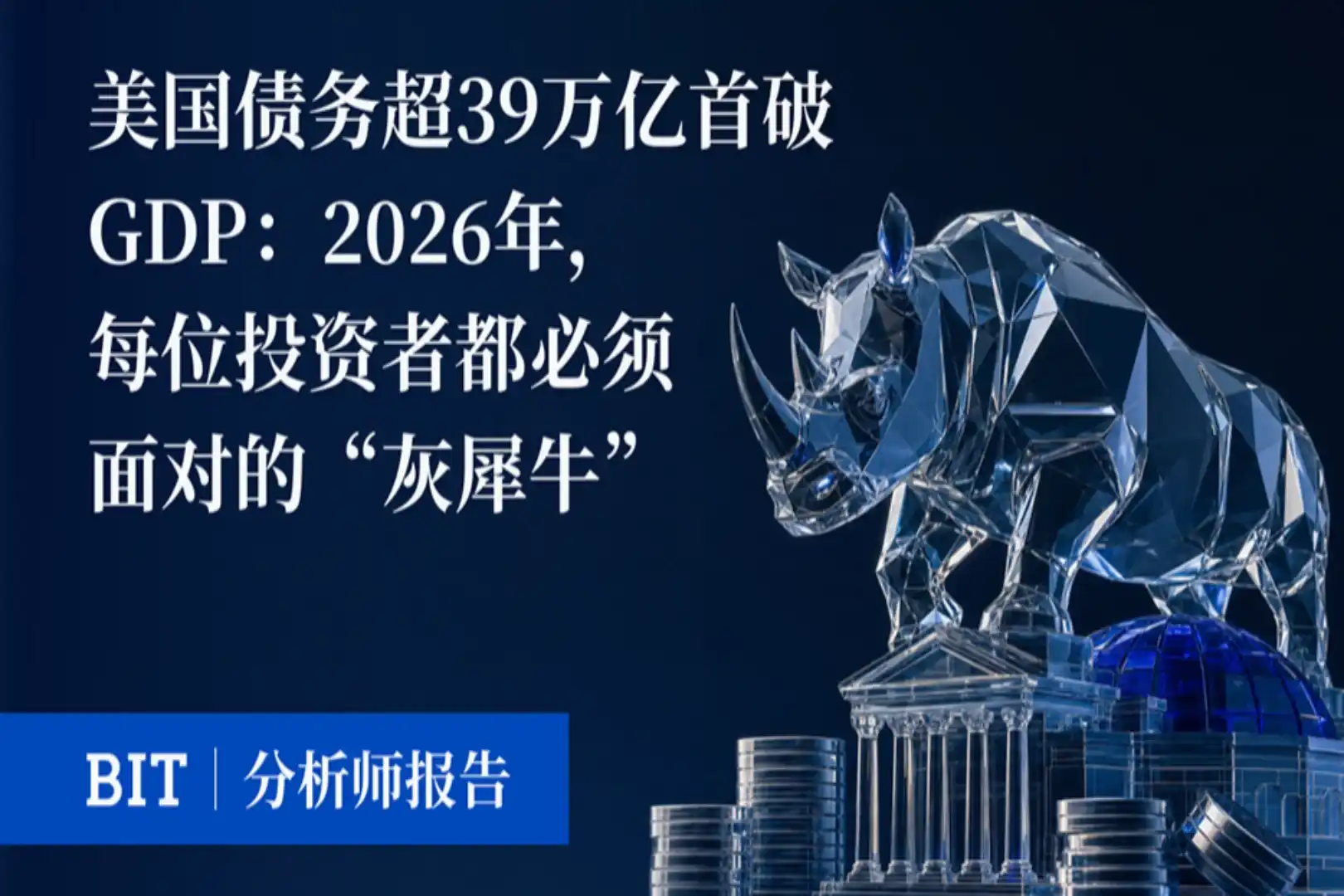
US Debt Exceeds $39 Trillion, Surpassing GDP for First Time: The 'Gray Rhino' Every Investor Must Face by 2026

The U.S. national debt has exceeded $39 trillion, with the debt-to-GDP ratio surpassing 100% in 2026 for the first time since WWII. The annual interest payment is projected to reach $1.039 trillion. Driven by structural factors like tax cuts, rising entitlement spending (Social Security, Medicare), and compounding interest, the deficit persists. The Congressional Budget Office warns the current fiscal path is unsustainable, projecting debt could reach 175% of GDP by 2056. While the U.S. is unlikely to default as it issues its own currency, the consequences include persistent inflation pressure, higher long-term interest rates (e.g., 30-year Treasury yields at 5.2%), and potential crowding out of private investment. A fiscal crisis could manifest as a sudden, sharp spike in borrowing costs if market confidence erodes. Major credit rating agencies have downgraded U.S. debt, reflecting these concerns. For investors, this signals the end of the era of permanently low interest rates. Equity investors should favor companies with strong current earnings over high-growth stocks reliant on low discount rates. Bond investors face headwinds for long-term Treasuries due to increased supply, making shorter-duration bonds and investment-grade corporates relatively attractive. Gold and real assets can provide a hedge against currency debasement risks. Three broad scenarios are possible: gradual stabilization through fiscal reform (unlikely given political gridlock), a slow-burn of high debt and interest rates dragging on growth (the most probable baseline), or a sudden loss of market confidence triggering a crisis. Key indicators to watch include CBO report updates, Treasury auction demand, and the 30-year Treasury yield. The core takeaway for investors is the need to adjust portfolios for a world of sustained higher government borrowing costs and interest rates.

marsbit36 min fa

US Debt Exceeds $39 Trillion, Surpassing GDP for First Time: The 'Gray Rhino' Every Investor Must Face by 2026

marsbit36 min fa

A 10,000-Word Interpretation of the "Optical Interconnect" Industry Chain: The AI Infrastructure Bottleneck Obscured by GPU Glare

**Summary: The Rise of Optical Interconnect in AI Infrastructure** This analysis explores the critical, yet often overlooked, role of optical interconnects in large-scale AI data centers. While GPUs provide raw computational power, the efficiency of AI clusters depends heavily on high-speed data transfer between thousands of cooperating GPUs during both training and inference tasks. Copper-based electrical connections are hitting physical limits in bandwidth, distance, and power consumption. Fiber optics, using light signals, offer a superior solution with exponentially higher bandwidth and lower energy use over longer distances. This shift is driving rapid growth in the optical interconnect market. The core translation device is the pluggable optical transceiver (or module), which converts electrical signals from GPUs into optical signals for fiber transmission and vice versa. Its manufacturing involves two distinct semiconductor domains: indium phosphide (InP) for optical chips (lasers, modulators, detectors) and silicon for digital signal processing (DSP) chips. A transformative next-generation technology is Co-Packaged Optics (CPO). CPO moves the optical engine (a silicon photonic integrated circuit, or PIC) much closer to the GPU or switch inside the same chip package, drastically reducing power loss and latency. CPO necessitates an external laser source and relies on silicon photonics (using Silicon-on-Insulator/SOI wafers) for integration with silicon chips. The optical interconnect ecosystem is highly fragmented, unlike the concentrated GPU market. Key bottlenecks and players span the entire supply chain: InP substrates (e.g., AXT), epitaxial wafers (e.g., IQE), laser chips (e.g., Sivers, Lumentum, Coherent), silicon photonics foundries (e.g., Tower Semiconductor), SOI wafers (e.g., Soitec), DSP/switch chips (e.g., Broadcom, Marvell), and underlying fiber (e.g., Corning). The article posits that AI infrastructure competition is extending from "who has more GPUs" to "who can secure the scarce optical interconnect supply chain." CPO represents the largest potential growth variable, with projections suggesting it could become a market worth tens of billions of dollars by 2028. Investment opportunities vary from conservative (large, diversified players) to aggressive (small, high-beta companies focused on specific bottleneck technologies), but the sector carries significant volatility and execution risks.

marsbit1 h fa

A 10,000-Word Interpretation of the "Optical Interconnect" Industry Chain: The AI Infrastructure Bottleneck Obscured by GPU Glare

marsbit1 h fa

Trading

Spot
Futures

Articoli Popolari

Come comprare MOVE

Benvenuto in HTX.com! Abbiamo reso l'acquisto di Movement (MOVE) semplice e conveniente. Segui la nostra guida passo passo per intraprendere il tuo viaggio nel mondo delle criptovalute.Step 1: Crea il tuo Account HTXUsa la tua email o numero di telefono per registrarti il tuo account gratuito su HTX. Vivi un'esperienza facile e sblocca tutte le funzionalità,Crea il mio accountStep 2: Vai in Acquista crypto e seleziona il tuo metodo di pagamentoCarta di credito/debito: utilizza la tua Visa o Mastercard per acquistare immediatamente MovementMOVE.Bilancio: Usa i fondi dal bilancio del tuo account HTX per fare trading senza problemi.Terze parti: abbiamo aggiunto metodi di pagamento molto utilizzati come Google Pay e Apple Pay per maggiore comodità.P2P: Fai trading direttamente con altri utenti HTX.Over-the-Counter (OTC): Offriamo servizi su misura e tassi di cambio competitivi per i trader.Step 3: Conserva Movement (MOVE)Dopo aver acquistato Movement (MOVE), conserva nel tuo account HTX. In alternativa, puoi inviare tramite trasferimento blockchain o scambiare per altre criptovalute.Step 4: Scambia Movement (MOVE)Scambia facilmente Movement (MOVE) nel mercato spot di HTX. Accedi al tuo account, seleziona la tua coppia di trading, esegui le tue operazioni e monitora in tempo reale. Offriamo un'esperienza user-friendly sia per chi ha appena iniziato che per i trader più esperti.

268 Totale visualizzazioniPubblicato il 2024.12.13Aggiornato il 2025.03.21

Come comprare MOVE

Discussioni

Benvenuto nella Community HTX. Qui puoi rimanere informato sugli ultimi sviluppi della piattaforma e accedere ad approfondimenti esperti sul mercato. Le opinioni degli utenti sul prezzo di MOVE MOVE sono presentate come di seguito.

活动图片