‘Odds Increasing’ Of US Bitcoin Buy In 2025 – Galaxy Analyst

bitcoinistPubblicato 2025-04-08Pubblicato ultima volta 2025-04-08

Introduzione

Alex Thorn, Head of Research at Galaxy Digital, expressed a marked shift in his outlook regarding potential United States government...

Trusted Editorial content, reviewed by leading industry experts and seasoned editors. Ad Disclosure

Alex Thorn, Head of Research at Galaxy Digital, expressed a marked shift in his outlook regarding potential United States government purchases of Bitcoin in 2025. Writing on Sunday via X, Thorn underscored what he described as an evolving picture, stating, “It does seem increasingly likely that the USA is making progress on the logistics and mechanics of the strategic reserve. We had predicted in dec 2024 that in 2025 the US would formally hodl BTC but not purchase, but we now see the odds increasing that US govt will make at least one purchase in 2025.”

Thorn pointed to recent comments from the Trump administration as the reason for the change: “See Bessent’s comment to tucker carlson, drumbeat from sacks and hines,” as well as the upcoming deadline for the BTC audit: “Keep in mind monday is deadline from SBR EO for govt agencies to complete audit of their bitcoin / digital assets holdings. Not clear they will release anything publicly on this but likely progress being made.”

US Bitcoin Purchase In 2025?

Thorn’s reference to “Bessent’s comment” alludes to remarks made by US Treasury Secretary Scott Bessent in a recent interview with Tucker Carlson. When Carlson asked why gold is being shipped around the world right now, Bessent, after a brief reply about gold, abruptly pivoted to Bitcoin.

Steven Lubka, head of private wealth at Swan, recounted via X, “Bessent was asked ‘Why is Gold moving around the world right now?’ And after giving a one line answer, he immediately of his own accord started saying ‘there are a lot of different stores of value over time. Bitcoin is becoming a store of value. Gold has been a store of value over time.’ This is quite the signpost for those with eyes to see.”

These comments arrive on the heels of the executive order signed by President Trump on March 6, formally establishing the US Strategic Bitcoin Reserve (SBR). The order repurposes any BTC the government obtains through forfeitures and seizures, placing it under direct federal control as part of a long-term strategic asset.
Under the same directive, the Treasury and Commerce Departments are tasked with formulating strategies for acquiring additional Bitcoin “provided the methods remain budget neutral and do not impose incremental costs on United States taxpayers.”

According to Robert “Bo” Hines, Executive Director of the Presidential Council of Advisers for Digital Assets, one possibility under examination is using gold certificates, which the Federal Reserve Bank of St. Louis values at a statutory price of $42.22 per troy ounce—significantly lower than the spot price of over $3,000 per ounce.

Speaking at the Digital Assets Summit on March 18, Hines reiterated the Trump administration’s commitment to Bitcoin and offered further insight into how much BTC the government may ultimately seek to secure, invoking an analogy to gold reserves. “I’ve been asked all the time, it’s like, how much do you want? I said, well, that’s like asking a country, how much gold do you want? Right. I mean, as much as we can get.”

Hines’s remarks were echoed by David Sacks—also known as the “Crypto Czar”—who has publicly championed greater government involvement in digital assets.

At press time, BTC traded at $77,570.
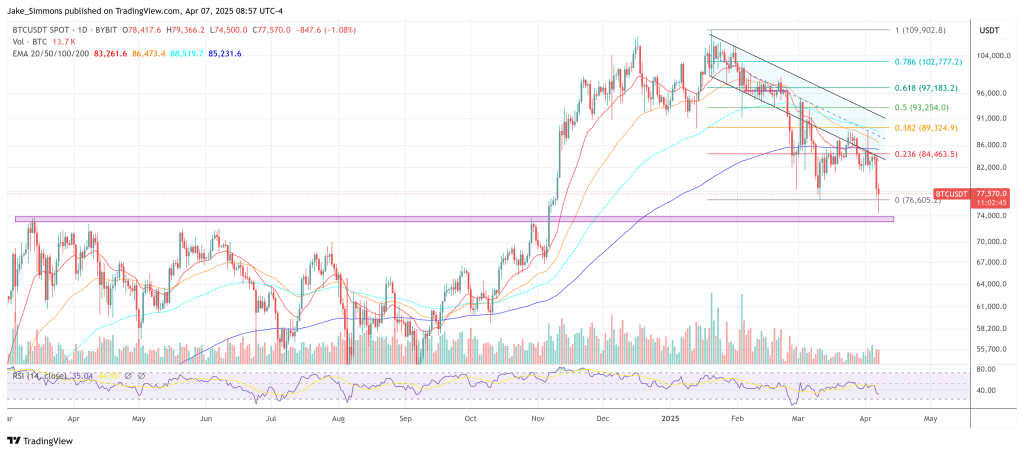
Bitcoin price
BTC stabilizes above $77,000, 1-day chart | Source: BTCUSDT on TradingView.com
Featured image created with DALL.E, chart from TradingView.com
Editorial Process for bitcoinist is centered on delivering thoroughly researched, accurate, and unbiased content. We uphold strict sourcing standards, and each page undergoes diligent review by our team of top technology experts and seasoned editors. This process ensures the integrity, relevance, and value of our content for our readers.

Jake Simmons has been a Bitcoin enthusiast since 2016. Ever since he heard about Bitcoin, he has been studying the topic every day and trying to share his knowledge with others. His goal is to contribute to Bitcoin's financial revolution, which will replace the fiat money system. Besides BTC and crypto, Jake studied Business Informatics at a university. After graduation in 2017, he has been working in the blockchain and crypto sector. You can follow Jake on Twitter at @realJakeSimmons.

Letture associate

Large Language Models Ace All Exams, Yet Move Farther from AGI: What Does This Paper Reveal?

The article discusses the ongoing challenge of defining and achieving Artificial General Intelligence (AGI). It notes that industry leaders have set vague, often profit- or time-based benchmarks for AGI, while the concept itself lacks a consensus definition—a situation the article compares to a "Rorschach test." It highlights a recent 2025 paper by researcher Michael Timothy Bennett, who proposes a new, measurable definition. Bennett frames AGI not as mimicking human performance on tests, which current large language models (LLMs) have already mastered, but as an "artificial scientist." A true AGI, according to this view, should be able to widely and efficiently adapt to new environments and tasks within real-world constraints (like computational and energy limits), focusing on the *discovery of new knowledge* rather than the replication of existing data. The author contrasts this with the current dominant approach of "scale-maxing"—massively scaling up data, parameters, and compute. While powerful, this method leads to models that fail on out-of-distribution problems and lack core intelligent abilities: they are passive learners, cannot reason causally, and cannot actively experiment or balance exploration with exploitation. The article argues that Bennett's framework offers a crucial shift. It makes AGI a quantifiable engineering problem and proposes new evaluation "adaptation benchmarks" that test an AI's ability to actively learn in novel scenarios. The conclusion is that achieving AGI will require a fundamental reset—a fusion of multiple methodologies beyond simple scaling, moving AI from mimicking patterns to embodying the scientific spirit of inquiry and discovery.

marsbit54 min fa

Large Language Models Ace All Exams, Yet Move Farther from AGI: What Does This Paper Reveal?

marsbit54 min fa

Pope Issues First AI Encyclical: 40,000 Words, 10 Key Points, Clarifying AI Anxiety

Pope Leo XIV's historic encyclical "Magnifica Humanitas," released in May 2026, marks the Catholic Church's first major document addressing artificial intelligence. The 40,000-word text moves beyond theological abstraction to confront practical AI anxieties affecting society. It argues that AI is no longer a mere tool but an embedded environment influencing daily decisions in areas like employment, healthcare, justice, and information, often without users' awareness. The encyclical presents ten core concerns. It highlights that the central issue isn't just regulation, but who holds the underlying *power*—control over data, compute, and platforms—often concentrated in private entities. It warns that even developers cannot fully explain AI systems, creating accountability gaps. While AI can simulate human interaction and creativity, it cautions against treating it as a moral agent capable of bearing true responsibility or forming genuine relationships. Key risks identified include AI's role in opaque decision-making for jobs or welfare, the amplification of persuasive disinformation, and the potential for education to focus on tool use over critical thinking. The document stresses that work has value beyond efficiency, and AI should enhance human capabilities, not merely replace roles. It firmly states that irreversible decisions, especially involving life and death, must remain under human judgment. Ultimately, the encyclical frames AI's challenge as anthropological, not just technological. As AI simulates uniquely human capacities like judgment and creation, it forces a re-examination of what makes human action meaningful: our capacity for responsibility, vulnerability, and bearing real consequences. The Pope concludes that technology is never neutral; its development and deployment are shaped by human values and choices, making an inclusive, ethically grounded dialogue essential for its future.

marsbit59 min fa

Pope Issues First AI Encyclical: 40,000 Words, 10 Key Points, Clarifying AI Anxiety

marsbit59 min fa

Trading

Spot
Futures
活动图片