Токен Pi Network (PI) растерял бычий импульс

cryptonews.ruPubblicato 2024-09-14Pubblicato ultima volta 2025-03-14

Токен Pi Network (PI) потерял более 50% своей стоимости после того, как 27 февраля достиг абсолютного максимума стоимости (ATH) на уровне $2,99. Текущая коррекция альткоина может еще больше углубиться

Разбираемся, что происходит на рынке Pi Network (PI) и чего ждать от цены криптовалюты.

На рынке PI Network царит неопределенность

Средний направленный индекс (ADX) для PI за последние два дня снизился с 36,5 до 30,6. При этом значения выше 25 указывают на сильный тренд, а ниже 20 — на слабый тренд или его отсутствие.

Текущее снижение показателя говорит о том, что, хотя пока что PI остается в восходящем тренде, импульс начинает ослабевать.

Кроме того, за последние два дня +DI поднялся с 12,3 до 27,3. -DI резко снизился до 14,9 с 29,3. Это свидетельствует о значительном увеличении активности покупателей и ослаблении давления продаж.

Однако, учитывая то, что бычий импульс на рынке Pi Network ослабевает, теперь тренд может развернуться. Альткоин может выйти в фазу коррекции или консолидации; при этом вероятность более резкого снижения также нельзя исключать.
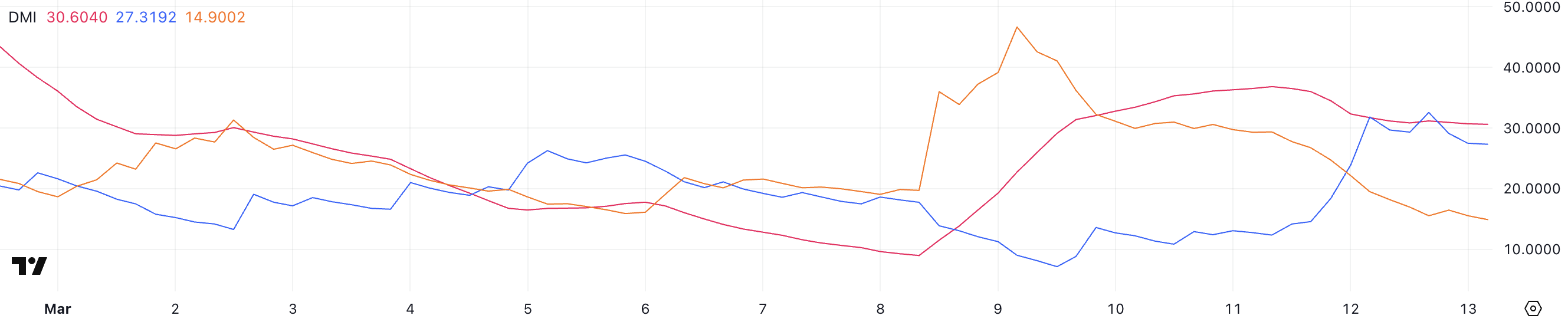
График DMI для PI. Источник: TradingView

Тем временем индекс относительной силы (RSI) резко поднялся до 60,90. Вчера и четыре дня назад показатель составлял 34,8 и 19,5 соответственно. При этом значения выше 30 сигнализируют о том, что криптовалюта входит в зону перекупленности.

Такая динамика RSI указывает на резкое изменение импульса — контроль снова перешел в руки покупателей. Если показатель продолжит расти и превысит порог в 70, то это станет либо сигналом о сильном бычьем импульсе, либо о начале краткосрочной коррекции.
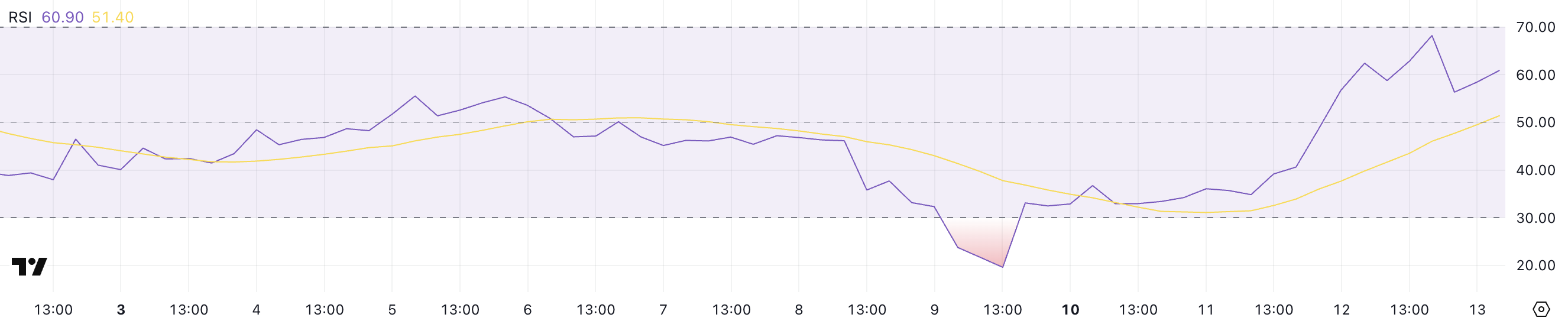
График RSI для PI. Источник: TradingView

Прогноз PI: падение может углубиться

На момент написания этого анализа PI торгуется по $1,55. За последние 24 часа токен подешевел на 10%.

В настоящее время альткоин преимущественно движется между поддержкой на уровне $1,57 и сопротивлением на $1,82.

Если тренд развернется в бычью сторону, тогда криптовалюта получит шанс пробить верхнюю границу канала и нацелиться на $1,98. Прорыв выше этой отметки может стать началом более сильного ралли, в рамках которого цена сможет достичь уровня $2,35.

Для реализации этого сценария потребуется устойчивая активность покупателей и уверенный прорыв уровня $1,82.
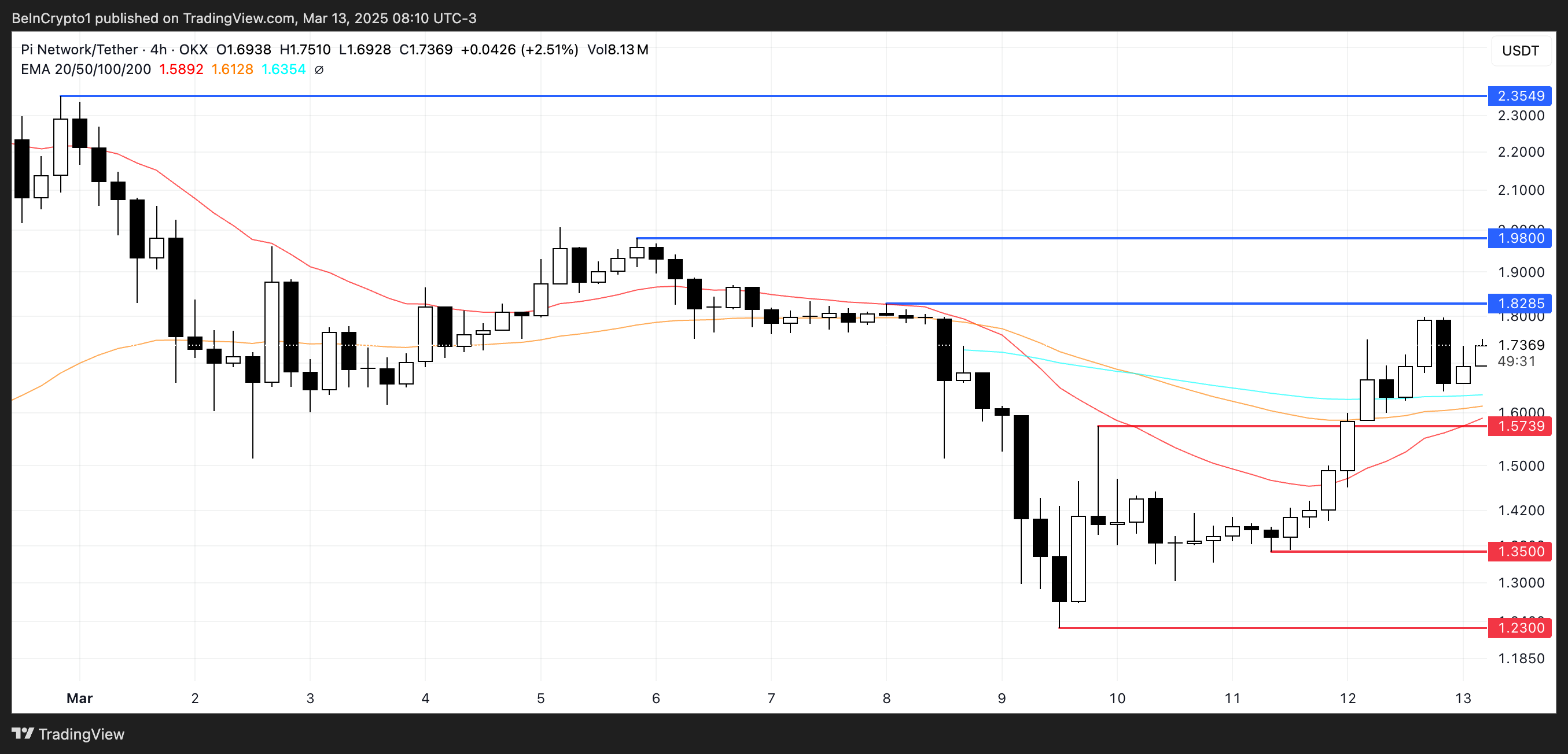
Анализ цены PI. Источник: TradingView

Однако если PI пробьет нижнюю границу диапазона, то бычий тренд ослабнет. В таком случае токен может протестировать более низкие уровни — $1,35 и $1,23.

Если альткоин не сумеет отвоевать поддержку на уровне $1,57, то ему будет грозить более длительная фаза коррекции.


Letture associate

From Auto Finance to Bitcoin to AI Engines: An Analysis of Cango's 'What Not to Do' Strategy

From Auto Finance to Bitcoin and Now AI: Cango's "What Not to Do" Strategy Cango, a Chinese auto finance platform that went public on the NYSE in 2018, is undergoing its third major transformation. After selling its entire auto business in 2024, it pivoted to become a large-scale Bitcoin miner, acquiring 50 exahash of mining rigs from Bitmain. However, its true goal was never Bitcoin, but owning and controlling energy infrastructure. Now, Cango is pivoting again. While most listed Bitcoin miners are leasing power to giant hyperscalers for AI training clusters, Cango is taking the opposite path. It has launched an AI inference subsidiary called EcoHash, focusing not on training but on distributed inference. The company's strategy hinges on the insight that over 70% of mining industry power is controlled by small, independent sites (10-50 MW), which are too small for hyperscalers but ideal for low-latency AI inference. Cango aims to partner with these small operators, providing the AI technology, customers, and financing through its EcoLink software layer, which can distribute workloads across sites for reliability. Cango maintains a hybrid model, running roughly 31.7 EH/s of Bitcoin mining for cash flow while aggressively cleaning its balance sheet—slashing long-term debt by 94.5% to $30.6 million and raising $75 million for its AI venture. Its first AI deployment will be at a 50 MW site in Georgia. The strategy faces skepticism, given the high costs of converting mining sites and the potential for an AI bubble. However, Cango's leadership believes discipline around "what not to do"—avoiding direct competition with hyperscalers in training—positions it to capture the long-tail demand for distributed AI inference power.

Foresight News11 min fa

From Auto Finance to Bitcoin to AI Engines: An Analysis of Cango's 'What Not to Do' Strategy

Foresight News11 min fa

Strategy's Bitcoin Sales Cap Far Exceeds $1.25 Billion: A Detail the Market Overlooked

The article discusses how MicroStrategy's potential Bitcoin sales go far beyond the announced $1.25 billion "reserve-building capacity." It clarifies a key distinction in the company's "BTC Monetization Program": selling Bitcoin to *build* a new dollar reserve (the $1.25B cap) versus selling to *replenish* the existing USD Reserve after it's used for expenses like preferred share dividends. The recent $216M BTC sale for dividend payments was a "replenishment," leaving the headline $1.25B building quota untouched. The plan actually outlines three potential funding pools from BTC sales: 1) Building the reserve ($1.25B cap), 2) Covering preferred share/ debt costs (no specified cap), and 3) Funding buyback programs (up to $20B). This means the structured sales potential exceeds $30 billion, not including uncapped replenishment sales. The piece argues this marks MicroStrategy's shift from a passive "buy-and-hold" Bitcoin proxy to an actively managed entity using BTC as a balance-sheet tool to manage its complex capital structure (common stock, preferred shares, debt, reserve). This creates new dynamics and potential conflicts, as actions benefiting one part (e.g., selling BTC to pay dividends) may pressure another (e.g., undermining the "never sell" narrative). Investors must now parse the company's specific terminology ("build" vs. "replenish") to understand the true scope of future BTC sales, which is significantly larger than the market initially perceived.

marsbit17 min fa

Strategy's Bitcoin Sales Cap Far Exceeds $1.25 Billion: A Detail the Market Overlooked

marsbit17 min fa

Goldman Sachs Report Deconstructs the Competitive Landscape of China's AI Large Models: Who Will Be the Long-Term Winner?

Goldman Sachs analyzes China's AI large language model (LLM) landscape, identifying key players and a strategic shift towards efficiency and global expansion. The report highlights that Chinese open-source/open-weight models are closing the performance gap with top global proprietary models at significantly lower cost, driven by architectural innovations like MoE. This enables a "two-tier" market: a high-end segment (e.g., GLM5.2, Qwen3.7 Max) with pricing at ~$1 per million tokens, and a low-end, price-sensitive global segment. Open-source strategies aid adoption but limit monetization, as deployments via third-party platforms (e.g., AWS Bedrock, Alibaba Cloud) may not generate direct revenue for model creators. The industry is thus moving towards "open-weight + community license" models with revenue-sharing to improve unit economics. Internationally, the focus is shifting from "token maximization" to ROI-driven enterprise adoption, particularly in non-U.S. markets. Major cloud platforms are integrating Chinese models (e.g., DeepSeek, MiniMax). Using a competitive framework based on pricing power, cost advantage, and financial strength, Goldman Sachs identifies **Zhipu AI** and **DeepSeek** as leaders in foundational text models, and **ByteDance** (with Seedance) leading in multimodal/video generation. **MiniMax** and **Kuaishou** are also rated favorably. The firm forecasts China's AI model API/subscription revenue growing from ~RMB 35bn (2026E) to RMB 879bn by 2030.

marsbit18 min fa

Goldman Sachs Report Deconstructs the Competitive Landscape of China's AI Large Models: Who Will Be the Long-Term Winner?

marsbit18 min fa

Trading

Spot
活动图片