P小将必学:如何通过GMGN查看钱包类型

Odaily星球日报Pubblicato 2025-03-14Pubblicato ultima volta 2025-03-14

Introduzione

使用GMGN分析钱包地址的高胜率交易风格与盈利能力。

原文作者:Hovz.(X:@hunggudng193260

我今天分享的内容是使用 GMGN 查看钱包类型,偏干货,可以收藏后慢慢食用。

该文章以 $WOLLY 为例子,以第一视角查看并分析钱包类型。

地址 1 :F319A69huqLXDZFSo84wSwkE3p3vcfgYiHTjd4tZtpX

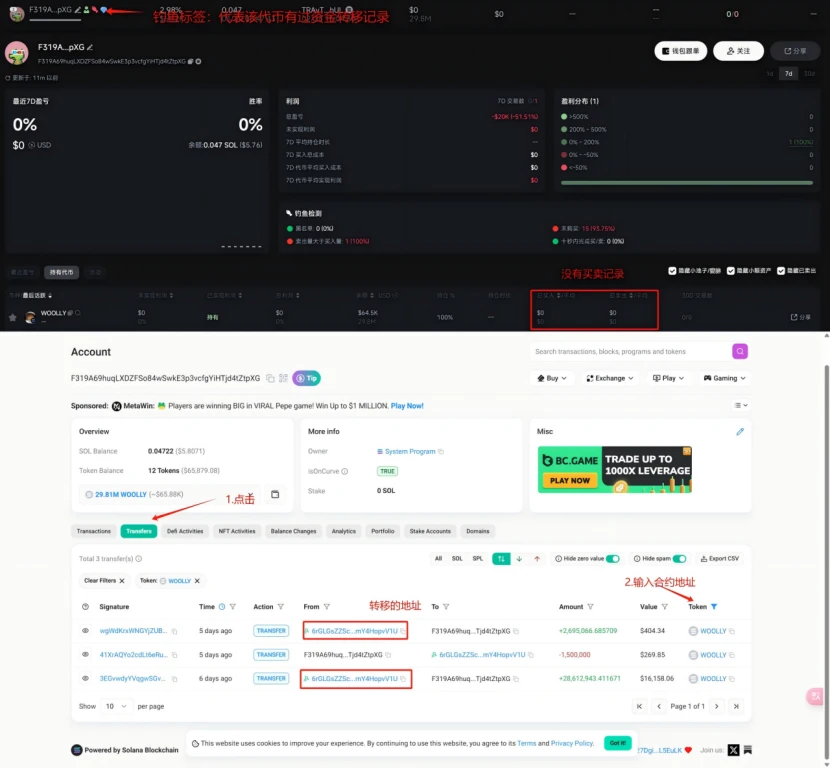
特征:这类地址在 top 10-20 之内,且有代币资金转移特征(小鱼图标),可以通过 Solscan 查到源头地址。如图按照我的顺序去查看后,就能查询到是从地址 6rGLGsZZSceZ9C7jbjfqDzm2jCsraSqtPUmY4HopvV1U 转移过来的。像这样的地址,极大概率是筹码地址,值得记录筹码,不值得作为聪明钱包追踪。

总结:

1. 存在代币转移特征 

2. TOP 持有者 

3. 庄地址但不适合收藏
P小将必学:如何通过GMGN查看钱包类型

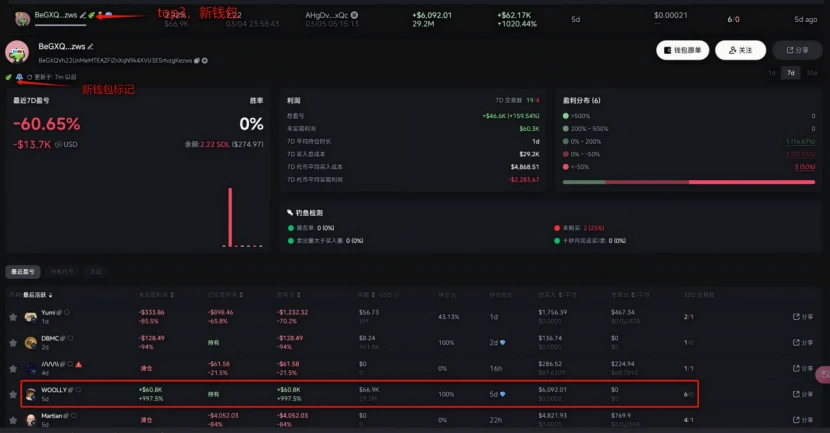
地址 2 :BeGXQVh22UnMeMTEAZFiZnXqN9k4XVU3ESrtvzgKezws

特征:

这类地址的特征很明显,是新钱包。然后他又在 TOP 10 之内,且只买不卖,那么可以定义为庄的筹码钱包,这样的钱包你找到多个之后对比就会知道庄家的持仓成本大概在哪里,这个钱包显示在代币市值只有 200 K 的时候大概在附近购买,那么它的底筹也差不多集中在这里。

总结:

1. 新钱包 

2. top 持有者 

3. 庄的底筹钱包且不适合收藏

同类:F4wMDP2HRumTLuUHHUTWZnGBj7MxkRezdJp3it4vcKwn C2FZxNGToRkspnrrGd2WDQBMo2p1571Agyg3xv9Dpu3t
P小将必学:如何通过GMGN查看钱包类型

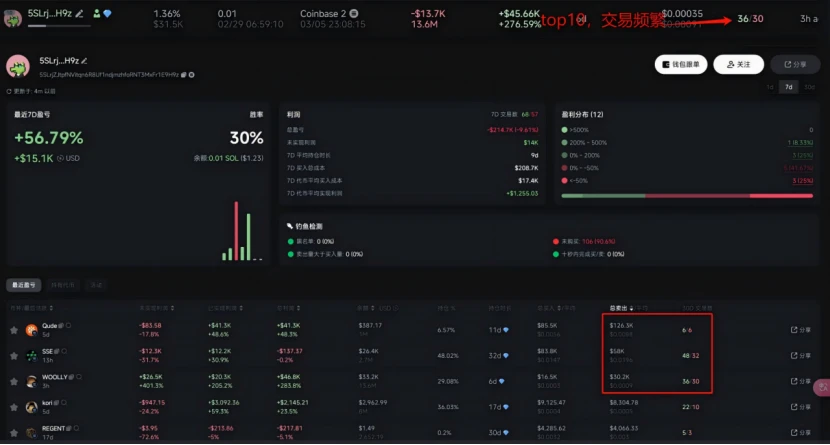
地址 3 :5SLrjZJtpfNVitqn6R8Uf1ndjmzhfoRNT3MxFr1E9H9z

特征:这类地址是很典型的操盘地址,极少部分的代币购买次数居多,且资金量大,用于控制 K 线。并且这个地址不仅在 $woolly 代币操盘,也在 $sse 操盘,这并不稀奇。它们可能是项目方请的 MM(做市商),这时候要看资金来源地址判断。

这里比较容易混淆的是操盘地址与大户波段地址,这里我对比举例一下 大户波段地址:

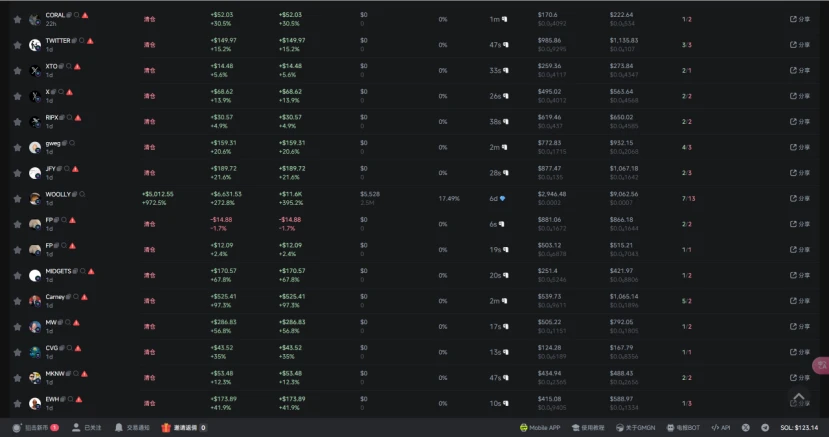
7iabBMwmSvS4CFPcjW2XYZY53bUCHzXjCFEFhxeYP4CY见图 4 ,首先这个钱包的地址频繁去交易内盘,首先定义为是一名内盘选手,其次它能购买并波段 $woolly 可能是受到朋友的 call,因为按照它交易的尿性是不太可能去大仓位购买一个代币的。

总结:

1. 资金聚焦于交易某个代币且其他代币购买很少,用于迷惑链上钱包捕捉者 

2. top 持有者 

3. 操盘钱包,看情况收藏
P小将必学:如何通过GMGN查看钱包类型

P小将必学:如何通过GMGN查看钱包类型

那到底什么地址值得关注呢?

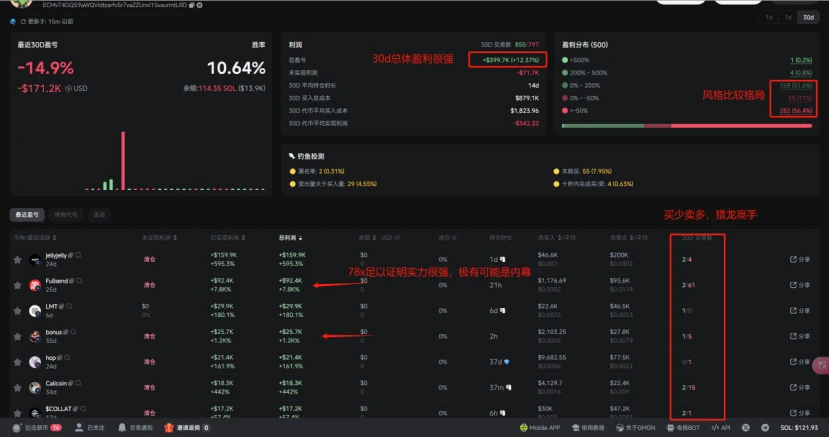
这里有个我从 $elvis 里捕获过的地址ECMvT4GQ59aWQVidtzarfvSr7vaZZUnvi1SvaurmtLRD

特征:

这个地址有特别多的高赔率,高盈利代币,$fullsend 能获利 78x 就不是简单人,加之别的代币也有不错的获利。再谈谈交易风格,这个地址的交易风格比较格局,浮亏 50% 以上的代币居多,并且出手特别少,交易一个代币要么拿到高赔率,要么格局到零。这样独具特色的地址可以标记起来,极其适合收藏和跟踪的。

总结:

1. 有多个高胜率代币 

2. 有独特交易风格 

3. 交易资金大

类似的地址还有: 215nhcAHjQQGgwpQSJQ7zR26etbjjtVdW74NLzwEgQjP 3KNCdquQuPBq6ZWChRJr8jGpkoyZ5LurLCt6sNJJMxbq
P小将必学:如何通过GMGN查看钱包类型

方法交给你们,剩下的就是认真去领悟了。

原文链接

Letture associate

Doubao and Qwen Will Discontinue Agent Functionality on July 15

On July 4th, Doubao and Tongyi Qianwen announced the impending shutdown of their user-created "AI Agent" features. Doubao confirmed its agent feature will be taken offline on July 15, directing users to ByteDance's CatBox app for similar needs. On the same day, Tongyi Qianwen notified users, specifying that personalized interactive agents and user-built agent functions will cease on July 10, with all agent features and services completely deactivated by July 15. After this date, access to agent configurations and historical chat records will be lost. This adjustment impacts core user scenarios like role-playing, personal assistants, and vertical tool agents. The shutdown date coincides with the official implementation of China's "Interim Measures for the Administration of Artificial Intelligence Human-like Interactive Services" on July 15. The new regulations impose strict rules on "human-like emotional interaction services," requiring platforms to implement measures like anti-addiction systems, minor verification, and content moderation. This move is widely seen as a proactive step by the platforms to align with regulatory timelines and mitigate compliance risks. Additionally, commercial challenges are a key driver. Analysis suggests that casual, human-like chat agents generate high-frequency, low-value interactions, leading to high computational costs with poor monetization. As the AI application market shifts from user growth to proving value, sustaining such "high-cost, low-efficiency" user-generated content becomes difficult. Both platforms have outlined transition plans. Doubao will allow data viewing and self-backup for a period after shutdown, with data scheduled for permanent deletion by October 15. Tongyi Qianwen similarly advised users to save important content via copying or screenshots before the deadline. This strategic retreat from C-end agent features signals a broader market shift. Compliance capability and sustainable business models are replacing user scale and feature richness as the new core competitive dimensions. Tongyi Qianwen's recent move to fully open its Agent and Skill platforms to third-party enterprises and developers further underscores a strategic pivot from low-value C-end services to high-value B-end enterprise scenarios.

marsbit1 h fa

Doubao and Qwen Will Discontinue Agent Functionality on July 15

marsbit1 h fa

Why Did Codex and ChatGPT Merge? What's Next for Codex? OpenAI Core Leader Answers Everything

In 2026, OpenAI's Codex saw explosive growth, with weekly active users surging over 5x to 5 million since January, driven largely by the February launch of its desktop app. Codex desktop lead Andrew Ambrosino explains key shifts behind its evolution. A core change is the inversion of development costs: implementation is now cheap, while curation and taste—judging which of many AI-generated prototypes is valuable—have become the new scarcities. Ambrosino defines taste as a blend of aesthetics, systems thinking, direction, and semantic coherence in interaction. He notes AI still struggles with design because evaluating it requires human cultural context and abstract reasoning about how components relate—capabilities beyond current models. Timing is critical: the same Codex app would have failed months earlier; success hinges on the model's capabilities at launch. Roles are blurring within his team, with engineers, designers, and PMs overlapping significantly. However, Ambrosino cautions against eliminating specialized roles entirely, as each field retains deep expertise. On AI-assisted development, the focus has shifted from measuring code written by AI to distinguishing between supervised and unsupervised generation. A current challenge is teaching models to simplify code, not just add complexity. The merger of Codex and ChatGPT stems from observed user behavior: non-developers adopted Codex for general knowledge work despite its developer-centric interface. This revealed a collapsing boundary between specialized tools and universal assistants. The vision is a "home base" that orchestrates tasks across external professional tools (like Excel or Premiere Pro) via connectors, rather than rebuilding everything internally. An internal example showed Codex helping edit video by interacting with Premiere Pro's files and even writing a plugin for it. The future direction is a unified, extensible platform that serves as a central hub for automating and managing work across any specialized tool the user employs.

marsbit2 h fa

Why Did Codex and ChatGPT Merge? What's Next for Codex? OpenAI Core Leader Answers Everything

marsbit2 h fa

Trading

Spot
活动图片