Falling Tides

insights.glassnodePubblicato 2025-02-18Pubblicato ultima volta 2025-02-26

Executive Summary

  • After Bitcoin’s second attempt to break above $105k in late January, the market has entered a contraction phase, with monthly price momentum sharply declining across major assets.
  • Bitcoin has held relatively steady, while Ethereum, Solana, and Memecoins have faced much deeper corrections, reflecting a shifting appetite for risk.
  • Solana has emerged as a market leader in capital inflows over the past two years, in contrast to Ethereum, which has comparatively struggled to attract sustained demand.
  • However, this week, all digital assets aside from Bitcoin have seen a dramatic decline in capital flows, with Solana, and its associated memecoin ecosystem taking a relatively large hit.
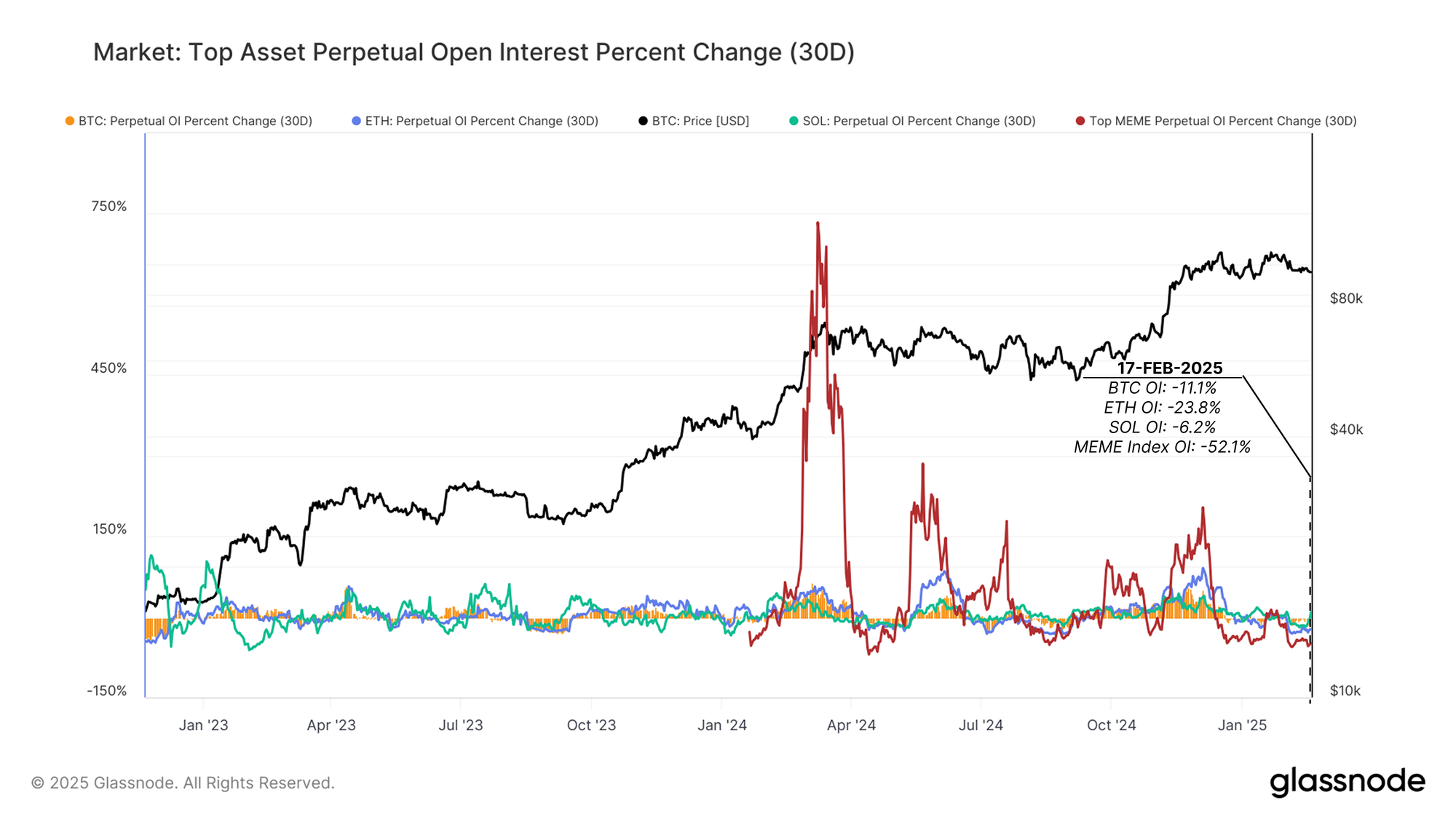
  • Perpetual futures open interest has declined across Bitcoin (-11.1%), Ethereum (-23.8%), Solana (-6.2%), and Memecoins Index (-52.1%), reflecting a diminished appetite for leveraged speculation.
💡
View all charts in this edition in The Week On-chain Dashboard.

Market Momentum Takes a Breather

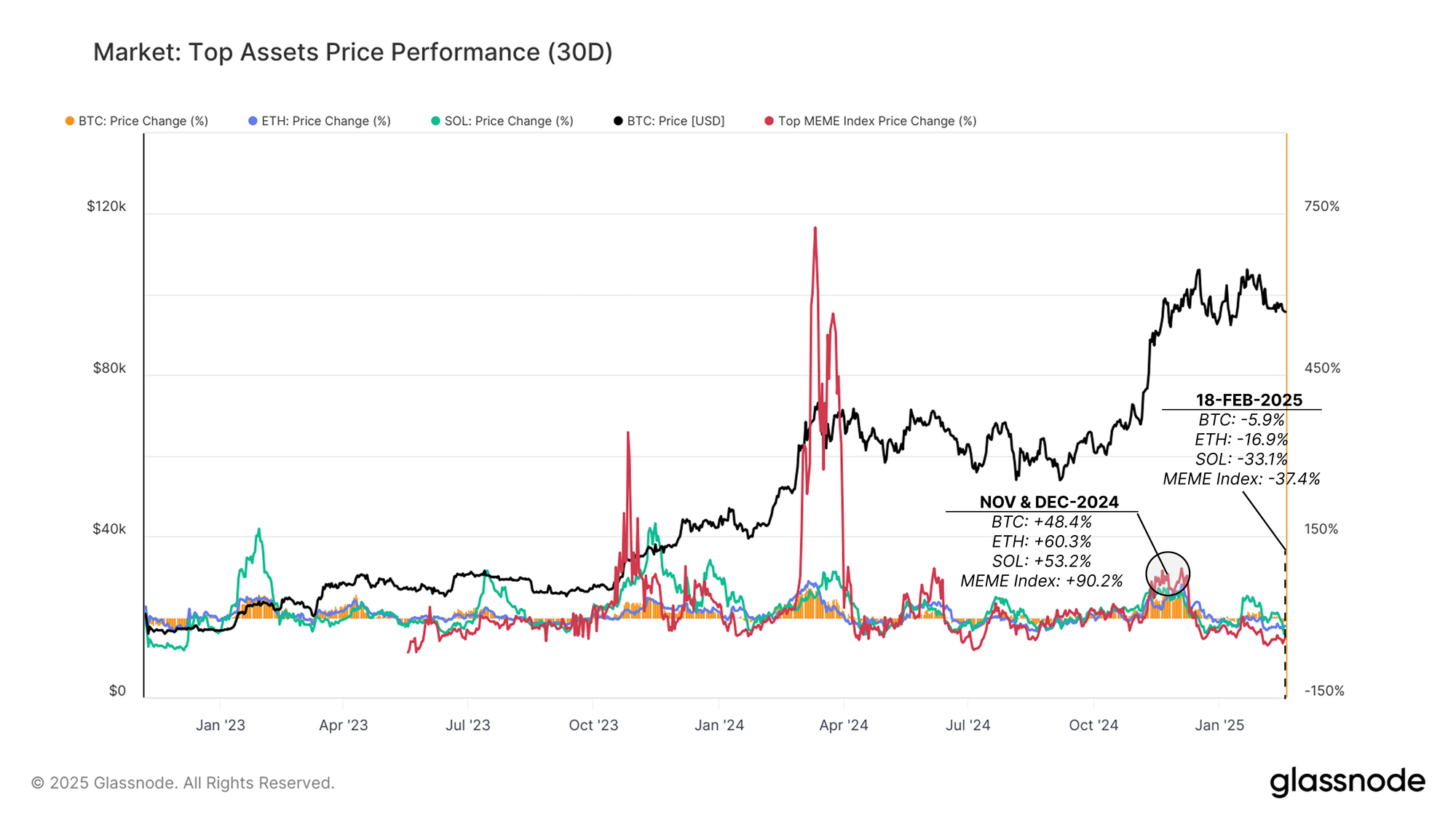
The Bitcoin market attempted to rally above the ATH, and back into price discovery in late January 2025. This rally, however, could not achieve the necessary momentum, and the market has entered into a period of contraction and consolidation since then, with price momentum sharply declining across major assets.

  • Bitcoin: +48.4% (Nov 2024) → -5.9% (Feb 2025)
  • Ethereum: +60.3% (Dec 2024) → -16.9% (Feb 2025)
  • Solana: +53.2% (Nov 2024) → -33.1% (Feb 2025)
  • Meme Coins Index: +90.2% (Dec 2024) → -37.4% (Feb 2025)

Notably, Memecoins and Solana have thrived during strongly trending market conditions but also tend to correct sharply during downturns. Ethereum has remained one of the weakest performers throughout this cycle, and whilst it has outperformed Solana this week, a robust trend of out-performance has not yet been established.
Live Chart

Assessing Performance So Far

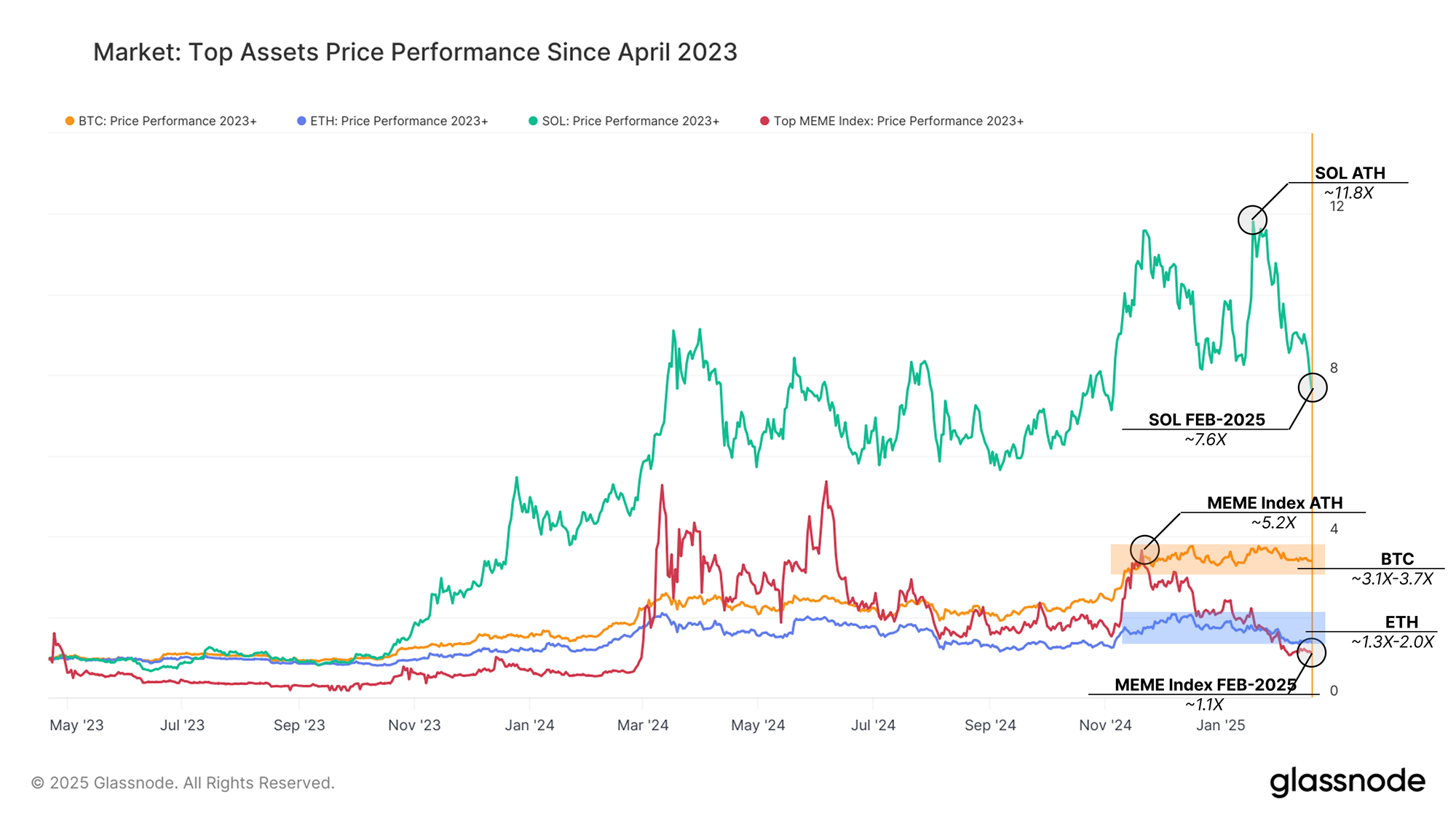
The recent slowdown comes after an extended period of strong gains across the major digital assets. Looking at the performance since early 2023, we can see clear differentiation in how each asset has navigated the cycle so far:

  • Bitcoin is trading within a range approximately 3.4x higher than April 2023, providing a benchmark return profile.
  • Ethereum has struggled compared to its peers, ranging between 1.3X and 2.0X relative to April 2023.
  • Solana's returns since 2023 peaked at 11.8x in early January 2025, but have since dropped sharply to around 7.6x as the current correction took hold.
  • Memecoins Index: Saw an explosive uptick in prices in mid-2024, largely aligned with Solana’s out-performance, and peaking 5.2X since 2023. However, recent weeks have seen this sector get hit quite severely, with total performance now being the worst out of the four assets.

This provides a view of Solana’s high-beta nature, where it has experienced both the strongest upside and also the sharpest corrections. Bitcoin’s steadier trajectory highlights its resilience as a benchmark return profile for the digital asset space. Memecoins, in particular, have seen a marked decline in investor demand of late, suggesting there has been a change in risk appetite.
Live Chart

Capital Flows Drive Markets

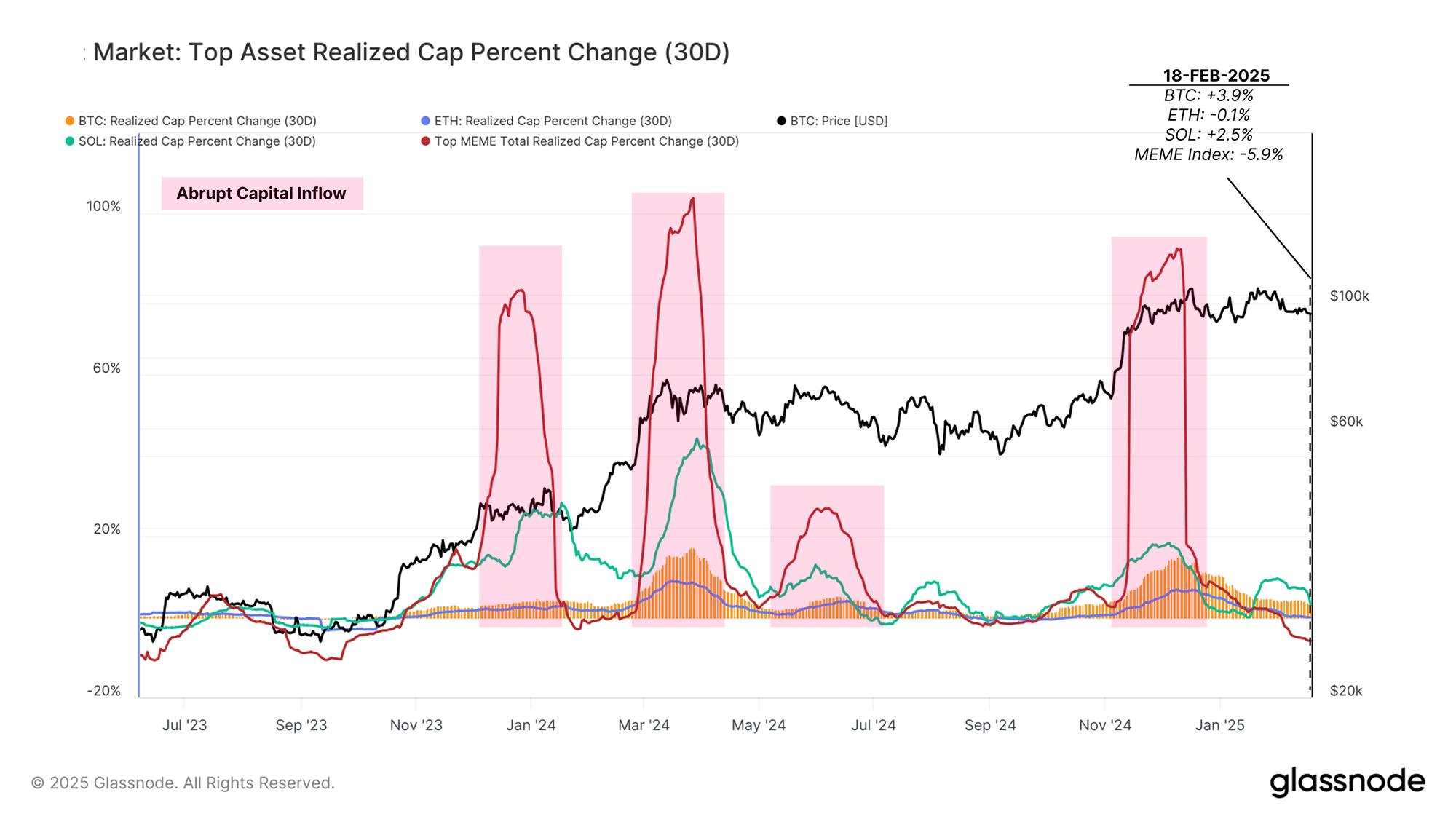
The strong out-performance of Solana over the last two years aligns with a persistent capital inflow from investor demand. Looking at the monthly change in the realized cap, we can see clear patterns in capital movement across various digital assets:

  • Solana: Has consistently attracted higher relative capital inflows, supporting its strong price appreciation.
  • Ethereum: Has seen the weakest capital net inflow out of the majors, explaining its relative underperformance.
  • Memecoins: Experienced several abrupt but unsustainable surges in capital inflow, reflecting speculative bursts, but without sustained momentum.

However, in recent weeks, the momentum of capital inflows has declined for all digital assets. Notably, Ethereum and Top Memecoins have now flipped negative (capital outflows), with Ethereum facing a -0.1% net outflow from the Realized Cap and Memecoins Index seeing an even sharper -5.9% outflow.

This signals a meaningful cooling down in speculative appetite and alludes to a potential for capital rotation out of riskier assets on the road ahead.
Live Chart

Weakness In Futures Markets

As momentum starts to fade in spot markets, we can also see a decline in capital inflows within the perpetual futures market. The cooling of demand on the spot side has led to a sharp drop in perpetual open interest (OI) across all major assets, signalling a reduction in speculative activity and lower cash and carry yields.

Over the last 30 days, the rate of change in open interest highlights a widespread retreat of capital:

  • Bitcoin OI: -11.1%
  • Ethereum OI: -23.8%
  • Solana OI: -6.2%
  • Memecoins OI: -52.1%

This trend of declining open interest across the board suggests that speculators are reducing their leveraged exposure, likely in response to weaker market momentum and increasing market uncertainty. The most extreme decline is seen in Memecoins, which tend to attract more short-term leveraged bets but lose traction quickly whenever sentiment weakens.
Live Chart

Funding Rates Signal Bearish Sentiment

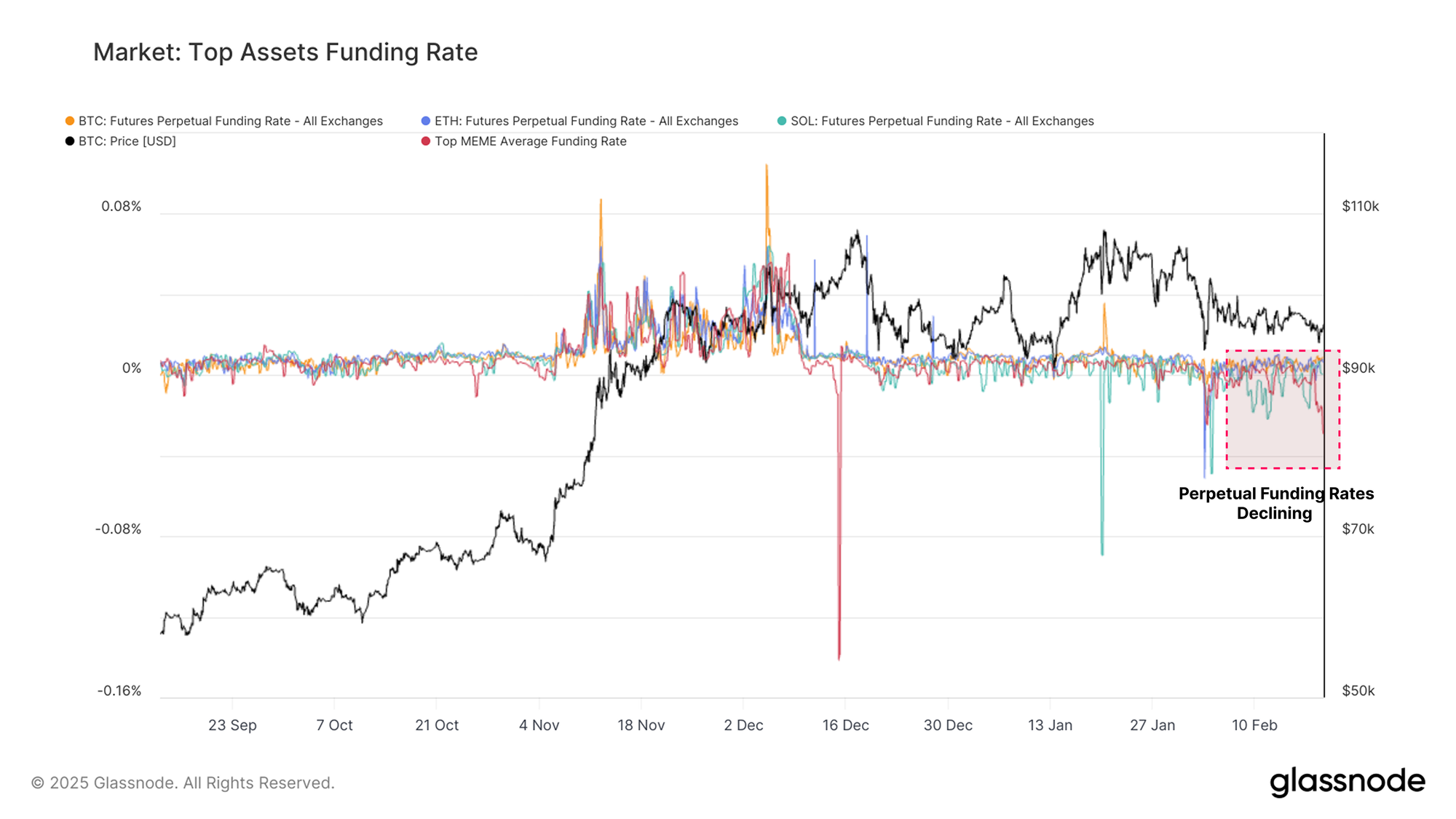
The weakening in open interest is further reinforced by a decline in perpetual futures funding rates. This reflects a shift toward more bearish sentiment and an unwinding of leveraged positions, particularly in riskier assets.

  • Bitcoin and Ethereum funding rates remain slightly positive, and their deeper liquidity profile tends to see positive funding rates except during sharp leverage wash-out events.
  • Solana funding rate have edged lower and have traded negative in recent weeks, signalling a cooling off of demand for long speculative positions.
  • Memecoins have seen funding rates turn very negative, indicating that shorts now dominate in these highly speculative assets, and many traders are closing their positions (or being liquidated).

Negative funding rates for Solana and Memecoins suggest a net shift towards bearish sentiment in higher-risk assets and a closing out of excessive long-sided leverage.
Live Chart

ETF Flows and Market Impact

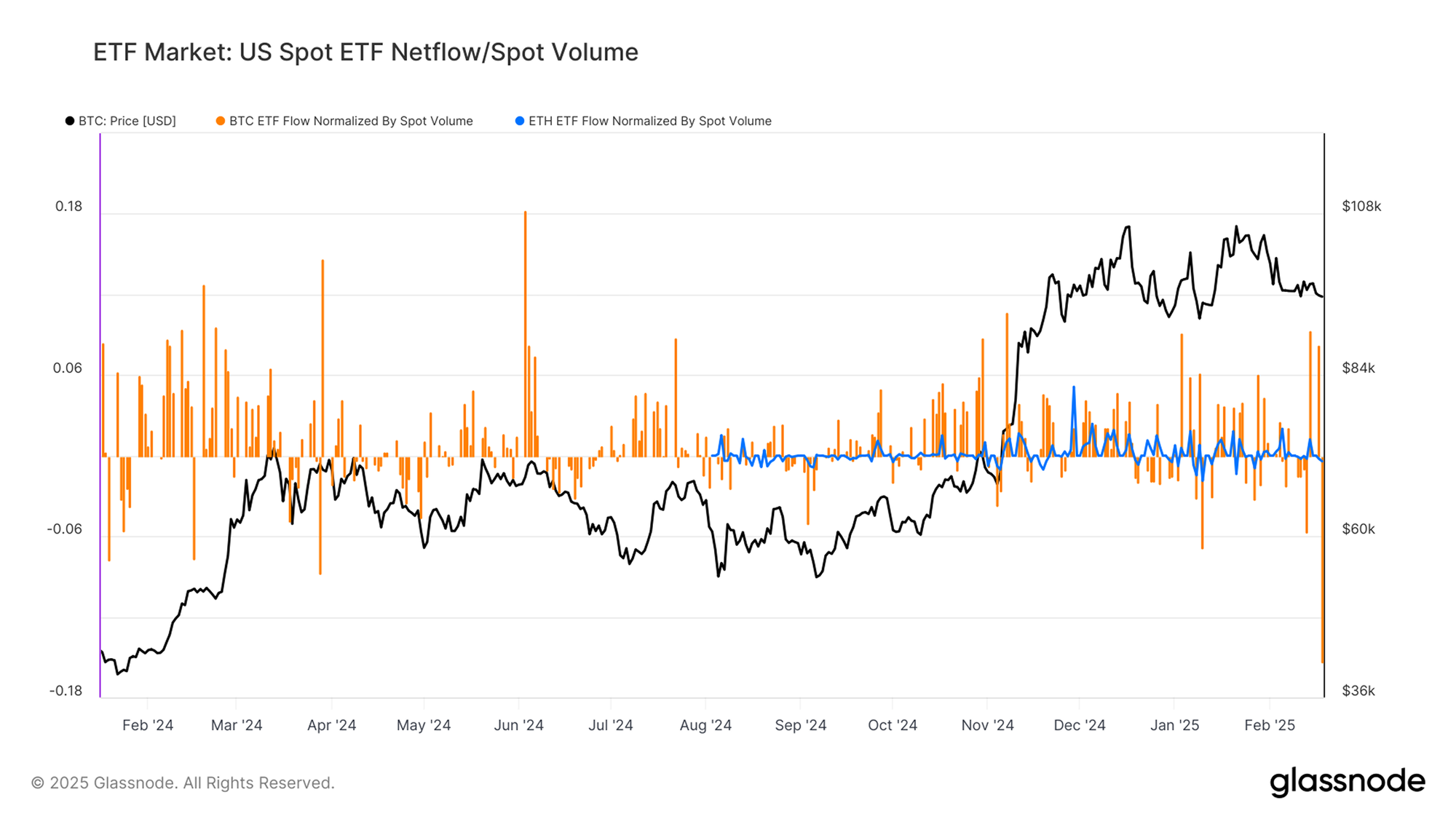
With the market in a contraction phase, institutional interest in Bitcoin and Ethereum has slowed based on spot ETF flows. By normalizing net inflows against each asset’s native spot volume, we can gauge the weight and influence of the ETFs on market dynamics.

  • Bitcoin ETFs saw several outflows exceeding $200M/day last week, however this was followed by a strong rebound in buy-side activity, exceeding 8% of global spot volume, and highlighting institutional demand (akin to ‘buy the dip’ behavior).
  • Ethereum ETF demand has cooled significantly and remains much smaller in scale compared to Bitcoin. ETF activity for ETH is hovering close to zero in terms of net flows in and out, suggesting a lack of strong traditional investor demand and participation.

This divergence has been a theme of this market cycle thus far and reinforces Bitcoin’s dominant role within the institutional asset mix. Ethereum continues to struggle to attract large, sustained inflows, which further explains its relative underperformance in recent years.
Live Chart

A Key Bull-Bear Threshold

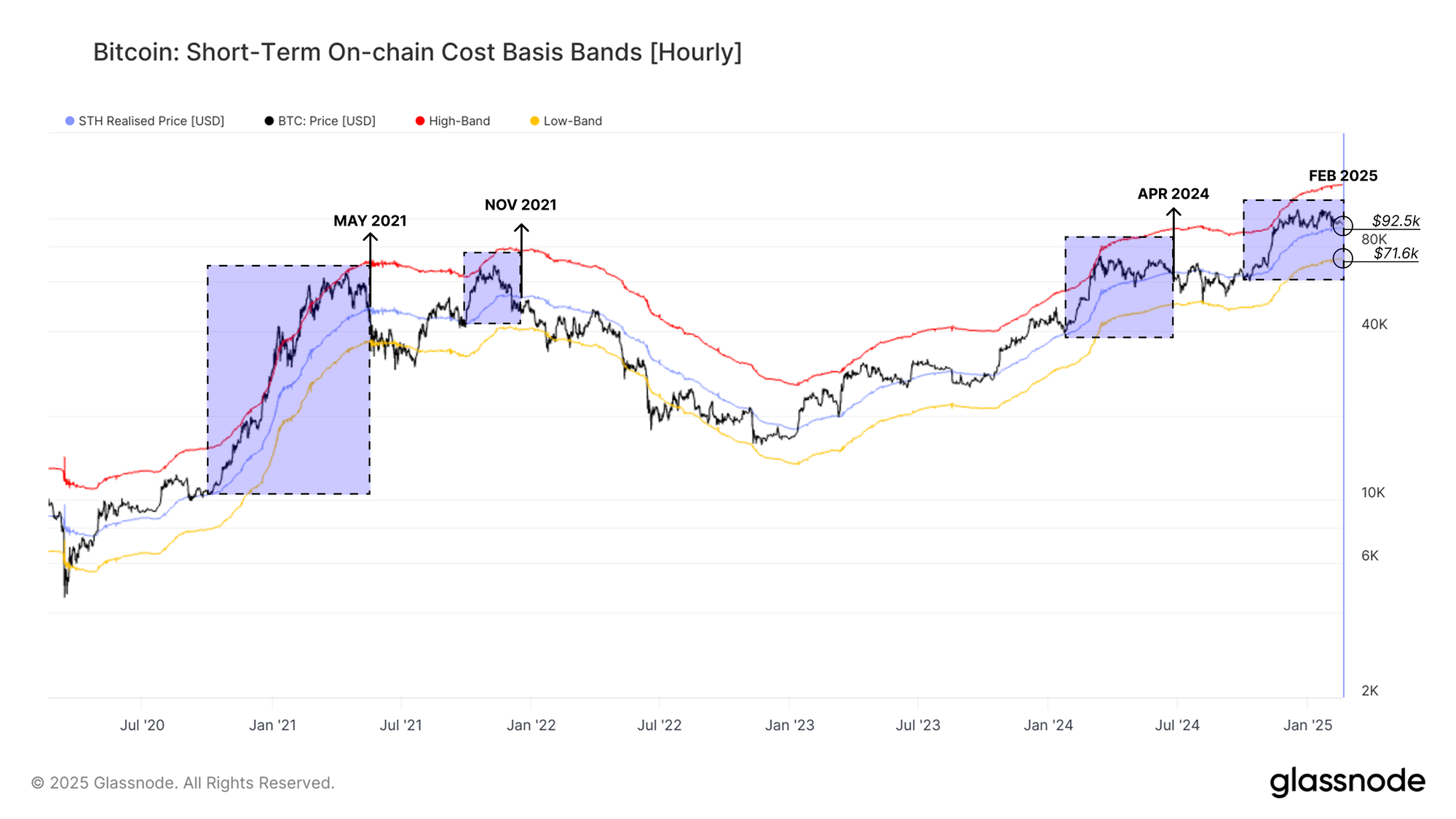
Bitcoin is currently trading $1k-$5k above the Short-Term Holder (STH) cost basis, located at $92.5k. Historically, this level has served as a key pivot point between local scale bull and bear phases, being the pivot point where the average recent buyer moves between a state of unrealized profit and loss.

Reviewing previous instances where Bitcoin reached a new ATH and then corrected lower, we can see a similar pattern in May 2021, Nov 2021, April 2024, and Feb 2024.

In each of these cases, the downtrend extended toward the lower band of the STH cost basis model, specifically -1 standard deviation (σ) below the cost basis. Currently, this lower band sits at $71.6K, helping frame up the potential downside risks should these historical patterns repeat.
Live Chart

Post ATH Consolidation

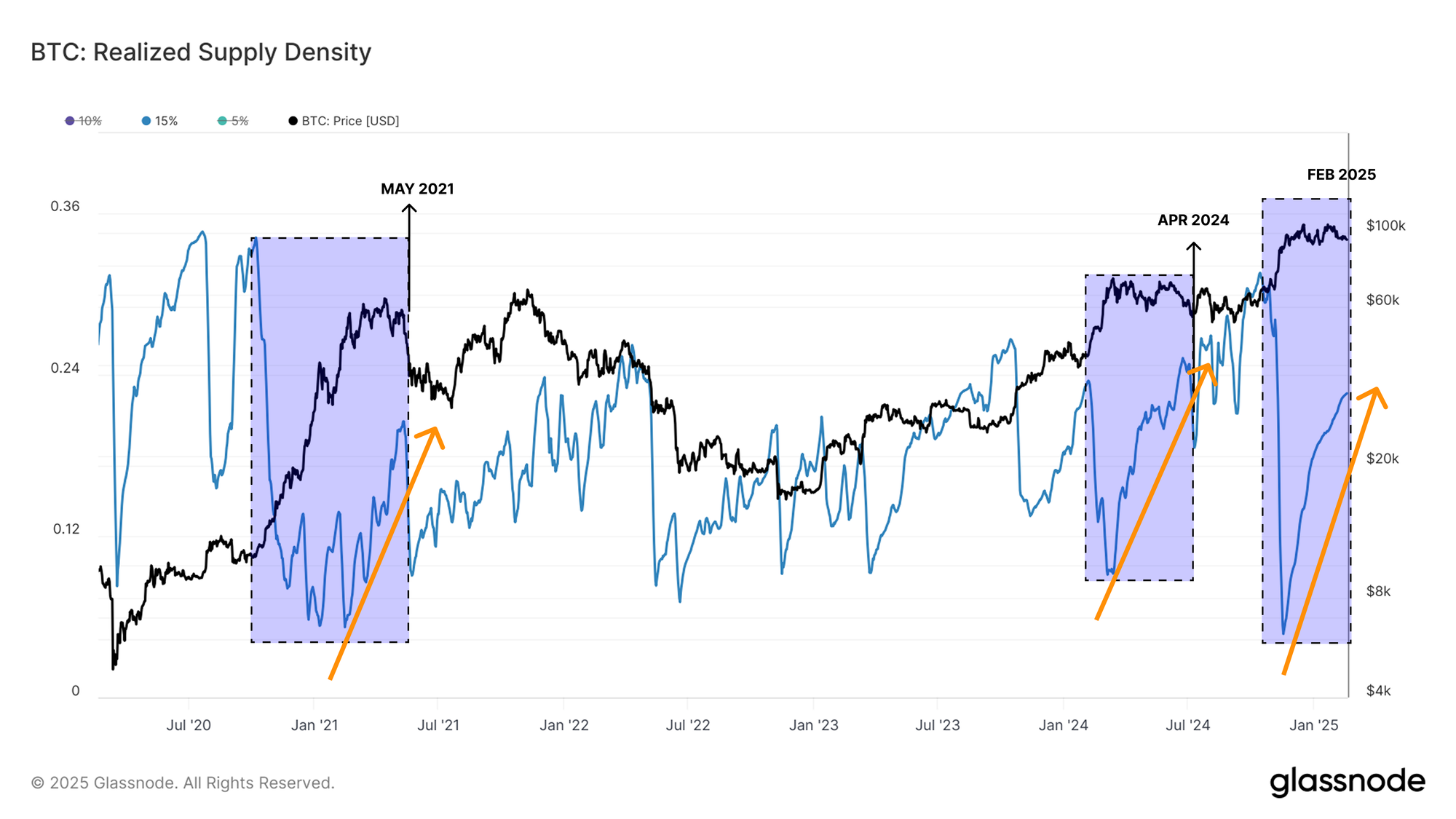
In prior instances where Bitcoin has reached a new ATH, we observe a consistent post-rally pattern, where a surge in realized supply density occurs within ±15% of the spot price. This results from the market transitioning from an aggressive uptrend into price consolidation, as the market trades within a relatively narrow range.

This behaviour is evident in previous cycle tops, where:

  • As the market rallies within price discovery, the realized supply density crashes lower all the way up to the price peak.
  • Market participants then begin redistributing coins as the market enters a correction or consolidation phase.
  • This often occurs close to the STH cost basis, as the conviction and demand profile of new investors is tested.

The current realized supply density aligns with a typical post-ATH consolidation phase, where buyers and sellers try to establish a new equilibrium before the next major trend unfolds.
Live Chart

Approaching a Decisive Market Moment

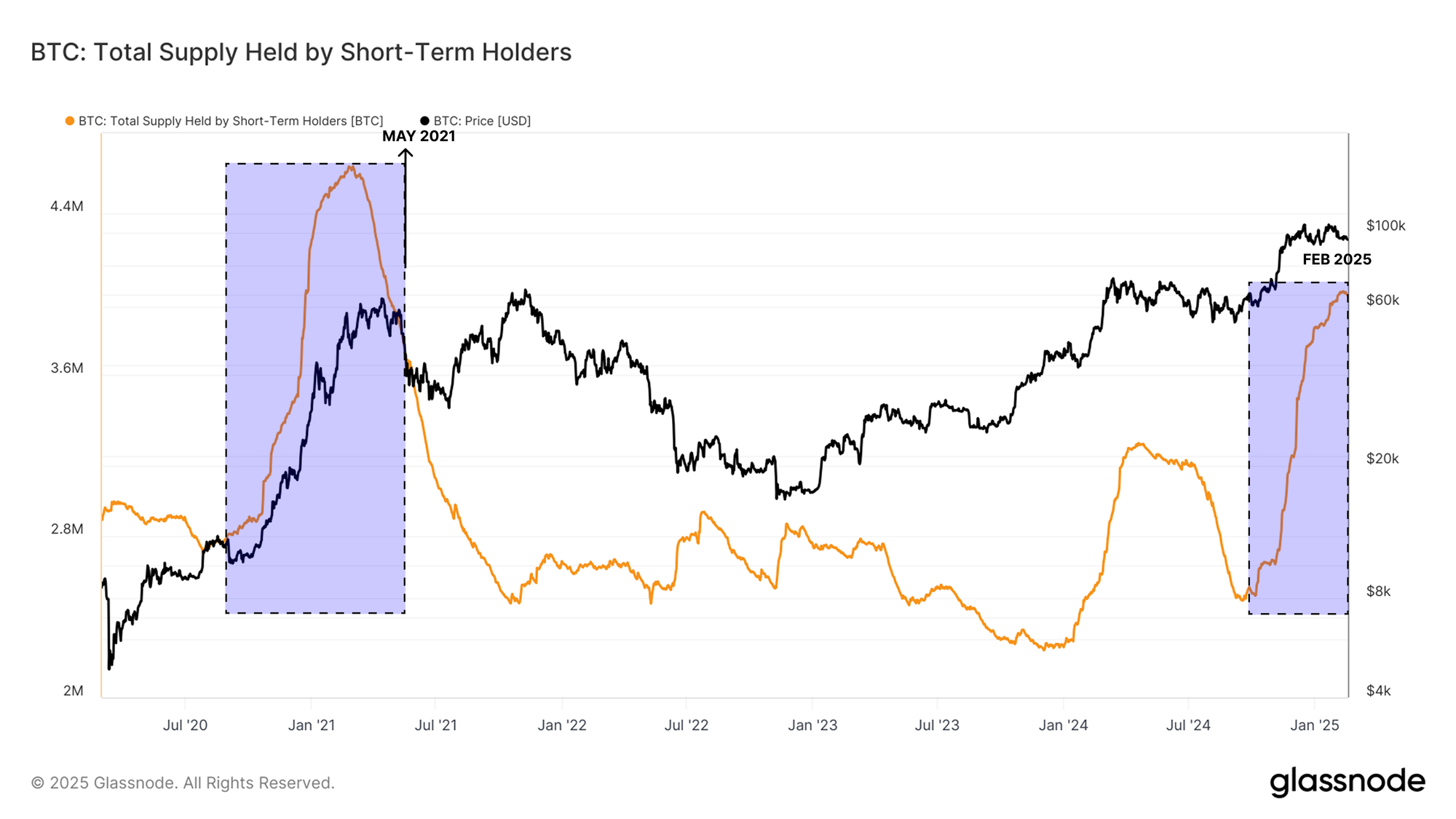
To better understand how sensitive the market is due to this supply density, we can analyze the supply held by short-term holders (STH) in recent post-ATH distribution phases. This helps gauge the patterns of new investor accumulation and whether current conditions resemble past cycle peaks.

When comparing STH supply changes, we observe:

  • The recent accumulation phase closely mirrors May 2021, suggesting a similarly large amount of supply, and investors will be sensitive to a price decline below $92.5k.
  • In April 2024, new investors also accumulated aggressively, but the magnitude of the STH supply uptrend in the current cycle structurally aligns more with May 2021 rather than 2024.

Given these similarities, we are now very close to a decisive moment in the market—a phase where price action is primed for uncoiling. If demand remains strong, Bitcoin could establish a new range above ATHs. However, a lack of sustained buy pressure could lead to a deeper distribution-driven correction, similar to prior post-ATH phases. This would likely be driven by panic amongst recent buyers who see their recently acquired coins move from being in profit to holding an unrealized loss.
Live Chart

Conclusion & Summary

Bitcoin has been consolidating around $95k for several weeks and is trading within a relatively stable range. The same cannot be said for the wider digital asset landscape, with Ethereum, Solana, and Memecoins all seeing significant drawdowns from their cyclical highs. In particular, Memecoins have seen a significant cool-off of demand, as evidenced by capital outflows, sharp price declines, and bearish sentiment in futures markets.

For Bitcoin, the key level to watch is the Short-Term Holder cost basis around $92.5k. This is a pivot point where a large proportion of recent buyers will see their holdings move into an unrealized loss. This could precipitate more downside as panic sets in. In either case, the current consolidation phase appears to be nearing its later stages, and the market looks ready to trend in one direction once again.


Disclaimer: This report does not provide any investment advice. All data is provided for information and educational purposes only. No investment decision shall be based on the information provided here and you are solely responsible for your own investment decisions.

Exchange balances presented are derived from Glassnode’s comprehensive database of address labels, which are amassed through both officially published exchange information and proprietary clustering algorithms. While we strive to ensure the utmost accuracy in representing exchange balances, it is important to note that these figures might not always encapsulate the entirety of an exchange’s reserves, particularly when exchanges refrain from disclosing their official addresses. We urge users to exercise caution and discretion when utilizing these metrics. Glassnode shall not be held responsible for any discrepancies or potential inaccuracies. Please read our Transparency Notice when using exchange data.


Letture associate

Google Cracks Down on 'AI Poisoning'

Google has taken a strong stance against "AI poisoning," a new form of manipulation where advertisers subtly feed information to influence AI-generated answers like those in Google's AI Overview. Unlike traditional SEO, which aims for higher website rankings, Generative Engine Optimization (GEO) seeks to have a brand or product recommended within the AI's response itself. This is particularly valuable as AI summaries, often perceived as neutral and comprehensive, can shorten the consumer decision path and directly influence purchases. The article illustrates the issue with a "hot dog experiment," where fabricated content was quickly picked up and presented as fact by AI. GEO exploitation is potent because AI models aggregate information from various sources—reviews, articles, forums—and can mistake coordinated marketing campaigns for genuine consensus. This threatens the core credibility of search engines. While Google's updated spam policy now explicitly covers attempts to manipulate AI-generated content, enforcement faces challenges. Google can leverage its long experience fighting SEO spam, using penalties like ranking demotion. However, sophisticated "gray area" tactics, such as sponsored third-party reviews or industry reports, are harder to distinguish from legitimate promotion. Other AI players, like Microsoft, have taken a more open approach to GEO, viewing it as a new channel for brands. Ultimately, as AI becomes a primary information source, maintaining the trustworthiness of its answers is a critical challenge for all platforms.

marsbit7 min fa

Google Cracks Down on 'AI Poisoning'

marsbit7 min fa

When Futu Turns into a Matchmaking Corner: Overseas Identity Becomes the Hard Currency for the Middle Class

When Futu Becomes a Matchmaking Corner: Overseas Status as the New Hard Currency for China's Middle Class Following a severe penalty announcement from Chinese regulators on May 22nd targeting offshore brokerages like Futu, its app community unexpectedly transformed into an impromptu matchmaking platform. Users posted相亲 (matchmaking) requests, explicitly seeking partners with overseas residency or citizenship, revealing a stark new reality: for China's middle class, an overseas identity has become a crucial asset. The regulatory crackdown, which restricts mainland Chinese residents from opening new accounts to buy overseas securities like US stocks, has sharply escalated the value of a foreign passport or permanent residency. This status now acts as a gateway to global asset allocation—including US equities, offshore property, and foreign currency deposits—effectively becoming a new form of "hard currency." Its scarcity, non-transferability (except through marriage, inheritance, etc.), and role as a hedge against domestic uncertainty have driven its premium. The article traces the evolution of how China's middle class views overseas resources: from an investment for opportunity (2000s), to risk diversification (2010s), and now to a mandatory "insurance policy" for financial access. With the regulatory window closing for many, the demand is shifting towards securing such status for the next generation through international education. The surreal scene of high-performing investors posting dating resumes underscores a 2026 where financial talent can be secondary to the right passport.

marsbit58 min fa

When Futu Turns into a Matchmaking Corner: Overseas Identity Becomes the Hard Currency for the Middle Class

marsbit58 min fa

Understanding Bound in One Article: The "Multi-signature + Timelock" Escape Mechanism and the Off-Chain Matching Black Box

**Title**: Understanding Bound: The Escape Mechanism of "Multi-Sig + Time Lock" and the Off-Chain Matching Black Box **Summary**: Bound Exchange, evolved from the earlier radFi platform, introduces a novel approach to Bitcoin trading by combining self-custody security with exchange-like speed. Its core mechanism relies on a 2-of-2 multi-signature (multi-sig) address for user deposits. One private key is held by the user via a passkey, and the other is held by Bound. This setup requires both keys to sign any transaction, preventing Bound from unilaterally accessing user funds (non-custodial). To address the risk of Bound becoming unavailable, a 3-month timelock is integrated into the Bitcoin script. After this period, users can withdraw their assets with just their single signature, ensuring an escape hatch. For trading, Bound operates a concentrated liquidity AMM. However, as Bitcoin L1 lacks smart contracts, the AMM curve, liquidity management, and trade price calculations occur off-chain in Bound's backend database. On-chain Bitcoin transactions serve only as final settlement receipts for pre-determined amounts. This creates a centralization point: the critical sequence of trade execution—which determines the exact price along the curve for each order—is managed off-chain by Bound in a non-transparent "black box." While the 2-of-2 setup protects user本金 (principal), the pricing and ordering of trades introduce potential operational MEV risks, as the order processing is invisible and unverifiable on-chain. In practice, users can also connect external wallets (like Unisat) for fully self-custodied trading, but this requires manually signing every transaction. The platform currently supports deposits of BTC and Runes only.

marsbit1 h fa

Understanding Bound in One Article: The "Multi-signature + Timelock" Escape Mechanism and the Off-Chain Matching Black Box

marsbit1 h fa

Technology Has No Barriers, 24/7 Trading is the Key to Hyperliquid's Success

The article argues that Hyperliquid's competitive edge lies not in technological superiority but in its 24/7 trading model, which fundamentally challenges traditional finance's fixed market hours. Based in Singapore with an 11-person team, Hyperliquid has generated significant revenue and trading volume. Its core advantage is the ability to facilitate trading continuously, including during weekends when major exchanges like the CME are closed. This was demonstrated when Hyperliquid listed a SpaceX pre-IPO perpetual contract on a Sunday, allowing the market to price the company hours before traditional institutions opened. This disruption has drawn regulatory scrutiny from traditional giants like CME and ICE, who cite risks like lack of KYC and market manipulation. However, the article suggests their concern stems from Hyperliquid eroding the "time monopoly" of established markets. The piece contrasts Hyperliquid's synthetic derivatives—pure price-betting contracts with no underlying asset or centralized issuer—with other models like PreStocks (dependent on real股权) and Ondo (licensed but targetable). Hyperliquid's code-based, decentralized structure makes it resilient to takedowns, even if founders face legal action. Ultimately, the author concludes that while it raises legitimate regulatory questions, Hyperliquid's "unforgeable" competitive barrier is the time advantage of non-stop trading, a feature legacy systems cannot replicate.

marsbit1 h fa

Technology Has No Barriers, 24/7 Trading is the Key to Hyperliquid's Success

marsbit1 h fa

Trading

Spot
Futures

Articoli Popolari

Cosa è BITCOIN

Comprendere HarryPotterObamaSonic10Inu (ERC-20) e la sua posizione nel mondo delle criptovalute Negli ultimi anni, il mercato delle criptovalute ha assistito a un aumento della popolarità delle meme coin, catturando l'interesse non solo dei trader, ma anche di coloro che cercano coinvolgimento comunitario e valore di intrattenimento. Tra questi token unici c'è HarryPotterObamaSonic10Inu (ERC-20), un progetto intrigante che mescola riferimenti culturali nel tessuto delle criptovalute. Questo articolo esplora gli aspetti chiave di HarryPotterObamaSonic10Inu, analizzando i suoi meccanismi, l'etica guidata dalla comunità e il suo coinvolgimento con il panorama crittografico più ampio. Che cos'è HarryPotterObamaSonic10Inu (ERC-20)? Come suggerisce il suo nome, HarryPotterObamaSonic10Inu è una meme coin costruita sulla blockchain di Ethereum, classificata secondo lo standard ERC-20. A differenza delle criptovalute tradizionali che possono enfatizzare l'utilità pratica o il potenziale investimento, questo token prospera grazie al valore di intrattenimento e alla forza della sua comunità. Il progetto mira a creare un ambiente in cui gli utenti coinvolti possono riunirsi, condividere idee e partecipare ad attività ispirate a diversi fenomeni culturali. Una caratteristica notevole di HarryPotterObamaSonic10Inu è la zero tassa sulle transazioni. Questo elemento allettante tende a incoraggiare il trading e il coinvolgimento della comunità, privo di costi aggiuntivi che possono scoraggiare i trader di piccole dimensioni. L'offerta totale della moneta è fissata a un miliardo di token, un numero che segna la sua intenzione di mantenere una circolazione sostanziale all'interno della comunità. Creatore di HarryPotterObamaSonic10Inu (ERC-20) Le origini di HarryPotterObamaSonic10Inu sono avvolte in un certo mistero; i dettagli sul creatore rimangono sconosciuti. Lo sviluppo di questo token non presenta un team identificabile o un piano esplicito, cosa non rara nel settore delle meme coin. Invece, il progetto è emerso organicamente, con il suo progresso fortemente dipendente dall'entusiasmo e dalla partecipazione della sua comunità. Investitori di HarryPotterObamaSonic10Inu (ERC-20) Per quanto riguarda investimenti esterni e finanziamenti, HarryPotterObamaSonic10Inu rimane ambiguo. Il token non elenca alcuna fondazione di investimento conosciuta o un sostegno organizzativo significativo. Invece, la linfa vitale del progetto è la sua comunità di base, che informa la sua crescita e sostenibilità attraverso azioni collettive e coinvolgimento nello spazio crittografico. Come funziona HarryPotterObamaSonic10Inu (ERC-20)? In quanto meme coin, HarryPotterObamaSonic10Inu opera principalmente al di fuori delle strutture tradizionali che governano spesso il valore degli asset. Ci sono diversi aspetti distintivi che definiscono il funzionamento del progetto: Transazioni senza tasse: Senza costi fiscali sulle transazioni, gli utenti possono comprare e vendere liberamente il token senza preoccuparsi di costi nascosti. Coinvolgimento della comunità: Il progetto prospera sull'interazione della comunità, sfruttando le piattaforme social per creare entusiasmo e facilitare il coinvolgimento. Discussioni, condivisione di contenuti e coinvolgimento sono elementi cruciali che aiutano ad espandere la sua portata e a favorire la lealtà tra i sostenitori. Nessuna utilità pratica: Va notato che HarryPotterObamaSonic10Inu non offre un'utilità concreta all'interno dell'ecosistema finanziario. Piuttosto, è classificato come un token principalmente per attività di intrattenimento e comunitarie. Riferimento culturale: Il token incorpora astutamente elementi della cultura pop per attirare interesse, collegandosi a appassionati di meme e seguaci delle criptovalute. HarryPotterObamaSonic10Inu esemplifica come le meme coin operino in modo diverso rispetto ai progetti di criptovalute più tradizionali, entrando nel mercato come costrutti sociali innovativi piuttosto che come asset utilitari. Cronologia di HarryPotterObamaSonic10Inu (ERC-20) La storia di HarryPotterObamaSonic10Inu è segnata da diversi traguardi notevoli: Creazione: Il token è emerso da un meme virale, catturando l'immaginazione di molti appassionati di criptovalute. Le date di creazione specifiche non sono disponibili, sottolineando la sua crescita organica. Inserimento negli scambi: HarryPotterObamaSonic10Inu ha fatto il suo ingresso in vari scambi, consentendo un accesso e un trading più facili da parte della comunità. Iniziative di coinvolgimento della comunità: Attività in corso volte a migliorare l'interazione della comunità, comprese gare, campagne sui social media e generazione di contenuti da parte di fan e sostenitori. Piani di espansione futura: La tabella di marcia del progetto include il lancio di una collezione NFT, merchandising e un sito di eCommerce relativo ai suoi temi culturali, coinvolgendo ulteriormente la comunità e cercando di aggiungere più dimensioni al suo ecosistema. Punti chiave su HarryPotterObamaSonic10Inu (ERC-20) Natura guidata dalla comunità: Il progetto dà priorità al contributo collettivo e alla creatività, garantendo che il coinvolgimento degli utenti sia al centro del suo sviluppo. Classificazione come meme coin: Rappresenta l'epitome delle criptovalute basate sull'intrattenimento, distinguendosi dai veicoli d'investimento tradizionali. Nessuna affiliazione diretta con Bitcoin: Nonostante la somiglianza nel nome del ticker, HarryPotterObamaSonic10Inu è distintivo e non ha alcuna relazione con Bitcoin o altre criptovalute consolidate. Focus sulla collaborazione: HarryPotterObamaSonic10Inu è progettato per creare uno spazio per la collaborazione e la condivisione di storie tra i suoi detentori, fornendo un canale per la creatività e il legame comunitario. Prospettive future: L'ambizione di espandersi oltre il suo presupposto iniziale verso NFT e merchandising delinea un percorso per il progetto per potenzialmente entrare in strade più mainstream all'interno della cultura digitale. Poiché le meme coin continuano a catturare l'immaginazione della comunità crittografica, HarryPotterObamaSonic10Inu (ERC-20) si distingue per i suoi legami culturali e il suo approccio centrato sulla comunità. Anche se potrebbe non adattarsi al modello tipico di un token orientato all'utilità, la sua essenza risiede nella gioia e nella camaraderia coltivate tra i suoi sostenitori, evidenziando la natura in evoluzione delle criptovalute in un'epoca sempre più digitale. Con la continuazione dello sviluppo del progetto, sarà importante osservare come le dinamiche della comunità influenzano la sua traiettoria nel panorama in continuo cambiamento della tecnologia blockchain.

1.5k Totale visualizzazioniPubblicato il 2024.04.01Aggiornato il 2024.12.03

Cosa è BITCOIN

Come comprare BTC

Benvenuto in HTX.com! Abbiamo reso l'acquisto di Bitcoin (BTC) semplice e conveniente. Segui la nostra guida passo passo per intraprendere il tuo viaggio nel mondo delle criptovalute.Step 1: Crea il tuo Account HTXUsa la tua email o numero di telefono per registrarti il tuo account gratuito su HTX. Vivi un'esperienza facile e sblocca tutte le funzionalità,Crea il mio accountStep 2: Vai in Acquista crypto e seleziona il tuo metodo di pagamentoCarta di credito/debito: utilizza la tua Visa o Mastercard per acquistare immediatamente BitcoinBTC.Bilancio: Usa i fondi dal bilancio del tuo account HTX per fare trading senza problemi.Terze parti: abbiamo aggiunto metodi di pagamento molto utilizzati come Google Pay e Apple Pay per maggiore comodità.P2P: Fai trading direttamente con altri utenti HTX.Over-the-Counter (OTC): Offriamo servizi su misura e tassi di cambio competitivi per i trader.Step 3: Conserva Bitcoin (BTC)Dopo aver acquistato Bitcoin (BTC), conserva nel tuo account HTX. In alternativa, puoi inviare tramite trasferimento blockchain o scambiare per altre criptovalute.Step 4: Scambia Bitcoin (BTC)Scambia facilmente Bitcoin (BTC) nel mercato spot di HTX. Accedi al tuo account, seleziona la tua coppia di trading, esegui le tue operazioni e monitora in tempo reale. Offriamo un'esperienza user-friendly sia per chi ha appena iniziato che per i trader più esperti.

3.8k Totale visualizzazioniPubblicato il 2024.12.12Aggiornato il 2025.03.21

Come comprare BTC

Cosa è $BITCOIN

ORO DIGITALE ($BITCOIN): Un'Analisi Completa Introduzione all'ORO DIGITALE ($BITCOIN) L'ORO DIGITALE ($BITCOIN) è un progetto basato su blockchain che opera sulla rete Solana, con l'obiettivo di combinare le caratteristiche dei metalli preziosi tradizionali con l'innovazione delle tecnologie decentralizzate. Sebbene condivida un nome con Bitcoin, spesso definito “oro digitale” a causa della sua percezione come riserva di valore, l'ORO DIGITALE è un token separato progettato per creare un ecosistema unico all'interno del panorama Web3. Il suo obiettivo è posizionarsi come un asset digitale alternativo valido, anche se i dettagli riguardanti le sue applicazioni e funzionalità sono ancora in fase di sviluppo. Cos'è l'ORO DIGITALE ($BITCOIN)? L'ORO DIGITALE ($BITCOIN) è un token di criptovaluta esplicitamente progettato per l'uso sulla blockchain di Solana. A differenza di Bitcoin, che fornisce un ruolo di stoccaggio di valore ampiamente riconosciuto, questo token sembra concentrarsi su applicazioni e caratteristiche più ampie. Aspetti notevoli includono: Infrastruttura Blockchain: Il token è costruito sulla blockchain di Solana, nota per la sua capacità di gestire transazioni ad alta velocità e a basso costo. Dinamiche di Offerta: L'ORO DIGITALE ha un'offerta massima fissata a 100 quadrilioni di token (100P $BITCOIN), sebbene i dettagli riguardanti la sua offerta circolante siano attualmente non divulgati. Utilità: Sebbene le funzionalità precise non siano esplicitamente delineate, ci sono indicazioni che il token potrebbe essere utilizzato per varie applicazioni, potenzialmente coinvolgendo applicazioni decentralizzate (dApp) o strategie di tokenizzazione degli asset. Chi è il Creatore dell'ORO DIGITALE ($BITCOIN)? Attualmente, l'identità dei creatori e del team di sviluppo dietro l'ORO DIGITALE ($BITCOIN) rimane sconosciuta. Questa situazione è tipica tra molti progetti innovativi nel settore blockchain, in particolare quelli allineati con la finanza decentralizzata e i fenomeni delle meme coin. Sebbene tale anonimato possa favorire una cultura guidata dalla comunità, intensifica le preoccupazioni riguardo alla governance e alla responsabilità. Chi sono gli Investitori dell'ORO DIGITALE ($BITCOIN)? Le informazioni disponibili indicano che l'ORO DIGITALE ($BITCOIN) non ha alcun sostenitore istituzionale noto o investimenti di venture capital prominenti. Il progetto sembra operare su un modello peer-to-peer incentrato sul supporto e sull'adozione della comunità piuttosto che su percorsi di finanziamento tradizionali. La sua attività e liquidità si trovano principalmente su exchange decentralizzati (DEX), come PumpSwap, piuttosto che su piattaforme di trading centralizzate consolidate, evidenziando ulteriormente il suo approccio di base. Come Funziona l'ORO DIGITALE ($BITCOIN) Le meccaniche operative dell'ORO DIGITALE ($BITCOIN) possono essere elaborate in base al suo design blockchain e alle caratteristiche della rete: Meccanismo di Consenso: Sfruttando il proof-of-history (PoH) unico di Solana combinato con un modello di proof-of-stake (PoS), il progetto garantisce una validazione efficiente delle transazioni contribuendo all'alta performance della rete. Tokenomics: Sebbene meccanismi deflazionistici specifici non siano stati dettagliati ampiamente, l'ampia offerta massima di token implica che potrebbe soddisfare microtransazioni o casi d'uso di nicchia che devono ancora essere definiti. Interoperabilità: Esiste il potenziale per l'integrazione con l'ecosistema più ampio di Solana, inclusi vari piattaforme di finanza decentralizzata (DeFi). Tuttavia, i dettagli riguardanti integrazioni specifiche rimangono non specificati. Cronologia degli Eventi Chiave Ecco una cronologia che evidenzia traguardi significativi riguardanti l'ORO DIGITALE ($BITCOIN): 2023: Il dispiegamento iniziale del token avviene sulla blockchain di Solana, contrassegnato dal suo indirizzo di contratto. 2024: L'ORO DIGITALE guadagna visibilità poiché diventa disponibile per il trading su exchange decentralizzati come PumpSwap, consentendo agli utenti di scambiarlo contro SOL. 2025: Il progetto assiste a un'attività di trading sporadica e a un potenziale interesse per impegni guidati dalla comunità, sebbene non siano state documentate partnership significative o avanzamenti tecnici fino ad ora. Analisi Critica Punti di Forza Scalabilità: L'infrastruttura sottostante di Solana supporta alti volumi di transazioni, il che potrebbe migliorare l'utilità di $BITCOIN in vari scenari di transazione. Accessibilità: Il potenziale basso prezzo di trading per token potrebbe attrarre investitori al dettaglio, facilitando una partecipazione più ampia grazie a opportunità di proprietà frazionata. Rischi Mancanza di Trasparenza: L'assenza di sostenitori, sviluppatori o di un processo di audit pubblicamente noti potrebbe generare scetticismo riguardo alla sostenibilità e all'affidabilità del progetto. Volatilità del Mercato: L'attività di trading è fortemente dipendente dal comportamento speculativo, il che può comportare una significativa volatilità dei prezzi e incertezze per gli investitori. Conclusione L'ORO DIGITALE ($BITCOIN) emerge come un progetto intrigante ma ambiguo all'interno dell'evolvente ecosistema di Solana. Sebbene tenti di sfruttare la narrativa dell'“oro digitale”, la sua partenza dal ruolo consolidato di Bitcoin come riserva di valore sottolinea la necessità di una chiara differenziazione della sua utilità e struttura di governance. L'accettazione e l'adozione future dipenderanno probabilmente dall'affrontare l'attuale opacità e dalla definizione più esplicita delle sue strategie operative ed economiche. Nota: Questo rapporto comprende informazioni sintetizzate disponibili a ottobre 2023, e potrebbero essersi verificati sviluppi oltre il periodo di ricerca.

99 Totale visualizzazioniPubblicato il 2025.05.13Aggiornato il 2025.05.13

Cosa è $BITCOIN

Discussioni

Benvenuto nella Community HTX. Qui puoi rimanere informato sugli ultimi sviluppi della piattaforma e accedere ad approfondimenti esperti sul mercato. Le opinioni degli utenti sul prezzo di BTC BTC sono presentate come di seguito.

活动图片