The truth about Pi coin: Could it be the next Bitcoin?

CointelegraphPubblicato 2025-02-13Pubblicato ultima volta 2025-02-13

Introduzione

Pi Network, one of 2025’s most controversial projects, promises mobile cryptocurrency mining but faces criticism over centralized control, inflated user numbers and its inflationary tokenomics.

What is Pi coin?

Pi Network, one of 2025’s most controversial projects, promises mobile cryptocurrency mining but faces criticism over centralized control, inflated user numbers and its inflationary tokenomics.

Everyone is talking about Pi coin. It’s arguably the most controversial project of 2025.

On the surface, Pi Network is a digital currency and decentralized finance project developed by Stanford graduates Nicolas Kokkalis, Chengdiao Fan and Vince McPhillip. In development since 2019, it is built on the premise that anyone should be able to mine cryptocurrency through a mobile application.

However, if you dig deeper, the project has faced continuous criticism. For instance, while Pi Network claims to have over 60 million users globally, blockchain data suggests significant discrepancies between these figures and actual activity.

Additionally, the project’s inflationary tokenomics, centralization of control and reliance on advertising revenue have drawn criticism for prioritizing user monetization over decentralization and innovation.

With its transition to the “open network” anticipated in the first quarter of 2025, the ecosystem is approaching a pivotal moment –— a trial in the gladiator ring, so to speak — fueling the ongoing buzz.
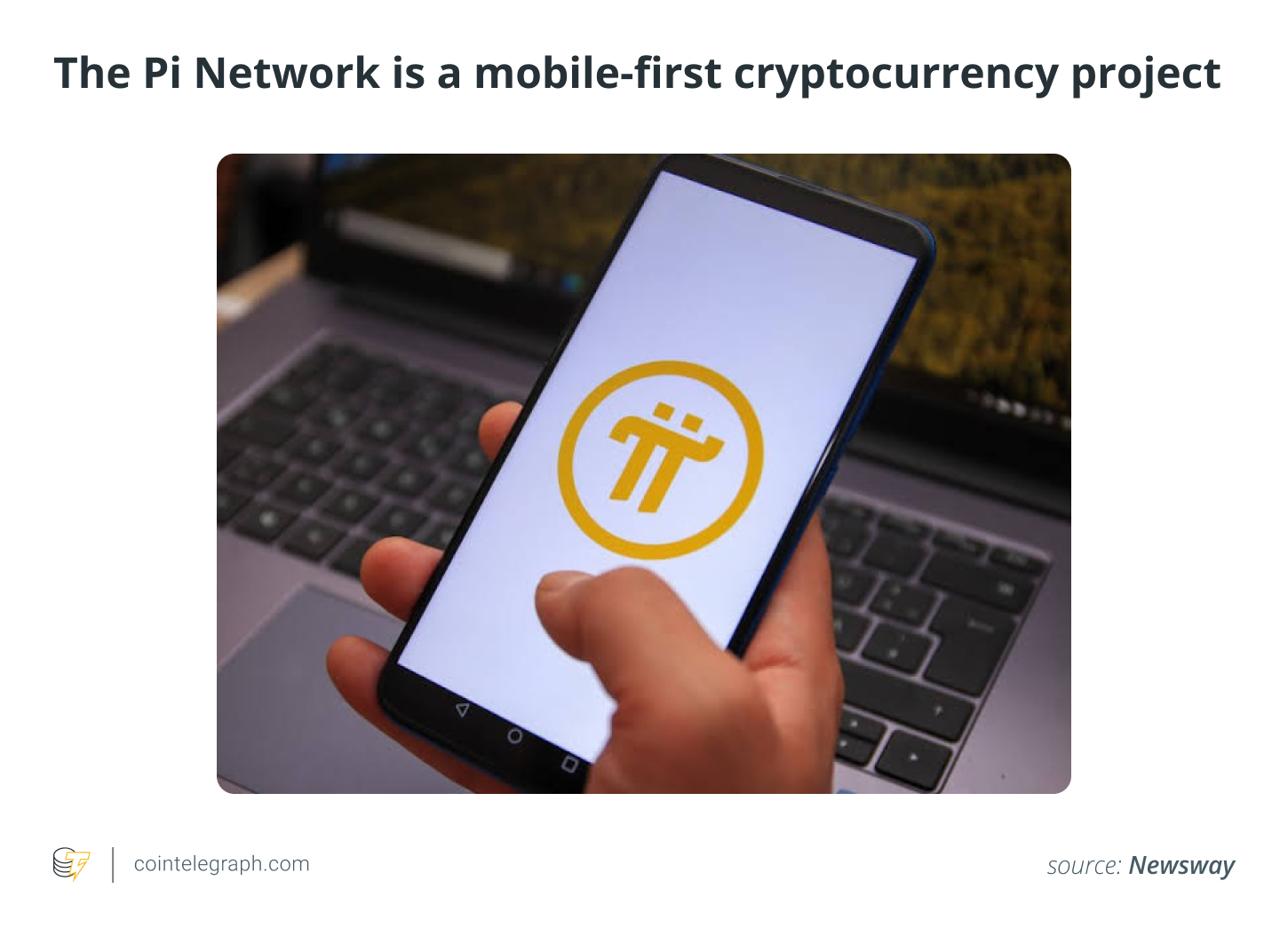
Pi Coin: A timeline of key events

Pi Network, initially launched in 2019 for smartphone-based crypto mining, has progressed through various phases, including Testnet, node program and enclosed mainnet. It is now transitioning to an open network with its mainnet migration in early 2025.

March 14, 2019: Official launch - Pi Network was officially launched on Pi Day (March 14), symbolizing the mathematical constant π (3.14). The initial version of the mobile application allowed users, referred to as “Pioneers,” to mine Pi cryptocurrency directly from their smartphones.

March 14, 2020: Testnet phase initiation - On its first anniversary, Pi Network commenced the testnet phase, marking a critical step toward decentralization. This phase enabled the deployment of distributed nodes worldwide, allowing community developers to test the blockchain and create utilities using Test-Pi.

Late 2020: Introduction of node program - Pi Network introduced its node program, allowing users to operate network nodes on personal computers. This initiative empowered Pioneers to contribute to the network’s security and transaction validation, fostering decentralization.

December 2021: Enclosed mainnet launch - Pi Network transitioned to the Enclosed Mainnet phase, where the mainnet became live but with a firewall preventing external connectivity. This period allowed users to complete Know Your Customer (KYC) verification and migrate their Pi to the live mainnet blockchain while the community built apps and utilities within the enclosed network.

October 2023: Roadmap announcement - The Pi Core Team released a milestone-based roadmap outlining past accomplishments, ongoing projects and future endeavors. This roadmap provided transparency and detailed the steps leading up to the Open Mainnet.

December 2024: Open network update - The Pi Network team announced that the Open Mainnet launch, originally expected by the end of 2024, would be postponed to the first quarter of 2025. This decision aimed to allow more users to complete KYC verification and migrate their tokens to the mainnet, ensuring a more inclusive and secure ecosystem.

January 2025: Mainnet migration progress - By January 2025, Pi Network had over 18 million KYC-verified users, with more than eight million having migrated their tokens to the mainnet. The team extended the KYC and Mainnet Migration Grace Period deadlines to Jan. 31 to facilitate the transition.

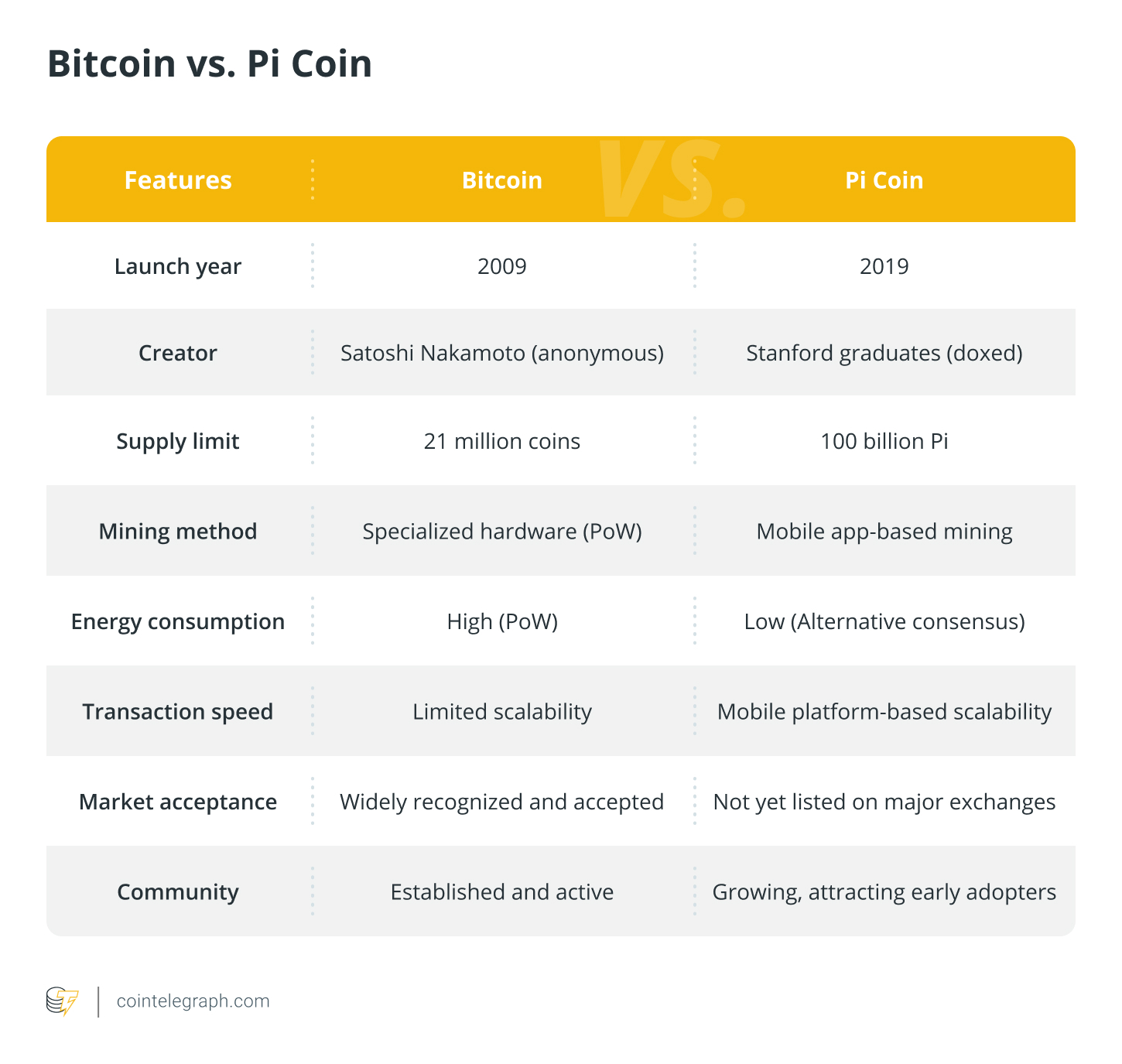
Differences between Pi coin and Bitcoin, launched in 2009, is a widely accepted digital asset with a capped supply. Pi coin, launched in 2019, offers mobile app-based mining and aims for broader accessibility but is still in its early stages with an undetermined market value.

Pi coin is certainly breaking the mold of traditional cryptocurrencies. To better understand this, let’s take a look at the table below:
Advantages of the Pi Network

By allowing users to mine Pi coins directly from their smartphones, the Pi Network removes traditional barriers like the need for expensive mining equipment or access to banking services.

Its straightforward design not only simplifies the mining process but also encourages more people to explore Web3 technologies, making cryptocurrency more approachable to a wider audience.

The Pi Network also uses the Stellar Consensus Protocol (SCP), which brings with it advantages such as energy efficiency, decentralized control and quick transaction speeds.

That said, the SCP does present some challenges, such as the complexity of setting up trust relationships between nodes and its dependence on stable network connections, which can be a drawback in areas with limited connectivity.

Despite these hurdles, one can see how the Pi Network aims to combine the strengths of SCP with its user-centric approach, creating a platform that has the potential to provide a more inclusive, scalable and sustainable digital currency solution.

Did you know? Pi Network allows users to "mine” Pi coins on their smartphones without draining the battery or using significant computational resources. This is possible because the actual work of validating transactions and securing the blockchain is handled by specialized computer nodes running the SCP.

Step-by-step guide to mining Pi coin

How the Pi Network approaches mining is its stand-out feature. However, with an “invite-only” system reminiscent of 2020’s Clubhouse, things might not be as simple as they seem.

Let’s take a look at the steps involved:

Download the Pi Network app:

For Android devices, visit the Google Play Store and search for “Pi Network.”

For iOS devices, go to the Apple App Store and search for “Pi Network.”

Create an account:

Open the app and sign up using your phone number or Facebook account.

Choose a unique username and set a strong password for security.

Enter an invitation code:

Pi Network operates on an invite-only basis to build a trusted community.

You’ll need an invitation code from an existing user to join. If you don’t have a code, you can search online or ask friends who are already using Pi Network.

Complete your profile:

Provide your real name, as it will be required for future verification processes.

Select your country and enter a valid phone number for account recovery purposes.

Start mining:

After setting up your account, you’ll see a lightning bolt icon on the home screen.

Tap the lightning bolt to initiate your first mining session.

Each mining session lasts for 24 hours. After that, you’ll need to open the app and tap the lightning bolt again to continue mining.

Increase your mining rate:

Invite friends and family to join Pi Network using your unique invitation code.

For each active referral, your mining rate increases.

Engage with the Pi Network community and participate in discussions to stay informed and potentially boost your mining rate further.

Build your security circle:

After mining for three days, you can enhance the network’s security by adding trusted members to your security circle.


Letture associate

Leading Players in Large Models Drain the Primary Market

The AI industry is witnessing an unprecedented concentration of capital into a handful of leading players, signaling what insiders call the "eve of a final shakeout." A staggering funding surge exceeding $7 billion hit just three Chinese companies in May alone—Kimi, StepFun (接近完成融资), and DeepSeek—with the latter's valuation reaching $45-$50 billion. Globally, giants like OpenAI, Anthropic, and SpaceX (set to merge with xAI) are preparing for public listings, collectively eyeing valuations over $3 trillion. This capital is no longer fueling a broad "hundred-model war" but is being funneled to "refuel" the final few contenders, following a sector-wide attrition rate exceeding 90%. This frenzy is driven by a fundamental shift in industry logic. The focus has moved from比拼模型智商 (competing on model intelligence) to "token factory economics." The explosion of long-context AI agents has massively increased token consumption per task. With token supply constrained by bottlenecks in HBM memory and power infrastructure—key factors in production costs—dominance now hinges on owning and efficiently operating large-scale compute resources. Major tech firms are investing hundreds of billions annually in this AI "power grid." Consequently, competition pivots to three core areas: 1) **Monetization** as the "AGI premium" cools, forcing a shift from user growth to revenue; 2) **Cost efficiency**, where reducing inference costs becomes the ultimate KPI as model capabilities commoditize; and 3) **Strategic path divergence** between enterprise-focused AI (prioritizing integration and reliability) and consumer-facing applications (betting on scale and user engagement). The message is clear: the final capital injections are determining the endgame lineup. Success will depend not just on technical prowess, but on transforming technology into a sustainable, profitable business model with demonstrable return on massive compute investments.

marsbit11 min fa

Leading Players in Large Models Drain the Primary Market

marsbit11 min fa

AI Giants Queueing Up for IPOs: Is This the 'Last Dance' for the U.S. Stock Market?

A massive wave of IPOs from AI giants like OpenAI, Anthropic, and SpaceX is taking shape, potentially reshaping the U.S. stock market. OpenAI is reportedly preparing for a historic IPO, targeting a valuation over $1 trillion and raising roughly $60 billion, which would dwarf previous records. Anthropic is also advancing its own IPO plans, projecting significant revenue growth and achieving quarterly operating profit. However, their financial profiles starkly differ. While Anthropic is nearing profitability with a focus on enterprise clients, OpenAI continues to report substantial losses, with a negative operating margin and expectations for positive cash flow only by 2029-2030. Analysts warn these listings could trigger a major "passive fund reshuffle," forcing index funds to sell holdings in established tech giants to make room for the new entrants, potentially pressuring the broader market. Some observers view the IPO rush as a "risk transfer," allowing early private investors to cash out at peak valuations while passing future financial uncertainty to public market investors. The divergent paths of Anthropic's near-term profitability versus OpenAI's long-term, high-cost growth narrative present a critical choice for investors. The outcome of these IPOs is seen as a major swing factor for risk assets in 2026, testing whether this surge marks a new cycle or a potential peak.

marsbit19 min fa

AI Giants Queueing Up for IPOs: Is This the 'Last Dance' for the U.S. Stock Market?

marsbit19 min fa

The Richest Fed Chair in 112 Years Is Here: Kevin Warsh Is Rewriting the Rules

Kevin Warsh, with a personal fortune exceeding $130 million, became the 112nd and wealthiest Chair of the U.S. Federal Reserve on May 22nd. A former Wall Street investment banker and key figure during the 2008 financial crisis, Warsh lacks a traditional academic background for a central banker but brings deep market experience. He proposes an unconventional policy approach of simultaneously reducing the Fed's balance sheet ("quantitative tightening") while cutting interest rates, arguing that a smaller balance sheet would allow for more effective rate policy. His ascent marks a potential regime change at the Fed. Warsh aims to reform the institution's decision-making processes, tighten communication discipline among officials, and reduce reliance on forward guidance like the "dot plot." This shift responds to the Fed's current dilemma: fiscal policy is expanding the government's balance sheet through deficits, while monetary policy's ability to shrink its own $6.7 trillion balance sheet is severely constrained, creating pressure on long-term interest rates. Analysts expect Warsh's tenure to sustain high volatility in the U.S. Treasury market due to persistent supply pressures. Furthermore, his leadership coincides with a gradual, structural erosion of dollar dominance, evidenced by its declining share in global reserves and cracks in the petrodollar system, with increased use of alternatives like the Chinese yuan in oil trade. For investors, this environment underscores the importance of portfolio diversification, including assets like gold and Chinese sovereign bonds, amid a fluctuating dollar credit anchor.

链捕手34 min fa

The Richest Fed Chair in 112 Years Is Here: Kevin Warsh Is Rewriting the Rules

链捕手34 min fa

τ Scaling: Huawei's New Growth Engine Designed for the Post-Moore Era

**Tau Scaling: Huawei's New Growth Engine for the Post-Moore Era** For 60 years, progress in semiconductors was driven by Moore's Law – making transistors smaller, denser, and cheaper. This path has now stalled due to plummeting returns below 7nm, astronomical lithography costs, and rising per-transistor expenses. After six years and testing 381 production chips, Huawei’s semiconductor team proposes a fundamental shift: **stop competing on size, start competing on time**. This is the core of their "τ (Tau) Scaling" theory. It treats *time* as the key optimization metric, compressing characteristic delays (τ) across all levels – from transistor switching (picoseconds) to data center tasks (seconds), spanning 12 orders of magnitude. **What is τ Scaling?** It holistically minimizes delay/time constants (τ) across four layers: transistors (switching speed), circuits (signal delay), chips (compute/memory access), and systems (end-to-end communication). The goal is to align optimization from process and circuit design to architecture and systems using this unified metric. **Mobile Application: LogicFolding** Without advancing the process node, this technique vertically stacks chips using ultra-precision hybrid bonding, distributing critical paths across layers ("stacking floors"). Results include a 55% transistor density increase, 41% better energy efficiency, over 40% higher SRAM frequency, and a roadmap targeting 4GHz by 2029. **AI Data Center Application: Full-Link Latency Compression** With 80% of AI cluster energy and 70% cost spent on data movement, the focus is slashing communication time. Key innovations include: 1. **Unified Bus:** Cuts multi-layer protocols, reducing remote access latency from microseconds to ~100 nanoseconds – 500x faster. 2. **Hi-ONE Optical Interconnect:** Replaces copper with fiber, enabling 8Tb/s per module and scaling distances from 1m to 100m for 10,000-chip clusters. 3. **3D Folding:** Solves the "interface bottleneck" of 2.5D packaging by vertically integrating memory, power, and optical I/O alongside compute, predicting over 100x integration density gain by 2035. **Re-fusion of Logic and Memory** The AI era, where data movement is more critical than computation, demands tight 3D integration of logic and memory, shifting industry influence towards memory and advanced packaging. **Remaining Challenges** include adapting EDA tools for 3D design, optimizing wafer-to-wafer process variation and vertical interconnect losses, and establishing new energy efficiency and benchmarking standards. **Conclusion:** The era of scaling physical dimensions is over. The era of scaling time has begun. By leveraging 3D stacking, system architecture, and interconnect optimization—rather than solely chasing advanced lithography—performance and efficiency can continue to advance. This is poised to be the semiconductor industry's core roadmap for the next decade.

marsbit1 h fa

τ Scaling: Huawei's New Growth Engine Designed for the Post-Moore Era

marsbit1 h fa

Trading

Spot
Futures
活动图片