Эмитент ETF Osprey просит судью заново рассмотреть иск против Grayscale

cryptonews.ruPubblicato 2021-03-12Pubblicato ultima volta 2025-02-12

Osprey Funds попросил судью суда штата Коннектикут пересмотреть его решение о присуждении победы Grayscale Investments в иске о недобросовестной торговой практике на сумму 2 миллиона долларов по биткоин-фонду управляющего активами.

Osprey подал ходатайство о повторном обжаловании 10 февраля в Высший суд Коннектикута, утверждая, что решение судьи Марка Гулда от 7 февраля было вынесено «до окончания раскрытия информации» и расширило сферу действия исключения в соответствии с Законом Коннектикута о недобросовестной торговой практике.

В январе 2023 года Osprey подала в суд на Grayscale и Delaware Trust Company, доверительного управляющего своего флагманского спотового биткоин-биржевого фонда (ETF), утверждая, что они ложно рекламировали Grayscale Bitcoin Trust (GBTC), что позволило ей лидировать на рынке.

В своем иске Osprey утверждала, что Grayscale представила преобразование своего траста в ETF как «предрешенный результат, когда она знала, что доступ вряд ли произойдет».

Судья Гулд встал на сторону Grayscale в своем постановлении от 7 февраля, который сказал, что иск Osprey включал обвинения в покупке и продаже ценных бумаг, что не подпадает под действие закона.

В его постановлении было добавлено, что на момент иска Osprey она и Grayscale «были единственными двумя управляющими активами на рынке возможностей для продуктов на основе траста, предлагающих тиккерное владение биткоином».
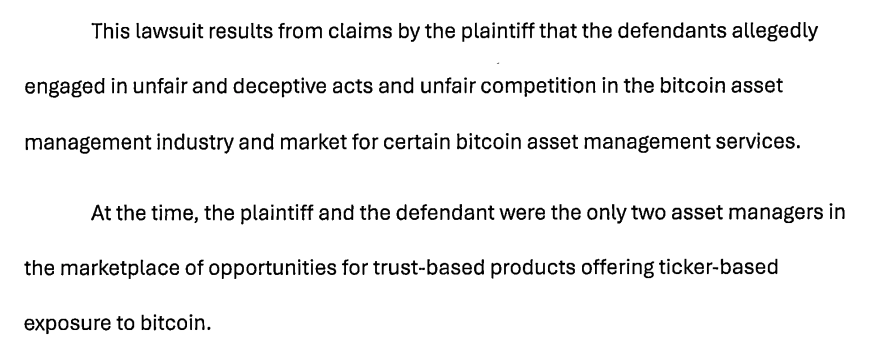

Выдержка из решения судьи Гулда. Источник: Высший суд Коннектикута

Спустя год после иска, в январе 2024 года, Комиссия по ценным бумагам и биржам одобрила преобразование GBTC в ETF после того, как он проиграл в суде Grayscale. Osprey заявила в июле 2024 года, что урегулирует свои претензии к Grayscale за сумму чуть менее 2 миллионов долларов, которые Grayscale не приняла.

Osprey заявила в своем ходатайстве от 10 февраля, что постановление судьи Гулда игнорирует различия между тем, как Федеральная торговая комиссия и суды Коннектикута относятся к обманчивой рекламе, и тем, как FTC и суды относятся к операциям с ценными бумагами, охватываемым законами Коннектикута и федеральными законами о ценных бумагах.

«Ограниченное подразумеваемое освобождение от CUTPA для претензий, основанных на «операциях с ценными бумагами», никогда не применялось, поскольку Решение неявно применяло его здесь, к претензиям, возникающим из обманчивой рекламы между конкурентами только потому, что они ведут бизнес в сфере ценных бумаг, управления активами или криптовалют», — написала Osprey.

Osprey и Grayscale не были частью «какой-либо «сделки с ценными бумагами» друг с другом», добавил он, и пояснил, что его претензии не касаются сделки с ценными бумагами, «которая считается мошеннической, обманной или иным образом подлежащей судебному преследованию между ее сторонами».

«Скорее, претензии Osprey сосредоточены на том, в какой степени недобросовестная конкуренция Grayscale, основанная на обманчивой рекламе, отвлекла долю рынка от Osprey», — написали юристы фирмы.

В прошлом месяце Osprey сообщила SEC о планах конвертировать свой Osprey Bitcoin Trust (OBTC) в спотовый биткоин-ETF после того, как сделка по приобретению ее конкурентом Bitwise провалилась.


Letture associate

Analysis of the Latest Portfolio Adjustment by the "Top Player" in the U.S. Stock Market: $9 Billion Short on NVIDIA, Shifting Focus to Power and Memory Sectors

AI investor Leopold Aschenbrenner has made a significant portfolio shift, taking a $9 billion nominal short position against top AI infrastructure stocks like NVIDIA, ASML, and Oracle. Simultaneously, he is redirecting capital towards what he sees as the next critical bottlenecks in the AI boom: power, memory, and data center networking, alongside private investments in AI model companies like Anthropic. This move is interpreted not as a call that the AI bubble has burst, but as a rotation within the infrastructure stack. The analysis highlights NVIDIA's recent $25 billion bond issuance as a potential signal, questioning why a cash-rich company would seek external debt despite high profits and increased dividends/buybacks. The core investment thesis is that the initial, crowded "picks and shovels" trade in semiconductors is maturing. The next wave of capital is expected to flow into the physical and logistical constraints of AI expansion: electricity supply, memory chip capacity, data center construction, and enabling technologies like optical networking (fiber) for high-bandwidth communication, where copper remains crucial for short distances. Aschenbrenner's substantial (approx. 20% of fund) private stake in Anthropic is noted as a key part of his strategy—investing directly in the "mine" (AI models) rather than just the "shovels." The discussion concludes that while certain segments may be overvalued, the overarching AI infrastructure demand driven by real product usage remains robust. The most promising long-term investments are seen in essential, non-sexy infrastructure—particularly energy and power companies—whose demand is viewed as a global constant irrespective of AI's cyclicality.

marsbitAdesso

Analysis of the Latest Portfolio Adjustment by the "Top Player" in the U.S. Stock Market: $9 Billion Short on NVIDIA, Shifting Focus to Power and Memory Sectors

marsbitAdesso

BIT Research: Liquidity is Disappearing, Will Bitcoin Replay the Bottoming Pattern of 2022?

The crypto market is currently in an adjustment phase driven by policy expectations and liquidity shifts. Despite a brief rebound fueled by geopolitical easing and SpaceX's strong IPO performance, unexpectedly hawkish signals from new Fed Chair Kevin Warsh have removed anticipated easing support. Concurrently, stablecoin liquidity is shrinking, with insufficient new capital inflows, pushing the market into a typically quiet summer period. Pricing lacks catalysts for a sustained rally. Daily trading volume has significantly contracted, stablecoin growth has slowed markedly, and the supportive effect of Strategy's (formerly MicroStrategy) STRC preferred stock-financed Bitcoin purchases is fading. Amid policy uncertainty, seasonal weakness, and liquidity contraction, Bitcoin faces near-term downward pressure. Warsh's hawkish pivot and refusal to provide a clear policy outlook have increased risk premiums, historically unfavorable for Bitcoin. Technically, the trend remains bearish below $73,700, with $62,446 as critical support. A break below could accelerate declines, though a prolonged consolidation phase, similar to 2022's bottoming process, is possible. Liquidity is a core constraint. Current daily volume is around $500 billion, roughly 25% of the peak during the July-Oct 2025 rally. The 12-month growth rates for USDT and USDC have fallen to ~20%, with 6-month growth near zero, indicating weak new inflows. Bitcoin ETF and Strategy-driven inflows have also weakened, with a 30-day rolling net outflow. With inflation at 4.2% above the Fed's target, combined hawkish policy, seasonal factors, and liquidity shortages challenge Bitcoin's ability to hold above $60,000. However, this adjustment phase may be forming a cyclical low this summer, potentially setting the stage for the next bull cycle.

marsbit29 min fa

BIT Research: Liquidity is Disappearing, Will Bitcoin Replay the Bottoming Pattern of 2022?

marsbit29 min fa

Who Makes the Best Use of Claude Code? The Answer Might Not Be Programmers

Claude Code Usage Report Summary (Based on ~400k sessions) Core Finding: In agentic programming with Claude Code, a clear division of labor has emerged: humans primarily decide *what* to build (planning decisions), while Claude decides *how* to build it (execution decisions). Key Insights: 1. **Effectiveness is not limited to programmers.** In code-generation tasks, success rates for users in non-technical fields (law, finance, management, research) are nearing those of software engineers. What matters most is the user's domain expertise and understanding of the problem to be solved. 2. **Domain expertise drives success and efficiency.** Sessions where users exhibited "expert" proficiency in the task's domain saw verified success rates double compared to "novice" sessions. Experts also delegated more work per instruction, with Claude executing more actions and producing more output. 3. **AI is amplifying, not replacing, domain knowledge.** Claude Code lowers the *implementation* barrier, not the *judgment* barrier. The value of knowing the "what" and "why" is increasing relative to just knowing the "how" to code. 4. **Usage is evolving.** Over a 7-month period (Oct '25 - Apr '26), the share of sessions for debugging halved, while use for software operations, data analysis, and non-code writing roughly doubled. The estimated economic value of typical tasks increased by ~25%. Conclusion: The data suggests coding agents are making programming background less critical for completing technical tasks. However, they reward and amplify deep domain understanding. The ability to successfully direct an AI agent stems more from mastery of a specific field than from coding skill itself. The primary gains come from being competent in a domain; deep specialization adds only marginal additional advantage. This may signal a shift where software creation becomes integrated into various professions.

marsbit1 h fa

Who Makes the Best Use of Claude Code? The Answer Might Not Be Programmers

marsbit1 h fa

Trading

Spot
Futures
活动图片