Klarna Explores Crypto to Keep Up with PayPal, But Neither Offer the Best Crypto Wallet

bitcoinistPubblicato 2025-02-11Pubblicato ultima volta 2025-02-11

Introduzione

Swedish payment giant Klarna plans to integrate crypto. The ‘last fintech in the world to embrace it,’ according to Klarna...

Swedish payment giant Klarna plans to integrate crypto. The ‘last fintech in the world to embrace it,’ according to Klarna CEO Sebastian Siemiatkowski.

While Siemiatkowski expected his post to ‘get a huge sign and two views,’ the community found it big news.

Why did Klarna delay this moment for so long, and what crypto services could it offer?

Let’s zoom in.

Buy Now, Pay Later… in Crypto? Klarna Explores Crypto Services

If the name ‘Klarna’ doesn’t ring the bell, how about ‘shop now, pay later’?

Klarna payments

Klarnas’s flexible payment system attracted over 85M users and 575K retailers globally.

But while competitors like Revolut and PayPal were actively exploring crypto (PayPal even launched its own stablecoin), Siemiatkowski considered Bitcoin a ‘decentralized Ponzi scheme.’

He also pointed out that crypto gas fees are sometimes worth more than the transaction – and while it’s true for Ethereum, Siemiatkowski evidently ignored all low-cost networks like XRP and Sui.

In Siemiatkowski’s defense, he admitted he had no idea how blockchain and mining work in 2021.

However, a lot can change in four years, and Klarna now wants to enter the crypto scene.

Siemiatkowski didn’t share any details, so we can only guess whether Klarna will enable flexible crypto payments or offer an entirely different service.

The entrepreneur also encouraged his followers to share their ideas. Some that received the most engagement were to:

  • Process transactions through Hedera Hashgraph, Solana, or XRPL
  • Settle transactions in stablecoins
  • Issue cashback in $BTC
  • Buy crypto and pay later (we wish)

We’ve yet to see if Klarna adopts any of these suggestions.

Beyond Basics: Why Best Wallet Outshines Traditional Fintech Apps

Fintechs like PayPal and Revolut may offer crypto services, but they mostly appeal to those only dipping their toes into digital assets.

For example, you can trade crypto with Revolut, but you can’t stake, buy new presale tokens, or store NFTs. It’s like a watered-down version of an advanced crypto trading platform, such as Best Wallet.

Best Wallet is, first and foremost, a secure storage solution. But beyond HODLing your assets and managing multiple wallets, it lets you swap, stake, track, and compare tokens across multiple chains.

On top of that, Best Wallet is the first and only app that lets you directly invest in hot presales. There’s no need to search for fresh tokens manually – Best Wallet presents a wide range of strictly vetoed projects in one user-friendly interface.
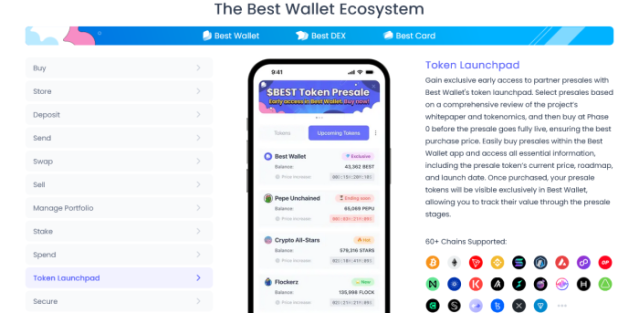
Best Wallet presale

The ecosystem’s native token, $BEST, now costs $0.02395 on presale. Its holders enjoy lower trading fees, higher stalking yields, and governance rights.

Just one day remains until the next price uptick, so this is the last chance to secure your share of tokens at such a discount.

Adapt or Fall Behind? The Fintech Industry’s Reality Check

Klarna’s pivot proves that no fintech can ignore the growing demand for crypto. Even the most stubborn heads are forced to adapt to changing consumer needs and adopt blockchain technology.

However, traditional fintechs have a hard time competing with crypto-first platforms like Best Wallet, which offer specialized features like crypto presale aggregator and staking. This unique functionality may help Best Wallet achieve its goal of capturing 40% of the market by 2026.

Meanwhile, we remind you to DYOR before participating in any crypto project. The market is extremely volatile, and no gains are guaranteed.

Bitcoinist

Bitcoinist

Bitcoinist is the ultimate news and review site for the crypto currency community!

Letture associate

An AI Read SpaceX's Prospectus and Wrote This Investment Memo in 12 Minutes

An AI agent autonomously analyzed SpaceX's 226MB S-1 filing, purchased real-time market data on-chain for $1.87, and generated a comprehensive investment memo in 12 minutes. The memo concludes a "Hold" recommendation. Bull Thesis: SpaceX holds a near-monopoly in commercial launch (80% of global orbital mass since 2023), operates the profitable Starlink business (10.3M subscribers, $7.2B adj. EBITDA), and is vertically integrated from rockets to AI via the xAI acquisition. Starlink alone is a standout, high-margin business. Bear Thesis: The AI division is a massive cash burn ($6.4B operating loss on $3.2B revenue in 2025). True debt obligations approach ~$42B, not the headline $29B, due to bridge loans and X-related debt. Significant contingent liabilities exist, including a potential $10B fee from a Cursor option agreement. The company faces concentrated counterparty risk (e.g., a $45B Anthropic contract), slowing revenue growth, and complex governance as a controlled company with four share classes. Valuation anchors Starlink's standalone value at ~$84B (applying Iridium's 7.4x sales multiple), suggesting the current ~$500B+ IPO target prices in immense future execution risk for Starship and AI. Key risks include Starship delays, accelerating AI losses, and underwriter conflicts (the IPO's lead banks are also lenders on the $20B bridge loan it aims to refinance). Investment triggers: upgrade to "Overweight" if priced ≤$350B and Starship meets milestones; downgrade to "Pass" if priced >$510B or key risks materialize.

marsbit12 min fa

An AI Read SpaceX's Prospectus and Wrote This Investment Memo in 12 Minutes

marsbit12 min fa

MLCC Capacitor Price Increase: A Comprehensive Overview of Beneficiary Companies

Recent teardown reports of Nvidia's next-generation AI chips have reignited investor interest in the MLCC (Multi-Layer Ceramic Capacitor) sector. Analysis of the Rubin architecture VR200 server reveals a 30% increase in MLCC count and a 182% surge in component value per rack compared to the previous generation, with GPU board usage nearly doubling. High-power, high-voltage hardware designs are driving massive adoption of high-end, high-withstand-voltage, and large-capacity MLCCs, exacerbating supply shortages. The global MLCC supply-demand balance remains tight. Leading Japanese and Korean manufacturers have successively raised prices across series, compounded by overseas capacity constraints and long-term customer order locks at major factories. Delivery lead times for high-end products now exceed 20 weeks, with capacity struggling to keep pace with surging orders. Demand drivers include AI servers, automotive electronics, and recovering consumer electronics, leading to both volume and price increases for MLCCs. The industry chain beneficiaries are outlined as follows: **1. MLCC Product Manufacturers:** Direct beneficiaries of price hikes. Key Chinese companies include Fenghua Advanced Technology (leading domestic player), Sanhuan Group (vertical integration from materials to products), and others like Hongyuan Electronics (military focus) and Torch Electron (specialty ceramics). **2. MLCC Raw Materials & Components:** The foundation of the supply chain. * **Release Film:** A critical consumable in production. Companies include Jiemei Technology (domestic leader), Shuangxing New Materials, and Sidike. * **Metal Powders (Ni/Cu):** Core materials for internal electrodes. Key suppliers are Boqian New Materials, Yuean New Materials, and Gripm Advanced Materials. * **Dielectric Ceramic Powder:** The core material determining MLCC performance. Sinocera Advanced Materials is a global leader, while Sanhuan Group and Fenghua Advanced Technology also have significant in-house capabilities. The report highlights that rising AI server power is significantly increasing requirements for chip capacitors and inductors, forecasting explosive industry growth aligned with projected GPU/TPU shipments through 2027-2028.

marsbit1 h fa

MLCC Capacitor Price Increase: A Comprehensive Overview of Beneficiary Companies

marsbit1 h fa

Trading

Spot
Futures
活动图片